Text written by Henni Parviainen
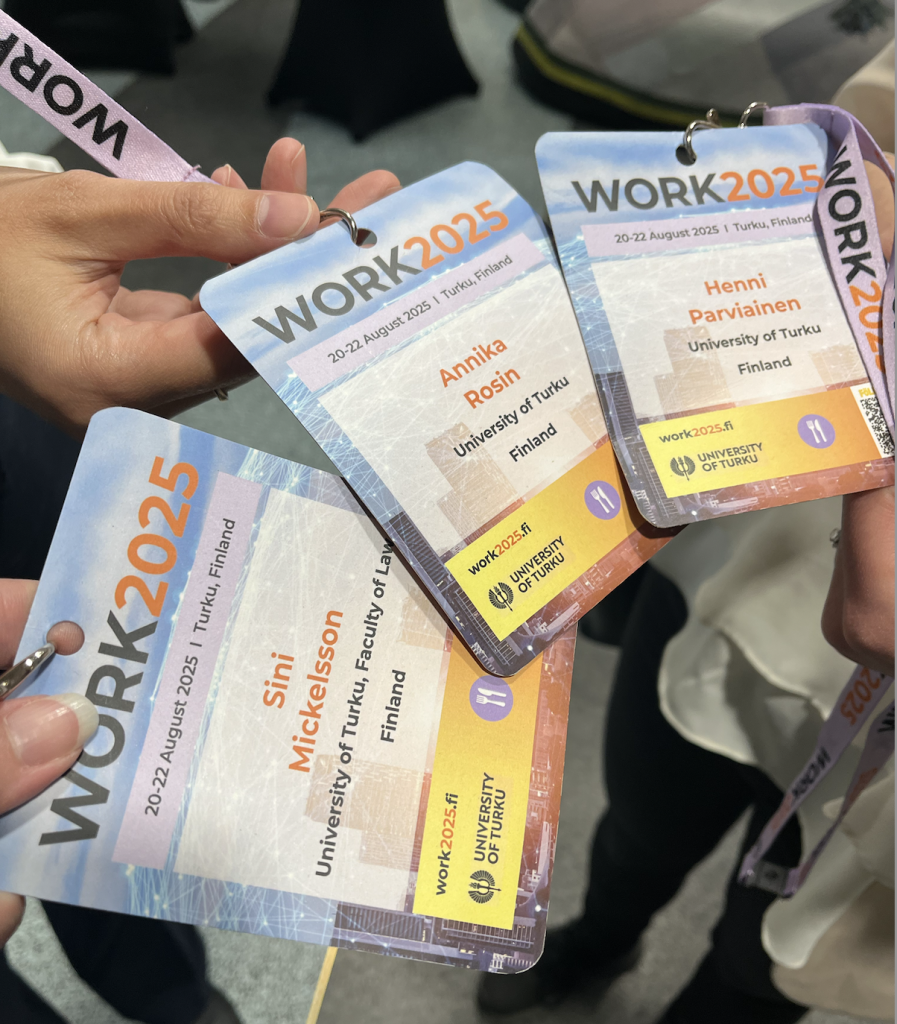
Artificial intelligence (AI) is transforming working life in unprecedented ways. Last week, at the WORK2025 conference in Turku, scholars from diverse fields came together to explore the theme of ‘Work in the Era of Unruly AI’. At AMEMPLOY, we are examining the legal implications of algorithmic management, and our three contributions to the conference aimed to weave regulatory insights into the multidisciplinary discussions surrounding AI’s impact on working life.
In her presentation, Associate Professor Annika Rosin shared the findings from our recent study, which investigates the potential of the EU’s Platform Work Directive (PWD) to improve the working conditions of platform workers by increasing transparency. By comparing the PWD with the transparency rights outlined in the General Data Protection Regulation (GDPR), the Artificial Intelligence Act (AIA), the Platform to Business Regulation (P2B) and the Transparent and Predictable Working Conditions Directive (TPWCD), we found that the PWD broadens and specifies the transparency rights of platform workers. Notably, the PWD has a wide personal scope that encompasses all platform workers regardless of their employment status. Furthermore, its material scope covers both automated decision-making and monitoring practices. One significant advantage of the PWD is its more explicit detailing of the information that must be provided. Moreover, the right to an explanation it establishes is clear and automatically applies without requiring specific requests. Associate Professor Rosin noted that the increased information available to platform workers could empower them to better control their working conditions and challenge unlawful practices. However, she emphasized that legally mandated transparency is only a partial yet limited solution to the challenges posed by algorithmic management.
Doctoral Researcher Sini Mickelsson examined a concrete algorithmic management use case of automated work shift planning, viewing it especially from the perspective of impact assessments. Using Finnish wellbeing services counties as an example, her presentation illuminated the diverse data sources accessible to automated work shift planning systems, while also addressing the legal limitations posed, among other provisions, by the GDPR’s data minimization principle. While it is clear that automated work shift planning systems trigger data protection impact assessment requirements under the GDPR regardless of the type of employer, the AIA’s fundamental rights impact assessments concern only public sector employers or employers that provide public services. Mickelsson raised an important concern: this disparity could lead to unequal protections for employees across public, private and third sectors.
In her presentation Doctoral Researcher Henni Parviainen explored whether the AIA strengthens workers’ remedies against unlawful algorithmic management practices. Remedies were defined broadly (see also De Gregorio & Demkova 2024) encompassing not only judicial remedies, but also independent supervision, employers’ internal mechanisms, and transparency rights. Workers in the EU have been guaranteed certain remedies under the GDPR, the Non-Discrimination Directives (2000/43/EC; 2000/78/EC; 2006/54/EC) and the Framework Directive on Information and Consultation (2002/14/EC). In this context, the AIA has the potential to increase transparency, making workers more aware of the use of some high-risk algorithmic management systems and the decisions made within them. Additionally, it could provide authorities with better tools to investigate these systems, by mandating the creation of more documentation, logs and reports of risks and serious incidents. However, significant limitations remain: judicial remedies and internal challenging possibilities appear to be lacking, transparency towards the workers is restricted, and various structural issues may undermine the effectiveness of the remedies. While the AIA complements the existing legal frameworks, its overall impact on the workers’ remedies could remain rather modest, rendering it insufficient to address the consequences of unruly AI in the workplace.
The contributions from the AMEMPLOY project underscore that, in an increasingly digitalized work environment, labour law issues are fundamentally intertwined with the regulation of data and technology. Determining which overlapping legal instruments govern the algorithmic management scenarios, and how, can be a complex undertaking. This development prompts new expertise needs for labor lawyers and human resource professionals navigating the new world of work.
The AMEMPLOY team’s presentations at the conference reminded that, AI use in the workplace is subject to a myriad of EU legislation. Essentially, these contributions highlighted that, alongside ethical considerations, regulatory constraints must be thoroughly addressed throughout the lifecycle of AI systems, not merely as an afterthought. Integrating regulatory expertise from the outset of AI development and adoption can help ensure that legal issues are proactively tackled rather than addressed reactively.
#algorithmicmanagement #WORK2025fi

Leave a Reply