UTUPEDA and EdLearn: My Decision to Move from the U.S. to Finland
I originally met Mari Murtonen, Vice Dean of the University of Turku’s Faculty of Education and the head of the UTUPEDA Centre for University Pedagogy, at an educational research conference in the United States back in the spring of 2024.
Just a month before, I had committed to enrolling in the Education and Learning (EdLearn) international master’s program at the University of Turku. In my application, I wrote at length about UTUPEDA and my desire to work with Mari, likely to an extent so excessive that, in hindsight, I feel bad for the admissions committee.
However, during the application process, I realized “Murtonen et al.” was only a name I’d seen on research papers. I knew nothing about Mari’s personality, the culture of the research group, or if conducting research with her as a master’s student would even be a possibility in the first place.
Despite this uncertainty, I chose to move to Finland after being admitted a few months later.
Meeting her at the conference immediately alleviated my nerves. I sent her a long email introducing myself after searching her name on the 15,000-person attendee list (starting with the overly formal introduction of “Hi Dr. Murtonen”). Later that same day, we chatted for hours about our work, our lives, our hobbies (including her love of knitting— ask her about it), and much more. Walking back to my hotel that evening, I texted my parents that I had made the right decision in attending the University of Turku.
Finns and Americans alike often ask why I chose to move to Finland. The conversation is formulaic. Americans tend to have some surface-level knowledge about Finland, which can be captured succinctly in five words:
- Happy
- Dark
- Cold
- Educated
- Aurora/Northern Lights
Some of these factors played a role in my final decision (not #3; I’m from Texas), but none of them were decisive. I wanted to work with UTUPEDA.
I first discovered UTUPEDA when conducting an evaluation of a doctoral student teacher training program at Duke University in the United States, my alma mater. Prior to this project, I had no knowledge of doctoral student teaching literature; I was only in the third year of my bachelor’s. When reading about the topic, I repeatedly stumbled upon the same names, many from the University of Turku.
I was fascinated by the amount of institutional support that Turku, and Finnish higher education overall, offers its faculty and staff for pedagogical training. Consequently, I decided that I’d be interested in moving to Finland and learning from UTUPEDA’s system.
A year and a half later, I’m doing exactly that. I’m now an intern in UTUPEDA’s Doctoral Supervisors Academy (DocSA) alongside Mari, Heidi Salmento, and other members of the UTUPEDA team. I’ve spent the last few months conducting interviews with leading University of Turku faculty members to identify best practices in doctoral supervision in order to help improve future DocSA participants. Although I’m still in the midst of data analysis, one finding has become increasingly clear: there is a demand for professional development in doctoral supervision.
Doctoral supervision is an inherently complex process, requiring a balance of the roles of intellectual guidance, project management, emotional and motivational support, feedback, academic socialization, and much more. Effective supervision, like effective pedagogy, depends on trust, patience, and meaningful relationships.
The same theme— meaningful relationship— is a consistent through line in all aspects of my experience in Finland. I’m writing this while on the train to Regensburg, Germany, to visit friends I first met in Turku through EdLearn’s double degree program. It’s a beautiful fall day outside, just a bit warmer than Turku. I spent my morning reading The Midnight Library by Matt Haig at a café in Munich, from which one line resonated with me:
“When you have worries about things you don’t know about, like the future, it’s a very good idea to remind yourself of things you do know.”
I’m not sure what’s next, and I’m not trying to wrap this in a neat lesson about the cliché of ‘living in the moment.’ It is no secret that my home country is in a state of disarray, to say the least. However, importantly, I’ve acquired a crucial trait over my last year in Finland: regularly slowing down to appreciate just how lucky I am.
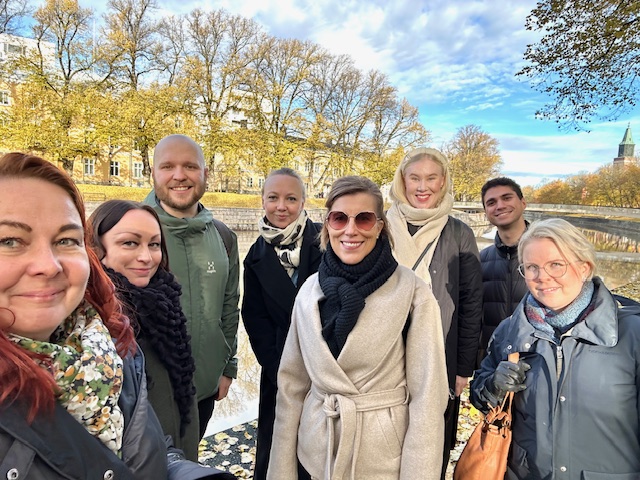
With certainty, I can say that my life would look very different without UTUPEDA and EdLearn. I have two new families within Educarium alone. These families don’t even include the friends I’ve made along the way through CampusSport classes, youth football (soccer) coaching for a local club, international student circles, and the Fulbright community.
I originally moved to Finland for the research, but it is apparent that the people are the greatest assets within both the EdLearn program and UTUPEDA. No matter the context, I will always find joy, intellectual stimulation, and community when around people I love working with. Although I may be over 8,500 km away from home, I’m always treated like family by my Finnish and fellow international colleagues— even if I can’t pronounce the letter ‘ä’ correctly.
Written by Drew Greene, a Fulbright grantee and an intern in UTUPEDA’s Doctoral Supervisors Academy (DocSA) in the Faculty of Education, University of Turku