
A Question Held in the Reader’s Heart: On Reading and Interpretation
My first encounter with literature was like this. It was Nowruz, the Persian New Year. My father fetched a collection of poems titled The Divan of Hafez, and each of us held a question silently in our hearts. He opened the book at random and read the poem aloud. Because Hafez’s lines hold several meanings at once, each of us received a different answer from the same couplet. No one assigned the poem. No test followed.
I did not know then that I was looking at the very thing I would later spend years studying. As Louise Rosenblatt argued, a text carries no meaning on its own; meaning occurs in the transaction between a particular reader and the words on the page. Everything in that room was transactional. Each of us brought our own question, and the same lines answered us differently. Nothing was assigned or checked afterwards.
Making room for aesthetic reading
Rosenblatt distinguished two stances. In efferent reading, we read to carry something away—information, an answer, or the gist. In aesthetic reading, we attend to what is happening within us as we read. Classrooms lean heavily toward the former, even when the text is a novel or a poem. My dissertation asks what conditions make room for the second stance.
One of my studies involved teaching a class of fifteen- and sixteen-year-olds in Finland, who responded to a work of literature by creating digital stories. The first lesson set no task. Instead, it was a curated sequence of materials, including a poem by Rumi, a passage from Dostoevsky, an excerpt from Proust, and a film clip. These materials were chosen so that the students might arrive at an aesthetic stance before anything was asked of them.
The text alone does not determine the stance. Pedagogical choices and creative response activities also play a role. Teachers make room for aesthetic reading by designing student-centered classroom conditions—specifically through open-ended, experiential prompts that privilege personal resonance over plot summary, paired with creative response practices like multimodal digital storytelling and collaborative peer discussion.
I see the same thing outside the classroom. I co-organize a multicultural book club at the Turku Main Library where people read books in different languages and from different backgrounds, and then discuss what they read. There’s one book and a dozen readers, each with their own interpretation of the text. Reader response is happening in front of me rather than arriving as data.
Different roles, one purpose
I came to fiction late. First, I published poetry, then I spent years translating other people’s novels into Persian. Only this year did I write one of my own. The Life That Is Not Happening follows Siavash, an Iranian doctoral researcher and poet in Finland, who drifts between two realities: one of loneliness and migration and another in which he has a wife and daughter who don’t exist in his present life. I left the nature of Siavash’s reality unresolved, telling the story through several narrators, none of whom have final authority. The reader must assemble it. The theory explained what the writing had already taught me.
To me, researcher, poet, translator, and novelist are one activity: a search through literature for what life means and what makes this distracted life bearable. That room at Nowruz is where I learned what reading could be. The poem had waited six hundred years for someone to bring it a question, and until someone did, it meant nothing at all.
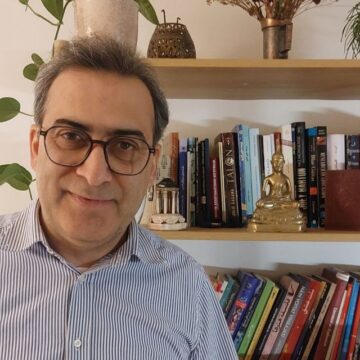
The writer Seyed Mohammad Momeni is a Doctoral Researcher at the Department of Teacher Education at the University of Turku. He is also a published author writing under the pen name Mani Momeni.