
Why Some Young People Struggle to Find Their Path?

Essi Alroth
After finishing school, most young people are expected to move on to further studies or work. But for some, that step is harder to take. These young people are often called NEETs, short for “not in education, employment, or training.”
In Finland, the NEET rate is lower than the European average. Still, tens of thousands of young Finns fall into this category every year. Our research team wanted to understand why this happens, and whether it depends on where you live.
We looked at data on over 730,000 young people aged 19–29, across all Finnish municipalities. What we found tells a bigger story about the challenges of growing up in today’s world.
Who is most at risk?
- Young men are more likely than young women to end up NEET.
- Education makes a huge difference. The less schooling you complete, the higher your risk.
- Young people with immigrant backgrounds face extra hurdles.
For first-generation immigrants, lower education levels and heavier family responsibilities explain some of the gap, but not all. Cultural and language barriers also play a big role.
Second-generation immigrants, who grew up in Finland, are closer to natives in terms of education and family life. Yet their NEET risk is still higher, likely due to longer-term disadvantages or discrimination that carry across generations.
We also noticed a spike in NEET rates right after graduation, suggesting that gap years are fairly common. But the group most at risk wasn’t teenagers, it was 27–29-year-olds. Many of them entered the job market during the financial crisis years and still carry its scars. It’s a reminder that tough times early in life can leave lasting effects.
Does where you live matter?
Yes, but less than you might expect.
Across the whole country, the same individual factors (gender, education, immigrant background) predict NEET status in a similar way. In other words, the core risks are consistent everywhere.
But local conditions still shape opportunities:
- Areas with more entry-level jobs give young people a better shot at getting started.
- Living in a place with high unemployment makes things harder.
- Surprisingly, having lots of different industries nearby doesn’t seem to help much.
Most young people can move or commute for education or work, but the most vulnerable youth depend on local opportunities and need a low barrier to entry into the job market.
We also saw clear geographical patterns: NEET rates are higher in eastern Finland and lower in the west. Interestingly, the municipalities with both the highest and lowest NEET rates were mostly rural, while the big cities sat closer to the national average. This hints that other local factors, like housing, services, social networks, or generational patterns, also play a role.
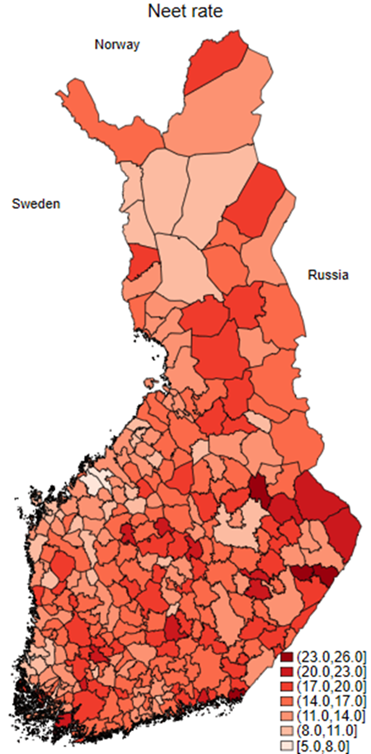
Map of NEET rates in Finnish municipalities (2017).
What about public services?
We expected that having more schools, doctors, or social workers nearby would reduce NEET rates. But we didn’t find a clear link. Just having services available within the municipality doesn’t guarantee that they’re accessible, easy to use, or designed in ways that work for young people.
Most vulnerable youth depend on local opportunities and need a low barrier to entry into the job market.
Why this matters?
Finland has an aging population, so bringing young people into work and education is more important than ever. But this isn’t just an economic issue. Being NEET can affect a person’s health, well-being, and confidence for years to come.
The takeaway? It’s not only about personal choices. Local job markets, opportunities, and support systems make a real difference. That means communities, not just the national government, need to step up to prevent young people from falling through the cracks.
Our results highlight different “faces” of NEET youth:
- young men drifting toward social exclusion,
- immigrant youth struggling with low education and language barriers,
- mothers finding it hard to re-enter the job market,
- recent graduates still searching for direction,
- an entire age group scarred by the financial crisis,
- rural youth held back by long distances and limited resources.
There’s no single solution. But some steps could make a difference:
- Creating more first jobs for young people, especially those with fewer advantages.
- Take a closer look at public services. It’s not just about numbers, it’s about making sure young people can actually use them.
- Support older youth as well. NEET isn’t only a teenage problem, many people in their late 20s are still struggling to find stability.
Author
Essi Alroth is a doctoral researcher in the social research department at INVEST. She studies youth exclusion and unemployment.
References
Ahlroth, E., Laaninen, M., & Niemelä, M. (2025). Conditions of youth transition: individual and municipal factors related to the NEET rate in Finland. Journal of Youth Studies, 1-25.
Eurostat. 2024. Statistics on Young People Neither in Employment Nor in Education or Training. Accessed March 5 2025.
Bäckman, O., and A. Nilsson. 2016. Long-Term Consequences of Being Not in Employment, Education or Training as a Young Adult. Stability and Change in Three Swedish Birth Cohorts. European Societies 18 (2): 136–157.
Karonen, E., and M. Niemelä. 2020. Life Course Perspective on Economic Shocks and Income Inequality Through Age-Period-Cohort Analysis: Evidence from Finland. Review of Income and Wealth 66 (2), 287–310.