
From arrival to belonging: What international students can do
Being an international student at the University of Turku has been the experience of a lifetime for me. The student culture in Turku is vibrant, and there is always some fun event happening at or around the university. As an international student, though, I cannot help but notice the glaring absence of other international students from most of these events.
Let’s talk about the apparent differences
Some structural differences between the lives of Finnish and international students are obvious. First, the money. Local students typically receive financial benefits from Kela, international students (many of whom move to Finland for studies) do not. International students who move to Finland for studies are required to have enough personal funds to sustain themselves while living here. On top of that, Finnish students are more easily able to supplement their income by working part-time at restaurants, supermarkets, etc. In absence of any such income, most of the international students are usually walking a tightrope when it comes to managing their finances. Every student event that costs something is then seen as an avoidable expense.
Second, the level of studies. Most international students (excluding exchange students) at the university are master’s students. Studies at the master’s level are usually quite intensive and do not leave a lot of room for attending student events. Even among the Finnish students, those at the master’s level are much more selective in terms of what event they decide to go to. Moreover, most of the Finnish students do both their bachelor’s as well as master’s studies in a joint fashion, which gives them at least a 5-year timeframe to be a university student here in Finland. This gives them several years, especially their bachelor’s years, to experiment, go to student events and parties, and find out what lifestyle works for them. International students, being typically master’s students, do not have so much runway to explore.
Third, the language. Let’s face it, there is a long way to go when it comes to making the student events international-friendly. Because of how integral the language is to most of the student events, such as all the Finnish or Swedish songs at the sitsits, I believe that the student culture in Finland has developed over the years to cater to the local students. The increased influx of international students seems to be a relatively recent phenomenon, and just about 10% of the official number of students (including bachelor’s, master’s and PhD students) registered with the University are international students, as per the Study Statistics of the University of Turku. So, it is not surprising that the student organizations are not prepared to deal with international students.
Let’s hear what the Finnish students have got to say
Despite all these reasons why international students do not partake in the student life the way local students do, there are also international students who want to make friends with the local students. Especially for international students who intend to stay back in Finland after their studies, making friends with locals is of immeasurable value – from getting to know the local culture, to feeling like at home in Turku, to just feeling more integrated into the community.
There have been multiple success stories of internationals integrating well into the Finnish society (Have you checked out the podcast series Finn-ish: Tales of Integration yet?). Instead of talking to the international students who have been “integrating well”, I decided to get to the other side of the story. I set out to ask four of my Finnish friends – Jade, Leena, Saku and Alina – some questions about the state of internationalization at the university.
Question 1: How many international students have you interacted with here at the university? How many of them would you say are your friends?
Jade and Leena said they have interacted with very few international students. Saku and Alina, on the other hand, have interacted with over 10 international students each. Saku met these students through the international friendship programme, and through being a tutor for internationals. Alina has met her international friends due to being a Finnish student in an international degree programme.
Nobody apart from Alina reported having more than 2 international students as friends.
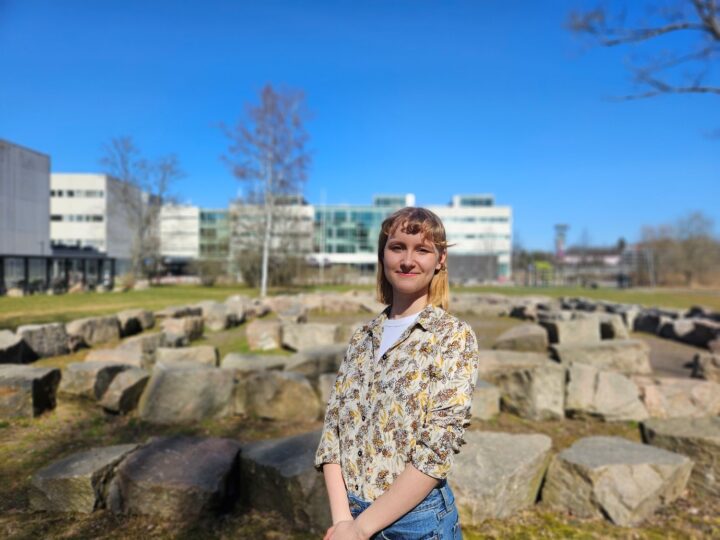
In picture: Alina Setälä
Question 2: Why do you think that is?
Jade, Leena and Saku said that interactions with international students are rare and brief mainly because there are usually no common courses with them. Outside of lectures also, the spaces where the Finnish students and international students hang out seem to be segregated. International students do not attend the same student events as them. And they do not go to events where international students might go.
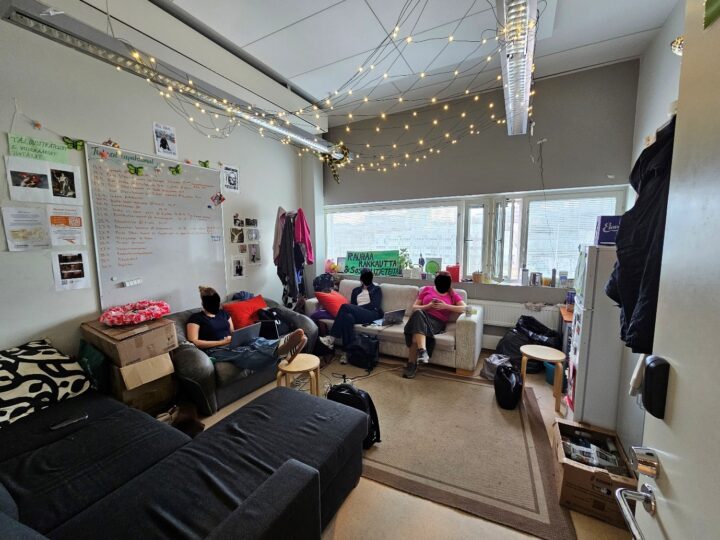
In picture: Clubroom of my student organization – Sosklubi
The “clubroom” deserves special mention, because many international students may not be aware of the concept. Student organization of almost every subject at the university has a clubroom on campus. Every student who is a member of the organization has access rights to this room. Becoming a member is a straightforward and inexpensive process. Jade and Leena believe that hanging out at the clubroom is a very easy, organic and low-pressure way of getting to know people.
Alina thinks that she has many international friends mainly due to being a student in an international degree programme. But she has also had international student friends even before in high school when exchange students would come to Finland. She sees it as an opportunity to learn about people’s stories of growing up in different places, and she feels that even subtle cultural differences can be very eye-opening. She personally never had an exchange during her studies, which she regrets, but to her, interacting with international friends is a great opportunity to gain that exposure.
Question 3: Would you like to make friends with international students? Or do you think it is nicer or better in whatever way to only have Finnish friends?
Leena said that she does not care, and that it is not something she thinks about. Saku and Jade said that it is good to have international friends as well. Jade said that the conversations with international students tend to be interesting. But they both said that meeting international students naturally would be nice. Making international friends is not something that they are proactively trying to do.
Question 4: We have an increasing number of international students and immigrants in general coming into Finland. Do you consider it important for the Finnish society that international students make friends with the local students?
Everyone felt the same way: friendships between international and Finnish students really do matter, because they help people understand each other better. Jade pointed out that these friendships help internationals see how life in Finland actually works, while also giving Finns a chance to learn about other cultures and widen their worldview. Leena agreed and said that forming ties with locals is an important part of integrating into Finnish society, even as she stressed that international students should not feel pressured to abandon their own cultural identities. Saku added that increased interaction across cultures could help reduce prejudice, since Finland still struggles with racism in his view. And Alina just summed it up in a warm way, saying that these friendships can be genuinely good for both sides and even “beautiful.”
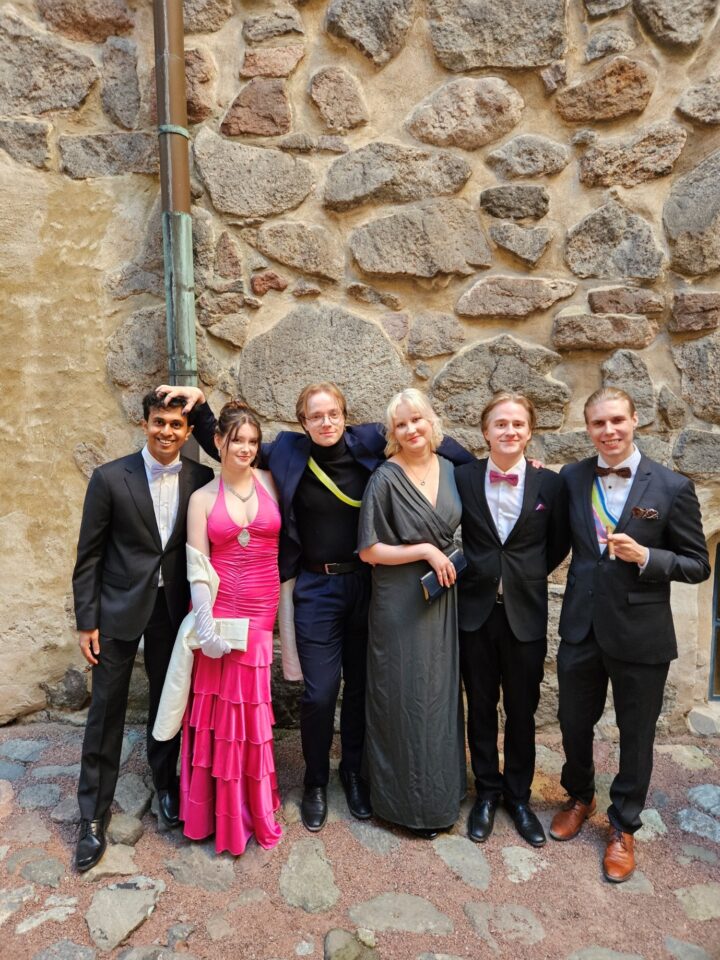
In picture: Jade Taina (second from left)
Question 5: Considering that Finns like yourself may not be proactive in connecting with the internationals, what is the one advice you would give to international students if they want to make friends with Finnish people?
All four of them basically said that if international students want to make Finnish friends, the easiest path is to go where Finns already are and gently push yourself into those shared spaces. Jade said that places like the clubroom work better than big parties because conversations happen more naturally there, and the Finns who hang out in those spots tend to be the more social ones anyway. Leena echoed that idea and said internationals should just show up where Finnish students are – clubrooms, parties, events – and talk to people whenever the moment comes. She pointed out that it’s really about making your face familiar and being proactive, because nobody is going to come knock on your door.

In picture: Saku Lehtoniemi (right)
Saku encouraged internationals to go to student events. He said there’s always someone willing to help, even if organizations aren’t fully prepared for international participation yet. He also felt that both international students and Finnish student organizations need to be more proactive so that everyone benefits. Alina added that Finns often become friends through shared activities, so joining hobbies or events where Finns are present makes things easier. She said that once the first barrier is crossed, Finns warm up – it just takes a bit of patience.
Where do we go from here?
The big picture that emerges from my interaction with my friends is that Finns aren’t against making friends with international students – they just rarely end up in the same spaces, and Finns themselves won’t usually make the first move. Because of that, friendships mostly happen only when internationals take the initiative.
Finns don’t meet internationals in their courses, clubrooms, or student events, so friendships don’t form organically. At the same time, they don’t actively seek out internationals – not out of dislike, but out of habit, comfort, or simply not thinking about it. Everyone agreed that international-Finnish friendships would help with integration, reduce prejudice, and make Finland more open and diverse.
If you are an international student in Finland who is looking to make Finnish friends, the advice that emerged for you was almost identical. Go where Finns already hang out (clubrooms, events, hobbies). Show your face repeatedly – familiarity helps. Start conversations even if Finns seem reserved at first. Shared activities make everything easier. Be patient; Finns warm up slowly but genuinely.
The takeaway? Finns are open to friendships, but the system and social habits don’t naturally bring people together. When internationals show up in Finnish spaces and take small social risks, friendships happen – and everyone sees that as good for both the individuals as well as the Finnish society. Unfortunately, as things stand currently, bulk of the Finnish students do not have/see many reasons to go out of their way to make friends with international students, and that does make the dynamic a bit lopsided. There is possibly a lot that could/needs to be done at the institutional levels to make the university and student organizations more integrated and inclusive. But discussing that would require another, if not several more blogposts.
Some practical tips to get you started
Instagram is your friend. Most student organizations’ IG pages are active and updated weekly. This is your best bet at trying to stay informed about what events are happening soon. Some important handles to follow would be @hybridiry, @humanitasry and @index_ry, for example. You can find a more exhaustive list of student organizations at the university website.
As a student at the university, your field of study determines what subject student organization you belong to. If you study natural sciences, for example, you could reach out to someone at Hybridi and try to find out what your subject-specific student organization is, and how you can join as a member.
If you do not use Instagram, but would still like to stay informed about the upcoming events, there are also usually Telegram groups or weekly mailing lists of student organizations that you can subscribe to. Another very effective and easy way is to simply integrate the calendar of your organization to your own calendar app. For example, here get the option to add the events calendar of Hybridi to your Google calendar.