
By Antti Lampinen, Collegium Fellow, TIAS.
Conference travel tends to generate a peculiar blend of faff and delight. There are timetables to hit, transfers to juggle, presentations to polish in awkward corners of terminals, and then – occasionally almost as an afterthought – the conference itself. At least for myself, these trips are always bifocal. On the one hand, there is the official academic self, temporarily defined by a paper or a panel. On the other, there is everything else: the excitement and tedium of travel, local delicacies to be tasted, news doom-scrolled with one eye on roaming charges, late walks through familiar cities now oddly estranged, or unfamiliar ones briefly made one’s own. Around and after the conference programme one may want to visit an interesting museum, restaurant, bookshop, or vintage store, or perhaps spend a few days with old friends before heading back to wherever one calls home at that particular time.
For myself, however, this familiar rhythm had been overshadowed by unease for several years now. Working in a field that cannot plausibly claim to solve the climate crisis, I found it increasingly difficult to justify flying across continents for a few days of scholarly sociability and twenty minutes at a lectern. I have never enjoyed flying anyway, and the anodyne airport spaces – those interchangeable monuments to globalised luxury consumption – never held an ounce of interest to me. Quite the opposite: the sight of designer brands in flashy displays nowadays prompts me to imagine acts of vandalism, if anything. Carbon-offset schemes, meanwhile, seemed less like solutions than moral outsourcing. The pandemic unexpectedly clarified matters. Online conferences proved not only tolerable but often better: lighter on emissions, lighter on performative networking, and vastly more accessible from all over the world. In April 2020, I resolved not only to minimise flying but, where possible, to commit to land-based conference travel altogether.
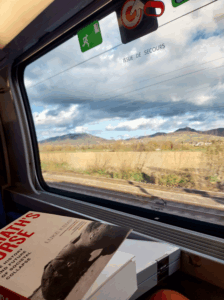
On the train in Spain. Among the travel reading I had with me Luke Kemp’s Goliath’s Curse, a sweeping comparison of societal collapses from the Stone Age to the contemporary world.
By any sensible measure, 2025 was not the year to test that resolve. A move from Athens back to Finland, the demands of a first year at the Turku Institute for Advanced Studies, and a dense cluster of autumn conferences all conspired against the intrinsic complexity of planning land-based travel. Yet within three months I travelled to four academic events around Europe – by land. Finland is hardly well placed within the European rail network, but ferries to Sweden make Stockholm an effective gateway towards the continent. In preparation for the autumn travels, earlier in the year I had snapped up a sensible offer of 10 Interrail travel days, to be spent within 2 months, with the total cost of 357 €. My partner had done the same thing, so we were happily able to combine the conference travels with a decent amount of non-work-related exploration.
With the discounted Interrail passes and some logistical patience, what initially seemed quixotic turned out to be not only feasible but deeply pleasurable and conducive to deeper thought. A conference in Oxford (Domesticating enslavement through group discrimination: Mediterranean systems of enslavement from Antiquity to the Middle Ages) was folded into a brief return to my former hometown in Scotland and old friendships. Reaching a colloquium in Potsdam (Divination and Authority in Graeco-Roman Antiquity) brought with it a Berlin-Stockholm night train whose mechanical failures (not at all uncommon, I am sorry to say) provided both delay and camaraderie. Finally, Málaga (The People and Its Enemies: Classical and Contemporary Perspectives on the Logics of Exclusion) and Oslo (a paper at a departmental research seminar) were linked in a single, improbable meander across the continent. Plans were adjusted, routes improvised, luggage packed to include both the Mediterranean and Nordic autumn weather. I had the chance to see several world-class museums along the travels, all for the first time: the Altes Museum in Berlin, the Musée gallo-romain in Lyon, and the Musée d’histoire de Marseille – all of which were rich in objects I had written about for years, but never yet had had the chance to take a proper peek at. In Oslo, I was given a wonderful tour of the university’s papyrological collection by Professor Anastasia Maravela.
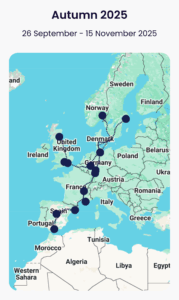
The Interrail app pretty nicely illustrates the journeys conducted with each ticket: in my case, the Potsdam trip and the Oslo-Stockholm stretch were not made with an Interrail ticket.
Geography stipulated that all the journeys began with a Stockholm-Hamburg stretch. For Oxford, we headed onwards to Cologne and then to Brussels to catch the Eurostar; the return was essentially the same way. For Potsdam, I snored on straight to Berlin – from where the local trains take less than an hour to Potsdam – and took the same route back. The grand Málaga-Oslo anabasis headed from Hamburg via Frankfurt (quick döner break!) to Marseille and then via Madrid to Málaga; the return trip choo-chooed first to Barcelona – again with Madrid, since the Spanish rail network is very centripetally arranged – then to Lyon, and then via Hamburg and Göteborg to Oslo. The rough estimate for the distance covered in all the three journeys jointly would come to around 16 000 km of rail travel: the Interrail app helpfully offers all manner of interesting data on the journeys made with each ticket. When thinking about the overall costs of travel, the total price per kilometre comes to around 0,07€.
Yet what really mattered during these travels was not efficiency, but texture. Travel days became genuine working days – reading, writing, thinking – punctuated by scenery, conversation, snacks, and sleep. The gradual shift of landscapes mattered to me in particular. As an ancient historian, I care about landforms, vegetation, rivers, and distances: about how environments have shaped societies, and vice versa. Watching biomes change from the window of a train offered insights no flight ever could. Somewhere near Narbonne, salt marshes dotted with flamingos unfurled outside the carriage – an almost absurd reward for slowness, unnoticed by the businessmen across the aisle, eyes fixed on their screens.
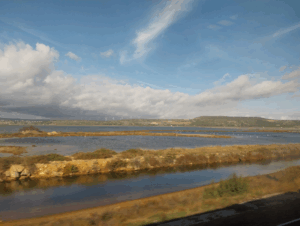
Flamingos! The salt marshes near Narbonne and Beziers were still hosting some of the birds.
The distances covered in autumn 2025 were substantial; the emissions were not. The conferences were all excellent and stimulating, and their topics dovetailed nicely with my TIAS project. Overall, I had a growing sense that travel itself could align with and highlight scholarly values rather than undermine them. Land-based travel fits naturally with the ethos of the Slow Academy – it reminds one that speed is rarely neutral, and almost never free. Incidentally, the TIAS reading group in Helsinki has recently been reading Maggie Berg’s and Barbara Seeber’s well-known manifesto The Slow Professor: Challenging the Culture of Speed in the Academy (University of Toronto Press, 2016). Such travel insists on limits, attentiveness, and continuity. Slowness is not an inconvenience to be endured for ethical reasons. It can be a condition of pleasure, attentiveness, and better work. Professors are not the only ones who might benefit from taking it slower.