
Note from the editors: this is the first in a series of posts about games for the TIAS blog. What can our research tell us about various games, what can games tell us about our research, our society, and our culture? Game on.
By Aleksi Karhula, Collegium Fellow, TIAS.
I am currently a TIAS collegium fellow focusing my research on the effects of increasing socioeconomic residential segregation. One of the aims of my TIAS project is to connect residential segregation to societal trust, political radicalization and attitudes towards other population groups. With our excellent INVEST survey data we can analyze how residential segregation is connected to the erosion of societal trust. Incidentally, my all-time favorite board game, Diplomacy, also deals with the topic of trust.
Diplomacy is an old board game dating back to the 1950s, and often advertised as being Henry Kissinger’s favorite board game. In Diplomacy each player represents one of seven nations roughly corresponding to great powers around Europe before World War I. The goal is to conquer all of Europe under your own rule. This might sound boring, and it did to me at first as I am not a big fan of war games in general, but one round of Diplomacy convinced me that the game connects to something very fundamental in human nature – something that intrigues you to play again and again.
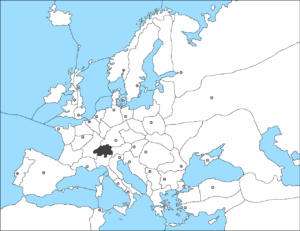
Rendering of the Diplomacy board of Europe divided into territories. (EWhale, CC BY-SA 4.0, via Wikimedia Commons)
Compared to many other strategic games the rules are very simple, you move your pieces or support moves from other pieces. The game leaves you no option to defeat your opponents just with brilliant moves of your own pieces. The trick is cutting deals with other players and building trust. The game proceeds several rounds, starting with a phase of negotiations that are free form between all the players. In negotiations you offer support for others’ moves in exchange for their support in other ways. After negotiations everybody writes down their moves on a slip of paper in secret. These are then revealed at the same time to see where the pieces on the board move or fail to move. This is followed by a new round of negotiations and moves. And at certain intervals you get new pieces on the board, if you have conquered regions, and lose them if you have lost regions. Ultimately the mechanics of the game revolve around trust. You build alliances that you try to keep intact, or at the crucial moments break. In both cases it is essential that you have other players that trust you and that you in turn can trust.
Add to the mix that board gamers (myself included) are a curious lot, during the game everything else outside of it is most often forgotten. You do not favor your family members, friends or neighbors when you are playing a board game. So where does the trust in other players come from? Would you trust Henry Kissinger making promises from the other side of the table?
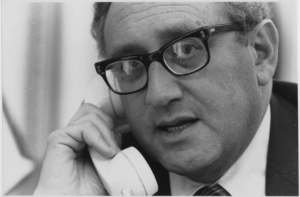
Would you trust Henry Kissinger in a game of Diplomacy? (White House Photographic Office, Public domain, via Wikimedia Commons).
I have played dozens of rounds of Diplomacy, and through experience I have learned that there are three types of new players in Diplomacy. Some do not trust anyone. They know the reputation of the game for backstabbing and avoid any moves that would require trust in any other players. The second type of player chooses very early another player, usually someone they know personally, that they place their trust in completely. Both of these strategies lead to certain loss in the game. And then, of course, there is the third type of player who swims like fish in the water straight-away – I would bet Henry Kissinger was one of them. They negotiate and place their confidence, but never all of it, in someone who seems trustworthy. They re-evaluate their trust in others constantly based on both negotiations with others and the position on the board. It is a constant state of uncertainty – much like life in general. And if you place your trust with skill, it leads to victory.
In essence, Diplomacy is a very sophisticated model example of how people build trust out of nothing. Every nation in the game has multiple strategies from the beginning regarding whom to attack and whom to ally with. There is even an internet library of Diplomacy openings illustrating the variability. Any attack or alliance is possible. Still, as you start to play you begin to build trust in some players and a lack of it in others. Trust is built slowly in the interaction through the negotiations and moves. There is very rarely complete trust, but often a considerable degree of it. It takes a long time to build trust, but only a second to completely erase it.
The notable aspect of the game is how it illustrates what happens when trust is betrayed. One game of Diplomacy can last hours, even a weekend. When you have built up your trust in someone for several hours and then they betray you, this seldom results in a cold, calculated re-evaluation of the game situation. Instead, it often leads to an immense feeling of hate and a desire for revenge no matter the cost. Indeed, if you can remember the feeling of losing a long game of Monopoly as a child, you have a faint echo of what it feels like to be betrayed in a long game of Diplomacy. Unlike in Monopoly, the mechanics of the game do not force anyone to take money from some unlucky soul landing on the property with your hotel, it is more like you choose to place the hotel where the other player is. And this feels extremely bad as you have trusted them, afterwards realizing you should not have done so. What happens after betrayal often is that the betrayed player places their trust completely in some other player with a strong position on the board, just to get back at the one who betrayed them. It does not matter if you lose, as long as the betrayer does not get a single thing and also loses in the end.
Does this sound familiar to other aspects of life? Whether you think of Brexit, Trump, or anti-immigration parties, there is a strong rhetoric of betrayal in these movements. The erosion of trust in institutions and mainstream politicians paves the way for populist movements. And, as in the game of Diplomacy, I am quite certain that some voters understand well that the movements might not be fully beneficial for them, but as long as you get back at traitors, this is tolerated. What is the answer then? The easy answer is, of course, do not betray people and expect that nothing happens. However, avoiding betrayal works well in Diplomacy, but real life tends to be more complicated. Often people are not actively betrayed by anyone, even those who they see as traitors. The decline of jobs or the diminishing of other opportunities result from a complex economic system that nobody fully understands. Not even the armies of economists who are nowadays often paraded in to give you certain – but usually contrary – answers to questions nobody can answer.
Would there then be a way to avoid both betrayals and feelings of betrayal? The best Diplomacy players can conquer the whole board without betraying anyone. How do they do this? By listening, talking, and interacting. Indeed, the interaction or the lack of it has long been seen as the theoretical foundation for trust in society. Through interaction, trust is strengthened. If we bowl alone, erosion of trust is only a matter of time.
If, for example, neighborhoods become more polarized by socioeconomic status, it is a very important question if this erodes the trust in others and society in general. And on the other side of the coin, it is much easier to demonize and hate people you do not interact with. One of the earliest things I learned in Diplomacy is that when someone is not talking to you, they are very likely attacking you on the next turn. It is not easy to interact with someone and then treat them badly; it is much easier to cut ties and treat them badly. If society becomes more fragmented it is not only the disadvantaged groups that lose trust in society, it is also the advantaged groups that find it easier to treat the less advantaged badly.
As the virtual environments seem to become more and more polarized, it is essential that we listen, talk, and interact with different people, whether in neighborhoods or elsewhere. And the research on the divides and how to bridge them becomes even more relevant. Talk with the Kissinger on the other side of the table, otherwise he might attack you during the next turn.







Great mentioning Diplomacy, always appreciated! I think a good analogy could be a condominium, so a block of flats. How do you trust that the neighbor doesn’t steal your bike…