
Note from the editors: this is the second in a series of posts about games for the TIAS blog. What can our research tell us about various games, what can games tell us about our research, our society, and our culture? Game on.
By Xin Liu, Collegium Fellow, TIAS.
Lottery is one of the most popular gambling games in the world. Over 100 countries run state-authorized lotteries. Modern lottery games include number games, scratch cards, raffles and sweepstakes. My project at TIAS examines state-sponsored lotteries in China. The China Welfare Lottery, established in 1987, and the China Sports Lottery, founded in 1994, are two national lotteries overseen by the Ministry of Finance. Both providers sell number games and scratch cards while sports betting is monopolised by China Sports Lottery. The Chinese lottery market has been expanding rapidly, in line with the global trend of growth in lottery sales. It is now the second largest in the world after the United States.
My research is driven by a question that can be asked across cultural, social and historical contexts: why do people continue to play the lottery despite being fully aware of the slim chances of winning? The answer to this question seems to lie in a self-perpetuating lottery fantasy. A desire to become wealthy drives the lottery play. The lottery’s potential for wealth engenders desire. However, once contextualised, the lottery fantasy appears to be more of a myth than an axiom. And as a myth, it is both maintained and constantly challenged. A key aim of my research is to understand how this myth of the lottery fantasy is produced, communicated and negotiated in China. The Chinese lottery both resembles and differs from those in other places. Understanding the lottery fantasy in China offers important insights into the global interconnections and local, historical specificities of the lottery game.
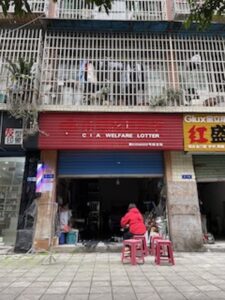
A recycling center that used to be a welfare lottery shop. Photo by Xin Liu.
I call the production and negotiation of the lottery fantasy ‘the labour of luck’. By ‘labour’, I mean the temporal, financial, physical and emotional work involved in creating opportunities for luck. Through observation at lottery shops and interviews with vendors and lottery players, I study the institutions and people that participate in this labour, as well as the cultural and material artefacts that facilitate it.
A good example of the labour of luck is the practice of ‘keeping the numbers’ (守 号). This phrase frequently occurs in discussions between vendors and customers. For instance, the vendor might ask the customer if they would like to choose the same numbers as they did for their previous purchase. However,守has more connotations than ‘to keep’. It also means to observe, to guard, to defend and to serve. The numbers that are kept or continuously purchased are typically carefully selected by the customer. This selection may be based on observation of past winning numbers. They may also select numbers that hold personal significance, such as important dates like birthdays.
A usual sight at the shops is players sitting in front of a lottery trend board, studying and analysing numbers from past lottery games. They analyse the ‘hot’ numbers, which are those that appear often in draws, the frequency of odd and even numbers, big numbers and small numbers, and the pattern of their appearance. Players often discuss their findings with each other and with the vendors. Sometimes they consult the vendor because of their expected expertise in the game. At other times, discussions about the numbers and the board form a major part of the social interaction between the players and the vendors.
To make players’ labour of luck more enjoyable, the vendors equip the shops with chairs, computers, water, air conditioning, and colourful decorations. To demonstrate the wealth-attracting capacity of the shops, the vendors display figurines such as the beckoning cat Maneki-neko and the Chinese God of wealth, as well as ‘honour rolls’ or ‘hero rolls’ of winning tickets bought from the shop, in easily visible places. Maintaining good relations with customers is important for the lottery vendors who are facing increasingly tough competition in the lottery market. An elimination system has been introduced to sports betting licence in recent years. Failure to meet the sales quota or violation of the rules can result in the loss of the licence. Acts that encourage lottery players to irrationally purchase lottery tickets, for example, by stating that lottery results are predictable and calculable, are considered violations.
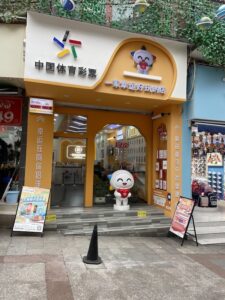
A lottery shop using the “A fun and lucky store” retail concept launched in 2021 by the Chinese sports lottery regulator. Photo by Xin Liu.
The prospect of losing a licence is a cause of concern for many vendors. As one shop owner told me, they were lucky to have obtained a licence in the first place. She and her husband were both made redundant during China’s pension reform in the early 2000s. They both come from a rural area. With only high school education and experience of working in a factory, they found it difficult to land new jobs. Running a lottery shop is a good solution. It does not require education or a specific set of skills. However, at the time of the vendor’s application, a condition for the licence was to demonstrate that there was enough capital to rent and renovate the shop according to the regulator’s standards. Fortunately, the owners’ relatives offered to rent them a space in their grocery store. They also managed to borrow money for renovation, which has been paid off .
Lottery shops are a distinctive feature of the Chinese lottery. Unlike many national lotteries, which can be purchased online and at supermarket checkouts, such as in Finland, the Chinese lottery can only be bought at a lottery shop. These shops therefore function as places where gambling, state regulation, financial pressure and interpersonal relations converge. Both the vendors and the lottery players contribute to the unequally distributed labour of luck that produces and games the lottery fantasy.