
By Oleksandra Nenko, Collegium Fellow (TIAS), and Tahani Al Dahdouh, Postdoctoral Research Fellow (Tampere IAS). This conversation is based on a roundtable moderated by Martin Cloonan at the annual meeting of the Finnish Institutes for Advanced Studies in January 2025.
Academic research is often imagined as a safe pursuit: long hours in archives, carefully designed surveys, or thoughtful analysis behind the closed door of an office. Yet for many of us, research is entangled with danger. Danger may come from political regimes that restrict freedom of research, from themes that touch upon sensitive societal issues or vulnerable social groups, or from being a researcher in the contexts affected by crises or wars. To do research “in dangerous times” means acknowledging risk, fragility, and exposure — while also insisting on the responsibility of scholarship to illuminate what sociopolitical tolerance or, contrariwise, exclusionary epistemologies prefer to conceal.
In what follows, we, representatives of two Finnish Institutes for Advanced Studies, reflect on our experiences with “dangerous research” and on the role of “danger” as a dimension of our academic practice. We discuss research themes that contain elements of risk, the turbulent contexts in which we pursue our research, and the ways our approaches, methods, and positionalities adapt in response to the critical situations we study.
- Research Themes in Dangerous Times
Oleksandra Nenko (ON): In my recent research projects, I approach “danger” as a multifaceted condition that shapes research themes, contexts, and lived experiences. With the start of Russia’s full-scale invasion of Ukraine, I could not help but refocus my research, previously related to emotional mapping, placemaking, and urban sustainability, on the wartime cities. Staying in the relative safety of Finland, I address the themes of place and identity in conditions of wartime displacement.
One of my recent projects focuses on Ukrainian wartime art, which has been negatively impacted by the war but has paradoxically boomed since the full-scale invasion. In their recent artworks, Ukrainian artists discursively and materially address fundamental transformations of time and space, identities and places, while formulating new artistic languages to speak about wartime trauma and the formation of national culture. Their works carry the signatures of danger and rupture: fragmented geographies and places, challenged memoryscapes, and an intensified sensitivity to the fragility of individual and collective Selves. Wartime artworks artistically reexamine basic identity tropes and concepts, such as home, country, land, belonging, and even humanity. What is “home” when it has been destroyed, and what remains of “humanity” when civilian suffering becomes routine?
Artists’ own practices also bear the imprint of wartime dangers: the precarities of rebuilding professional and personal routines in damaged home places or within unfamiliar environments of displacement. War alters not only physical landscapes but also artistic identities and the conditions of artistic work. Displaced Ukrainian artists undergo a dramatic reconfiguration of their professional roles — from locally rooted cultural figures to “exiles” negotiating recognition, legitimacy, and belonging abroad.
In another research project, developed together with my colleagues — geographers from Taras Shevchenko National University of Kyiv — I examine how wartime danger transforms the emotional landscape of Kyiv and the different types of emotional places emerging in a city at war. This work is based on collective autoethnography and digital participatory emotional mapping of places that acquire a specific emotional charge due to the war. We discovered that the city at war is subjectively shaped through a network of places of safety and danger, trauma and dignity.
As a cross-over with the previous project, we also examine artistic interventions appearing on the streets of wartime Kyiv and Kharkiv. These artworks contribute to the symbolic healing of wartime cities by intensifying feelings of patriotism and visualising cultural codes in central public spaces, commemorating losses in ruined sites, and re-signifying military infrastructures within everyday urban landscapes. My colleagues in Kyiv work in the immediate context of danger — between air raids, amid electricity blackouts and heating cuts — daily witnessing how the city is transformed by military aggression. Yet we conduct this work together, believing that it communicates the reality of the war to the international community and provides academic insight into the resilience of wartime cities.
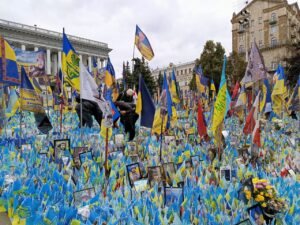
Spontaneous memorial at Maidan Nezalezhnosti, Kyiv, 2025. Photo by Olena Kononenko (used with permission).
Tahani Al Dahdouh (TAD): As a Palestinian researcher originally from Gaza, my research themes emerge from a sense of injustice, a refusal to remain helpless, and a commitment to act rather than stay silent while witnessing the genocidal war from abroad. I was formerly an academic in Gaza and am currently a volunteer. I have experienced hardship myself and later witnessed firsthand the suffering of university students and academics. I see how they struggle to keep higher education functioning even under extraordinary circumstances. This is why I chose to study and rethink resilience in higher education within contexts of genocidal war.
Findings from my research on Gaza’s university students revealed that personal attributes such as determination and beliefs about the value of time supported students’ focus on learning. Another study, conducted at the institutional level, aimed to understand how Gaza’s universities continued teaching and learning during the war. The findings pointed to three underlying mechanisms developed to preserve identity and refuse erasure: externalization, decentralization, and randomness.
These findings challenged the concept of “resilience.” They brought forward not coping or adapting strategies, but agency — insistence on legitimacy and declaration to the world: we are still here. Although buildings were destroyed, “our universities live on.” The findings also highlighted the Palestinian concept of “sumud,” related to resilience and resistance, however, distinctive from them. The interplay of these concepts was insightful however not investigated in detail, so I applied for funding from the Kone Foundation to continue my research. Currently, I delineate the overlapping concepts of resilience, resistance, and sumud, whose vagueness generates analytical ambiguity and, at times, political misuse and epistemic injustice.
My research topics also stem from personal and collaborative reflections on my academic practice. I volunteered to teach remotely at Gaza’s universities during the genocidal war. I must say, it was not easy at all. Teaching is always an emotionally charged profession; even in stable contexts, it can be stressful. Teaching in wartime requires bearing witness, sharing in grief, and holding space for hope. I was not alone in this; my coteacher’s support was essential in caring for students, supporting each other pedagogically, and, most importantly, sustaining emotional strength at times when grief dominated our interactions. We faced many challenging situations and a continuous tension between regulating our own emotions, feeling empathy toward students, and maintaining standards of quality education. This experience led us to reflect on ourselves as teachers and learners and to conduct a research study grounded in our lived experiences.
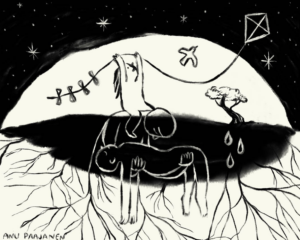
No title, 2024, by Anu Paajanen (used with permission).
- Research Approaches in Dangerous Times
ON: I think, dangerous contexts require methodological innovation. Conventional methods are rarely sufficient when working with wartime art, displaced professional communities or war-torn urban landscapes. Instead, research becomes a dialogical, intersubjective, and embodied practice. In my recent projects I turn to the following research approaches that treat knowledge as relational, situated, and deeply affected by conditions of danger.
- Participatory action research (McIntyre, 2008) to ensure that those most affected are not mere subjects but co-creators of the project, e.g. co-researchers.
- Mixed methods (Hesse-Biber, 2010) to help integrate and relate subjective and objective data, or different dimensions of qualitative data, such as narrative and ethnographic, to establish a better comprehension of agencies and spaces, distorted by the war.
- Autoethnography, individual or collective, to explore researcher’s own thoughts, feelings, and embodied experiences, bringing the personal and tacit knowledge into the spotlight as a valuable resource (Denshire, 2014).
- Narrative interviews with deep listening to create a discursive space where sensitive issues and personal and emotional experiences can be voiced with care.
- Interdisciplinary collaboration, for example with artists, to open new avenues of insight, as well as explore alternative archives of knowledge, such as artworks.
TAD: Conducting dangerous research requires careful methodological design and thoughtful implementation. Research questions, of course, guide the methodology, but researchers doing dangerous research must also remain flexible in designing data collection tools that best capture the phenomenon under investigation. For instance, in my qualitative research with Gaza’s academics, I found that they preferred to be interviewed rather than respond to open-ended survey questions. This preference stemmed from their overloaded work schedules, limited resources of the working environment, and limited time available for writing. These experiences have taught me that methodology must remain sensitive to people’s realities and constraints, especially in war-affected contexts. With this in mind, I primarily use:
- Narrative interviews (Mueller, 2019): to capture participants’ voices, lived experiences, and meaning-making processes.
- Selfstudy research approaches (Butler & Horton, 2025): to reflect on, critically analyze, understand, and improve one’s own practice and professional actions.
- Mixed methods: combining survey data with open-ended questions to enrich and contextualize insights.
In my upcoming studies, together with my collaborator I aim to use:
- Integrative literature reviews: to synthesize and evaluate current knowledge on the research topic. This approach is central to Huff’s (2009) “sensemaking/sensegiving circle of scholarship” (p. 4).
- Bricolage (KiniSingh, 2023): an artistic, flexible method of investigation and creation that brings together diverse materials, perspectives, and analytical tools.
It is worth noting that even when the study design and data collection instruments are carefully planned, implementation is not always straightforward. For instance, in one of my previous studies — despite its ethical approval and informed consent forms with clearly outlined research objectives and data confidentiality — some students were hesitant to participate. Their hesitation was understandable given the political instability and the fact that Gaza is under colonial occupation. This hesitation reflected students’ heightened political alertness as well as awareness. In such cases, when the researcher’s background is known to participants, familiarity can help ease concerns and establish a trusting relationship throughout the research process.
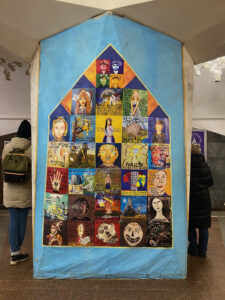
Children’s artworks in Kharkiv subway station hall, Kharkiv, 2025. Photo by Oleksandra Nenko.
- Positionality in Dangerous Times
ON: To research under dangerous conditions is to constantly negotiate one’s positionality. For me, this involves being a displaced intellectual in search of new points of reference, someone who both witnesses and enables other witnesses to be heard. It also means reaching beyond the purely rational into the emotional, the felt, and the imaginary. Dangerous research requires engagement rather than detachment. The researcher becomes an equilibrist, balancing empathy with analysis, involvement with reflection, exposure with self-care. Positionality is not a fixed standpoint but a moving equilibrium shaped by the risks and solidarities of the research journey.
TAD: I constantly reflect on my role, position, and the impact of my presence on the research process. Doing research in dangerous, politically charged, or colonially shaped contexts requires acknowledging that I am never a neutral observer. My identity as a Palestinian researcher from Gaza shapes not only how participants relate to me but also how I interpret their narratives, silences, and emotions. This contextual embeddedness is essential for understanding nuances in the data and contributes to achieving what Bruner (1986, p. 52) refers to as verisimilitude, whereby interpretations offered in research can be regarded as “true to conceivable experience.”
Maintaining awareness of positionality means engaging in transparent dialogue with research participants and acknowledging potential power imbalances. I continuously examine the intersecting layers of insiderness and outsiderness I inhabit: an insider through shared history, language, and experiences of loss; an outsider through my work abroad, my physical distance, and my absence from Gaza over the past eleven years.
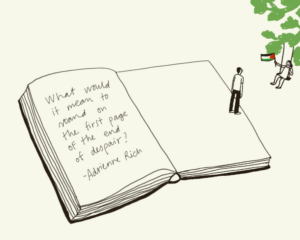
No title, 2024, by Anu Paajanen (used with permission).
- Social Impact of Research in Dangerous Times
ON: Research in dangerous times is not only about producing academic knowledge; it is also about shaping public conversations and supporting vulnerable communities. Working with displaced artists, for example, I see the importance of collaboration: co-designing research and action projects with artists themselves and ensuring that their visions and voices remain at the centre.
Following this idea, together with Ukrainian artists in Finland we launched an initiative to establish a professional Ukrainian Artists Association in Finland (UAAF). Together with stakeholders from the Finnish arts, culture, academia, and civil society, we organised an interdisciplinary seminar titled “War-ning Art: Resilience, Response, and Artistic Knowledge in Finland” on December 3rd last year (2025). The seminar addressed the role of the arts and artists in times of war and polycrisis, the professional resilience of artists who have experienced displacement, and the significance of their artistic knowledge within the contemporary Finnish art scene. Social impact also involves making voices and stories public through digital platform-based solutions. In this spirit, within the UAAF initiative we are currently working on a web platform representing Ukrainian artists in Finland (www.ukrfinart.com).
It is also important for me to contribute, in the ways available to me, to the well-being of Ukrainian cities. At present, I participate remotely as an invited lecturer and mentor in research activities of the Faculty of Geography at Taras Shevchenko National University of Kyiv. Building on our findings from emotional mapping, with students we do research on Maidan Nezalezhnosti and Mykhailivska Square as central public spaces, sites of political and cultural representation and sites of memory-making during wartime.
TAD: The recent shift in my research towards incorporating artistic methods to investigate resilience, resistance, and sumud is driven by the belief that art can enable a plurality of stories and complexify visions about experiences Gazan academics have been enduring. The creative artistic process is grounded in an ethical stance that refuses to flatten teachers’ experiences, neither as ‘helpless victims’ nor as ‘superheroes’ who can miraculously keep their work moving despite unimaginable psychological and physical pain.
We plan to create a multisensory installation that will bring under the same roof stories and experiences of teachers in Gaza and in the diaspora, generating new meanings through their assembling. Teachers’ experiences will be honoured also by creating a digital memory archive that showcases academics’ stories, work, and activities during wartime via audio, video, and photographic materials. This artistic approach not only documents experiences but also facilitates cross-cultural dialogue, provokes Finland’s cultural diplomacy, and invites national and international audiences into urgent discourses often absent from mainstream narratives. In doing so, it positions art and research as intertwined practices that mobilize public engagement and support broader social understanding and solidarity.
***
Doing research in dangerous times is not a heroic act but a vulnerable, risky, and deeply relational process. It involves navigating personal danger of being in endangered contexts or working with a sensitive theme, obscurity of displacement experiences in peaceful contexts, ethical complexities and emotional weight of working with communities in distress. Yet it also opens pathways to reimagine scholarship itself: as participatory, embodied, interdisciplinary, and socially engaged.
The task of dangerous research is not only to document suffering but also to illuminate possibilities of resilience, solidarity, and recovery. Whether through the art of displaced Ukrainian artists or the activities of Gaza university students and teachers, dangerous times generate alternative visions on agency and ways to act in the society, even in the most dramatic circumstances. Recognizing danger as an immediate part of everyday life in many parts of the world, including lives of researchers, gives ground for critical, decolonial, engaged scientific rethinking of the status quo of concepts and interpretative frameworks.