When do we stop being students?

Aino Kalske

Aino Kalske
TCSMT postdoctoral researcher

I was out for a fancier-than-usual lunch with some postdoc and researcher colleagues when the waiter casually presented us with an innocent, yet loaded question, “Are you students?”. All of us were in our mid-thirties. A full decade had passed since our undergraduate and master’s degree studies, and at least four years since any of us had been even PhD students. Maybe this was an attempt to flatter, to say you look young enough to be 23? No, we were not students and even the most suspicious salesperson in Alko rarely asked for our IDs anymore, so we definitely did not even look that young. This perhaps well-meant question sparked a conversation in our table about how should we feel about the assumed student status, does it imply that our work is not real work and when do the regular folk start taking us seriously.

During my time in the US as a postdoc, I found it even more difficult than in Finland to convey the seriousness of what I did to the outside world. Explaining to some of my non-academic friends and acquaintances that I am a postdoc frequently incited the question “So… Are you going to get a job at some point?”. While I am fairly certain they did not mean to undermine the value of the time I was spending in the greenhouse, field and lab uncovering the mysteries and evolutionary origins of plant-plant communication, I was baffled and felt misunderstood. Every time. Without skipping a beat, I found myself explaining that “I actually do get paid, you know.” Maybe not the most convincing argument in conveying the importance academic research and my part in it, but they caught me by surprise. Every time.

Should we take these casual comments to mean that what we do for work is not real work? We are world experts in our fields, our research gets recognized by the global, international community of peers, we find answers to questions no-one even though to ask ten years ago and still, to the outsider we are simply students. If getting to spend our days fueled by curiosity and discovery is not considered, by some, to be real work then is that something to be upset about? Perhaps it is not work in the sense that our productivity is not yielding a direct monetary or material benefit to anyone in the time scales other more traditional work does. Full disclosure, I have spent some of my work days as a postdoc punching holes in plant leaves with a metal pet brush. The purpose of this activity was to create a uniform repeatable damage treatment to my experimental plants, but put out of context, it just sounds like the goings on of a crazy person.

If our work not being considered work is a mere problem of terminology, then we should take these comments as opportunities for conversation about what is it like to have the creation of knowledge as a profession. However, if they echo a deeper mistrust and dismissal of the role of science in society, we should be worried. Perhaps we need to start making it clear to more than just the occasional waiter that even though what we do on a day to day basis may not always sound like work, the academic pursuit for a more profound understanding of our world is, nonetheless, of unquestionable importance.

Posted in Personal thoughts | Tagged , , , | 1 Comment

Interdisciplinary Research and Institutes for Advanced Studies – a perspective

Georges Kazan, DPhil (Oxon) Senior Research Fellow TIAS (Archaeology) University of Turku

“All knowledge begins with a question”
Neil Postman
 

Today’s world is increasingly facing complex challenges, from Climate Change to Covid-19, and beyond. Historically, interdisciplinary research has served as an approach (not an end) to a problem that cannot be fully embraced by any single discipline. New disciplines, such Neuroscience or Biochemistry, have emerged as a result, enabling the complex problems to be studied more effectively and in greater depth. But what exactly is interdisciplinarity? This is a word that Microsoft Word, at least, does not recognise. Definitions of interdisciplinarity and transdisciplinarity are currently diverse and contested. Similarly, the structures supporting interdisciplinary research have not been extensively studied. The reason for this may be that most definitions focus on what interdisciplinarity is, rather than how it is performed, and that explorations of best practices for interdisciplinary research often require the reassessment of university models themselves.

Most university research originates within a discipline-based research environment, prevalent since the 19th century. This enables scholars to deepen knowledge in specific fields. This process can, however, result in increased distance between disciplines, fragmenting the research landscape and reducing efficiency. Those who dare to reach across the divide and incorporate data and/or methods from other disciplines in order to enhance their research can face a number of barriers:

  1. Existing disciplinary structures do not provide a ready fit for interdisciplinary research
  2. Assessment of research publications and funding often dominated by disciplinary expertise
  3. Not always possible to explain the future output of research that is exploratory in nature
  4. Lack of a common epistemic frame of reference to connect separate disciplines

As a result of points 1-3, interdisciplinary research often lacks the funding and freedom it needs to proceed effectively. Point 4 tends to particularly affect researchers in qualitative fields within the Social Sciences and Humanities (SSH), where there tends to be less conceptual overlap between (and even within) fields. However, if an interdisciplinary concept and framework can be established successfully, there is then an opportunity to integrate the new research into existing disciplinary structures by establishing it as a field in its own right. To develop and undertake interdisciplinary research, therefore, scholars require the time, facilities, flexibility and autonomy to take risks in pursuing potentially unproductive research for its own sake.

The Institute for Advanced Study (IAS) model offers the only established platform in academia for ‘bottom-up’, interdisciplinary research. While universities are increasingly managed using market-based models, with a strict focus on academic and societal impact, the IAS concept was established in Princeton almost a century ago to enable curiosity-driven pursuit of knowledge with no view to its immediate utility or the expectation of meeting predetermined goals. Since 2000, the number of IASs has grown significantly, part of a general trend of increasing support for environments without a specific research focus. Many of these more recent IASs, such as Turku Institute for Advanced Studies, are situated within universities, where they serve to enhance excellence and increase institutional prestige. In China, the transformative potential of IASs has been recognised as an important starting point for the reform of Higher Education Institution (HEI) research, with a network of 15 IASs now integrated into China’s HEI landscape (China Network of Institutes for Advanced Studies 2018).

Due to cultural similarities and a strong commitment towards public investments in social welfare and education, Nordic societies are often grouped together as exponents of the ‘Nordic Model.’ Such approaches have resulted in unique levels of social capital and trust.  At the same time, if the Nordic Model of public investment is to survive complex, existential, threats (e.g. aging populations, changing working models, global competitiveness), it must evolve and adapt to changes in its surroundings. This is directly relevant in the Nordic Higher Education Institution (HEI) sector, which is at present mostly state-funded. Within the Nordic HEI sector therefore, there is both an opportunity and a necessity for separate research institutions to connect and collaborate on a shared basis of mutual trust. Bringing down barriers to knowledge exchange also provides new possibilities for disciplinary and interdisciplinary research in a range of areas, on issues of high societal significance.

IASs present an ideal environment for such an initiative. Within the Nordic region, eight IASs exist at present. However, these generally operate in isolation of each other, are based on a range of different operating models, and participate in different international IAS networks or consortia. At the instigation of Professor Martin Cloonan (Director, TIAS), I conceived and developed, on TIAS’s behalf, a three-workshop series, Beyond Advanced Studies, in partnership with the Swedish Collegium for Advanced Study and Aarhus Institute of Advanced Studies. Funding for this was provided by the Joint Committee for Nordic research councils in the Humanities and Social Sciences (NOS-HS). The purpose of this series is to explore a co-ordinated approach to the IAS concept in the Nordic region by exploring the core question of “What is the Nordic approach to IAS and interdisciplinary research?” By building critical mass and concentrating expertise, it seeks to provide a platform within the Nordic region for disciplinary, sectoral and international dialogue in an important area – interdisciplinary research.

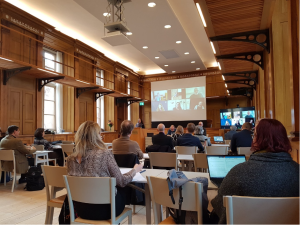
Photo: Beyond Advanced Studies – Workshop I, Swedish Collegium for Advanced Study

In November 2021, the first workshop in the series took place in Uppsala, Sweden, arranged and hosted by the Swedish Collegium for Advanced Study. Directors and Fellows of Nordic Institutes for Advanced Studies (IASs), plus expert guests from inside and outside academia, met in-person and via video conferencing for an exploratory discussion of interdisciplinarity, researcher careers and applications of the IAS concept. In addition to presentations by directors of Nordic IASs, the workshop was addressed by experts on the IAS model and on interdisciplinary research practices, as well as representatives of the Swedish Research Council and other interdisciplinary units. Swedish Collegium fellows, including members of its Erik Allardt fellowship scheme and early-career programme, Pro Futura Scientia, also shared their experiences. The participation of French, British and German IAS directors was especially valuable, helping to establish common ground internationally and throw light onto aspects specific to Nordic IASs. An online open innovation tool was used to capture ideas and perspectives throughout. The next workshop will take place in Aarhus (8-9 March 2022), with the series concluding in Turku at the final workshop. After this, conclusions will be compiled and summary findings published.

The increased emphasis being placed on interdisciplinary research at institutional level (e.g. Horizon Europe and NordForsk) provides significant opportunities to establish, within a disciplinary context, the new approaches developed within Nordic and European IASs, for example as larger research projects or research units. By facilitating closer co-operation between IASs, and collaborative refinement of IAS mechanisms, Beyond Advanced Studies seeks to consolidate and stimulate Nordic approaches to the IAS model, for the benefit of interdisciplinary researchers and research alike. 

Please feel free to follow us on the website and Twitter link below:

Beyond Advanced Studies

Website: https://sites.utu.fi/beyond-ias/

Twitter: @StudiesBeyond

Posted in Uncategorized | Leave a comment

Bioteknologian keinoin homemyrkkyjä vastaan

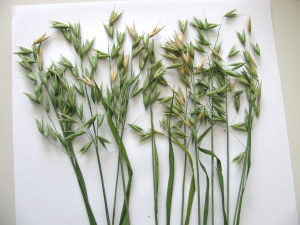
Punahomeen saastuttamaa kauraa Turun lähistöltä heinäkuun lopulla 2012.

Punahomeen saastuttamaa kauraa Turun lähistöltä heinäkuun lopulla 2012.
Kuva: Tapani Yli-Mattila.

Kirjoittaja: tutkijatohtori Riikka Peltomaa, Luonnontieteiden, lääketieteen ja tekniikan tutkijakollegiumi

Homemyrkyt eli mykotoksiinit ovat homesienten tuottamia yhdisteitä, jotka voivat aiheuttaa ihmisille ja eläimille vakavia terveydellisiä haittoja sekä äkillisesti että pitkäaikaisen altistumisen seurauksena. Otollisissa olosuhteissa näitä myrkkyjä tuottavat sienilajit voivat muodostaa homekasvustoja eri ravintokasveihin, pääasiassa viljoihin, pähkinöihin ja hedelmiin. Homekasvustot voivat aiheuttaa haitallisia tauteja kasveille, ja ne voivat myös muodostaa myrkyllisiä mykotoksiineja kasvupaikalla tai edelleen viljavarastossa ja kuljetuksen aikana. Joidenkin tilastojen mukaan mykotoksiineja on havaittu jopa 60−80 prosentissa maailman elintarvikesadosta.

Homesieniä kasvaa kaikkialla maailmassa, sillä ne ovat äärimmäisen sopeutuvaisia erilaisiin elinympäristöihin. Monet sienet elävät tiiviissä vuorovaikutuksessa muiden organismien, kuten bakteerien, kasvien ja eläinten, kanssa, ja ne ovat joutuneet kehittämään erilaisia vuorovaikutus- ja suojautumistapoja esimerkiksi estääkseen muiden kilpailijoiden selviytymisen. Niinpä tietyissä kasvuolosuhteissa tai haitallisissa ympäristöolosuhteissa sienet tuottavat erilaisia toissijaisia aineenvaihduntatuotteita eli niin kutsuttuja sekundaarimetaboliitteja. Tuhansien tai jopa miljoonien erilaisten sienten sekundaarimetaboliittien joukosta on tunnistettu monia hyödyllisiä yhdisteitä, merkittävimpinä ehkä antibiootteina tunnetut penisillisiini, kefalosporiini ja muut beetalaktaamit, mutta myös immunosuppressiivisia lääkkeitä, kasvihormoneita sekä hyönteisille myrkyllisiä yhdisteitä. Lisäksi sienet tuottavat sekundaarimetaboliitteina myös ihmisille ja eläimille myrkyllisiä yhdisteitä, joita kutsutaan mykotoksiineiksi. Continue reading →

Posted in Personal thoughts, Research | Tagged , , | Leave a comment

A Pessimist in the Academia

Henna-Riikka Pennanen, Postdoctoral Researcher (TIAS)

I am a bit of a pessimist. It is not that I do not believe things will work out in the end, it is just that I do not think they are likely to work out for the best. Presumably, this vague outlook colors my academic work just as it does my personal life, but how exactly?

Ronald Barnett writes that it is “easy enough to be pessimistic about the character of academic life in the twenty-first century, for there is much to be pessimistic about —” (Academic Working Lives, 2014). The distorted work–life balance, instrumentalism, and auditing and surveillance regimes are merely some of the pessimism-inducing aspects of the academic workplace Barnett recites. Not to mention constant rejections, precarious positions, and the unending competition. In fact, my wonderful pessimist colleagues and I have internalized the mantra of cut-throat competition so well that our favorite pastime is to compete over who thinks they have the least chances of success in landing a grant or getting published. Thus, there is a symbiotic relationship: the academia indulges my pessimism, and then my cynicism and resignation add to the general pessimistic atmosphere. If it were not for my equally wonderful optimist colleagues, I doubt nothing would ever change for the better around here.

My research revolves around pessimism as well. The primary sources I am currently working with are rife with pessimism. This is unsurprising since I am studying U.S. perceptions and representations of rising Japan as a threat to the United States and world peace in the early decades of the twentieth century. In the primary sources of a historian, pessimism comes in many forms: a general philosophy of history as a (often cyclical) process tending to the worse; a philosophical or religious belief that the humanity is the worst or the world they have created is the worst of possible worlds; and skeptical or even alarmist reactions to specific events and intellectual, political, or social currents. Historical pessimism is reflected in “time-consciousness.” That is, the individual or collective consciousness of “a given present in relation to its past and future,” as K. F. Helleiner, Professor of Economic History, argued in an essay in 1942.

For example, in 1919, Thomas Millard predicted a conflict involving China, Japan, and the United States (Democracy and the Eastern question). A journalist and a “China Hand,” Millard speculated on the likely causes of future international conflicts. Drawing from Professor Charles W. Eliot, Millard argued that the causes of war were:

national distrusts, dislikes, and apprehensions, which have been nursed in ignorance, and fed on rumors, suspicions, and conjectures propagated by unscrupulous newsmongers

and

clashing commercial or industrial interests, contests for new markets and fresh opportunities for profitable investments of capital.

Cover page of Millard’s Democracy and the Eastern Question. Public domain.

In addition, there was an ideological element involved. Millard believed that two opposing theories of international polity—namely autocratic militarism and democracy—were drawing nations into conflict in the East, just as these theories had recently battled out in Europe in the Great War. In the Northeast Asia, rising Japan stood for autocratic militarism and China for the “weak and apprehensive democracy.” According to Millard, preventing this coming contest and shielding China from Japanese aggression necessitated “direct and active participation—some say leadership—of America,” if not for any abstract ideological principles, then for U.S. national security and interests.

Sounds eerily familiar, right? Similar gloomy assessments of a coming international conflict involving the United States and a rising—or more accurately, a risen—East Asian power abound today, as does the ideological framing of the conflict in terms of democracy versus autocracy. Only the roles assigned to China and Japan have been reversed, and the historical analogy pundits draw from is the Cold War instead of World War I. Consequently, just as the early twentieth-century U.S. Americans were wondering whether they were destined to fight Japan, the whole world is now speculating on whether China and U.S. are heading towards a new Cold War.

When working with my historian’s hat on, my aim is to understand a historical text in its proper historical context(s). Accordingly, if I wish to assess the time-consciousness of the author as it is reflected in the text, I need to read the text against the context and the collective time-consciousness of the day.

Thus, we can note that as the World War I was briefly followed by liberal optimism for a peaceful future of world affairs, Millard’s prediction of an international conflict appears pessimistic. Then again, the tide of opinion regarding Japan was slowly turning. A reviewer in the American Journal of International Law denounced the book, writing that the author was “frankly and aggressively anti-Japanese” and that “Mr. Millard may be wrong, but he has no doubts.” And yet, the reviewer also noted that while the U.S. observers were “always ready to assume the worst of European monarchies,” some of them were now beginning to have misgivings about Japan, too. In this atmosphere, Millard’s reading of the situation could be judged more generously as realistic, and for example, another reviewer in The Journal of International Relations did not find fault with the book. However, only with the benefit of hindsight can we conclude that Millard was not sounding an alarm for nothing.

Studying history, I can put aside my personal time-consciousness and the collective time-consciousness of my own time. Studying the present, they are more difficult to sidestep. Today, the general mood regarding world affairs is starkly more pessimistic than a hundred years ago. Tim Stevens and Nicholas Michelsen depict pessimism as our Zeitgeist (Pessimism in International Relations, 2020), exacerbated by, for example, the tightening geostrategic competition between China and the United States and fears of democratic backsliding.

Image: Henna-Riikka Pennanen

So, coming back to the debate on whether there will be a new Cold War—and leaving aside the question whether this is a fitting historical analogy in the first place—it would be (far too) easy to find affirmative evidence, and present an analysis confirming my own pessimistic disposition and conforming to the sweeping pessimism of our age. To avoid this, I have come up with two strategies: the (in)famous academic “on the one hand/on the other” and joining forces with optimists. If any of you wonderful pessimists and optimists out there have worked out other strategies to reach nuanced and balanced assessments of the present, please let me know.

Posted in Personal thoughts, Research | Leave a comment

Thoughts on Academic Career Structures

Jianwei Li, head and torso, photograph in front of trees

Jianwei Li, Collegium researcher and group leader in MediCity

Discussions on academic career structures have recently become popular in Germany, a leading country in science and technology. The #IchBinHanna Twitter hashtag emerged in the German academic society in the summer of 2021. The discussion was triggered by a two-minute video made by the German Ministry of Education and Research (BMBF). The video was conceived to tell the story of how to find a permanent academic position in Germany. As a result, BMBF received extremely large amounts of protests about the academic career structures in Germany. The German Federal Statistical Office suggested that in 2019 87% of academics were working on fixed-term contracts. Everyone knows that the fixed-term contracts force the employee to move every few years. Temporary contracts increase feelings of insecurity in the researchers and inhibits scientific innovation, as high-risk projects need a stable academic environment. Continue reading →

Posted in Personal thoughts | Tagged , , | 1 Comment

The frustrating and very human combination of family and research

Reima Välimäki is a Postdoctoral Researcher at TIAS and the Department of Cultural History, as well as an Adjunct Professor of Medieval History

When writing this, my child is having a cold. Again. Once again, cancelled meetings. Again, a time reserved for concentrated reading and data collection is interrupted by wiping a runny nose and pleas to put Peppa Pig on. Peppa Pig (incarnated as a balloon) was also floating behind the back of my colleague while we had a Zoom meeting. He wisely pointed out that we have a certain disadvantage compared to the medieval intellectuals we study. Peppa hardly broke Bernard of Clairvaux’s contemplation – but of course, Bernard had chosen what we hadn’t: a life in celibacy.

Bernard of Clairvaux, who was not interrupted by Peppa Pig. However, in 1146 he saw a vision of lactating Virgin Mary, but that is another story.

The first comparison that occurs to most researchers with family is not, however, cloistered medieval men but our colleagues without children. In the horrible Academic September in Finland (our very special purgatory with the start of the semester and major funding calls overlapping) such a comparison becomes acute and frustrating. How are we to compete with colleagues conversing with Kant while our heads are filled with the opening tune of Caillou? How is one supposed to produce a paradigm shift when sometimes it is a challenge to shift all the puzzles and children’s books that have invaded one’s desk? The “career breaks” line in the academic CV does not quite cover all the everyday interruptions that come with the package.

Yet, I still manage to believe that children can enrich also our research in addition to the obvious enrichment of our personal lives. At least in the humanities, where the focus is the wonderfully messy human condition. In the past decades, the array of subjects covered by academic history has expanded immensely: workers, women, family, children, minorities, everyday life, sexuality, disability, to name but a few. Behind this development are not only paradigm shifts but the increased diversity of academic historians.

While personal experience does not guide our research methods, it very much affects what we pay attention to in the first place. I noticed this when re-reading the Stettin inquisition protocols from 1392-1394, a group of documents I’ve been used in various studies since my MA thesis. However, only after becoming a father myself, I spotted this piece of information:  (I have written about it before in Finnish)

In her interrogation, a 24-year-old woman Grete Joris told that both she and her husband Mathias had been summoned by the inquisitor. Mathias had been unable to answer the summons because after walking a mile, he had had to turn back home carrying their son. Probably it was a small child getting tired – or a father realising that he cannot carry the child for the whole journey, dozens of miles. A very human moment, and familiar to anyone trying to walk with a toddler. And one I only paid attention to after struggling with my own kid.

So while taking care of our children – or elderly relatives – inevitably occupies our research time, we can perhaps cherish the thought that those frustrating moments make us more aware of the fragility, imperfectness, exhaustion, and support given and needed that are an essential part of humanity past and present.

I am yet to discover how to frame that in a grant application.

Posted in Uncategorized | Leave a comment

Tähtienvälistä pölyä ja vuosittaisia supernovaräjähdyksiä

Picture of author Erkki Kankare

FT Erkki Kankare
Kollegiumtutkija (TCSMT)
Fysiikan ja tähtitieteen laitos

Suurimman osan ajasta tähdet ovat tasapainossa tähden omaan energiantuotantoon perustuvan paineen ulospäin työntämän voiman ja tähden oman massan sisäänpäin vetävän painovoiman välillä. Tähtien energiantuotannon lähde on ydinfuusio, jossa kevyemmät alkuaineet muuttuvat raskaammiksi, kuten vety heliumiksi, vapauttaen energiaa tähden ytimessä. Massiivisimmissa tähdissä prosessi voi edetä aina rautaan asti. Kaikkein massiivisimpien, noin kahdeksan Auringon massaisten ja tätä suurempien tähtien elinkaaret päättyvät pääsääntöisesti niin sanottuun luhistumissupernovaräjähdykseen.

Luhistumissupernovaräjähdykset ovat hyvin kirkkaita, erityisesti ensimmäisten muutamien kuukausien ajan, ja täten niitä voidaan havaita ja tutkia toisista galakseista aina kosmologisille etäisyyksille asti. Vertailun vuoksi, Auringon kaltaisen tähden elinkaaren pituus on noin kymmenen miljardia vuotta. Massiivisten, luhistumissupernovana räjähtävien tähtien elinkaaret ovat puolestaan vain miljoonien tai kymmenien miljoonien vuosien luokkaa. Täten luhistumissupernovien esiintymisrunsaus myös seuraa aktiivista tähtienmuodostumista. Mitä enemmän galaksissa syntyy uusia tähtiä, sitä runsaammin siinä myös räjähtää luhistumissupernovia. Omassa Linnunradassamme on arvioitu eri menetelmillä räjähtävän supernova keskimäärin pari kertaa vuosisadassa. Linnunradassa ei ole kuitenkaan havaittu itse supernovaräjähdystä sitten vuoden 1604 Keplerin supernovana tunnetun paljain silmin nähdyn kohteen jälkeen. Tärkeä syy tähän on tähtienvälinen pöly, jolla viitataan pieniin mikrometrin luokkaa ja sitä pienempiin grafiiteista tai silikaateista muodostuviin kiinteisiin hiukkasiin, jotka himmentävät näkyvää valoa. Pari pölyn himmentämää supernovajäännettä viimeaikaisemmista supernovaräjähdyksistä onkin modernina aikana löydetty eri menetelmin. Continue reading →

Posted in Research | Tagged , | 1 Comment

Biomimicry: A fairway to seek sustainable solutions for a better world

Tharun Kumar Kotammagari TCSMT Postdoctoral Research Fellow Bioorganic group   Department of Chemistry University of Turku

Tharun Kumar Kotammagari
TCSMT Postdoctoral Research Fellow
Bioorganic group
Department of Chemistry
University of Turku

Biomimicry is “Innovation Inspired from Nature.” It is nothing but learning from nature or taking design ideas from nature. It is a new way of inventing by looking at the natural world for inspiration. When I was in school and my biology teacher taught about photosynthesis, I wondered how this complex process could happen in the leaf using water from the roots, CO2, and the presence of sunlight. The leaf is amazing when doing such things. This inspired people studying leaves to start working with solar cell manufacturers. Plants do not see CO2 as a poisonous gas, as we see it as a greenhouse gas now!

Plants found a way to convert CO2 into glucose and starches in a sustainable manner. Now it is our turn to find a sustainable solution for this. One of the best ideas presented is converting CO2 into polycarbonates, biodegradable plastics. This is what plants are doing, and the idea was implemented by Geoffrey W. Coates from Cornell University. Many researchers around the world are working to convert CO2 into a fuel in different ways by using carbon engineering, artificial photosynthesis, etc. If researchers can address questions regarding sustainability in this process, it will definitely be a groundbreaking innovation. However, critics argue that the world’s main priority should not be to capture CO2, but instead to emit less of it. Continue reading →

Posted in Personal thoughts, Research | Tagged | 3 Comments

The Sun – trying to understand the dragon

Nina Gieseler

Nina Gieseler, Collegium Researcher, Space Research Laboratory

The Sun, humanity’s personal star, is known by all of us. We all have embraced it’s warmth, enjoyed beautiful sunsets, or experienced a sunburn. Like everybody might have their own perspective on the Sun, my personal relationship is a particular one. While I really enjoy sunbathing I see the Sun also as a kind of employer. The Sun produces what I study: energetic particles, accelerated to high energies in solar eruptions.

I am, therefore, very familiar with the Sun’s rough side, its dangerous aspects, its ugly face. I imagine the Sun as a dragon. Right now it is a sleepy dragon, just about to fully wake up. That might sound a bit scary, and yes, it is! While the Sun never stops to shine, this other kind of radiation, the energetic particle radiation, occurs sporadically, and if it hits Earth, it can harm all life! We call this space weather, and when these solar storms blow, you better get inside if you are an astronaut; you better power off if you are a satellite. And you better don’t fly with a plane over the poles, where the Earth’s magnetic field can’t significantly shield you.

The last deep-sleep phase was in 2019/2020, characterized by the dragon not changing its appearance, nothing happening, boring even. This is called solar minimum. We know this phase but we also know what comes after! The question is, “when will it happen and how bad will it be?” Continue reading →

Posted in Uncategorized | Leave a comment

Interdisciplinarity as a strategy

Mona Mannevuo is a Postdoctoral Researcher at TIAS and the Department of Contemporary History

This post is based on a talk given at the international online symposium Across Boundaries in Sciences. The event was hosted by All European Academics (ALLEA) and the Council of Finnish Academies on 5 May 2021. The program, talks and more detailed information of the event can be found here.

Interdisciplinarity, multidisciplinarity, transdisciplinarity… The cherished idea of crossing boundaries in science has many names. Sometimes, we forget that boundary crossings may be a risky business for young academics working in highly precarious and competitive academia.

Although I am at an early stage of my career, I have a multidisciplinary academic background in the humanities and social sciences. I did my MA in cultural history (2009), but I defended my PhD in gender studies (2015). After finishing this PhD, I was employed as a research fellow in a FiDiPro project ‘Social Science for the Twenty-First Century: Employment Activation and the Changing Economy-Society Relation’. Subsequently, I was recruited to the ‘Tackling Biases and Bubbles in Participation’ (BIBU) consortium. While contributing to this project, my research environment was the Centre for Parliamentary Studies.

Since January 2021, I have been working on my own three-year post-doctoral project at Turku Institute for Advanced Studies. At TIAS, my affiliation is contemporary history, but I am also leading a project titled ‘Communication across borders: Shifting boundaries of politics, science and public relations’, which is funded by the Helsingin Sanomat Foundation.

Working in these different environments has taught me several things. First of all, my background has equipped me with rich knowledge of various fields and perhaps even strategic tools to survive in contemporary academia. However, academia is quite conventional and hierarchical, and I sometimes feel like an outsider (see Interdisciplinary Madness comic). In fact, I can feel a bit queasy when someone asks what my actual field of study is. I would like to pretend that it is just my curiosity that has led me to this situation, but truthfully, it is the difficulty of making long-term plans in contemporary academia.

Academic life as a succession of projects

Whereas ‘interdisciplinarity’ sounds exciting as a buzzword, the reality in interdisciplinary projects can be quite exhaustive and draining. In particular, early-career scholars often need to change topics rather drastically according to the themes of the projects for which they are employed.

It also feels like the society puts unrealistic expectations on interdisciplinary projects: they are expected to change the world, solve societal maladies and yield an astronomical return on invest. The problem is not the idea of interdisciplinarity but the project culture in which, paraphrasing Eve Boltanski and Luc Chiapello (2007), the actual content of the project seems less important than the general impression of networked scholars’ ability to juggle competing commitments at once.

But science is not magic. In 2015, when Nature published a special issue on interdisciplinarity, the editorial stated that ‘true interdisciplinary science cannot be rushed’. We may have hopes, but interdisciplinarity research is a risky business, because it often takes time to achieve results. It also takes time to build academic relationships and to see the value in other approaches, but competitive, fast-paced academia does not always foster collegiality.

Therefore, as the Nature editorial continued, we must rethink hierarchies: ‘All involved must be confident that colleagues from other disciplines use equal academic rigour and scientific standing, even if the methods used in rival fields seem alien’. Otherwise, the project exists as one main subject that depletes most of the resources and leaves the partners as orbiting satellites.

The main risk for young scholars working on interdisciplinary projects is that they may not offer career advancement but, rather, advance someone else’s strategic agenda. Thus, early-career scholars need to be acutely aware of the possible power relations in interdisciplinary projects. It is easy to make a project look interdisciplinary, but it is on the ‘shop floor’ where epistemological boundaries are negotiated.

In reality, the political economy of academia does not encourage young scholars to take the risk of crossing boundaries. Instead, they learn to promote interdisciplinarity within proper limits. They learn to ask critical questions, but not too critical, because there is no time for that. They learn to follow their curiosity, but not too much; interesting issues are noted but never actually explored, because the next project is waiting.

The order of knowledge

The problems in interdisciplinary project culture are not entirely new. They were already puzzling critical scholars in the 1950s. In The Organization Man (1956), William H. Whyte ponders how ‘the bureaucratization of the scientist’ leads to ‘projectism’, where scholars play a role set for them by funding committees with the hope of producing a sophisticated research design:

As one young scientist, Walter Roberts puts it: ‘There is a tremendous difference between science as it is done in the laboratory and science as it is reported. True science is helter-skelter, depending on one’s hunches, angers, and inspirations, and the research itself is done in a very personal fashion. Thirty or forty years ago [in the 1920s] it was written up this way. In reporting a great discovery a scientist would say, ‘I was working on such-and-such reaction when I dropped some sulphuric acid by mistake. When I examined it I found, to my surprise, a strange thing going on…’ But today nobody would write it up this way.

It seems, then, that academics have struggled with the idea of instrumental, top-down, problem-focused research for decades. What worries me about the current trend of evidence-based policymaking is that it may give the impression that there is some apolitical, pragmatic way to turn research into the administrative language of ‘best practices’ and ‘what works’. Instead, we have to admit that uncertain times are filled with messy, conflicting interests; the more evidence we have, the more decisions and selections we must make and the more accountable we are for our actions.

Interdisciplinarity as a buzzword may give an impression of consensus. However, critical interdisciplinary research is far from finding the one best solution. Transformative interdisciplinary fields, such as cultural studies and science and technology studies, emerged from the various disciplinary subfields. Indeed, the most interesting problems often evolve in the margins, and they are so strange that they cannot be understood or explained without consulting various actors within and outside the university. From a critical perspective, interdisciplinarity is a strategy – not for instrumental purposes but for restructuring the order of knowledge.


References:

Boltanski, Luc & Chiapello, Eve. The New Spirit of Capitalism. Translated by Gregory Elliott. Verso, 2007. Originally published 1999.

Editorial, ‘Mind Meld’. Nature, Volume 525 Issue 7569, 16 September 2015.

Whyte, William H. The Organization Man. University of Pennsylvania Press, 2002. Originally published 1956.

Posted in Uncategorized | 1 Comment