Mauno Koivisto -luennot
Yhdistys järjestää vuosittain Mauno Koivisto-luennon, joka käsittelee jotain ajankohtaista taloudellista tai yhteiskunnallista aihetta.
2026 Luento on 19.11 klo 13–15:00 Turun yliopiston Tauno Nurmela -salissa. Tervetuloa!
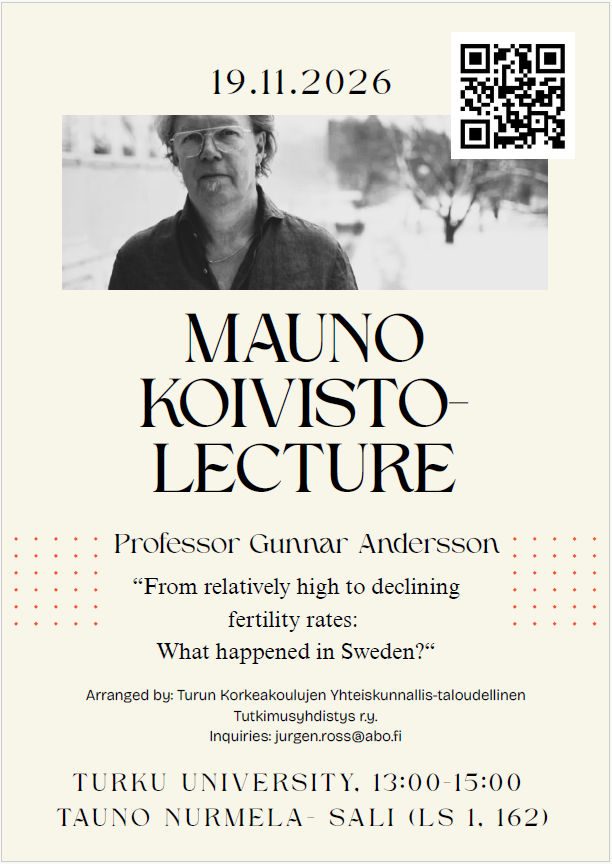
This presentation attends to the research process and research findings on the falling birth rates of Sweden, a situation that is not far too different from that in Finland. Research at the Stockholm University Demography Unit has attended to the conundrum of the falling birth rates since around 2010. Based on analyses of Swedish register data, we are able to unravel the underlying structure of the fertility decline and demonstrate that the behavioral changes in terms childbearing are entirely due to declining propensities of childless people to become parents. The decline in first-birth rates does not differ much across socio-economic groups or regions of Sweden. Moreover, the decline is not produced by a declining propensity to form new couples, but childless cohabiting people have become less prone to become a parent – and to marry. Furthermore, the decline in first-birth rates is not just an issue of postponed parenthood among young people, it extends to higher reproductive ages and will result in increasing fractions of women and men that will eventually remain childless. Our research reveals that factors that normally relate to changes in childbearing behavior, such as business cycles, changes in family policy or gender relations have no role in explaining current developments. Survey data from the Swedish Generations and Gender Surveys show that the intentions to become a parent in the future have also declined. The analyses underline that subjective factors such as worries about different global uncertainties appear related to the intentions of having children. The development observed for Sweden is in no way unique to this country and a general conclusion is that changes in the subjective perceptions of the present and the future have helped fuel the fertility decline, regardless of any factual circumstances that are unique to Sweden.
=============================================================
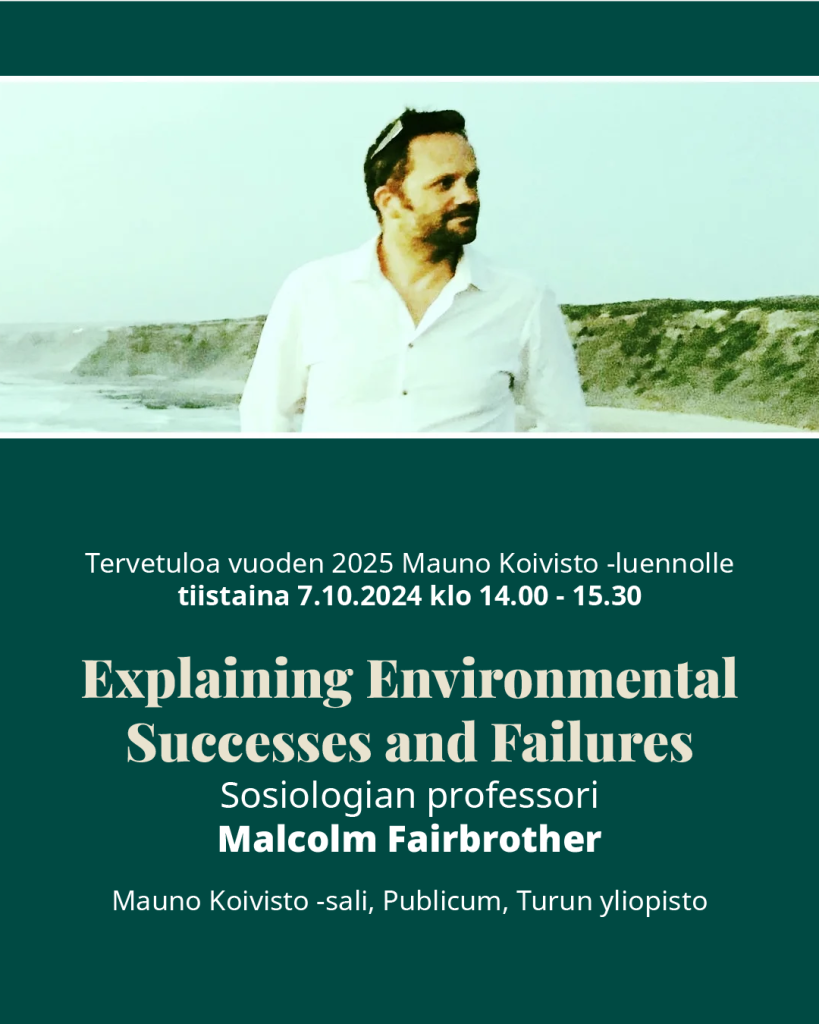
2025 Luento on 7.10 klo 14:00 Turun yliopiston Mauno Koivisto -salissa. Tervetuloa!
(Myös striiminä: https://aboakademi.zoom.us/j/69781209016)
2024 Kriminologian professori Janne Kivivuori (Helsingin yliopisto): Mitä on historiallinen kriminologia? Esimerkkinä pohjoismainen pitkän keston henkirikostutkimus
2023 Taloustieteen professori Johanna Rickne (Tukholman yliopisto): Sexual Harassment and Gender Inequality in the Labor Market
2022 Poliittisen historian professori Vesa Vares (Turun yliopisto): Pelkkää urheilua vai moraalinen velvoite? Jalkapallo politiikan, rahavallan ja edistyksen paineissa Mussolinista Qatariin
Luento käsitteli jalkapallon historiaa politiikan, rahavallan ja edistyksen näkökulmista. Luentotallenne on nähtävillä YouTubessa:
2021 Historiantutkija ja dosentti Tapio Bergholm (FT, YT): Mauno Koivisto ja Turun yliopistot
Vuoden 2021 Mauno Koivisto -luennolla historiantutkija ja dosentti Tapio Bergholm (FT, YT) tutustutti kuulijat presidentti Mauno Koiviston nuoruusvuosiin. Luento pohjautuu Bergholmin syksyllä 2020 julkaistuun teokseen Kiihkeä Koivisto.
Hybridiluennon tallenne on nähtävissä YouTubessa:
2019 Rehtorit Jukka Kola (Turun yliopisto) ja Moira von Wright (Åbo Akademi), keskustelun vetäjänä emeritusprofessori Heikki Paloheimo (Tampereen yliopisto): Turun yliopistot 2020-luvulla.
2018 Professor Eszter Hargittai (University of Zurich): The Digital Reproduction of Inequality: The Implications of Differentiated Skills and Online Participation.
2017 Ohjelmajohtaja Mika Aaltola (Ulkopoliittinen instituutti): Maailmanluokkaisen Suomen turvallisuus suurvaltapolitiikan murroksessa.
2016 Professor Mikael Hjerm (Umeå University), kommentoija dosentti Elina Kilpi-Jakonen (TY, sosiaalitieteiden laitos): Prejudice, past, present and future.
2015 Pääjohtaja Erkki Liikanen (Suomen Pankki), kommentoija professori emeritus Paavo Okko (TY, taloustieteen laitos): Optimismi, pessimismi ja realismi talouspolitiikassa.
2014 Professor Torben M. Andersen (Aarhus University), kommentoija VTT Juhana Vartiainen (Valtion Taloudellinen Tutkimuskeskus): The Nordic welfare model and welfare services – can we maintain acceptable standards?
2013 Professor Paul De Grauwe (London School of Economics and Political Science), kommentoija professori Sixten Korkman (Aalto-yliopisto): Design failures in the Eurozone and how to fix them (linkki luentoon liittyvään tekstiin, pdf)
2012 Professor Walter Korpi (Swedish Institute for Social Research SOFI, Stockholm University): The Rise and Decline of Western Full Employment Welfare States, 1920s – 2005: Distributive Conflict, Partisan Politics, and the Unified Theory
2011 Professor Eric Uslaner (University of Maryland): Segregation, Diversity, and Mistrust.
2010 Professor of Canada Research Chair in Electoral Studies Henry Milner (Université de Montréal): Democratic Deficit: The Challenge of Raising Youth Participation (linkki luentoon liittyvään tekstiin, pdf)
2009 Professor Peter Taylor-Gooby University of Kent at Canterbury): Political Legitimacy and Social Citizenship: a dilemma of austerity
2008 Professor of Political Sociology Jørgen Goul Andersen (Aalborg University): Miksi hyvinvointivaltio menestyy globalisaation paineista huolimatta?
2007 Professor of empirical sociology, scientific director Jelle Visser (Amsterdam Institute for Advanced Labour Studies): Welfare State Reform and Corporatism – what’s the connection?
2006 Professor of Social Statistics John Micklewright (University of Southampton): International Surveys of Educational Achievement: How Robust are the Findings?
2005 Andreas Schleicher (OECD): Kansainvälinen PISA-tutkimus
2004 Presidentti Mauno Koivisto: Kontrafaktuaalinen historian tarkastelu
2003 Päällikkö Pekka Sutela (Suomen Pankin Siirtymätalouksien tutkimuslaitos): Venäjä: matkalla Eurooppaan?