Search for a Vanished River

Marko Lamberg is a Collegium Researcher at the Turku Institute for Advanced Studies and the Department of Scandinavian Languages

A couple of weeks ago, Mikel Calle Navarro discussed the concept of the river in his exciting entry in this same blog. I spontaneously commented it, because I had previously pondered the same problematic, albeit in a different context.

As someone who has been born in Jyväskylä, Central Finland, I, too, had learned that the first inhabitant of the region was a certain Heikki Ihannuksenpoika who lived along the Jyväsjoki river at the beginning of the sixteenth century.  However, not until I had started my project with pre-modern location descriptions, I realised that I did not know where Jyväsjoki was situated. Nowadays, almost no one uses that name, and one cannot find it on official maps either. Several rivers flow through the areas the town of Jyväskylä consists of, but they have completely different names. The Digital Name Archive (Nimiarkisto), maintained by the Institute for the Languages of Finland, knows Jyväsjoki, but its map locates it on a dry slope far away from Jyväskylä.

In the local historical literature, I found that the name Jyväsjoki, which probably originally meant ‘Grain River’, had evolved to a settlement name, Jyväskylä (‘Grain Village’). Historians and linguists had already stated that in several works, but no one had analysed this process in detail. Moreover, no one had asked why the present-day town of Jyväskylä is not called Jyväsjoki. And where does or did that river lie?

I found the name Jyväsjoki in court protocols and taxation lists from the sixteenth century when it had been used both as a name of a river and of a settlement. Apparently, the Jyväsjoki river was much longer than the area of the Jyväsjoki settlement. That posed problems for both the local inhabitants and for the early modern government as it was necessary to define exactly where taxpayers dwelled and where their lands were situated. Some inhabitants and administrators chose to use another, more precise name, Leppäkoski (‘Alder Rapid’) regarding the settlement in the area. The government used even a third toponym, Palokka (‘Burnt Land’), referring to slash-and-burn cultivation method practised by the early inhabitants, and decided that the two northernmost farmsteads should be treated as a separate village under that name. That is how the settlement of Jyväsjoki/Leppäkoski got a boundary in the north, but the name Jyväsjoki did not disappear. In fact, it outlasted the competing name Leppäkoski for reasons we can merely guess: perhaps Jyväsjoki was older and more established, perhaps many felt that Leppäkoski referred to a too limited area in the local space. However, Jyväsjoki changed as a settlement name: firstly, contemporaries began speaking of Jyväsjoen kylä (‘Grain River Village’), but long toponyms tend to shorten, so already during the late sixteenth century the official and most widely accepted name of the settlement was Jyväskylä. However, Jyväsjoki continued to exist as a river name.

But although I was able to clarify this process’s outlines, I still did not know where this river was situated. However, I managed to find four references to it in present-day contexts. Firstly, there is a hydrological measurement station along the Tourujoki river in the vicinity of the present-day town centre of Jyväskylä; secondly, the Luonetjoki river which flows through the community of Tikkakoski (‘Woodpecker Rapid’) approximately 17 kilometres northward from the Jyväskylä centre is occasionally spoken of as Jyväsjoki; thirdly, the former school building along the Luonetjoki river is still called Jyväsjoen koulu (‘Jyväsjoki School’); and finally, the bridge over the Köntysjoki river, approximately 23 kilometres northwestward from the Jyväskylä centre, is called Jyväsjoen silta (‘Jyväsjoki Bridge’). All the aforementioned rivers – Tourujoki, Luonetjoki/Jyväsjoki and Köntysjoki – seem to carry same waters (and sediments) from north to southward, to Päijänne, which is the longest lake in Finland. The name of Tourujoki seems to refer to a person name, apparently one of the early settlers, whereas köntys in modern Finnish means a clumsy person, although as a river name it probably just meant ‘slow’. What Luonetjoki meant originally is more difficult to say, but linguists analysing toponyms have suggested that it is somehow connected to water, perhaps to a term signifying flooding waters.
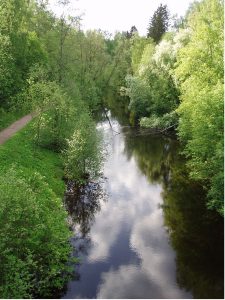
The Tourujoki river which flows mostly in a deep valley belonged once to the southernmost parts of the water route called Jyväsjoki. Picture: Juan Ramirez/Wikimedia Commons.

Luckily, I was able to find a description of the length and course of the Jyväsjoki river in a book published in 1863 and written by Claes Wilhelm Gyldén, the superior director of the Finnish Forestry and Geodesy Board. Gyldén also published a map depicting Finland, and his map contained even a visualisation of the course of Jyväsjoki. Apparently, the river was approximately 35 kilometres long, and it ran through several lakes before it reached Jyväskylä and Päijänne, the longest lake in Finland. The idea that a river runs through several lakes and keeps its name felt quite unfamiliar, so I checked several dictionaries and etymological dictionaries, and I even took a closer look upon the Finnish legislation and its definitions. It appeared that there is no universal definition regarding what actually a river is. For those early hunters, fishers and settlers who came to Central Finland in the Middle Ages, it was convenient to use just one name when they were, in fact, referring to a longer water route leading from Päijänne to the north. It did not matter them that they occasionally passed water bodies which also could be spoken of as lakes. Problems arose only when the permanent settlement which formed along the water route had to be separated from the water route itself as a concept of its own. For the descendants of the settlers as well as for later-day settlers, it was more natural to regard lakes as start and endpoints for individually named rivers. Consequently, the water route once spoken of as Jyväsjoki is nowadays spoken of as a series of several rivers and lakes, the above-mentioned Tourujoki, Luonetjoki and Köntysjoki being some of the names given to shorter sections of the route. Most likely, these alternative names were used already when Gyldén published his book and his map.
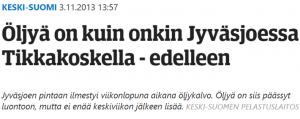
After a leakage from a sewer, a headline in the local newspaper Keskisuomalainen, published in Jyväskylä on 3 November 2013, stated that there was still oil in the Jyväsjoki River in Tikkakoski, a community approximately 17 kilometres northward from the Jyväskylä centre. This is a rare example of the use of the old name Jyväsjoki in modern contexts. It has not appeared in local newspapers during the last years, but at least birdwatchers use it occasionally when they report their observations in the Tikkakoski area.

Regarding the blurred memory of Jyväsjoki, I have suggested to the Museum of Central Finland that it could collect still existing oral history regarding the name. Perhaps there are still some chapters of the story of Jyväsjoki which have not been told yet.

I have treated the problem of Jyväsjoki more detailed in my article (in Finnish) in Lähde – historiatieteellinen aikakauskirja . There are not so many works written in English and dealing with the history or geography of the Jyväskylä region, but those who are interested in Finnish rivers or Finnish geography in general can utilise the Map Site of the National Land Survey of Finland.



Posted in Research | 2 Comments

River: an erroneous concept

Picture of author in front of a mountainous landscape

Mikel Calle Navarro, PhD
TSCMT Post-doctoral researcher at the Department of Geography

Before you keep reading, please think for a moment the scenery the word ‘river’ evokes to you… Does it include a flowing water line with green trees on sides, swimming fish or some other animal drinking water from it? Did your picture resemble the one in Collins’ dictionary? “A river is a large amount of fresh water flowing continuously in a long line across the land”.

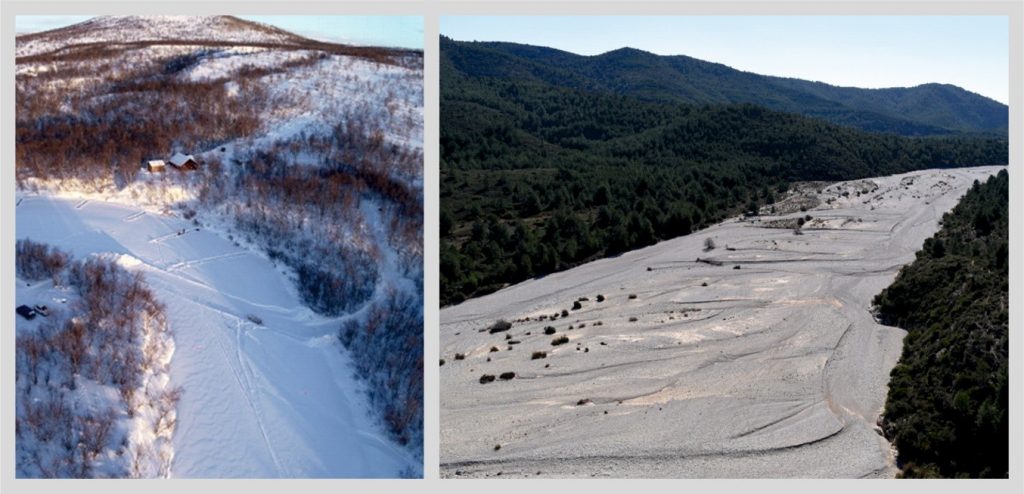
Here you have two pictures (Figure 1), on the left a river covered by a thick ice and snow layers, on the right a river completely dry. Does your mental scenery for ‘a river’ -or the Collin’s- fit with some of these pictures? So, the question is, what do they have in common?


Figure with two pictures of rivers that differ from the dictionary definition of river mentioned in the text.

Figure 1: Pulmanki River, Finnish Lapland (left, photo by FCRG) and Rambla de la Viuda River, Valencia, Spain (right, photo by FloodsRG)

Ok. Let’s start.

Rivers are spread all over the world. They bring many services to the present society: drinkable water, food (and jobs-related), a recreational space for both sailing or swimming, an aesthetic landscape to put on Instagram, and many others. They also provide a source of energy (e.g. hydro-power), irrigation for our croplands, industry and farms. In a few words, we rely on rivers all over the world to bring such a precious treasure: WATER. Continue reading

Posted in Personal thoughts, Research | Tagged , , | 2 Comments

Embracing the New Year in the Midst of Seasonal Darkness

Lihua Sun

Lihua Sun, post doctoral researcher at the Turku Collegium for Science, Medicine and Technology

I sincerely wish everyone a happy new year! The 2020 was extraordinary, particularly shaded by the pandemic. Normal academic life is challenged, but it seems not to be only negative. For instance, several my colleagues expressed higher effectiveness in remote working including mentoring and writing. On my side, working remotely seems to be ideal since I can flexibly arrange my work hours while helping with family members. Nevertheless, somewhat lack of social life sounds depressing for many people, not to mention other challenges like unemployment or loss of close ones. Beyond all consequences of the pandemic, however, I would like to raise my concern for winter blues which may also greatly affect sociality and joyfulness.

We are still in the darkest wintertime, where emotionally down with less motivation for social interactions (maybe also sleeping too much, little to no energy, or eating too much) characterizes the winter blues, or known as the seasonal depression. You may be surprised that, in Finland, winter blues or its sub-syndromes affect over one third of the population. Causal factors for it include the short daylength, and the first-in-line choice for treatment is light therapy. Daylength in southern Finland ranges seasonally from 6 till 20 hours (or 7 till 23 hours when counting the morning and evening twilight). Darkness is a prominent character of the Finnish winter, since it lacks daylight plus the mostly cloudiness. While darkness often accompanies bad emotions that we may subjectively feel, my recent study highlighted one brain mechanism potentially explaining it, i.e., seasonal variation in socio-emotionally important brain neurotransmission.

Continue reading

Posted in Personal thoughts, Research | Leave a comment

Lignin – the new petroleum?

Picture of author Lokesh Kesavan

Lokesh Kesavan
TCSM Postdoctoral researcher
Materials Chemistry and Chemical Analysis

The world has been heavily dependent on fossil geo-resources for its scientific exploration and material progress, so far. Due to fast depletion, non-renewability, and increased carbon foot prints of fossil geo-resources, there is a need for technological maneuvers to combat the scarcity of resources, pollution, and unsustainability. This is also one of the key themes in sustainable development goals. Researchers around the world have started looking at new possible resources in nature, and have identified bio-resources, especially forests, as the next treasure houses. Though forest products research has been in practice since long ago, it has not gained momentum with petroleum reservoirs still providing raw materials easily and cost effectively.  However, after the advent of new buzzwords like ‘climate change’, ‘sustainability’ and ‘circular economy’, the focus on bio resources and utilizing them in an eco-friendly way has grown multifold in recent years. Continue reading

Posted in Research | Tagged , , , | Leave a comment

Should research always be “useful”? A case for fundamental science, by Sophie Reichert

Picture of author Sophie Reichert

Sophie Reichert
TCSM Collegium Researcher
Ecology and Evolution Biology

This question came up with a friend and fellow researcher recently. She had just given a public lecture on her topic of research in ecology and was asked why her work was important /relevant / useful. As researchers this is quite a recurring question from people, especially for those of us working in fundamental research. Fundamental research is usually a curiosity driven investigation; most of the time, it is motivated by a gap in knowledge about something. Quite simplistically, in opposition to fundamental research is applied research, which in theory focuses on filling a need established prior to the start of the project. More basically, fundamental research wants to elucidate “why is this phenomenon important”, whereas, applied research will focus more on “how can I use this?”. Given these descriptions, applied research seems more valuable, especially since resources and efforts are often limited—after all, applied research attempts to offer practical solutions to some of the most pressing issues, including epidemics, food shortages, pollution, etc. But, as stated in (UNESCO, 2015), “basic science and applied science are two sides of the same coin, being interconnected and interdependent”.

Unfortunately, the viewpoint that applied research is superior / more valuable than fundamental research is prevalent and quite common. As most part of scientific research is funded by governmental grants (i.e. public funds), public opinion has a very strong influence and gives great importance over the allocation of funding to and in science. As a result, when fundamental research is perceived as ineffectual and/or frivolous, this perspective influences legislators and funding agencies to reduce funding to fundamental research. Continue reading

Posted in Personal thoughts, Research | Tagged , , | Leave a comment

NOT, ketterä teleskooppi, kirjoittajana Erkki Kankare

Picture of author Erkki Kankare

FT Erkki Kankare
Kollegiumtutkija, TCSM
Fysiikan ja tähtitieteen laitos

Covid-19 pandemian aikana sosiaalisten lähikontaktien vähentäminen on tärkeää koronaviruksen leviämisen ehkäisemiseksi. Turun yliopistossakin henkilökunta on yhä pääsääntöisesti etätöissä, jos se työtehtävien puolesta on mahdollista. Aikaisemmin keväällä parin kuukauden ajan päällä oli kattavampi “lockdown”. Tutkijoille koronavirukseen liittyvät rajoitukset vaikuttavat tutkimusaineiston hankintaan mitä erinäisimmin tavoin. Omalla tähtitieteen alallani tukimusdatani on havaintoja ammattilaisteleskoopeilta. Tutkimukseni keskittyy niin sanottuihin tähtitieteellisiin transientteihin, havainnoillisesti päivistä vuosiin kestäviin ilmiöihin, jotka liittyvät täydelliseen tai osittaiseen tähden tuhoutumiseen, kuten supernovaräjähdykseen joka päättää tähden elinkaaren. Supernovaräjähdykset ovat hyvin kirkkaita ja niitä voidaan tutkia muista galakseista. Johtuen supernovien verrattain nopeasta evoluutiosta niiden tutkimus vaatii toistuvia monitorointihavaintoja verrattain usein muutosten seuraamiseksi yli pitkienkin aikaskaalojen. Täten supernovien havainnot hyvin tyypillisesti tehdään ns. “service” muodossa, jossa teleskoopin henkilökunta suorittaa havainnot tutkijoiden valmistelemien tarkkojen ohjeiden perusteella – näin siis jo ennen Covid-19 pandemiaa. Continue reading

Posted in Personal thoughts, Research | Leave a comment

Fieldwork in biology during the COVID-19 pandemic by Antoine Stier

PhD Antoine Stier
TCSM Postdoctoral Researcher
Ecology and Evolution Biology

The ongoing COVID-19 pandemic has a strong impact on our everyday life, forcing us to adapt both our personal and professional lives. Many academics now face the challenges of getting used to remote working, but many tasks remain impossible to conduct from home. While essential empirical work can still be conducted within research premises in most Universities, conducting work outside the laboratory (i.e. in the field) incurs some specific challenges. Biology researchers within the University of Turku  are not only conducting fieldwork in Finland, but also in various places around the world ,such as in South-America for studying the Amazonian forest, Myanmar for studying Asian elephants or some remote French sub-Antarctic islands (Crozet Archipelago) for studying king penguins in my case.

While many countries cancelled most fieldwork-related activities last spring (an unfortunate timing considering that many field activities are restricted to a narrow time-window during this season), we have been relatively lucky in Finland to have the possibility to conduct minimum to normal fieldwork activities thanks to a relatively quiet COVID situation and support from our institutions. However, conducting fieldwork abroad has mostly been cancelled and is continuing to be cancelled (for very valid reasons), incurring the inevitable loss of precious data. Continue reading

Posted in Personal thoughts | Leave a comment

Motivation across a transition by Heta Tuominen

Collegium Researcher (TIAS) Heta Tuominen

Once again students have returned from summer holidays back to school and started their academic years. Some of them (including my daughter, by the way) are starting off their sixth, that is, the final year in elementary school and, thus, approaching the transition to lower secondary school (grades 7–9). Studying young people’s motivation and well-being in school is, in my view, always relevant, but could it be especially important across such an educational transition period in early adolescence.

Yes, it seems so. Previous studies show that an overall negative change in academic motivation takes place during early adolescence and that this decline is most pronounced during educational transitions. Also, negative changes have been seen in adolescent students’ school-related well-being. That is to say, educational transitions can indeed pose a risk for adolescents’ academic motivation and well-being.

In our recent study (Tuominen, Niemivirta, Lonka, & Salmela-Aro, 2020), we looked precisely into this by investigating 1) what kinds of motivational profiles can be found among sixth- and seventh-graders, 2) how do these profiles change across the transition from elementary to lower secondary school, and 3) how they are linked to well-being, in this case, school engagement (how engaged a student is in schoolwork) and school burnout (how exhausted, cynical, or inadequate a student feels in relation to school demands). Continue reading

Posted in Research | Tagged | Leave a comment

Pohdintoja tutkijanuran vaiheista, kirjoittajana Teemu Niiranen

Henkilökuva kirjoittaja Teemu Niirasesta, ylävartalo ja kasvot näkyvät.

Dosentti Teemu Niiranen
TCSM kollegiumtutkija
Kliininen laitos, sisätautioppi

Lääkäritutkijan uralla otetaan monia askelia, joista kaikki eivät aina välttämättä tunnu askelilta eteenpäin. Kliinisen erikoistumisen jälkeen yleistietämys omasta erikoisalasta on parhaimmillaan, minkä jälkeen aletaan usein keskittymään hallintotehtäviin sekä yhä kapeampiin lääketieteen osa-alueisiin. Tutkijan uralla tilanne on usein samankaltainen. Väitöksen jälkeisen post doc -jakson lopussa tutkija on usein tehokkaimmillaan, kun hän pystyy oleellisimmat tutkijan taidot opittuaan keskittymään 100-prosenttisesti tutkimustyöhön.

Mikäli tutkija kuitenkin perustaa post doc -jakson jälkeen oman tutkimusryhmänsä, työpäivän sisältö ei yleensä olekaan enää entisen kaltainen. Varsinainen tutkimustyö, eli ainakin omassa tapauksessani datan tuottaminen, analysointi ja raportointi, onkin muuttunut loputtomiksi puhelinkokouksiksi, budjettien laatimiseksi ja henkilöstöhaasteiden ratkomiseksi. Continue reading

Posted in Personal thoughts | Leave a comment

Explaining quantum physics with arts and games by Matteo Rossi

Author Matteo Rossi faces forward infront of a blackboard. Head and torso are visible.

Author PhD Matteo Rossi
TCSM Postdoctoral Researcher
Turku Quantum Technologies group

This post is about one aspect of our job as scientists that we often tend to neglect or avoid as much as possible but plays a very important role towards the society: outreach. Outreach is a challenging task, as it requires us to rethink our everyday work from the perspective of someone completely new to the topic, to communicate the relevance of your research engagingly, to explain in a few minutes concepts that you learned in years of studies and training.

Some topics are particularly challenging, as they are so far from common experience. With these, the hardest part is to find a way to give an intuitive description of the phenomena that happen, and this is exactly the case I’ve been facing in explaining quantum mechanics.

Quantum mechanics was formulated a century ago to explain the physics of the microscopic constituents of matters, such as atoms, molecules or photons. While it is a clear, sound mathematical construction, that can predict experimental results with high accuracy, it is well known for being a difficult topic to understand. Continue reading

Posted in Personal thoughts, Research | Tagged , , , , | Leave a comment