Classics in Time of Pandemic: Lock-down Reflections from the Ivory Tower by Michiel Meeusen

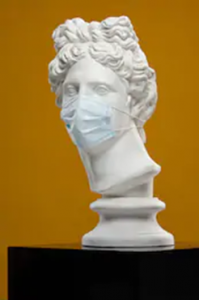
Bust of Apollo Belvedere wearing a mouth mask © Shutterstock

Western literature starts with a disease. At the beginning of the Iliad, Homer sings of an “evil pestilence” (1.10) sent by the Olympic god Apollo to devastate the camp of the Greeks during their siege of Troy. Apollo, the god of medicine and healing (among other specialisms), could bring ill health and deadly plague with his arrows too. It is this darker side that the Greeks get to face: “his coming was like the night” (1.47).

The Trojan war has been dragging on, non-stop, for almost a decade now but is about to enter its decisive phase. Unsurprisingly, the morale among the Greeks is at an all-time low, war-wearied, traumatized, and homesick, as they have become. An extremely irritable situation even for the noblest Greek hero. Add an epidemic to this epic mess and see what happens. (Homer’s thoughts, not mine.)

To give you some context. The angry god mainly targeted his plague arrows at Agamemnon (the Greek general), who had dishonoured Chryses (Trojan priest of Apollo) by scornfully rejecting the glorious ransom he offered in exchange for his captive daughter Chryseis (now Agamemnon’s personal booty). Long story short: Agamemnon eventually gives in to the plea of the assembled Greeks to release Chryseis and appease Apollo. After all, he “would rather the people be safe than perish” (1.117). Subsequently, he confiscates Briseis, the sweetheart of Achilles, thus triggering the next crisis. Great leadership for sure! Continue reading

Posted in Personal thoughts, Research | Tagged , | Leave a comment

Pascal’s Wager for Climate Denialist by Hemmo Laiho

TIAS Post-doctoral researcher Hemmo Laiho

Blaise Pascal (1623–1662), a famous French mathematician, is also famous for a philosophical slash theological slash game-theoretical thought experiment known as Pascal’s wager. You can find the thought experiment in the section §233 of the collection of his notes titled as Thoughts (Pensées, originally published 1670) and from many secondary sources. Skipping details and nuances and already adapting the original version for my purposes, the experiment goes roughly as follows.

You cannot prove by reasoning whether God exists or not, but you can legitimately think what consequences there would be if you believed in God and acted accordingly or if you did not. You can also speculate about the gravity of these consequences in two opposing scenarios, in one of which there is God and in the other of which there is no God. You end up facing four options and possible results: (1) If you are a true believer and God exists, it can be expected or at least supposed that your gain is enormous or indeed infinite (eternal rejoice, you know). (2) If you are an unbeliever and God exists, then you risk infinite gain, possibly facing infinite loss (perhaps you are not allowed in Heaven). (3) If, on the other hand, you believe in God but God does not exist, it can be supposed that you end up limiting your choices in this life, whereas (4) as an unbeliever you would gain more. Such mundane things, however, are disproportionate to infinitely good and infinitely bad, which is why it is rational for you to opt for the first alternative, that is, to believe in God and act accordingly. Continue reading

Posted in Research | Tagged , , | Leave a comment

Where has winter gone !?…..Is climate crisis knocking at our doors? by Lokesh Kesavan

Lokesh Kesavan

Lokesh Kesavan, TCSM Postdoctoral Reseacher, Department of chemistry

By this time, most of us realized that, something is abnormal in the environment and in the climate due to absconding snowy, cold, sub 0 ℃ weather, which is hallmark condition of Finland during the months, December-March. This raises everyone’s eyebrow with a common question ‘where has winter gone?’ This winter seems to be very warm and all the snow which was about to fall, has gone melted in the sky already and falling as rain. Most importantly, the depressing darkness is completely vanished away from the scene during the daytime. There are people who like unusual warm weather in winter season, but most of the Finnish people like regular bone chilling cold weather. However, what everyone would like to have is the bright sunlight during the daytime of the winter season, which we have been gifted this year by the nature. Wait a minute! Is this truly a life enriching gift or the beginning of disaster? Is climate change crisis finally knocking at our doors? These questions have to be contemplated seriously by meteorologists and other scientists, also by climate change denying politicians. Continue reading

Posted in Personal thoughts | Leave a comment

How to thrive and keep sane in academia? Looking back to my 2+ years in TIAS by Minna Santaoja

TIAS Alumni Dr. Minna Santaoja

TCSM postdoctoral researcher Nicolino Lo Gullo brought up the issues of mentoring and mental health of academics in his recent post to TIAS/TCSM blog. These are issues I want to pick up as well, as I summarize my experiences in TIAS.

I was working as a postdoctoral researcher in TIAS from October 2017 to the end of 2019. It was wonderful and horrible time. The timing of the TIAS position was perfect, as I had just finished working in an Academy of Finland funded project on sustainable diets (POPRASUS) and did not know what, or rather where, I was going to do next. It was a self-esteem boost, at first, being a collegium postdoc, one of the selected few. But soon came the hangover and the familiar impostor syndrome kicked in. I was supposed to be doing some sort of top-notch research, but I was struggling to get any writing done at all. I had let the competitivity and the misplaced emphasis on publication metrics crawl under my skin. Continue reading

Posted in Alumni, Personal thoughts | 2 Comments

Crystallography, a (tragic) love story by Pedro Dinis

Pedro Dinis, TCSM Postdoctoral Reseacher, Department of Biochemistry

Given free-reign by the Turku Collegium of Science and Medicine to write about anything made the choice of topic quite easy, as macromolecular crystallography has accompanied my budding scientific career. It also comes at a critical juncture in the field with the emergence of cryogenic electronic microscopy (Cryo-EM).

Two parts science, one part art

A young researcher eagerly enters a lab for the first time. His goal a simple affair, to crystallize a protein. He manages to get his protein both as pure and as concentrated as possible. The future is looking bright. But, what is the next step?

One could scour the literature regarding the topic of protein crystallization, without finding the precise way to do so. And the reason is not some cabal of old scientists gate-keeping future generations, but a simpler explanation: there is no exact way to lead a protein to form crystals. Each protein is as each individual, a unique, special snowflake. All that researcher has, as indeed we all do, are simple guidelines. You need to mix the protein with SOMETHING that will lead it to a controlled precipitation, i.e. crystal formation, instead of uncontrolled precipitation (think of curdling milk). Because the Universe is vast and full of SOMETHINGs, the best the scientific community has to offer is mixtures of salts, buffers and other precipitants that were previously shown to crystallize a protein (crystallization screens). Continue reading

Posted in Research | Leave a comment

No snow for skiing – a real problem or not?

Ilkka Heinonen, Academy Research Fellow and former Collegium Researcher, Faculty of Medicine, Turku PET Centre

It should be winter time and many people would love to ski, but there is currently simply no snow for skiing. Luckily this is not a problem as we have ski tunnels, such as one in Paimio very close to Turku. Even people from Helsinki region drive there during the weekends to enjoy skiing.

Cycling pathways are now often icy and have sand and even small rocks, but skiing can also be done with roller skies. Impivaara in Turku is great place for this even if there is no snow. Too few skiers go there, but everyone should try!

Any physical activity such as walking or cycling is good for our health, but cross-country skiing appears to be especially good exercise for us. Even science supports that cross-country skiing is associated with lower incidence of diabetes and hypertension, and ultimately even lower all-cause mortality. A recent study published in Psychiatric Research also indicates that people who participate in long-distance skiing events such as Vasaloppet have lower incidence of depression, as well as low all-cause mortality. Continue reading

Posted in Alumni, Personal thoughts, Research | 3 Comments

A Holocaust Scholar in Finland by Helena Duffy

Collegium Researcher Helena Duffy

TIAS meeting, 13th January 2020. ‘What is your research project about?’ ‘What interesting thing happened to you during your recent holidays?’ These are two of the four questions to be answered during the ‘Speed Dating’ exercise. Lasting four minutes (two minutes for each person), the exercise is designed to integrate the new arrivals into the existing cohort of TIAS scholars. The people I talk to all explore questions highly pertinent to the current social and environmental crises: effects of early stress, ethics of procurement, the destruction of the primeval forest in Poland… In this context, my own ghosts of terrified and exhausted women clutching their exhausted and terrified children on the ramp at Auschwitz seem remote to the point of being unreal. But the vision continues: soldiers are barking orders in an incomprehensible language and, held on short leashes, dogs are yelping. Is it how it happened or is it how I remember it from Spielberg’s Schindler’s List? ‘I study cultural representations of Jewish mothers during the Holocaust,’ I recite in front of each new person I introduce myself to. ‘I focus on how motherhood shaped women’s experience of Nazi persecution and how the mothers’ difficult choices are judged by literature.’ Even though in Finnish the term for the Nazi genocide of the Jews is almost the same as in English, I glimpse confusion on my interlocutors’ faces when I pronounce the word ‘Holocaust’. Is it because of the noise that fills the room as some forty people are trying to talk simultaneously and we can hardly hear our own thoughts? Or is it because the Holocaust is something that ‘didn’t happen in Finland’, as the Finnish Wikipedia page ‘Holokausti’ proudly announces. So as not to jeopardise the military cooperation between Berlin and Helsinki, Heinrich Himmler gave up, at least for the moment, on pursuing Finland’s Jews. Out of the 350 Jewish refugees who had sought shelter in Finland, only eight were deported. ‘Only’ or, should I say, ‘as many as’ eight? Continue reading

Posted in Research | 3 Comments

Tiedettä ja taidetta koetusta ajasta (Valtteri Arstila)

Collegium-tutkija Valtteri Arstila

Miksi tulevaisuus on edessämme ja mennyt takanamme? Milloin katse tulkitaan vihjailevaksi tai tuijotukseksi? Mistä syntyy varsin yleiset ajatukset nykyhetken erityisyydestä ja ajan virtaamisesta, jos kerran nykyfysiikan mukaan nykyhetki ei ole mitenkään erityinen ja aika ei virtaa?

Nämä ovat esimerkkejä kysymyksistä, joita olen käsitellyt kohta päättyvässä TIAS-tutkimusprojektissani. Sen yleisenä teemana on ollut subjektiivinen aika, eli se kuinka koemme ja käsitteellistämme ajan ja ajalliset ilmiöt. Olen lähestynyt tätä teemaa niin metafysiikan, mielenfilosofian kuin psykologisten tutkimustulostenkin kautta, painottaen erityisesti subjektiivisen ajan moninaista luonnetta. Toisin kuin jaettu tai objektiivinen aika, subjektiivinen aika on mukautuva: hyvässä seurassa aika rientää ja tylsistyneenä se matelee. Subjektiivinen aika on täynnä katkoksia, se auttaa meitä ymmärtämään asioiden välisiä syy-seuraussuhteita ja näyttelee keskeistä roolia siinä, milloin ilahduttava hymy muuttuu epäilyttäväksi. Continue reading

Posted in Personal thoughts | 1 Comment

Mentoring the mentors by Nicolino Lo Gullo

Nicolino Lo Gullo, TCSM Postdoctoral Researcher, Department of Physics and Astronomy

I am at that stage of the academic career in which I cannot consider myself a young scientist but I do not think of myself as a senior researcher neither. It is true that now I feel more comfortable with the basics of being a researcher such as identifying new problems, generating ideas, collaborating with colleagues, and writing papers to disseminate results of my research. As anyone else, I have learned how to handle all this over the years, mostly by looking at more senior scientists and, no need to say, making many mistakes.

One of the duties that a young scientist undertakes in the attempt of climbing the academic career is the supervision of students, and of PhD students specifically. Usually everything starts when we are asked to help a student in our group. Suddenly we become the reference for the student and without being completely aware of it, we start guiding the student in the tortuous path of the PhD. Are we ready for it? Most likely not, but nevertheless we embark on this venture. Continue reading

Posted in Personal thoughts, Research | 1 Comment

TIAS and Scholars at Risk by Kimi Kärki

Kimi Kärki, Post-doctoral Research Fellow at TIAS

Scholars at Risk (SAR) is an international network of academic institutions, organised to support and defend the principles of academic freedom and to defend the human rights of scholars around the world. It is coordinated from the United States of America, originally established in University of Chicago in 1999, and nowadays based in New York University. The network membership now includes more than 500 academic institutions in 39 countries. Scholars at Risk also maintains affiliations and partnerships with other associations and organizations with related objectives, including e.g. Academy for Research and Higher Education, Catalan Association of Public Universities (ACUP), Colonial Academic Alliance, Communauté Université Grenoble Alpes, Compostela Group of Universities, Consortium for North American Higher Education Collaboration (CONAHEC), European Students Union (ESU), European Universities Association (EUA), International Migration, Integration and Social Cohesion (IMISCOE), Magna Charta Observatory, Swissuniversities, Swiss Academies of Arts and Sciences, and Network of Universities from the Capitals of Europe (UNICA). Continue reading

Posted in Personal thoughts, Research | Leave a comment