The following caption of Ricky Gervais analyzing the difference between science and religion (taken from here https://www.youtube.com/watch?v=KOi2AgNfQCg) is widely used in memes around the internet.
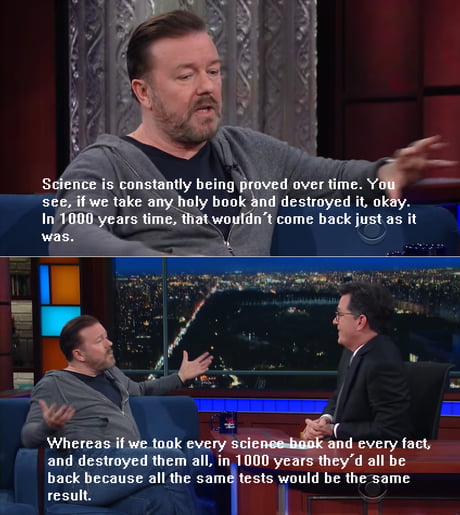
I appreciate that Ricky Gervais speaks for science and does so in an eloquent and intuitively compelling manner. However, I want to make some (critical) comments on the topic:
First of all, what is known as the modern science came into existence somewhere between 1500 and 1800. As historian Richard S. Westfall writes:
[The] question [about the scientific revolution] is whether the enterprise of science as it was carried out after 1687 was radically different from that before 1543. Clearly, I think that it was and that the transformation was a once and for all event that has never been reversed. Scientists of today can read and recognize works done after 1687. It takes a historian to comprehend those written before 1543. (2000, 44).
Clearly, the “books of science” have not been similar to what they are today in the long history of human civilizations if we are not even able to read 500 years old books. This indicates that the modern science is not something that can be achieved independently of specific historical conditions and chains of such conditions. There is no guarantee that, if there was some kind of (epistemological) apocalypse, that science would come back in 1000 years (if ever). There have been many millennia when modern science simply did not exist.
Surely, Gervais is arguing that if we had an experimental science in the post-apocalyptic future, then we would achieve the same results. However, there have been many unsuccessful experiments, and there seems to be no guarantee that we must learn to perform experiments correctly and make correct inferences on the basis of them. For example, I could have an experimental tradition where I investigated whether horoscopes are true. I would read a statement that “if you keep your mind open, you will learn something important” and then make an experiment: I walk with an open mind and learn that my neighbor is a Chelsea-fan. This “experiment” would then confirm my theory, and the books of science would be filled with astrology. The point here is that experiments alone don’t do much if we are not adequately arranging other aspects of our epistemology (if we do not understand the idea of falsification, for example).
The point Gervais is making seems to be that, given that we have a successful experimental science, then the results must be what they are. This is in fact how the question “Could we have a different science?” is understood in the so called inevitability vs. contingency debate (e.g. Hacking 2000, Soler 2008, Kinzel 2015, Virmajoki 2018): We ask “Could there exist a science that is fundamentally different but equally successful as the actual science?” and if the answer is no, then science is inevitable. No consensus exists on the answer. Neither is it clear how that question could be answered. (See Soler et al 2015).
There are (at least) two major arguments against the inevitability of science.
First, the so called “argument from underdetermination” says that, given a set of evidence, we can formulate competing theories that are supported by that evidence. A version of this argument is directly about the nature of experiments: given that we use somewhat complex instruments and given that we need to make “auxiliary assumptions” to infer an observable consequence from a theory, a negative result from an experiment does not tell us whether our theory is false or whether the experiment and the inferences associated with it went wrong. A toy example: If I guess I have lost some weight and then I stand on a scale that shows that I have gained some weight, it is completely possible that the scale does not work adequately. Given that tests are very difficult to perform and interpret, it simply is not true that the same tests provide the same results. It is very common that scientist debate how an experiment should be conducted and interpreted.
Secondly, the so called “pessimistic metainduction” (Laudan 1981) says that there were successful theories in the past that were false. It follows (the argument continues) that our successful theories can be (or probably are) false. And if our theories can be false but successful, in 1000 years after the apocalypse, there could be a different but successful science, the one that is correct and captures the reality.
All this indicates that after an apocalypse, science might not come back in the same form as we have it now. And even if did, it is not clear whether religion would not. Take the Bible for example. Probably no book in 1000 years would have the exactly same stories as in the Bible, given the historical descriptions within the stories. However, there could be a book that shares the same worldview and moral lessons. Perhaps monotheism is a consequence of our psychological relationships between father-figures and, given that in the societies of the post-apocalyptic future those relationships exist, monotheism would occur. It could also be the case that our moral code has some deep evolutionary wiring and would be coded in the sacred books in a similar form as it is in the Bible. Perhaps ideas of omnipotence, transcendence etc. are some sort of cognitive noise that is produced by our cognitive system. I do not claim that these suggestions are true; but an argument can be made that also religion would come back in a similar form after an apocalypse. And if so, the difference between science and religion lies not in their inevitability and contingency.
Surely, it is possible to argue that even though both science and religion came back after the apocalypse, they would come back for different reasons: Whereas religion is based on ideas that we born with or are shaped by cultural structures, science would take its form due to the influence of the nature – here we have “the pull of the nature intuition”. I think that there is something appealing in this argument but the details are difficult to fill in. The “pull of nature” idea is too simple and it is not clear how to distinguish between the ways in which science depends on culture and the way in which religion depends on culture. In my view there probably is a difference, but I do not have the guts to claim that I can formulate it.
We have seen that optimism towards the recovery of science from apocalypse is not justified. We should not defend science and its importance as a worldview and practice with arguments that are easily questioned – the value of science does not depend on what would happen in 1000 years after an apocalypse.
All this indicates that we need much more nuanced picture of why science works and how it differs from religion. A picture that relies solely on the fact that scientist make tests does not explain how we have been able to achieve a successful science that is a good candidate to be a (somewhat) correct description of (some aspects of) reality.
References:
Hacking, Ian (2000). “How inevitable are the results of successful science?”. Philosophy of Science 67 (3). 58–71.
Laudan, Larry (1981). “A confutation of convergent realism”. Philosophy of Science 48 (1):19-49.
Kinzel, Katherina (2015). “State of the field: Are the results of science contingent or inevitable?”. Studies in History and Philosophy of Science Part A 52.
Soler, Léna & Trizio, Emiliano & Pickering, Andrew (2015). Science As It Could Have Been. Discussing the Contingency/Inevitability Problem. University of Pittsburgh Press.
Soler, Léna (2008). “Revealing the analytical structure and some intrinsic major difficulties of the contingentist/inevitabilist issue”. Studies in History and Philosophy of Science Part A 39 (2). 230–241
Virmajoki, Veli (2018). “Could Science Be Interestingly Different”. Journal of the Philosophy of History 12 (2). 303-324.
Westfall, Richard S. (2000). ”The Scientific Revolution Reasserted”. In Osler, Margaret J. (ed.) Rethinking the Scientific Revolution. Cambridge University Press. 41-55
One thought on “Ricky Gervais, the pull of the nature and the inevitability vs. contingency of science”