
Adolescent mental health research is now more global than ever, but critical gaps remain

Yuko Mori and Xiao Zhang
Adolescence is a critical period for mental health, shaping well-being into adulthood. Cross-national research can provide valuable insights into both universal patterns and context-specific challenges especially when the data is representative and the tools used are culturally sensitive.
Our new systematic review, published in BMJ Global Health on 25 July 2025, looked specifically at cross-national research on adolescent mental health that includes low- and middle-income countries (LMICs).
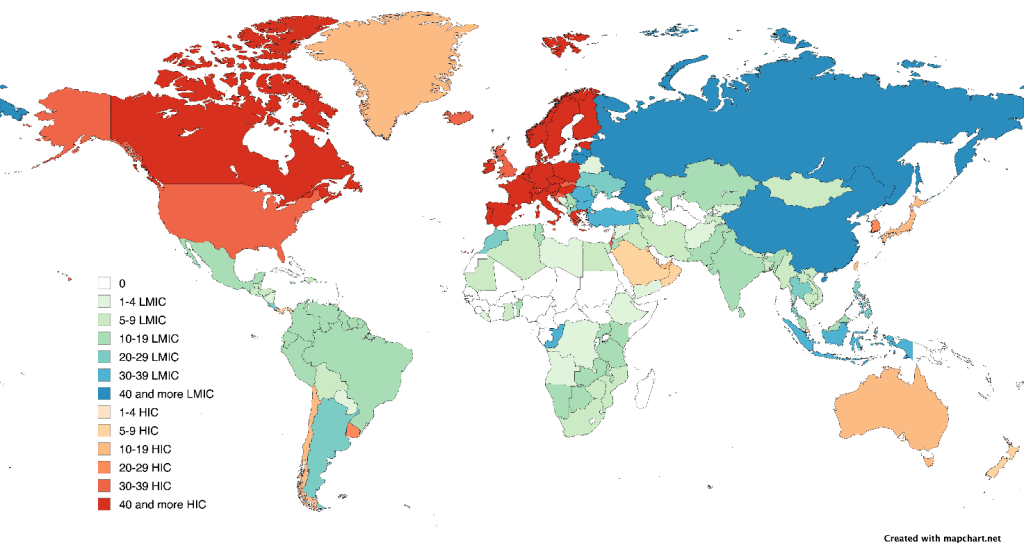
We analysed 172 studies covering over 12 million adolescents from 166 countries, each including at least one LMIC. The good news is that there has been rapid increase in cross-national research involving LMICs over time, especially after 2020. At the same time, 52 countries were not represented in any of the studies we reviewed. Most of these were in Sub-Saharan Africa (27 countries) and the Pacific region (8 countries).
What kind of research have been done so far?
We found out that there are three large-scale international surveys that dominate cross-national adolescent mental health research:
- Health Behaviour in School-aged Children study (HBSC): used in 19.8% of studies
- Global School-based Student Health Survey (GSHS): used in 12.2% of studies
- Programme for International Student Assessment (PISA): used in 8.1% of studies
These surveys have contributed enormously to building a global picture of adolescent well-being. At the same time, most existing research relies on cross-sectional, school-based surveys and self-reported questionnaires.
While these survey research have limitations, such as capturing only one point in time, excluding out-of-school adolescents, and relying on potentially biased self-reports, they are relatively low-cost, efficient, and easy to administer across countries.
This makes them hugely valuable for generating large-scale, cross-national data, especially in LMICs where resources for longitudinal or clinical studies might be limited.
Bullying and internalising problems (such as anxiety and depression) are among the most frequently studied topics. In contrast, externalising behaviours – including aggression, impulsivity, or conduct problems – are often overlooked, despite their significant role in adolescent development and well-being.
A Western lens in a global context
One striking finding was that many mental health measurement tools used were originally developed in Western countries. While these tools are widely adopted, their validity and cultural relevance in diverse settings remain uncertain.
This raises a crucial question: are we truly measuring adolescent mental health in ways that reflect different cultural realities?
Every adolescent, regardless of where they live, deserves equitable access to mental health care. Our findings suggest strong progress toward a more inclusive global evidence base, with LMICs increasingly represented in cross-national mental health research.
Strengthening collaboration, improving infrastructure for data collection, and supporting culturally grounded approaches can help extend this momentum even further.
By understanding mental health through diverse cultural perspectives, we can move beyond one-size-fits-all definitions and uncover richer, more complex patterns that shape adolescents’ lives, providing a solid foundation for their development and a brighter future.
Writers:
Yuko Mori works as Postdoctoral Researcher at the Research Centre for Child Psychiatry
Xiao Zhang is a Doctoral Researcher at the Research Centre for Child Psychiatry