SLT historical linguistics seminar 13.5 – Winding through the dusty deserts of a lush philology, pt 1

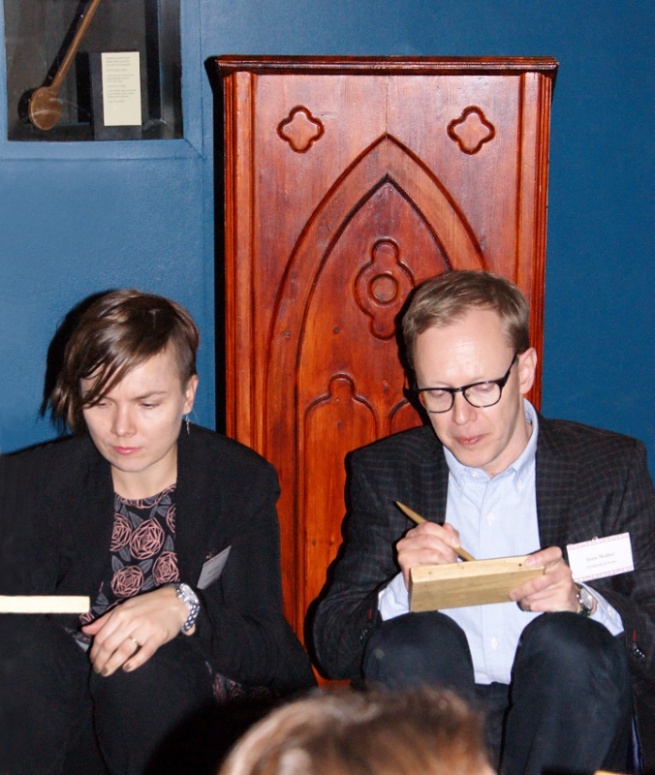
What games of chance did the ancient Romans play? What role did Latin have to play in fifteenth-century England? Can a portion of medieval street names in Turku be seen as loans from Baltic Sea region city plans, and to what degree do they draw their names from their context and functions, like a nearby market square? Could eighteenth-century runes in the Dalarna region in Sweden contain Finnish? What were the characteristics of a good book in the prologues of sixteenth-century English translated literature? Here are some examples of the questions discussed in the historical linguistics seminar of the UTU School of Languages and Translation Studies on May 13th 2016. We were many and the discussion was fruitful! Some key areas of research that were presented included multilingualism, paratextuality, historical onomastics, as well as vocabulary research and language contacts.
Sorolainen's Postilla 1625. Commons Wikimedia, University of Helsinki

Multilingualism is a concept relevant to the research of Delia Schipor, Sara Norja, and Tuomo Fonsén. Schipor was visiting from the University of Stavanger, Norway, and her study focuses on the shift from Latin to English in documentary writing in late medieval England. She studies the interplay and relative proportions of English, Latin, and French in documentary texts, and explores the possible links between genre and code choice. This same shift into English, or the process of vernacularization (becoming native-like in language), but in scientific texts, is the object of Sara Norja’s doctoral study in the Department of English. She is making a digital edition of ten manuscript versions of an English alchemical text, The Mirror of Alchemy, from the fifteenth to the seventeenth centuries. She will examine the similarities and differences between the manuscripts, their transmission, and their relationship to European alchemical tradition. Tuomo Fonsén from the Department of German, on his part, studies multilingualism in pedagogical texts, that is in seventeenth- and eighteenth-century pedagogical grammars of German in the kingdom of Sweden. These were bilingual, as Swedish was the medium of teaching German. He studies the writers, readers, and sources of these grammars, and the effects of a certain pedagogical approach on the linguistic philosophical stance of the grammars.

Paratextuality is a common denominator in the doctoral research of Sirkku Ruokkeinen and Aino Liira, both from the Department of English. Ruokkeinen studies the paratexts of sixteenth-century translated English literature aiming to find out how the work at hand is commented on, evaluated, and valued. She will use both theory on paratexts and the appraisal theory from discourse analysis as a basis for her work. Her study might even offer some answer to what constituted a good book to sixteenth-century Englishmen and –women! Aino Liira examines the communicative and text-organizing functions of paratexts in the translated version of Ranulf Higden’s Polychronicon. Her material consists of both manuscripts and early printed editions, and one of her goals is to see what impact the change in medium had on paratextual features.

To be continued
Text by Aino Haataja

The Zoo

An important part of academics’ work is attending conferences; think Presentation Skills meets Proseminar, or an MA Elective class, but with professors and researchers instead of students. While some of the best conferences are symposia with just a dozen or so papers, such as our own Linguistics Meets Book History last autumn, others are huge, with hundreds or thousands of participants. I went to a biggie in mid-May: the International Congress on Medieval Studies in Kalamazoo, Michigan.

If you work on anything to do with the Middle Ages, the Kalamazoo congress will be on your bucket list. Affectionately known as The Zoo, it is an annual event organised by the Medieval Institute at Western Michigan University. It is attended by 3000 medievalists each year, and this time the number of sessions was 567, each of them with three or more presentations, spread over three and a half days.
usa_kzoosign

This was the first time I attended the congress, and I have to admit it was difficult to choose between so many intriguing-sounding parallel sessions. I tended to choose sessions which, one way or the other, focused on language; these were clearly in the minority as most of the speakers at The Zoo are historians rather than historical linguists. As much as you might learn from papers on topics that you are not that familiar with, it is often more useful to choose presentations which have some potential relevance for your own work. The clearly most linguistic session I attended was on polysemy in Old English, but I also went to three panels on translation, with papers on texts translated in the Middle Ages, translating medieval texts today, and on one occasion, not just rendering Chaucer in present-day language but also transmuting the Canterbury Tales into a comic book. One of my favourite sessions was a well-attended panel introducing some of the most ambitious projects for digitising medieval manuscripts; overall, Digital Humanities was quite prominent at the congress. My own paper on multilingual practices in post-Conquest England was in a less well-attended manuscripts session. As for the texts discussed at The Zoo, the English-language materials ranged from Beowulf to True Blood. For more on what went on at the congress, it is worth checking #kzoo2015 on Twitter.
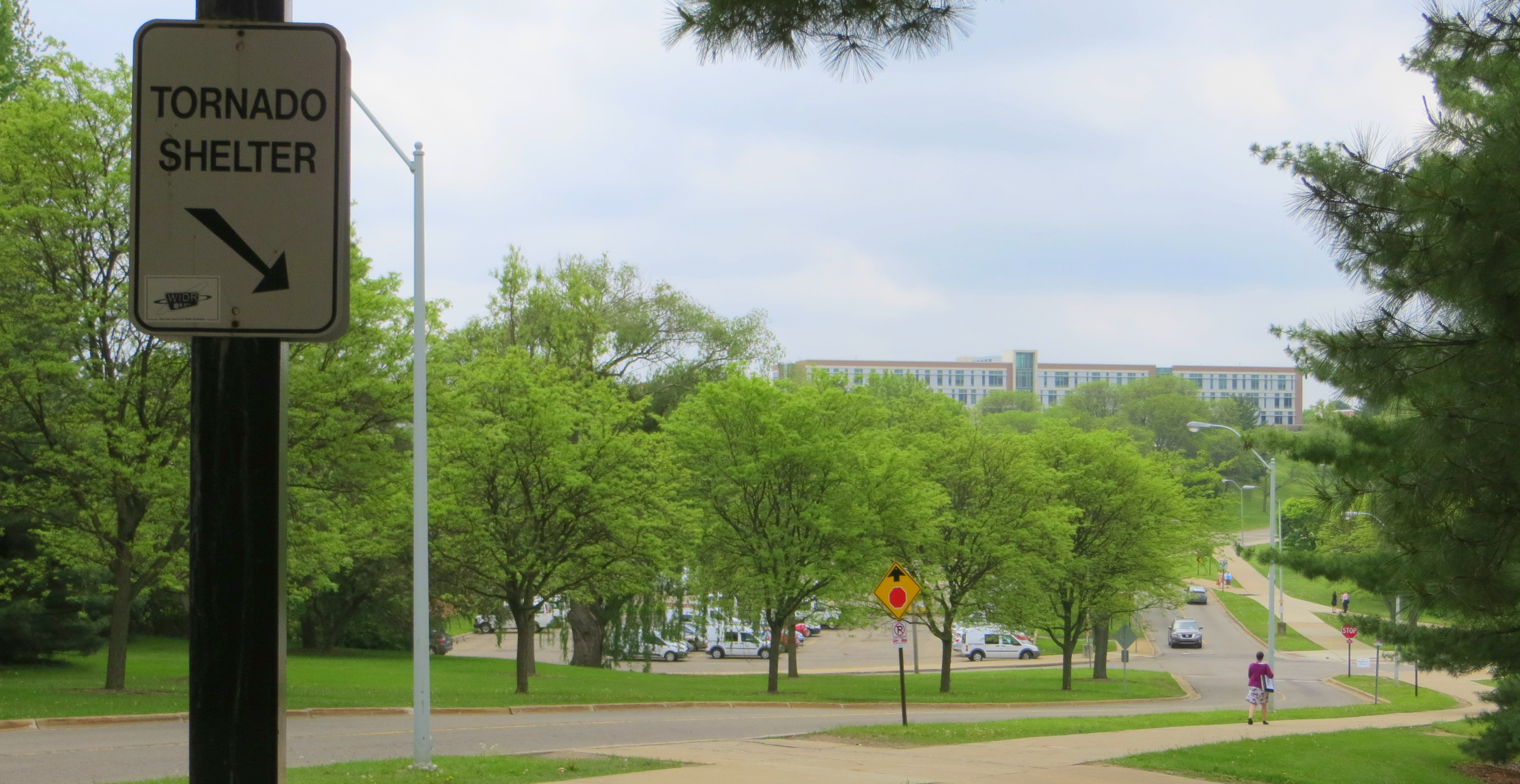
usa_tornado
Kalamazoo itself is the size of Joensuu and located a three-hour train ride from Chicago. My impression was that the town is known for three things: the Glenn Miller song from the 1940s, the range of local beers, and the university (might the last two be interconnected?). With 24,000 students, WMU is a good example of an American campus that is like a city within a city. The buildings are many, there are sports facilities and eateries, and in the middle there is a lovely green park complete with a pond (and swans). Many of the congress participants actually stayed on campus and slept in the dormitories. That part of the Kalamazoo experience I missed, as I stayed in a downtown hotel instead. Maybe next time?

Text and photos by Janne Skaffari

Turku #PoPsymp 2014: International symposium of linguistics and book history

SONY DSC

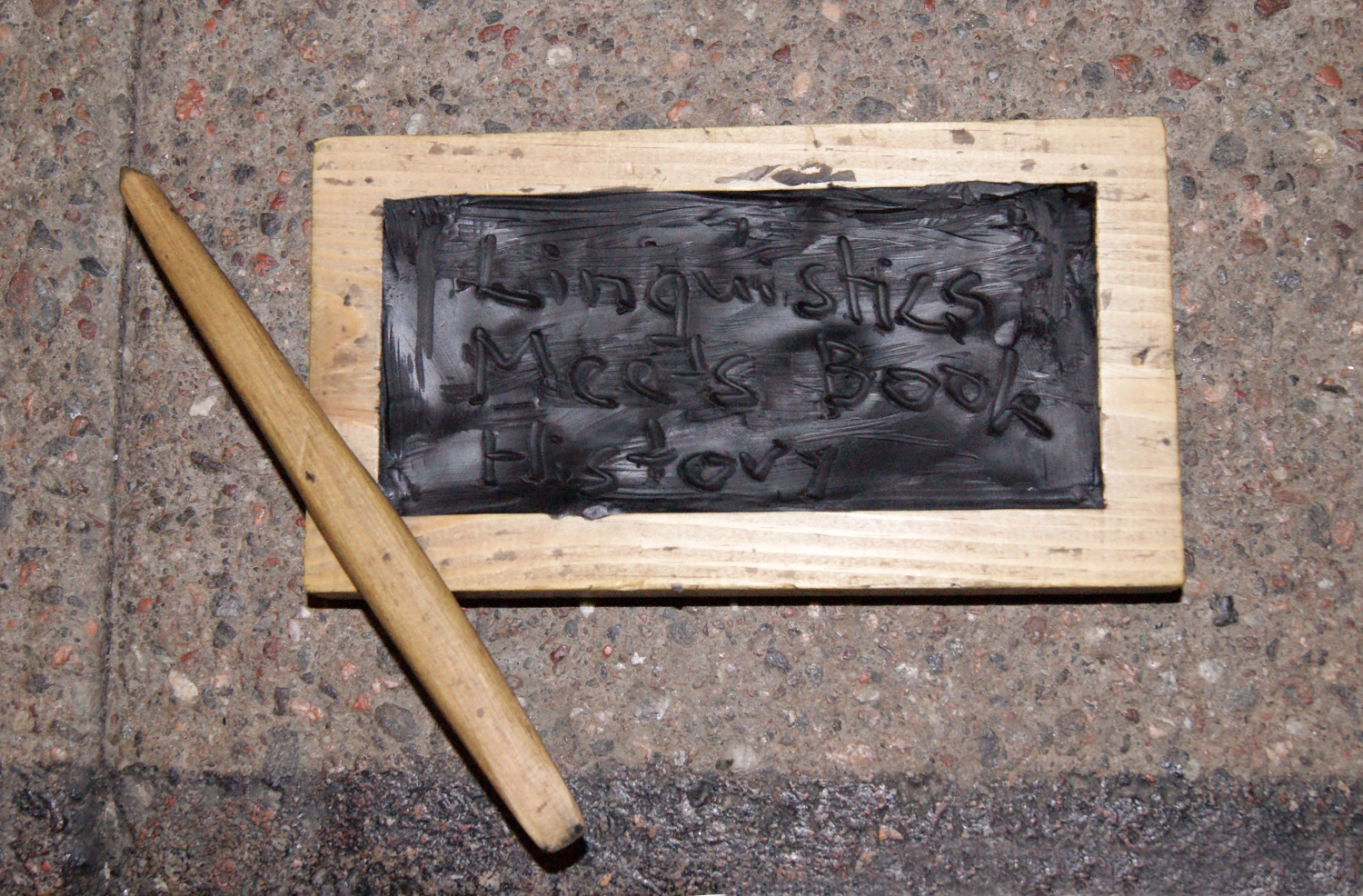
Linguistics met book history on 24–25 October 2014 as twenty-odd participants gathered in the Turku Main Library for an invigorating two days of presentations and discussion on the interaction of linguistic and material issues in the study of historical text. Linguistics Meets Book History: Seeking New Approaches (aka the PoP symposium), was organised by the Department’s Pragmatics on the Page (PoP) team in association with the Turku Centre for Medieval and Early Modern Studies (TUCEMEMS).
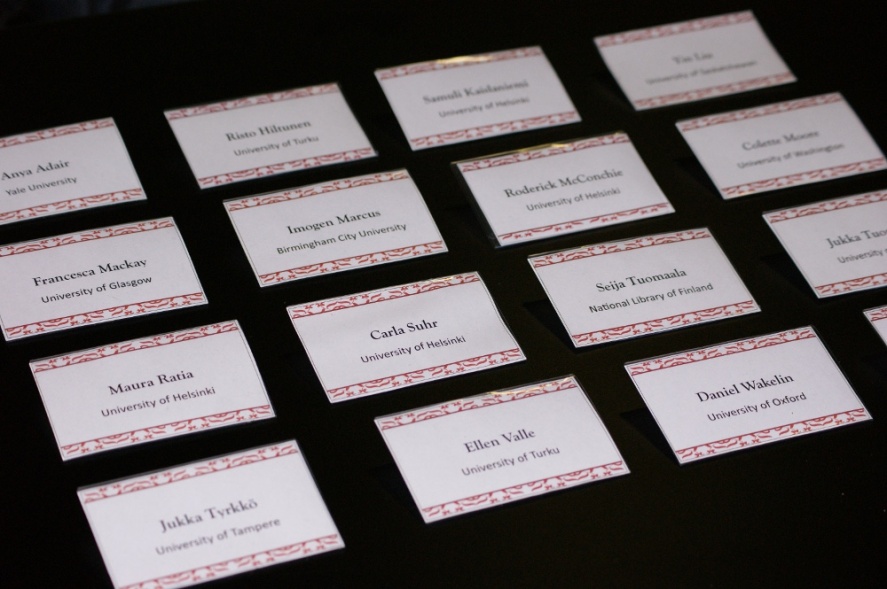
badges
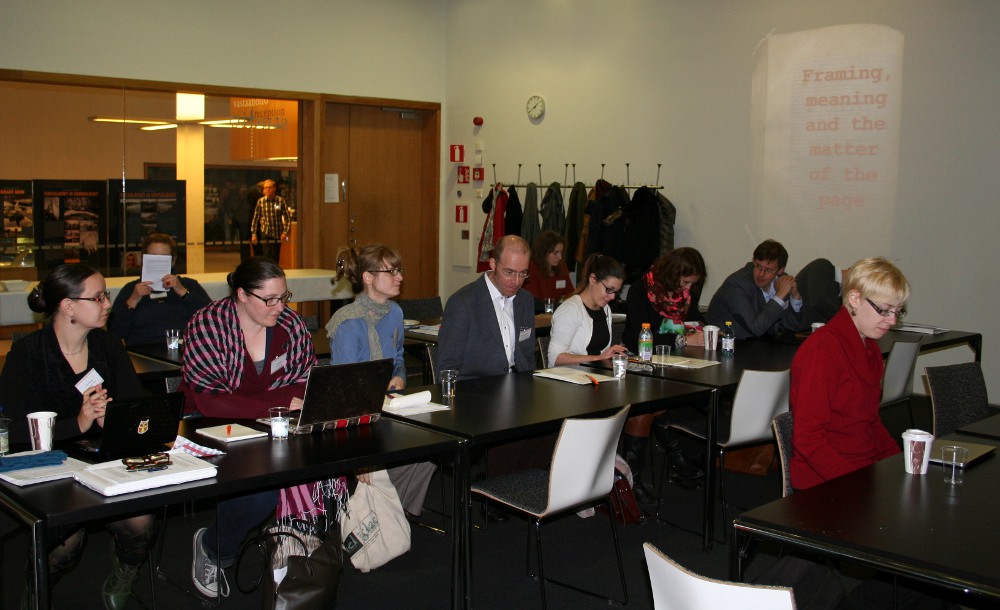
We were treated to a number of stimulating presentations on topics such as code-switching, corpus studies, script-switching, otiose and ambiguous strokes, speech markers in manuscripts, layout and organisation of the page, genre markers, and reading practices. The majority of the contributors studied late medieval to early modern material, namely manuscripts and early books, letters, inscribed artefacts and various corpora.

crowdPOP

The three keynote speakers demonstrated a variety of approaches to combining linguistics with historical and material context. Colette Moore (University of Washington) spoke on linguistic and scribal organisation in Middle English devotional texts. Her study focused on the use of visual and textual organisation in the interpretation of historical dialogues. Jukka Tyrkkö (University of Tampere) discussed multilingualism in early printed books, concluding that code-switching correlates with bibliographical features such as format. Daniel Wakelin (University of Oxford) delivered a paper on the communicative aspects of page-framing and the patterns of ruling.

Personal highlights for the writers included, for example, Anya Adair’s presentation on ambiguous (rather than otiose) strokes in late medieval scripts; Maura Ratia’s presentation on textual labels signalling genre, text type and/or discourse form; and Daniel Wakelin’s keynote on aesthetic functions and implications of e.g. prestige carried by such practical elements as page ruling.
crowd2
The symposium concluded in a round-table discussion on the re-introduction of philology as a terminological starting point to studies of linguistics and book history, tactics for editing historical texts, and the usefulness of collaboration between people working on different time periods. The participants unanimously agreed that the symposium had been fruitful and everyone sounded excited about the idea of #PoPsymp2.0.
aboavetus
Scholars relaxing after a long day. The evening programme included a guided tour to the Aboa Vetus exhibition Letter by Letter: Traces of Reading and Writing.

Text and photos: Aino Liira, Sara Norja and Sirkku Ruokkeinen

Networking and applying linguistics

afinla-e
The Finnish Association of Applied Linguistics (AFinLA) organizes an annual autumn symposium. The symposium is this year organized by the School of Languages and Translation Studies at the University of Turku. We expect to have more than 100 participants listening to plenaries, presentations and workshops on applied linguistic topics.

The association is an important networking tool for anyone interested in applied linguistics. In addition to the symposium, AFinLA awards the annual Afinlandia prize for an excellent MA thesis within applied linguistics in Finland. Every three years an award is also given to an excellent PhD thesis.

To build networks between researchers interested in similar areas AFinLA has special interest groups (SIGs). At present, there are 5: Language Policies, Discourse Studies, Dialogic and Sociocultural Language Research, Assessment, and Teaching and Learning in a Foreign or Second Language. By becoming a member of AFinLA, you can also join the SIGs.

The membership fee in 2013 is 24 € (only 16 € for students!) – and if you pay only 10 € more, you also receive the AFinLA yearbook, which is published every autumn. It includes peer-reviewed articles of the top studies presented at the symposium. The yearbooks are a good way to see what is going on within applied linguistics in Finland. AFinla also has an electronic publication series AFinLA-e that also includes peer-reviewed papers that may not be directly related to the theme of the autumn symposium.

This year’s theme is Language Users of Tomorrow. This follows nicely from the earlier theme Language Learners of Today that was used when the symposium was last held in Turku. This also reflects linguistic thinking; we now are more and more interested in the future: What does language proficiency consist of in the future? What is the effect of digital environments? How does language use change in workplaces? Population is ageing, what are the effects on languages in society? Come and see!
Pekka Lintunen
Afinla-banner