Visualising knowledge: reflections from the Reading Visual Devices conference

On 22 May, the foyer of Arcanum buzzed with anticipation as attendees gathered for the Reading Visual Devices conference organized by the Early Modern Graphic Literacies (EModGraL) project. The event began with a warm welcome from Marjo Kaartinen, Rector of the University of Turku and a member of the EModGraL project. Rector Kaartinen highlighted the city’s rich late medieval and early modern heritage, noting that there could hardly be a more fitting location for a conference focused on early modern graphic devices. She concluded her opening remarks by expressing the university’s pride in the project.
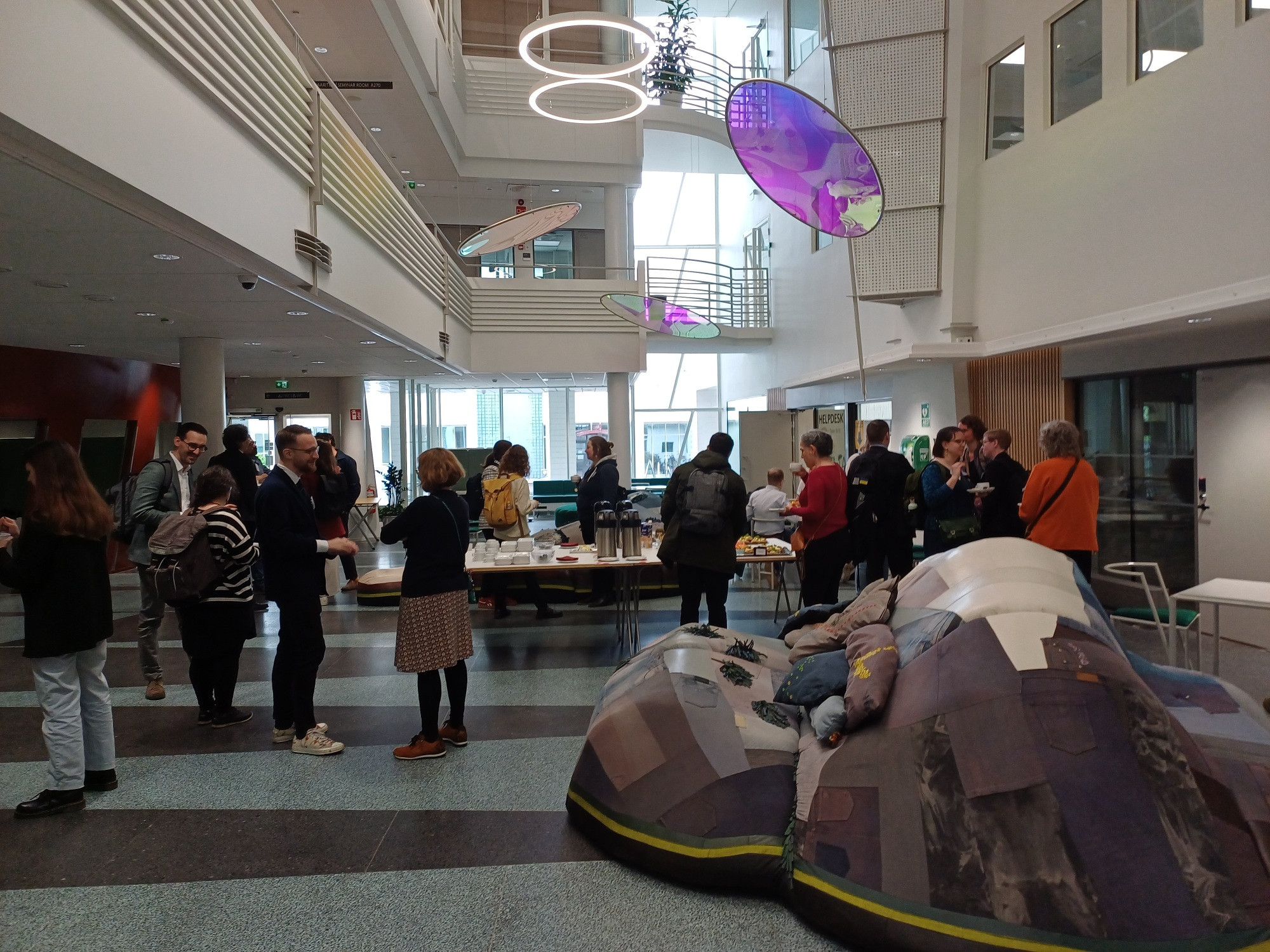
Attendees enjoying coffee and conversations between sessions in the lobby of Arcanum

Next to take the stage was Professor Matti Peikola, the principal investigator of the EModGraL project. He extended thanks to the project’s primary funders – the Research Council of Finland and the City of Turku. As the four-year project draws to a close this summer, the conference marked a significant milestone in its final phase. In attendance were two of the project’s key collaborators: Professor Wendy Scase (University of Birmingham) and Dr Carla Suhr (University of Helsinki), both of whom gave keynote speeches. A third keynote was presented by Professor Andrew Riggsby (University of Texas).

The multidisciplinary conference brought together researchers interested in late medieval and early modern visual devices such as images, diagrams, charts, and tables that convey information alongside text. Over the course of three days, the programme featured three keynote lectures and 25 paper presentations, covering topics ranging from diagrams in early modern grammar textbooks to witchcraft pamphlets and medical manuscripts. Together, the papers offered insight into how graphic devices were used, understood, and employed to visualise knowledge in the late medieval and early modern periods.
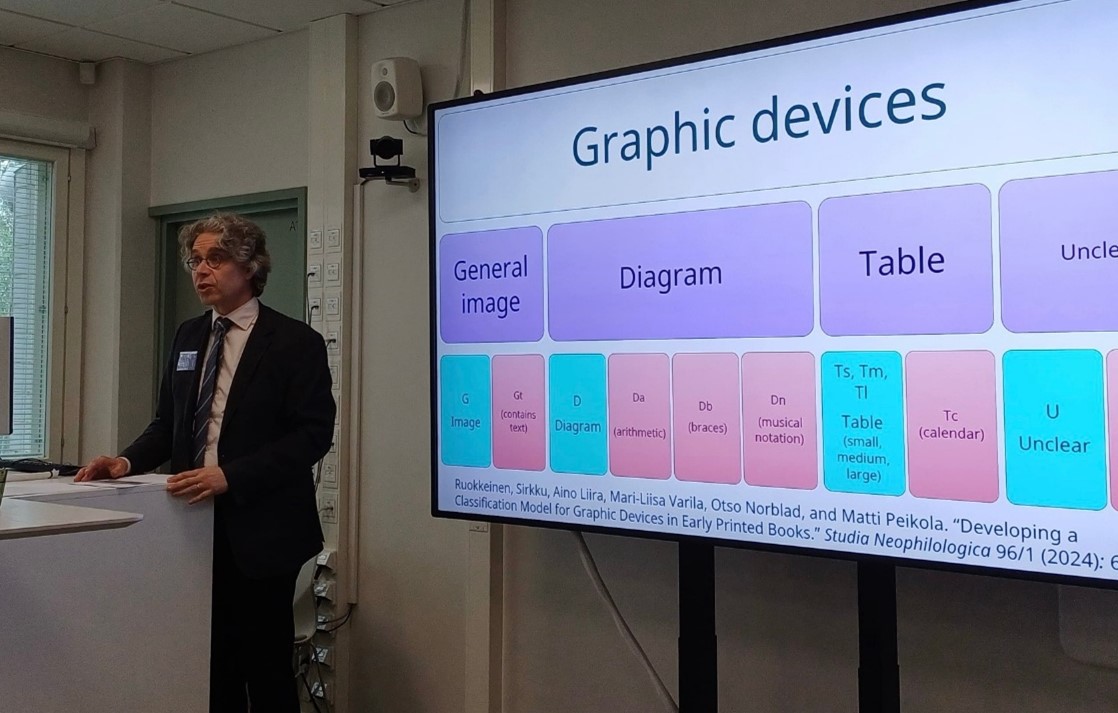
Professor Matti Peikola presenting findings from the EModGraL project

The international conference drew approximately 40 attendees from a range of academic disciplines. As a student assistant, it was inspiring to observe professionals in action – presenting their findings and exchanging ideas. For me personally, the most rewarding aspect was witnessing the academic community that the project has built over the years.

Finally, on behalf of all the student assistants, I would like to thank Dr Sirkku Ruokkeinen, whose support and guidance helped ensure the smooth organisation of the event. Reading Visual Devices was a successful three-day conference, hosted by what Rector Kaartinen described as a “particularly fabulous project.” As heard in the discussion following Dr Mari-Liisa Varila’s paper on the first conference day, one cannot help but wonder: what’s next? Perhaps, a well-earned holiday for the EModGraL team.

Text by Maria Tervakangas

Photos by Pinja Miettinen
TiTaRa: Between Science and Magic Symposium Through the Eyes of an Assistant

The TiTaRa: Between Science and Magic Symposium was a great success! The symposium was held on 10–11 October here in Turku together with the Finnish Network of Magic Studies to explore topics such as Western esotericism, magic, witchcraft and early sciences bordering them (such as alchemy and astrology). Participants arrived from around the world, and the topics varied from medieval England all the way to Finland in the 19th century and everything in between.

There were three of us assistants, and in addition to assisting at the symposium, there was a variety of things to do both before and after the event: checking the symposium’s emails, designing and setting up signposts and nameplates, compiling a book of abstracts of all the presentations and making social media posts… Some of these sounded a little intimidating at first for someone with no prior experience on such things but it turned out to not be too difficult after all because we had such a great team. Help was always available, and it was easy to divide some of the work between the three of us. During the symposium, our main responsibilities were working at the reception and assisting with the technology (thankfully no issues arose with the computer!).

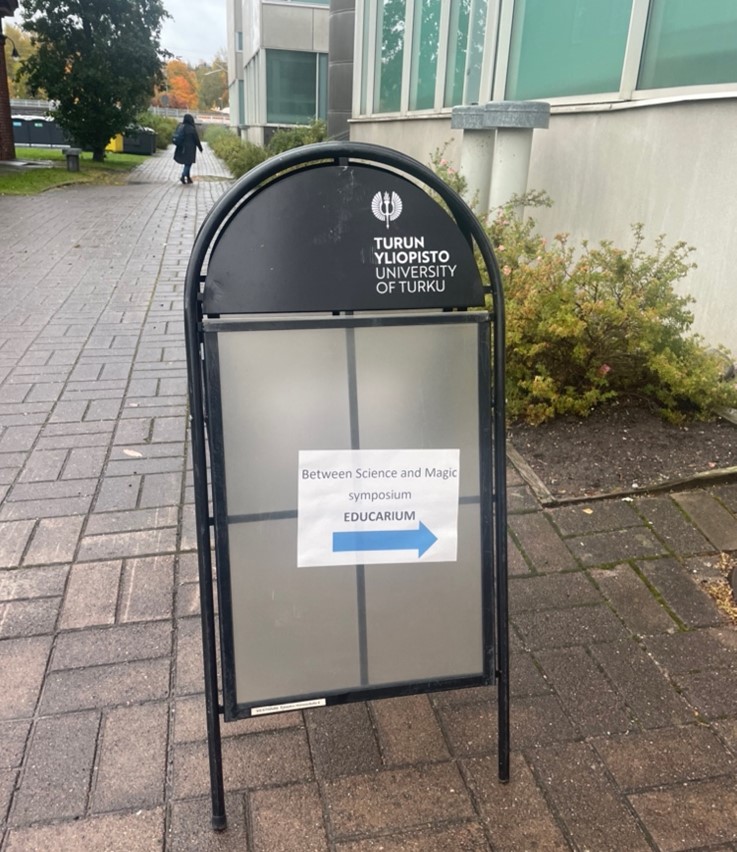
The signpost guiding our guests in

Day 1 of the symposium started bright and early on a rainy October morning for us assistants and other organizers of the event. The first things to do were putting up signs outside so that all of our guests could find their way in and making sure the presentations of the day were set up and ready to go. Attendees started arriving a bit before 9 a.m., and our job was to welcome everyone at the reception and hand out nameplates. At 9:15 it was time to officially start the symposium! The first presentation was one of our two keynote speakers, Professor Egil Asprem from Stockholm University. The presentation was about Romani magic and the sexism & racism involved in it with most fortune tellers at the time being women, as well as the stereotypes surrounding it being fraud.

After the first presentation, we had a quick coffee break and then continued with two more presentations before lunch. As assistants, we divided the work so that one or two of us stayed at the reception and the other(s) helped with setting up the presentations (and had the perk of listening to them!). Hearing many of the presentations was honestly one of the best parts about being an assistant at a symposium with such an interesting theme! After lunch, there were three more presentations, and then it was time for coffee once more, followed later in the evening by a City of Turku reception and a dinner at Brewery Restaurant Koulu. After the coffee, we made sure everything was in order for the second day. The first day went by very quickly and left me more excited.

Day 2 started quite similarly for us as the first day. Friday’s first presentation was another one of our keynote speakers, Carla Suhr from the University of Helsinki, whose topic was witchcraft and medicine in early modern English witchcraft pamphlets. The presentation focused on the visual features of the pamphlets, advertisements of proprietary medicines and how they were presented to the audience.  The second day passed by just as quickly as the first, with a total of six presentations in addition to Carla Suhr’s presentation. There was so much to learn, and everyone’s presentation added new perspectives to the theme of the symposium; I learned about the role of magic (and science) in astronomy & astrology, dance, dreams & nightmares and so much more! In a flash, the second day was finished too. Everything went even better than I had anticipated; we had no major issues and everyone seemed to enjoy themselves.

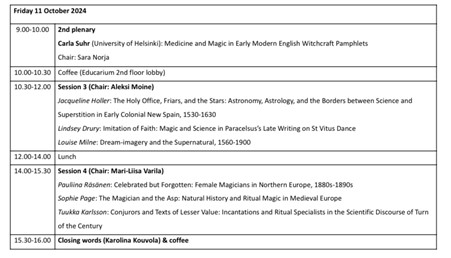
The schedule of day 2

It was a great experience to learn about all that goes into organizing an event like this, and it felt inspiring to see how passionate everyone seemed to be about their own presentations, and all the discussion each presentation sparked among the attendees. During coffee breaks, it was nice to hear bits and pieces of conversations the attendees were having, often inspired by the previous presentations. I would recommend an assistant internship like this to everyone! It was such an interesting way to meet new people and to learn how academic events are organized. The topics were interesting, everyone was extremely kind, and it hardly felt like work at all. A big thank you to everyone who was part of the symposium!

Text and photos by Maija Riikonen

Doctoral researcher exploring the FINSSE-11 conference: What is the role of non-human animals when it comes to sustainability in English studies?

FINSSE, the Finnish Society for the Study of English, was founded in 1998 “to advance university-level research and teaching in Finland of the English language, literatures in English and cultures of English-speaking peoples”. Biennially, a FINSSE conference is organised “to bring together university teachers, scholars and advanced students from all fields of English studies.” This year’s conference was held in Helsinki 13‒14 June, with the theme “Sustainability in English Studies”.

When I read the Call for Papers in February, I was very happy to see that the theme of this year’s conference would be sustainability. The CFP started by defining sustainability as comprising environmental, social and economic sustainability and asking what it has to do with language and literature. The role of language was seen as a tool through which the viability of communities is sustained and sustainability goals are negotiated, and literature as one through which alternative and more sustainable worlds can be explored. Also, the question of ensuring that research practices in English studies are sustainable was addressed. In addition to the general introduction to the theme, there were topic suggestions related to for example language resources, language policy, ELF, language teaching, translation, equality, identity, health, ecolinguistics, environmental humanities and several approaches to literature.

Besides being excited about the theme in general, I was curious to see how it would be approached in the presentations; which perspectives of sustainability would be discussed, and maybe most importantly, who would be considered being part of the group that the sustaining is done for—humans only, or sentient beings in general. Typically, the current (mainstream) definitions of sustainability exclude sentient beings other than humans as having moral value, but there has been an increasing call for defining sustainability as including non-human animals as ends in themselves. However, there was no mention of them in the CFP, and the United Nations’ Sustainability Development Goals, which were mentioned briefly in the CFP, are extremely anthropocentric. In the SDGs, non-human animals are treated as either resources for human consumption or, at the species level, as worth conserving in order to keep providing humans with ecosystem services.

In total, the conference program included one plenary presentation, 30 individual presentations, four poster presentations and a panel discussion during the two conference days. In addition, a meeting for doctoral students was arranged the day before the actual conference. I attended 13 presentations and the panel discussion. Using the abstracts as my guide, I aimed to see all those presentations that in one way or the other were connected to sustainability. When there were no such options available, I made my choice based on other reasons, such as my personal interests or the expected relevance to my own research.

I found all the presentations I heard interesting and having scientific, social or practical significance, and the panel discussion on the future of English studies teaching was excellent—both content- and entertainment-wise. Sustainability itself, however, was discussed relatively rarely—and sometimes the term seemed to be used more as a buzzword than in connection with the actual concept—but there were some thought-provoking exceptions. Those presentations were related to the sustainability of language resources; connections between the global environmental crisis and trains in literature and film; researchers’ more sustainable travelling practices; the consequences and possibilities of Caribbean romance literature for environmental and cultural sustainability; and the cost of sustainability in Margaret Atwood’s MaddAddam. All in all, while there were several interesting connections made to sustainability, the question of non-human animals mentioned above was left to be addressed.

After the conference, I would say that FINSSE-11 was definitely worth attending. The atmosphere was very warm and welcoming, and the program was varied. The next FINSSE conference will be organised in two years, and I warmly encourage everybody working in the field of English studies at any English department in Finland to participate. And if you are not yet a member of FINSSE, or just want to know more about the society, click here!

Anna Runsio

The author is a doctoral researcher at the Department of English, University of Turku. Her doctoral dissertation deals with the linguistic representation of research animals’ agency in historical materials. She is particularly interested in combining linguistics with historical critical animal studies, i.e. using linguistic methods for investigating the exploitation of non-human animals in the past and its consequences today.

A harmony of work and play – Working as a conference assistant in the Trextuality conference

Serving as a conference assistant and project intern is an excellent decision. Please, let me tell you why!

The info desk of the Trextuality conference, occupied by two conference assistants (taken by the Trextuality social media team)

I attended the Trextuality conference as an assistant and project intern. The conference was aimed at scholars working in translation studies and textual criticism, as well as neighbouring disciplines, such as literary studies and book history. The conference was held 7–9 September 2023 at the University of Turku in the recently renovated Arcanum building and in Educarium. The presenters’ topics were very varied, so you were bound to find something interesting. Personally, I was most interested in seeing how a conference would be organised. In addition, there were several presentation topics that intrigued me. For example, reference module 2B in the image below.

The afternoon schedule of the second day of the conference

Now that you’ve had a glance at just one of the days of the conference, you’ll probably see why I wholeheartedly recommend grabbing the next opportunity to be a conference assistant! Should you not have the time to dedicate to an internship of three or five study points, you get to participate in the lectures held by the attendees for free. If even that somehow fails to entice you to join, let it also be mentioned the food was very good and very free. I will reiterate, there is no need for a commitment to a project internship. You can just be a conference assistant with no strings attached, and these regular assistants were the majority of our numbers. Should you have the time and inclination for an internship, keep reading. If not, keep reading anyway.

So, you want study points for your efforts. You can get a project internship and three study points for your efforts if you put in around 81 hours of work. You get five study points if you put in 135 hours of work, as with regular courses. The 80-hour mark is pretty easy to achieve, whereas the 135-hour mark will require some special arrangements with your supervisor.

There are usually several different ways to help around, be it before, during, or after the conference. I will mostly be talking with this conference in mind, but much of this applies to project internships done as a part of other types of events as well. For instance, before the conference there were signposts to be set up and the lecture rooms had to be rearranged to suit the conference’s needs. Some of us were a part of the photography and social media teams that created content about the conference during the event. I was a part of the shift list team. Our planning made sure every room and the help desk were always occupied by at least one assistant. 

During the conference, the social media team and help desk and lecture room assistant duties offered a chance to pitch in. In addition, simply attending the presentations held by the attendees counted towards the hour threshold. Due to sick calls, I had to go a little light on attending presentations. I spent most of the conference manning the information desk, ready to help conference guests with whatever questions or needs they might have.

After the conference, there is the option of writing about your experiences for publications, which is exactly what I’m doing right now! These publications can be magazines read by linguists or blogs, such as the one you’re reading this text on.

We, the assistants, were called the T-rex team. The working spirit of the T-rex team impressed me. There were quite a few cases of illness that popped up during the conference among the assistants. Despite this, our line held, and we fulfilled our duties.

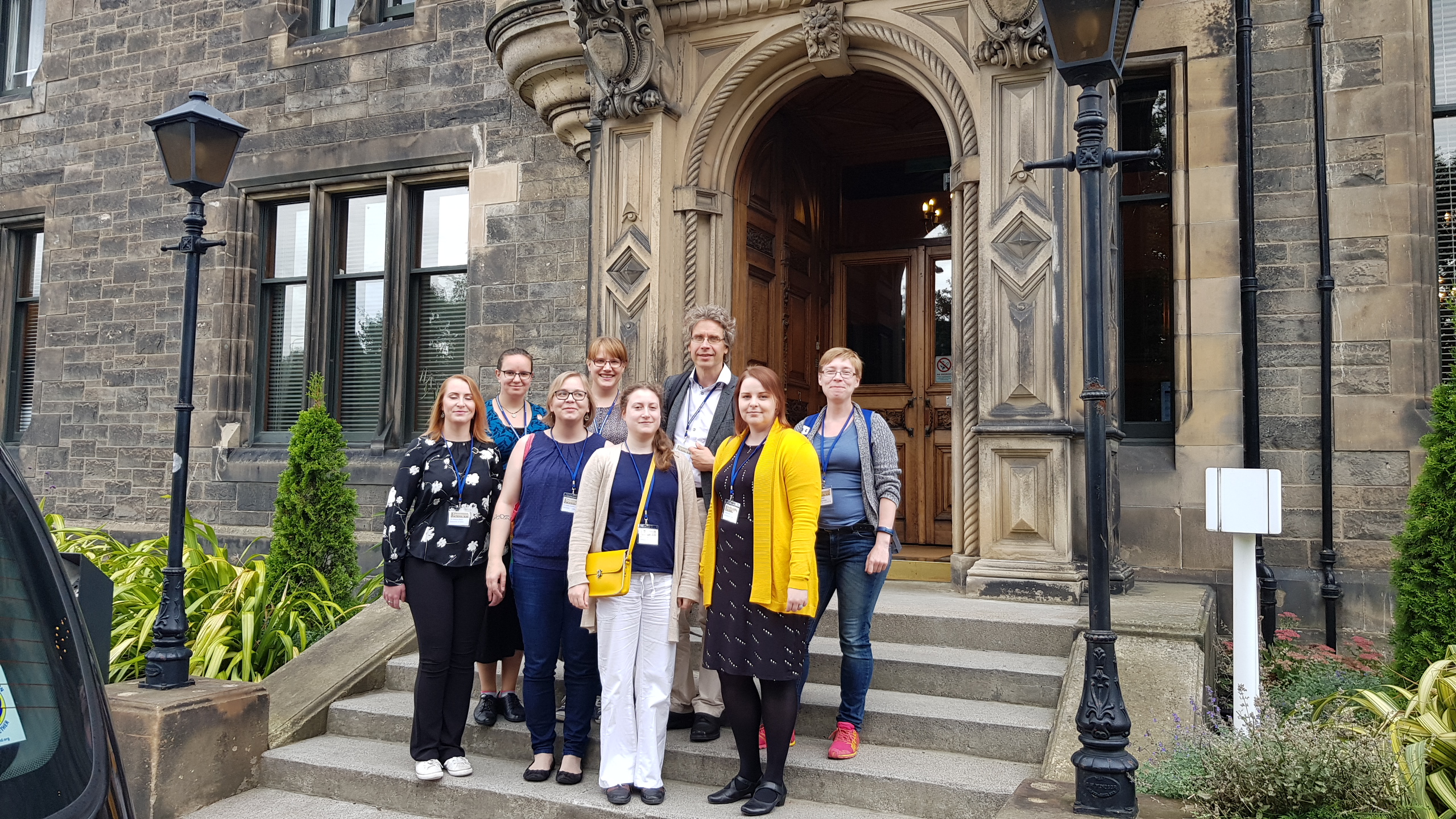
A group photo of some of the conference assistants (taken by the Trextuality social media team)

Our supervisors, the actual organisers of the conference, were the masterminds behind the whole operation, pulling it off like the true academics they are. Many occasions needed quick solutions and creative problem-solving that only the organisers had the authority to do. Say, helping with luggage forgotten by the attendees. Whenever we, the assistants, were at our wits’ end, asking our supervisors didn’t leave us on the rocks. We, the helping hands, were in good hands ourselves.

What for me personally made the entire conference was how kind and patient the guests were. If they needed help with something, they were polite, and if we had to find something out for our guests, they waited calmly, without rushing us. Their demeanour was professional and pleasant all around. We also received a great deal of kind words from the attendees in the form of emails sent to the organisers after the conference, which I personally found very heart-warming to hear.

To summarise, if interested, the next time you get an email saying that conference organisers are looking for assistants, grab a friend and volunteer. Do it for the study points, the experience, just to help out if nothing else. The worst that can happen is getting free food and a chance to meet fun people. Doesn’t sound like a bad deal to me.

Text by Ali Lamminen

Philologists in Edinburgh

The International Conference on English Historical Linguistics (ICEHL) was organised for the 20th time in Edinburgh on 27–30 August. The conference gathers together English scholars from around the world, studying English from Old to Late Modern.

Almost all of our researchers from the Philological Track made it to ICEHL. Matti Peikola, Mari-Liisa Varila, Hanna Salmi (currently at the University of Stockholm), Aino Liira, and Sirkku Ruokkeinen gave papers in the workshop “Paratextual Communication in a Historical Linguistic Perspective”, organised by Matti Peikola and Birte Bös (University of Duisburg-Essen). Matti Peikola and Peter Grund (University of Kansas) presented a paper on orthographical variation together with Johanna Rastas. Aleksi Mäkilähde gave a paper on the metatheory of pragmaphilology. Susanna Mäkinen gave a paper on references to fugitives in runaway slave notices. I gave a paper on the different translations of The Mirror of Alchemy. We were a busy lot!

This was my first ICEHL, but I hope it won’t be the last. The conference was packed astonishingly full of great papers and interesting discussions; the programme can be found here. I have never been to a conference with so many excellent papers on fascinating topics that were relevant for my own research. I was especially excited by papers on topics such as medieval Latin-English code-switching, spelling variation and standardisation in the early modern period, and multilingualism in late modern medical discourse.

Despite the busy academic programme, there was also time for social events. The conference ceilidh on Tuesday 28 August was especially memorable: it was wonderful to dance and to watch a crowd of other scholars skipping merrily along to the live traditional music. Lots of us also found time to climb up to Arthur’s Seat, the majestic hill right next to the conference location.

ICEHL also involved a final day of activities on Friday 31st August. Most of us Turku philologists – unsurprisingly – chose to go to Lindisfarne, the monastic Holy Island where the Anglo-Saxon Lindisfarne Gospels were produced. The weather was astoundingly warm and sunny; we had a glorious day trip filled with island beauty, the island’s old history, and clean sea wind. It was a fitting and excellent ending to a week’s worth of English historical linguistics.

Text by Sara Norja
Photo by Minna Nevala

My Days as a Conference Assistant

The Finnish Society for the Study of English (FINSSE) held its eighth biannual conference here in Turku this summer. Having never attended a conference before, I leapt at the opportunity to work as an assistant at the event and get credits for my Master’s internship. I’m glad I did, for The FINSSE-8 conference, “What’s in a Century?”, turned out to be the highlight of my academic year.

The whole experience was very positive. The organising committee welcomed me with open arms; I was given clear instructions as to what was expected of me and in moments of doubt I could simply ask for help. It soon became clear that organising a conference takes hours and hours of planning and preparation. Even I, a mere assistant, sat through several meetings and wrote countless emails. Those in charge certainly had a lot of work on their hands! Funding, venues, catering, timetables, name tags – all the meticulous work done in advance resulted in a successful conference.

During the event I took care of odd jobs here and there: I put up info signs, greeted people at the registration, carried water bottles and whatnot. I dabbled with things that may seem small, but, in the end, helped create a smooth conference experience. I was being useful and I liked it!

Amidst the work and responsibilities there were fun surprises and major perks. For example, during the first conference day we were treated to a small music number. The memory of conference participants, postgrads and professors alike, swirling around and dancing to the tunes of a violin will probably stay with me forever. Most importantly, though, I got a glimpse into the inner circle of English research in Finland: I felt like a little sponge soaking up knowledge and ideas. I had the opportunity to attend some interesting paper sessions and meet people working in fascinating fields of research – the conference even provided me with help for my upcoming MA thesis. The research community felt warm and supportive and people seemed to enjoy the conference. I’m lucky I got to be a part of it.

Text by Lilli Laine

Revisiting Galway: Translation Meets Book History

The English Department seems to be building up a special affinity with Galway. The ESSE conference last August was attended by quite a crowd (see blog post here); earlier last year I had the chance to visit the National University of Ireland in Galway as Moore Institute Research Fellow. And now I am back at the Institute for more research and networking in connection with a seminar on book history and translation studies.

There are a thousand excellent reasons to come back to Galway: the Irish are an extremely friendly people (and seem to share a number of things with Finns – maybe living at opposite ends of Europe makes for some sort of a bond?), Galway is an attractive and cosy town with an interesting history, and the University offers a vibrant intellectual atmosphere and a very warm welcome to visiting scholars.

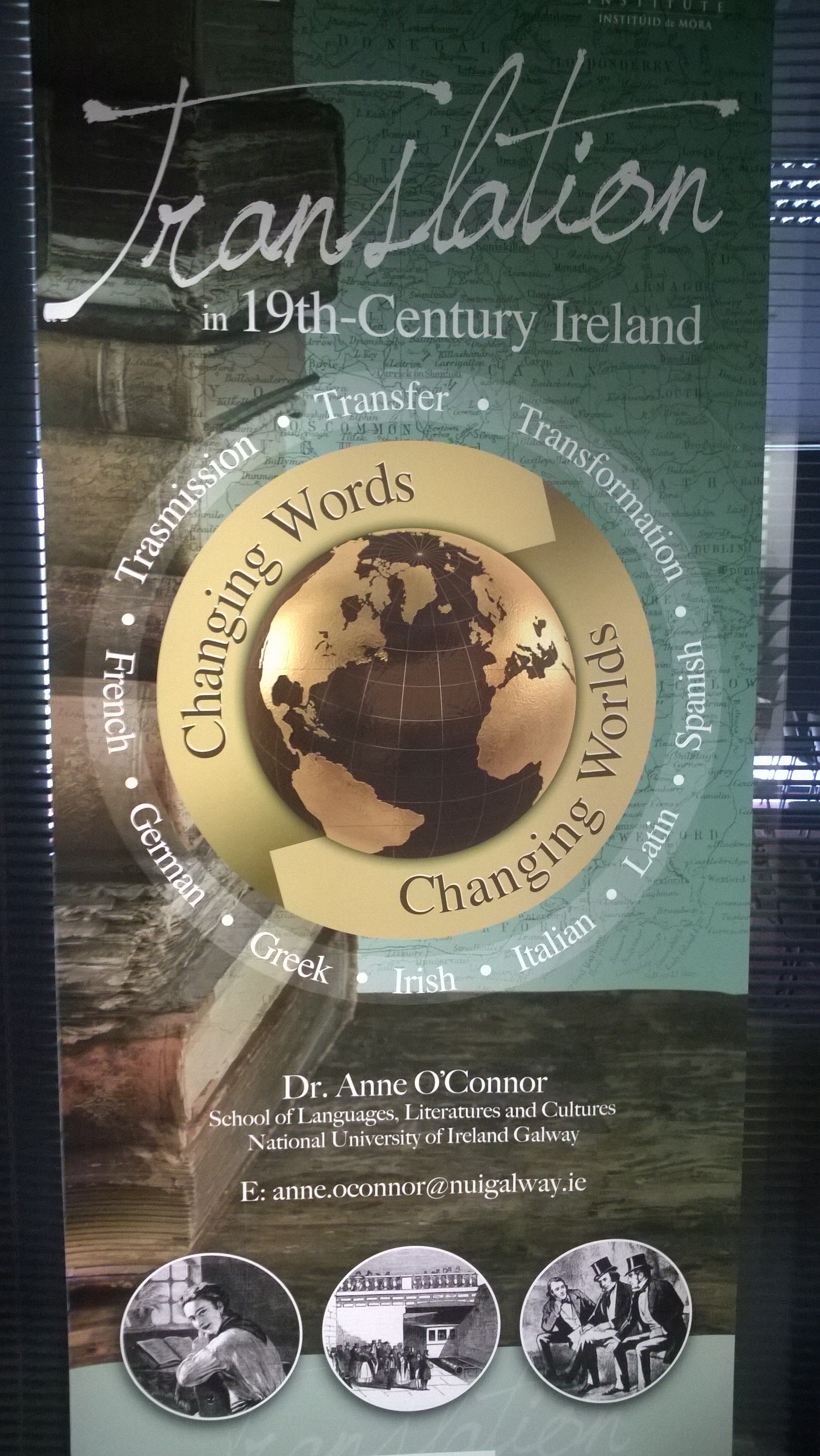
The conference “Book History Meets Translation Studies” was organised by Dr. Alice Colombo, a Marie Curie scholar in Galway, together with Dr. Anne O’Connor, who has just come out with a fantastic book on Irish translation history in the 19th century (see here) and Dr. Niall Ó Ciosáin, a renowned scholar of the Irish print culture (see here). The conference brought together researchers from different parts of the world and with widely varying topics, ranging from multilingual texts in 19th century North Africa to book illustrations, from Urdu scribes’ manuals to publishers’ archives. Katja Vuokko from our department gave a paper on Finnish translators’ footnotes; I talked about the Tauchnitz series “Collection of British Authors” and the introduction of British literature in Finland. The keynote speaker was Prof. Norbert Bachleitner from the University of Vienna with a highly interesting paper on 18th century women translators.

Apart from academic interests, Galway boasts a wealth of historical sites and places to see (and a very large number of pubs). In a street corner there is a statue of Oscar Wilde and the Estonian author Eduard Vilde, “a humorous quip on literary history”. The original statue of the W/Vildes is in Tartu (sculptor Tiiu Kirsipuu); the copy was presented to the city of Galway to celebrate Estonia’s membership in the EU. In real life, the two authors never met.

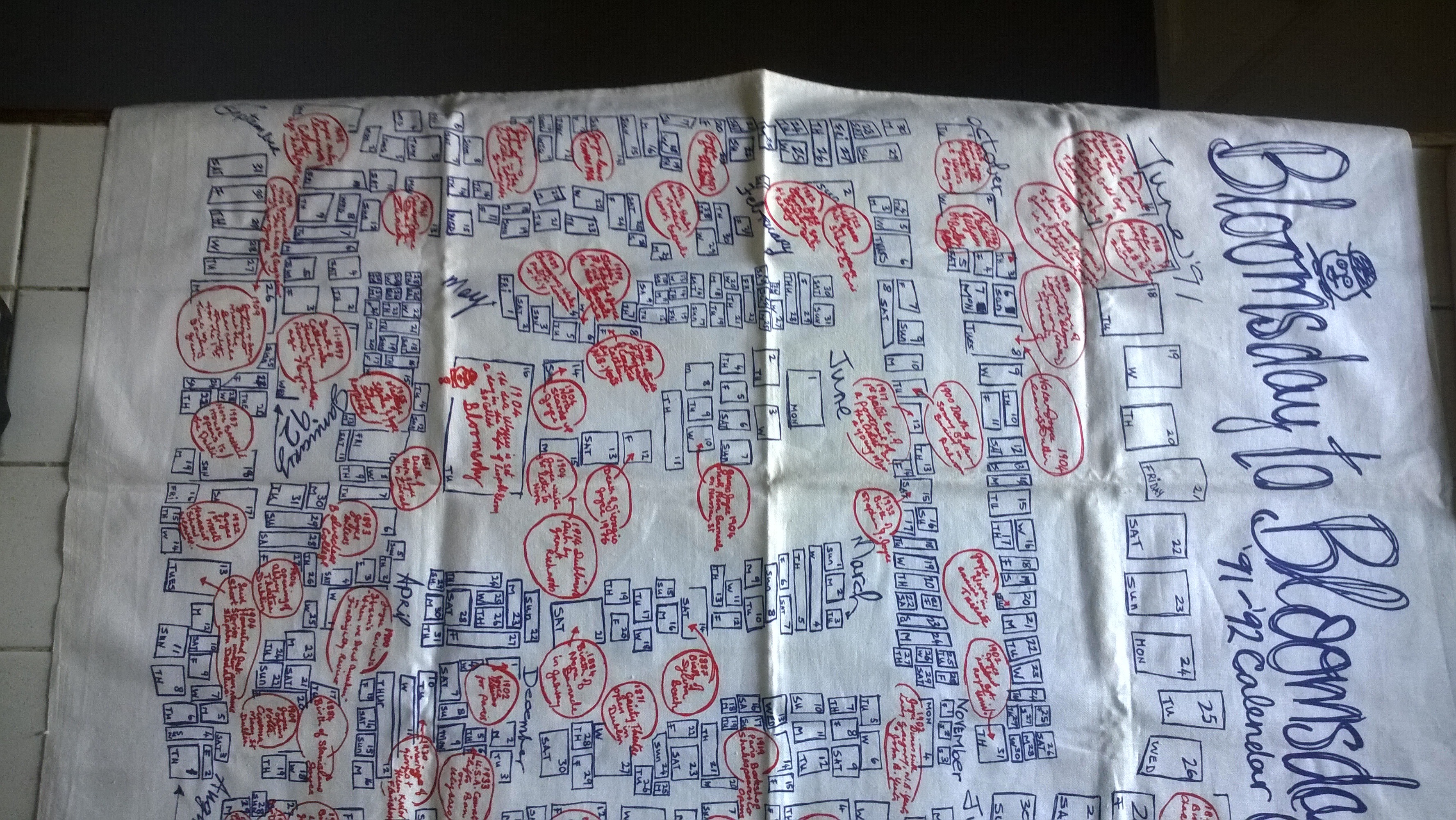
For me the most memorable place in Galway is Nora Barnacle’s house in Bowling Green, where I was taken by my wonderful landlady Sheila (the museum is presently not open for public). This was the home of Nora, James Joyce’s wife, and it is the smallest museum in Ireland with just two rooms and a backyard. Mary and Sheila Gallagher bought the house in 1987 and it is thanks to them that the house has been preserved and restored. The teatowel in the picture below celebrated the 1991 Bloomsday; one in the series of events organised by Mary and Sheila.

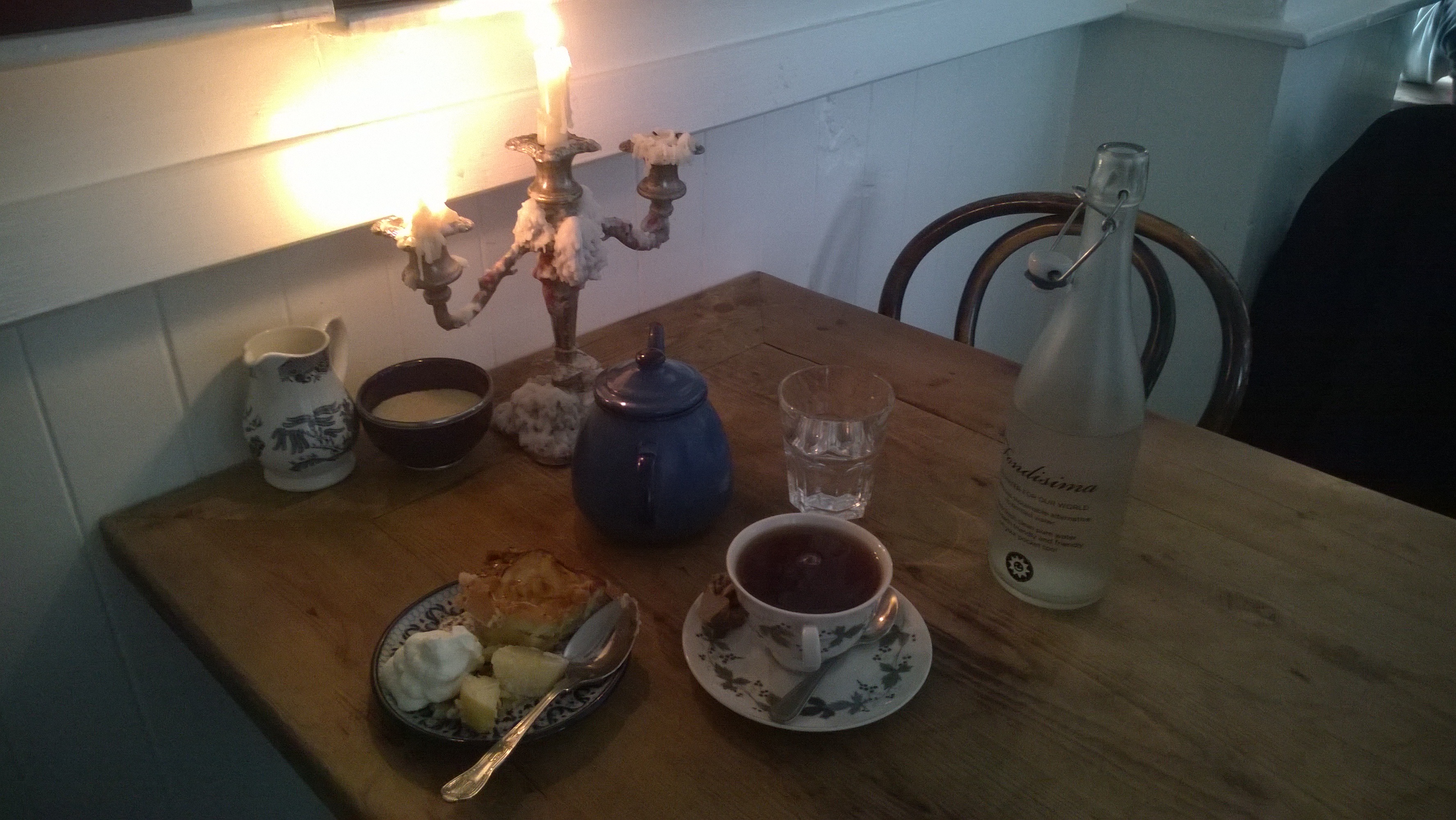
No research visit is complete without cafés and tea houses. There is plenty to choose from in Galway: Ard Bia at Spanish Arch and The Kitchen at the Galway museum are my favourites. A perfect way of combining work and leisure on a rainy day!

Text and photos by Outi Paloposki

Greetings from Gorgeous Galway

irelandview

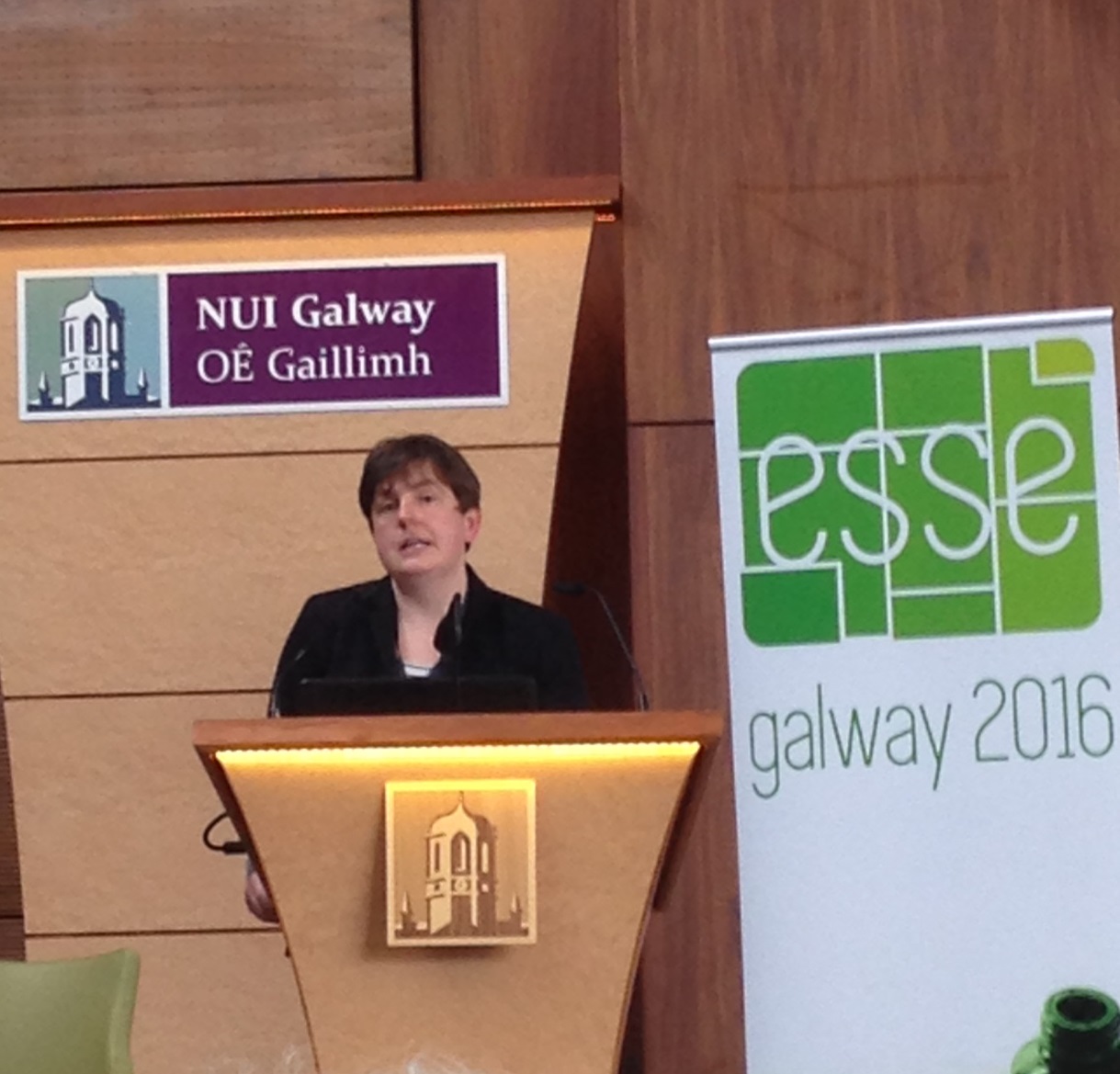
While our historical linguists were enjoying the heatwave in Essen, another delegation from the English department went on a similar mission to a place with just one letter’s difference: ESSE – the European Society for the Study of English biannual conference in gorgeous Galway, Ireland. Our research project funded by the Academy of Finland, Out of the Ordinary: Challenging Commonplace Concepts in Anglophone Literature, hosted a round table debate on the topic of competition for research funding in Europe and its consequences for English Studies. Visions were similar from all over Europe: competition for research funding is fierce, resources are diminishing, but everybody is making it work one way or another. Cautiously optimistic could perhaps be seen as the general attitude in the end of the discussion: after all, we have platforms like ESSE in and from which to push the English Studies agenda further. Besides the round table, the five-day conference with over seven hundred participants held numerous highlights, both intra- and extracurricular.

The conference began and ended with prestigious keynote lectures, the first by Emma Smith, Professor of Shakespeare Studies at Oxford. Her discussion on the changes, annotations, and scribbles made by previous owners to copies of Shakespeare’s First Folio denotes the very material quality of books as writing — they are not just stories but also stories about people who have owned or handled them. Smith is further known for her pedagogical efforts, not least of which is the Approaching Shakespeare podcast series, a very accessible way to get to know the Bard of Avon.
emmasmith

The conference ended on another high note, when Professor and author Colm Tóibín in his keynote, titled “As Things Fall Apart: The Response to Violence in the work of W.B. Yeats and James Joyce”, discussed Irish political history and literary analysis hand in hand, with a plot and detailed characterization as only a novelist/scholar could tell it. Thrilling treat, indeed!

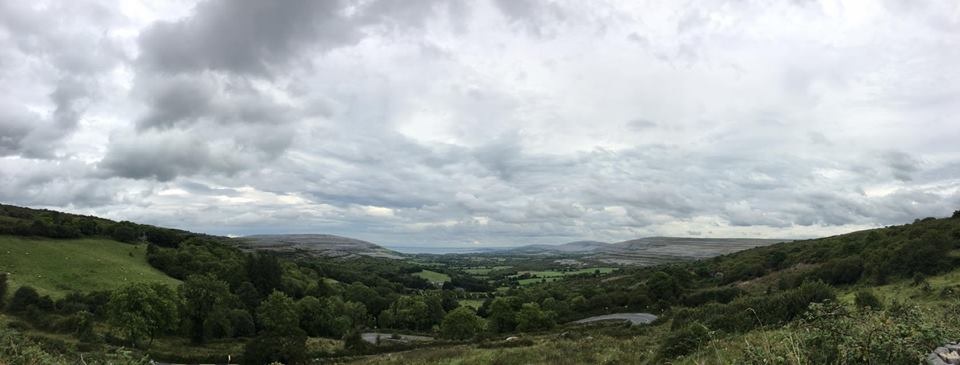
With storytellers like Tóibín hailing from Ireland, it is no wonder that Galway will be the European Capital of Culture in 2020. The beautiful Atlantic scenery, seafood, music, culture, grazing sheep, ponies, and cattle in the green valleys make it an ideal destination for anyone looking to fall in love with places like the historical Kylemore Abbey pictured below. The Gothic castle and Victorian walled garden are now home to the Benedictine community, who welcome visitors to take in the peaceful atmosphere by the lake, which can only be described in the words of the Irish poet, Patrick Kavanagh: “Tranquillity walk with me/And no care/O, the quiet ecstasy/Like a prayer”.
kylemore

Text by Elina Valovirta
Photos by Ira Hansen and Elina Valovirta.

p.s. The next ESSE conference will be held in Brno, Czech Republic, in 2018. For more photos about ESSE, see the ESSE website and for another conference report from a participant in the very successful panel on children’s literature, see here.

Heat wave and historical linguistics in Essen

For university faculty, summer does not simply equal vacation. It is also a prime time for international conferences that are part of our work as researchers. In the end of August, historical linguists flocked to Essen, Germany for the 19th biennial ICEHL conference (22–26 August). ICEHL stands for “International Conference on English Historical Linguistics”.

essen2

The four conference days were packed with excellent plenaries and fascinating papers on all aspects of English historical linguistics – for example pragmatics, speech representation, syntax, variation, language contact, phonology and semantics. Together, the papers covered a millennium of the story of English, from Old English to Late Modern English. You can take a look at the programme here.

Our Philological Track was well represented in the conference. Hanna Salmi gave a paper on verse and prose debates in early modern England. Aleksi Mäkilähde discussed his pragmaphilological approach to the study of language choice in Early Modern English school drama. Janne Skaffari also dealt with multilingual practices in a paper he gave together with Arja Nurmi from the University of Tampere. Finally, Matti Peikola and I discussed early sixteenth-century title-pages as sites of textual discourse. We were delighted to be in the same session with our former Turku colleague Carla Suhr (currently University of Helsinki) who also explored early English title-pages in her talk.

While the other members of our team are frequent ICEHL delegates, this was my first (but probably not the last) ICEHL conference. I really enjoyed my time in Essen, and the heat wave that struck us during the conference was a welcome break after the chilly Finnish summer. The next ICEHL will be hosted by the University of Edinburgh in 2018. As that is the 20th ICEHL conference, organised during the famous Fringe festival in August, I am sure it will be a festive experience indeed!

Text and photos by Mari-Liisa Varila

SLT historical linguistics seminar 13.5 – Winding through the dusty deserts of a lush philology, pt 2

World map from the Polychronicon. Wikimedia Commons, Bodleian Library.
The seminar continued with the Department of Finnish and Finno-Ugric languages revealing its onomastic side, as we heard presentations from Kirsi-Maria Nummila and Regina Bűdi. Nummila studies medieval street names in Turku and the credit that is their due to Baltic Sea region city plans or the so called German city plan. This city plan seems to have been variously implemented by some big East-European cities like Stockholm, Turku, and Tallinn, and these cities, interestingly, share street names. In her research, Nummila has questioned the traditional view that medieval street names were formed quite spontaneously drawing from the functions and situation of the street, and suggests that they might rather have been borrowed along with the city plan. Bűdi studies the proper names in the Turku bishop Ericus Erici Sorolainen’s sermon collection (Postilla 1621/1625), and more precisely in its gospel text passages. She compares these proper names to the ones found in corresponding passages in Mikael Agricola’s New Testament (1548) and the first Finnish whole Bible (1642), as well as in mainly sixteenth-century German, Latin, Greek, and Swedish translations of the Bible. Her aim is to study the similarities and differences between the proper names from these sources, the degree to which Sorolainen’s proper names were impacted by foreign languages and historical language development, and the gradual assimilation of foreign personal names into Finnish. She also wants to specify the definition of some nouns that could be seen as both common and proper nouns.

Asta Rauhala from the Department of Scandinavian Languages presented her doctoral research that concerns early, thirteenth- to seventeenth-century, Swedish loans into Finnish. Rauhala’s goal is to discover the scope and semantic categories of especially the medieval borrowed vocabulary, the speed of the borrowing process, and the length of time the loans were used in written language. Perhaps this could even lead to new etymologies or to new perspectives on language contacts and life in medieval Eastern Scandinavia! Likewise related to Scandinavian languages is Kendra Willson’s (TIAS) study that examines the possibility of Finnish and Sami names and words appearing in Scandinavian runes, especially ones that we have not been able to decipher thus far. One tricky rune that Willson presented at the seminar reads ”MINVLESIÖMEPVRVANTA” that seems to include at least the words “to me” (minvle), and “eat” or “food” (siöme), and “porridge” (pvrv) in Finnish. It was a good brainteaser to have a guess at the meaning of this passage at the seminar.

Other researchers doing detective work similar to Willson are doctoral candidates Harri Uusitalo and Reko Tikka. Uusitalo from the Department of Finnish studies the Finnish translation from Swedish of a seventeenth-century land law document, the Aitolahti land law. Uusitalo will edit the document that is still in manuscript form and investigate its sources and its possible author based on for example handwriting and vocabulary. Two sources that are previous translations are already known, but there still are passages in the document that are from neither of these. One possible writer is Hartvig Speitz, who may have written the text while sitting a punishment in jail! Uusitalo also wishes to study the development of Finnish legal language. Tikka from the Department of Classics researches games of chance in ancient Rome and the early Middle Ages. Using written and archeological sources, he aims to find out what kinds of games of chance were played and what their significance and functions were to the players. For instance, their possible use in gambling is investigated. Tikka suspects the absence from many European languages of a verb denoting especially the play of children, that exists in Finnish and Swedish (‘leikkiä’, ‘leka’), may up to recent times have discouraged the study of games as a less dignified pursuit. This kind of research is to my mind great proof of how the knowledge of and research in languages can aid cultural and historical study. The dusty deserts of philology do not seem so barren after all.
Find out more about the historical linguistic research of each department on the UTU departmental websites under “Research and doctoral studies”.

Wishing everyone a creative, sunny, and relaxing summer!
On behalf of the seminar presenters,
Aino Haataja, MA, English