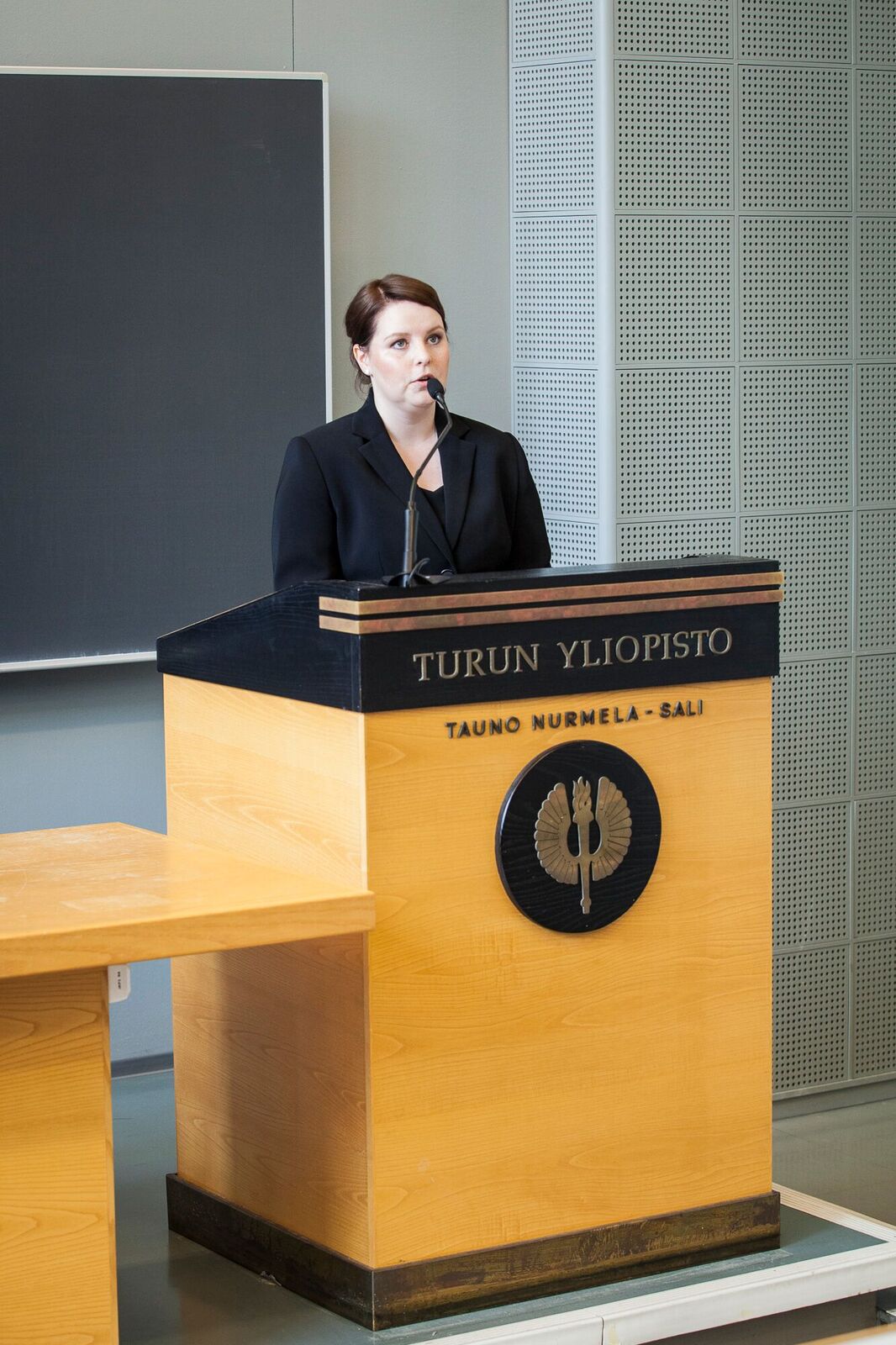
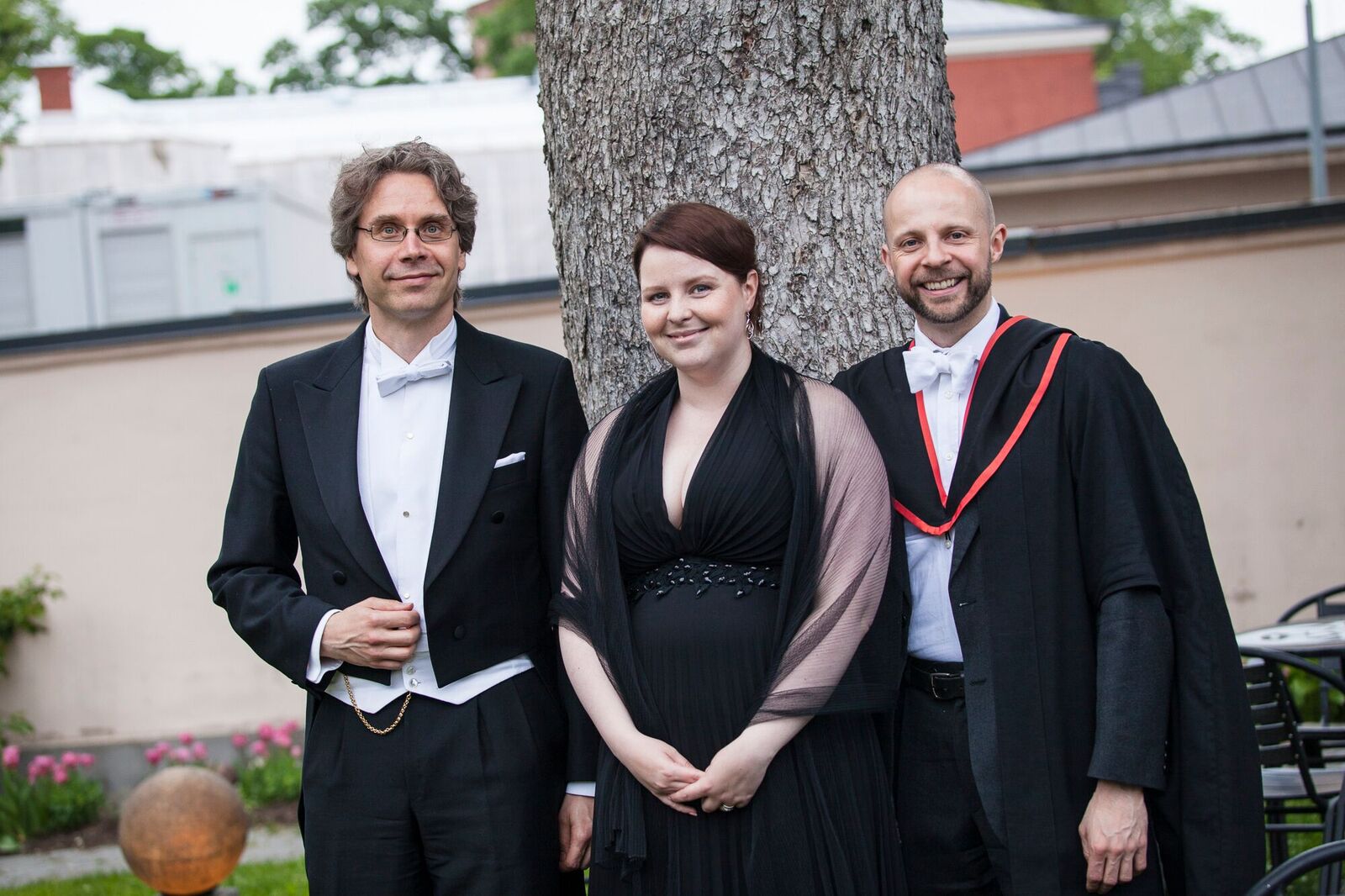
Postmodern feminist challenging of dominant discourses: Mehdi Ghasemi’s doctoral defence

The second one of the two doctoral defences at the Department of English in the spring 2016 was Mehdi Ghasemi’s “Quest/ion of Identities in African American Feminist Postmodern Drama: A Study of Selected Plays by Suzan-Lori Parks”. The public examination of the dissertation took place at the University of Turku on 10 June, 2016. The candidate’s performance in the defence was eloquent and he was able to justify his choices and elaborate on the points that he was requested to clarify. Despite it being a Friday afternoon in June, the defence was attended by more than thirty people – and it was conducted in an orderly fashion.
mehdi
Mehdi Ghasemi’s doctoral dissertation is a study of three plays by Parks from the standpoints of postmodern drama and African American feminism with a focus on the terrains that reflect the quest and question of identities for African Americans, especially African American women. The study is a reading of three plays by Suzan Lori-Parks – The Death of the Last Black Man in the Whole Entire World (1990), Venus (1996) and Fucking A (2000). Ghasemi’s interpretetations of the three plays offer valuable insights on this understudied playwright and genre. Ghasemi argues that “Parks in these plays uses postmodern drama and African American feminism to encourage reflections on intersectionality in order to reveal the concerns of African Americans, particularly African American women“ (p. i).

The opponent was Professor Jopi Nyman from the University of Eastern Finland, and Professor Joel Kuortti acted as custos. Professor Nyman posed demanding questions on the theoretical issues involved as well as on the particular analyses of the three plays. Mr. Ghasemi replied confidently, resulting in an engaging discussion that – judging from their reactions – was also appreciated by the audience. Finally, the opponent gave his final statement. There were no questions from the floor.

Mehdi Ghasemi is from Tehran, Iran and completed his MA on “Walt Whitman’s Loud Voice of Democracy and Individuality” at the Islamic Azad University of Karaj. The dissertation is published electronically in the Annales Universitatis Turkuensis B419.

Text by Professor Joel Kuortti, custos

The transmission of early scientific writing: Mari-Liisa Varila’s doctoral defence

It is always a happy occasion for the whole department when a doctoral candidate defends their dissertation. This spring we were treated to not only one but two public examinations of doctoral dissertations. The first was that of Mari-Liisa Varila. On 28 May 2016, she defended her dissertation titled “In search of textual boundaries: A case study on the transmission of scientific writing in 16th-century England”.

Mari1

Varila’s study concentrates on the text-production practices of scribes and compilers as they copied scientific (in this case, mostly astrological) texts in manuscript form. Early scientific writing has not been researched as much as the extant material would merit; nor has book production in the early sixteenth century been studied extensively, especially the production of manuscript books. Varila’s study helps to bridge both of these gaps in research. Her primary material consists of three English manuscripts including mostly scientific texts. These manuscripts have not been studied in detail before.

Mari2

The opponent was Daniel Wakelin, Jeremy Griffiths Professor of Medieval English Palaeography at the University of Oxford. Professor Matti Peikola acted as custos. Wakelin and Varila engaged in a lively, intriguing discussion on matters scribal, textual and material. The enthusiasm with which both the opponent and the candidate participated in the discussion was palpable to the audience. Wakelin commended Varila on her innovative approach, which combines several disciplines in order to present an accurate picture of her manuscript material and conclusions.

The combination of approaches including manuscript studies, textual scholarship and historical discourse linguistics allows Varila to look at her material in novel ways and to understand the broader contexts behind the manuscripts’ production. She concludes that early scientific texts and works are often flexible in their boundaries. Scribes could copy selectively and the information content was often more important than the linguistic form. Material features are important: the constraints of the physical page can affect the texts being copied. Varila also shows that the connections between manuscripts and early printed material are a fruitful object of study. We were happy to attend such a successful examination, a fitting finale for the years of hard work!

mari4

Text by Sara Norja & Aino Liira
Photos by Miikka Varila

SLT historical linguistics seminar 13.5 – Winding through the dusty deserts of a lush philology, pt 2

World map from the Polychronicon. Wikimedia Commons, Bodleian Library.
The seminar continued with the Department of Finnish and Finno-Ugric languages revealing its onomastic side, as we heard presentations from Kirsi-Maria Nummila and Regina Bűdi. Nummila studies medieval street names in Turku and the credit that is their due to Baltic Sea region city plans or the so called German city plan. This city plan seems to have been variously implemented by some big East-European cities like Stockholm, Turku, and Tallinn, and these cities, interestingly, share street names. In her research, Nummila has questioned the traditional view that medieval street names were formed quite spontaneously drawing from the functions and situation of the street, and suggests that they might rather have been borrowed along with the city plan. Bűdi studies the proper names in the Turku bishop Ericus Erici Sorolainen’s sermon collection (Postilla 1621/1625), and more precisely in its gospel text passages. She compares these proper names to the ones found in corresponding passages in Mikael Agricola’s New Testament (1548) and the first Finnish whole Bible (1642), as well as in mainly sixteenth-century German, Latin, Greek, and Swedish translations of the Bible. Her aim is to study the similarities and differences between the proper names from these sources, the degree to which Sorolainen’s proper names were impacted by foreign languages and historical language development, and the gradual assimilation of foreign personal names into Finnish. She also wants to specify the definition of some nouns that could be seen as both common and proper nouns.

Asta Rauhala from the Department of Scandinavian Languages presented her doctoral research that concerns early, thirteenth- to seventeenth-century, Swedish loans into Finnish. Rauhala’s goal is to discover the scope and semantic categories of especially the medieval borrowed vocabulary, the speed of the borrowing process, and the length of time the loans were used in written language. Perhaps this could even lead to new etymologies or to new perspectives on language contacts and life in medieval Eastern Scandinavia! Likewise related to Scandinavian languages is Kendra Willson’s (TIAS) study that examines the possibility of Finnish and Sami names and words appearing in Scandinavian runes, especially ones that we have not been able to decipher thus far. One tricky rune that Willson presented at the seminar reads ”MINVLESIÖMEPVRVANTA” that seems to include at least the words “to me” (minvle), and “eat” or “food” (siöme), and “porridge” (pvrv) in Finnish. It was a good brainteaser to have a guess at the meaning of this passage at the seminar.

Other researchers doing detective work similar to Willson are doctoral candidates Harri Uusitalo and Reko Tikka. Uusitalo from the Department of Finnish studies the Finnish translation from Swedish of a seventeenth-century land law document, the Aitolahti land law. Uusitalo will edit the document that is still in manuscript form and investigate its sources and its possible author based on for example handwriting and vocabulary. Two sources that are previous translations are already known, but there still are passages in the document that are from neither of these. One possible writer is Hartvig Speitz, who may have written the text while sitting a punishment in jail! Uusitalo also wishes to study the development of Finnish legal language. Tikka from the Department of Classics researches games of chance in ancient Rome and the early Middle Ages. Using written and archeological sources, he aims to find out what kinds of games of chance were played and what their significance and functions were to the players. For instance, their possible use in gambling is investigated. Tikka suspects the absence from many European languages of a verb denoting especially the play of children, that exists in Finnish and Swedish (‘leikkiä’, ‘leka’), may up to recent times have discouraged the study of games as a less dignified pursuit. This kind of research is to my mind great proof of how the knowledge of and research in languages can aid cultural and historical study. The dusty deserts of philology do not seem so barren after all.
Find out more about the historical linguistic research of each department on the UTU departmental websites under “Research and doctoral studies”.

Wishing everyone a creative, sunny, and relaxing summer!
On behalf of the seminar presenters,
Aino Haataja, MA, English

SLT historical linguistics seminar 13.5 – Winding through the dusty deserts of a lush philology, pt 1

What games of chance did the ancient Romans play? What role did Latin have to play in fifteenth-century England? Can a portion of medieval street names in Turku be seen as loans from Baltic Sea region city plans, and to what degree do they draw their names from their context and functions, like a nearby market square? Could eighteenth-century runes in the Dalarna region in Sweden contain Finnish? What were the characteristics of a good book in the prologues of sixteenth-century English translated literature? Here are some examples of the questions discussed in the historical linguistics seminar of the UTU School of Languages and Translation Studies on May 13th 2016. We were many and the discussion was fruitful! Some key areas of research that were presented included multilingualism, paratextuality, historical onomastics, as well as vocabulary research and language contacts.
Sorolainen's Postilla 1625. Commons Wikimedia, University of Helsinki

Multilingualism is a concept relevant to the research of Delia Schipor, Sara Norja, and Tuomo Fonsén. Schipor was visiting from the University of Stavanger, Norway, and her study focuses on the shift from Latin to English in documentary writing in late medieval England. She studies the interplay and relative proportions of English, Latin, and French in documentary texts, and explores the possible links between genre and code choice. This same shift into English, or the process of vernacularization (becoming native-like in language), but in scientific texts, is the object of Sara Norja’s doctoral study in the Department of English. She is making a digital edition of ten manuscript versions of an English alchemical text, The Mirror of Alchemy, from the fifteenth to the seventeenth centuries. She will examine the similarities and differences between the manuscripts, their transmission, and their relationship to European alchemical tradition. Tuomo Fonsén from the Department of German, on his part, studies multilingualism in pedagogical texts, that is in seventeenth- and eighteenth-century pedagogical grammars of German in the kingdom of Sweden. These were bilingual, as Swedish was the medium of teaching German. He studies the writers, readers, and sources of these grammars, and the effects of a certain pedagogical approach on the linguistic philosophical stance of the grammars.

Paratextuality is a common denominator in the doctoral research of Sirkku Ruokkeinen and Aino Liira, both from the Department of English. Ruokkeinen studies the paratexts of sixteenth-century translated English literature aiming to find out how the work at hand is commented on, evaluated, and valued. She will use both theory on paratexts and the appraisal theory from discourse analysis as a basis for her work. Her study might even offer some answer to what constituted a good book to sixteenth-century Englishmen and –women! Aino Liira examines the communicative and text-organizing functions of paratexts in the translated version of Ranulf Higden’s Polychronicon. Her material consists of both manuscripts and early printed editions, and one of her goals is to see what impact the change in medium had on paratextual features.

To be continued
Text by Aino Haataja