What’s that MA Thesis all about?

On 8 April 2025, students and staff members of the Department of English gathered for the annual MA Thesis Symposium. The event has been organized since 2013, so one could safely say that it is turning into a true tradition of the English Department.

The MA Thesis Symposium showcases MA research done at the department. Major students who have just completed or are about to complete their MA Thesis give a short presentation where they talk about their thesis topic, methodologies and key findings, and often also about what it is like to write an MA Thesis. The symposium is specifically aimed for students starting their MA Thesis seminar, who might wonder about topic selection and the process in general, and BA level students, who are thinking about what to specialize in in their MA studies. The symposium also gives the speakers an opportunity to talk about their research and gain public speaking experience in a relaxed and friendly environment.

This year, we were lucky to have speakers from each of the Department’s MA tracks: philology, discourse, second language acquisition, literature, and multilingual translation studies. The level of maturity, professionalism and enthusiasm of the presenters was impressive. Each outlined their topic with confidence and was well-versed in academic language and presenting style, all the while making their varied topics accessible to everyone in the audience. The presenters carried themselves well through the lively discussions and answered questions from the audience knowledgeably. The event certainly served as encouragement to those still a bit apprehensive about writing an MA Thesis.
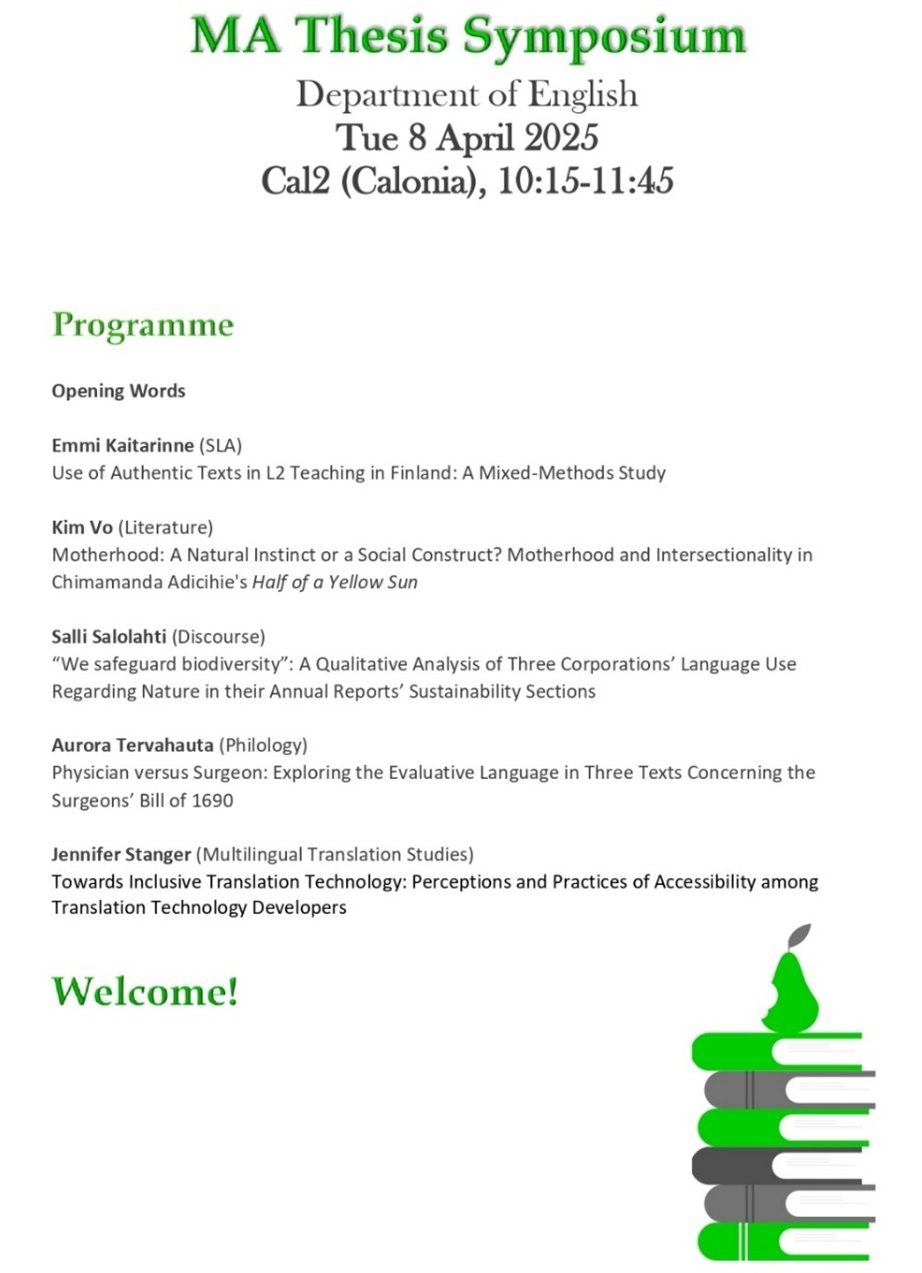
The program for MA Thesis Symposium held at Department of English on Tuesday 8 April 2025 Programme: Opening Words Emmi Kaitarinne (SLA) Use of Authentic Texts in L2 Teaching in Finland: A Mixed-Methods Study Kim Vo (Literature) Motherhood: A Natural Instinct or a Social Construct? Motherhood and Intersectionality in Chimamanda Adicihie's Half of a Yellow Sun Salli Salolahti (Discourse) “We safeguard biodiversity”: A Qualitative Analysis of Three Corporations’ Language Use Regarding Nature in their Annual Reports’ Sustainability Sections Aurora Tervahauta (Philology) Physician versus Surgeon: Exploring the Evaluative Language in Three Texts Concerning the Surgeons’ Bill of 1690 Jennifer Stanger (Multilingual Translation Studies) Towards Inclusive Translation Technology: Perceptions and Practices of Accessibility among Translation Technology Developers
This year’s MA Thesis Symposium had speakers from all of the Department’s MA Tracks.

I asked the presenters to join me in writing this blog, and Salli Salolahti and Kim Vo hopped onboard. Here they reflect on their experience of writing an MA Thesis and creating a short presentation based on it. They also touch on what it felt like to talk about their research in front of a live audience.

Salli Salolahti (Discourse track):

The MA thesis process definitely taught me a lot more than I initially thought it would! I perhaps naively thought that I would just get it done and that the biggest obstacle would be writing a paper this extensive. However, it turned out that for me the biggest obstacle to overcome was not the writing or any theory – it was perfectionism!

To make progress in the MA thesis process, you have to go through different steps like turning in your topic proposal, research plan, first draft, and so on. I had to accept that these would be less than perfect and that the whole process is simultaneously about showing what I have already learned and learning something new. I spent a lot of time experimenting with different approaches before finding the ones that I could make work. While this was at times frustrating, it was also great to realise that I was able to reflect on and solve many of the issues myself.

When it came time to present my thesis, I assumed squeezing it into a ten-minute presentation would be easy, but it turned out that was not the case. It had been a while since I submitted my thesis, and I had promptly forgotten how much ground it covered! While ten minutes initially sounded like plenty of time, in the end it went really fast.

I was both excited and nervous to present my research. Speaking in front of a live audience did not make me nervous, as I am used to it, but the idea of possibly misrepresenting something about my own research, methods, or theories stressed me. But I needn’t have worried about it: as soon as I started talking, it felt like I remembered everything. It was actually quite nice to talk about something that I myself had done and was proud of and also knew more about than anyone else in the room!
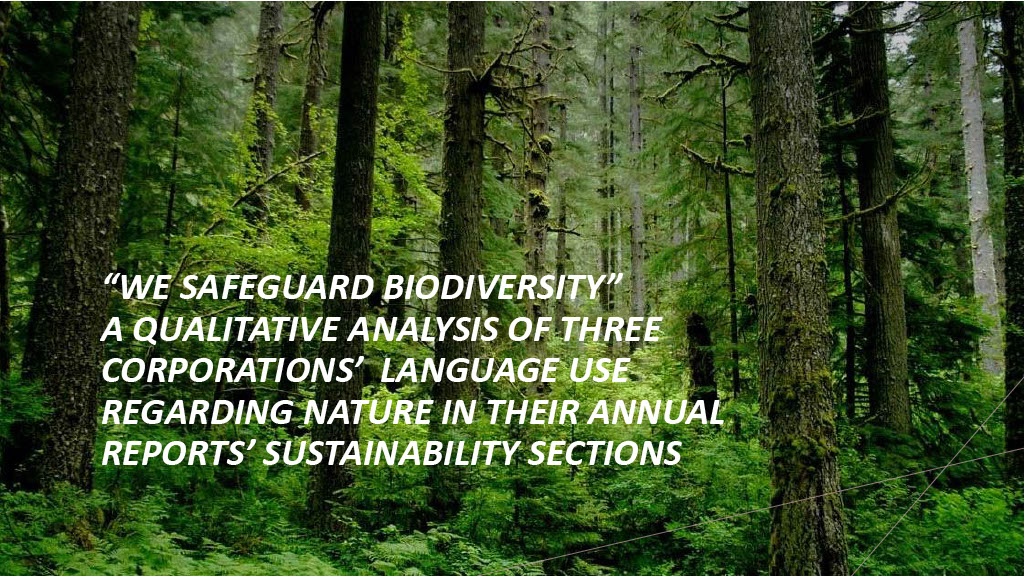
The title slide from Salli Salolahti's powerpoint presentation, depicting the title of the presentation (“We safeguard biodiversity”: A Qualitative Analysis of Three Corporations’ Language Use Regarding Nature in their Annual Reports’ Sustainability Sections) in white in front of a picture of a forest
In her MA Thesis, Salli Salolahti used ecolinguistics, critical discourse analysis and transitivity analysis from systemic functional grammar to analyze the language different corporations use when they talk about nature.

Kim Vo (Literature track):

My MA thesis explores a deceptively simple question: is motherhood an innate, natural instinct — or a social construct shaped by culture and expectation? As it turns out, writing about motherhood felt a lot like… well, becoming a mother.

The early days of thesis writing were filled with anticipation – glowing, even. I was excited, full of ideas, and ready to dive in. Then came the “morning sickness” phase: nausea-inducing literature reviews, endless source hunting, and the creeping dread that maybe I’d bitten off more than I could chew. But just like in pregnancy, there were those magical kicks – moments when my analysis clicked, and I felt the baby (read: thesis) growing into something real.

The final stretch? Labor. Pure, exhausting, deadline-driven labor. Pulling everything together felt like pushing through contractions – painful, but with a purpose. And finally, there it was: a fully formed thesis, screaming for attention and citations.

Presenting my work was another surprise. Despite two years of teaching experience, I still felt butterflies facing a new audience. But once I started talking, the nerves melted away. Ten minutes flew by – barely enough time to scratch the surface – but I was proud to share my research and answer questions.

This journey taught me that writing a thesis isn’t just academic – it’s deeply personal, occasionally chaotic, and ultimately rewarding. And like any proud parent, I’m just glad it’s finally out in the world.
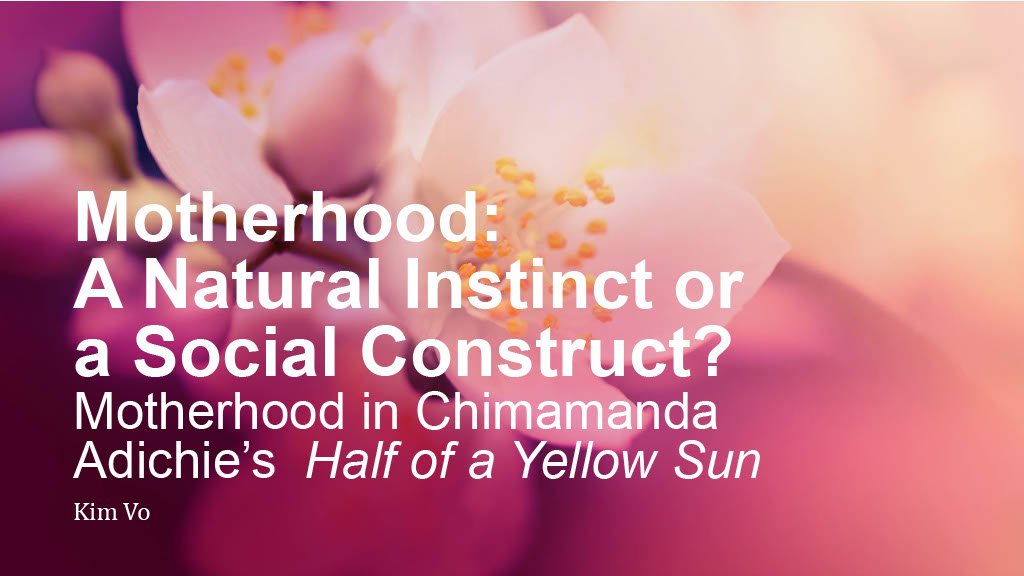
The title slide from Kim Vo's powerpoint presentation, depicting the title of the presentation (Motherhood: A Natural Instinct or a Social Construct? Motherhood and Intersectionality in Chimamanda Adicihie's Half of a Yellow Sun) in white in front of a picture of flowers
In her MA Thesis, Kim Vo explored the many types of motherhood present in Chimamanda Adichie’s depiction of post-colonial Nigeria and concluded that motherhood exists as a dynamic interplay between instinct, choice, and social influence.

Text and photos by Ira Hansen, Salli Salolahti and Kim Vo
TiTaRa: Between Science and Magic Symposium Through the Eyes of an Assistant

The TiTaRa: Between Science and Magic Symposium was a great success! The symposium was held on 10–11 October here in Turku together with the Finnish Network of Magic Studies to explore topics such as Western esotericism, magic, witchcraft and early sciences bordering them (such as alchemy and astrology). Participants arrived from around the world, and the topics varied from medieval England all the way to Finland in the 19th century and everything in between.

There were three of us assistants, and in addition to assisting at the symposium, there was a variety of things to do both before and after the event: checking the symposium’s emails, designing and setting up signposts and nameplates, compiling a book of abstracts of all the presentations and making social media posts… Some of these sounded a little intimidating at first for someone with no prior experience on such things but it turned out to not be too difficult after all because we had such a great team. Help was always available, and it was easy to divide some of the work between the three of us. During the symposium, our main responsibilities were working at the reception and assisting with the technology (thankfully no issues arose with the computer!).

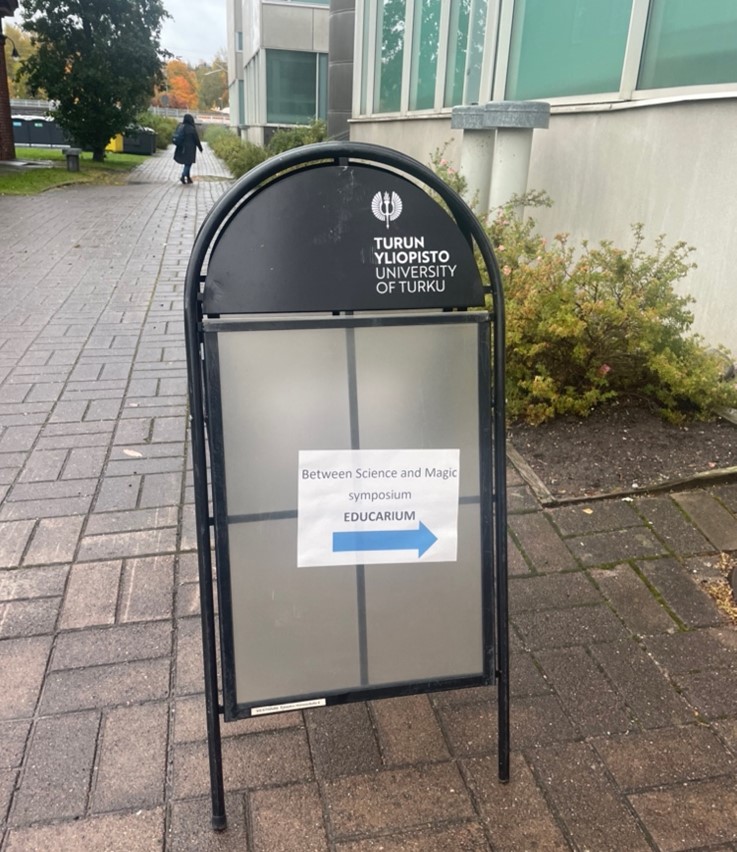
The signpost guiding our guests in

Day 1 of the symposium started bright and early on a rainy October morning for us assistants and other organizers of the event. The first things to do were putting up signs outside so that all of our guests could find their way in and making sure the presentations of the day were set up and ready to go. Attendees started arriving a bit before 9 a.m., and our job was to welcome everyone at the reception and hand out nameplates. At 9:15 it was time to officially start the symposium! The first presentation was one of our two keynote speakers, Professor Egil Asprem from Stockholm University. The presentation was about Romani magic and the sexism & racism involved in it with most fortune tellers at the time being women, as well as the stereotypes surrounding it being fraud.

After the first presentation, we had a quick coffee break and then continued with two more presentations before lunch. As assistants, we divided the work so that one or two of us stayed at the reception and the other(s) helped with setting up the presentations (and had the perk of listening to them!). Hearing many of the presentations was honestly one of the best parts about being an assistant at a symposium with such an interesting theme! After lunch, there were three more presentations, and then it was time for coffee once more, followed later in the evening by a City of Turku reception and a dinner at Brewery Restaurant Koulu. After the coffee, we made sure everything was in order for the second day. The first day went by very quickly and left me more excited.

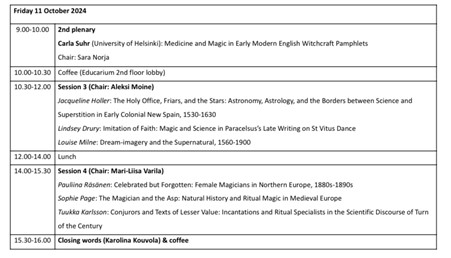
Day 2 started quite similarly for us as the first day. Friday’s first presentation was another one of our keynote speakers, Carla Suhr from the University of Helsinki, whose topic was witchcraft and medicine in early modern English witchcraft pamphlets. The presentation focused on the visual features of the pamphlets, advertisements of proprietary medicines and how they were presented to the audience.  The second day passed by just as quickly as the first, with a total of six presentations in addition to Carla Suhr’s presentation. There was so much to learn, and everyone’s presentation added new perspectives to the theme of the symposium; I learned about the role of magic (and science) in astronomy & astrology, dance, dreams & nightmares and so much more! In a flash, the second day was finished too. Everything went even better than I had anticipated; we had no major issues and everyone seemed to enjoy themselves.

The schedule of day 2

It was a great experience to learn about all that goes into organizing an event like this, and it felt inspiring to see how passionate everyone seemed to be about their own presentations, and all the discussion each presentation sparked among the attendees. During coffee breaks, it was nice to hear bits and pieces of conversations the attendees were having, often inspired by the previous presentations. I would recommend an assistant internship like this to everyone! It was such an interesting way to meet new people and to learn how academic events are organized. The topics were interesting, everyone was extremely kind, and it hardly felt like work at all. A big thank you to everyone who was part of the symposium!

Text and photos by Maija Riikonen

A harmony of work and play – Working as a conference assistant in the Trextuality conference

Serving as a conference assistant and project intern is an excellent decision. Please, let me tell you why!

The info desk of the Trextuality conference, occupied by two conference assistants (taken by the Trextuality social media team)

I attended the Trextuality conference as an assistant and project intern. The conference was aimed at scholars working in translation studies and textual criticism, as well as neighbouring disciplines, such as literary studies and book history. The conference was held 7–9 September 2023 at the University of Turku in the recently renovated Arcanum building and in Educarium. The presenters’ topics were very varied, so you were bound to find something interesting. Personally, I was most interested in seeing how a conference would be organised. In addition, there were several presentation topics that intrigued me. For example, reference module 2B in the image below.

The afternoon schedule of the second day of the conference

Now that you’ve had a glance at just one of the days of the conference, you’ll probably see why I wholeheartedly recommend grabbing the next opportunity to be a conference assistant! Should you not have the time to dedicate to an internship of three or five study points, you get to participate in the lectures held by the attendees for free. If even that somehow fails to entice you to join, let it also be mentioned the food was very good and very free. I will reiterate, there is no need for a commitment to a project internship. You can just be a conference assistant with no strings attached, and these regular assistants were the majority of our numbers. Should you have the time and inclination for an internship, keep reading. If not, keep reading anyway.

So, you want study points for your efforts. You can get a project internship and three study points for your efforts if you put in around 81 hours of work. You get five study points if you put in 135 hours of work, as with regular courses. The 80-hour mark is pretty easy to achieve, whereas the 135-hour mark will require some special arrangements with your supervisor.

There are usually several different ways to help around, be it before, during, or after the conference. I will mostly be talking with this conference in mind, but much of this applies to project internships done as a part of other types of events as well. For instance, before the conference there were signposts to be set up and the lecture rooms had to be rearranged to suit the conference’s needs. Some of us were a part of the photography and social media teams that created content about the conference during the event. I was a part of the shift list team. Our planning made sure every room and the help desk were always occupied by at least one assistant. 

During the conference, the social media team and help desk and lecture room assistant duties offered a chance to pitch in. In addition, simply attending the presentations held by the attendees counted towards the hour threshold. Due to sick calls, I had to go a little light on attending presentations. I spent most of the conference manning the information desk, ready to help conference guests with whatever questions or needs they might have.

After the conference, there is the option of writing about your experiences for publications, which is exactly what I’m doing right now! These publications can be magazines read by linguists or blogs, such as the one you’re reading this text on.

We, the assistants, were called the T-rex team. The working spirit of the T-rex team impressed me. There were quite a few cases of illness that popped up during the conference among the assistants. Despite this, our line held, and we fulfilled our duties.

A group photo of some of the conference assistants (taken by the Trextuality social media team)

Our supervisors, the actual organisers of the conference, were the masterminds behind the whole operation, pulling it off like the true academics they are. Many occasions needed quick solutions and creative problem-solving that only the organisers had the authority to do. Say, helping with luggage forgotten by the attendees. Whenever we, the assistants, were at our wits’ end, asking our supervisors didn’t leave us on the rocks. We, the helping hands, were in good hands ourselves.

What for me personally made the entire conference was how kind and patient the guests were. If they needed help with something, they were polite, and if we had to find something out for our guests, they waited calmly, without rushing us. Their demeanour was professional and pleasant all around. We also received a great deal of kind words from the attendees in the form of emails sent to the organisers after the conference, which I personally found very heart-warming to hear.

To summarise, if interested, the next time you get an email saying that conference organisers are looking for assistants, grab a friend and volunteer. Do it for the study points, the experience, just to help out if nothing else. The worst that can happen is getting free food and a chance to meet fun people. Doesn’t sound like a bad deal to me.

Text by Ali Lamminen

Unraveling the Complexities of Competence

Earlier this spring, I had the opportunity to attend an eye-opening event on the “complexities of competence”, namely, Marja-Leena Niitemaa’s doctoral defense on Complexities of Competence: A Study on Finnish Upper-secondary Lexical Development and Use of L2 English. I had no idea what to expect, other than it was a formal event, and, I imagined, a very nerve-racking one, at least for the doctoral candidate.

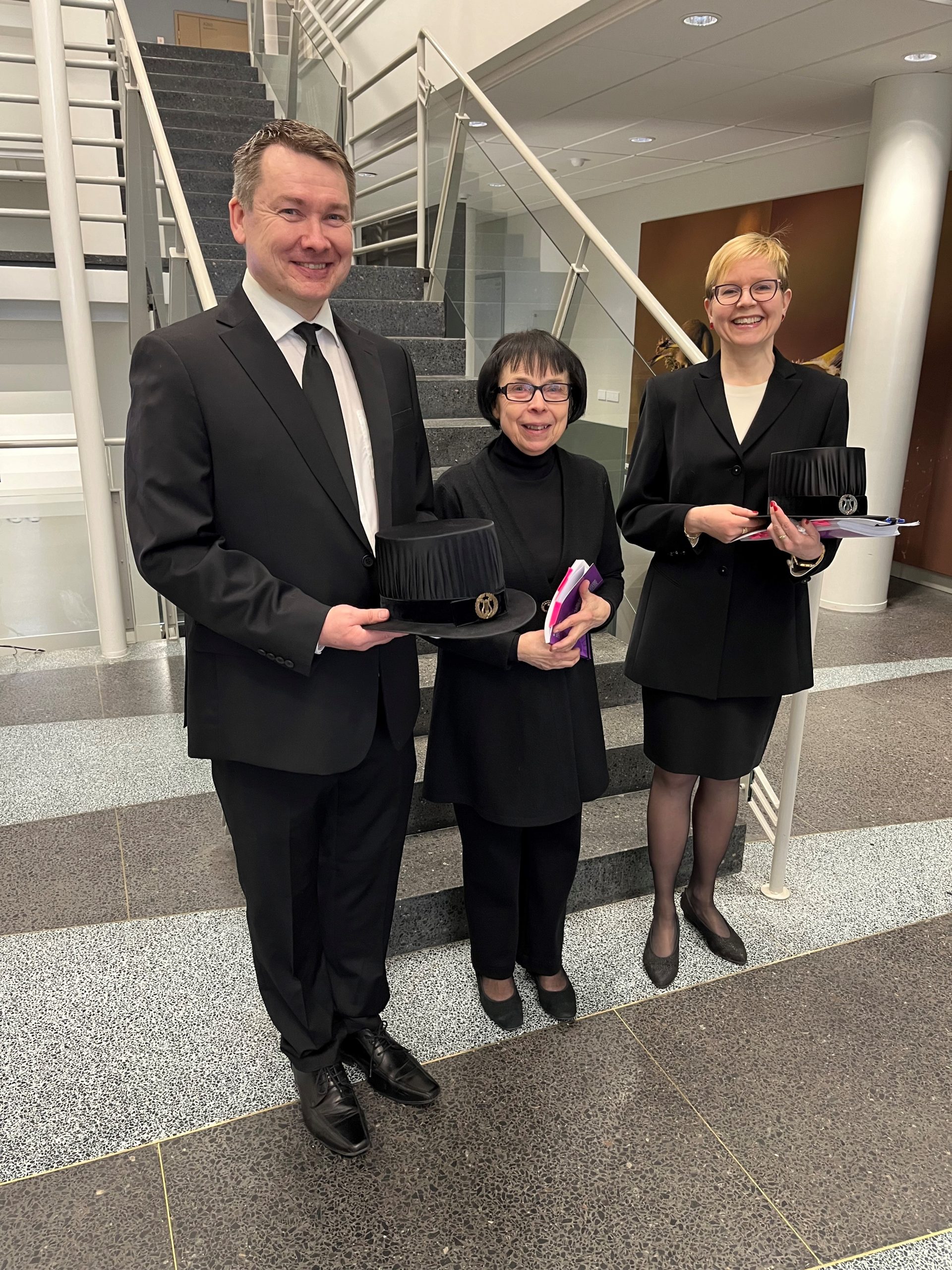
The viva voce is the ultimate climax of years of hard work, i.e., blood, sweat and tears for many. Finally, the day has arrived when you can present to the public the cornucopia of knowledge you have acquired along your PhD journey. The grace and dignity of the event was humbling.

Marja-Leena’s viva began with an introduction by the Custos, Professor Pekka Lintunen. Senior Lecturer Katja Mäntylä of the University of Jyväskylä was Marja-Leena’s Opponent (thesis examiner). Marja-Leena’s lucid lectio praecursoria captured the audience’s interest from the start because the topic of her dissertation is perhaps something many people can relate to, i.e., acquiring and applying foreign language skills through digital means. The complexities Marja-Leena spoke of refer to the multifarious and interweaving ways in which young people acquire English today. Learning English is no longer limited to the classroom only; rather, students draw upon the resources their environment offers, e.g., internet and television. 

Marja-Leena Niitemaa together with Custos Professor Pekka Lintunen and Opponent Senior Lecturer Katja Mäntylä

The event was indeed a learning experience, having struggled with my own complexities along my PhD journey. For example, how do you navigate around unexpected results, results that controvert decades of previous research? This can really multiply your symptoms of imposter syndrome! How do you get your head around statistics when your brain has not been wired for such things—let alone interpreting them! How do you balance work and tend to your PhD brainchild? How can you tell procrastination to go pound sand? The answers to these questions are, of course, different for everyone. Perseverance and determination certainly help, keeping your eye on your target and thinking back to why you began your PhD journey in the first place also help.

For me, experiencing Marja-Leena’s viva helped me to garner the much-needed faith I needed to invest in myself. I was able to witness first-hand the culmination of hard work, determination and learning processes that go into writing a dissertation. This, if anything, gave me a nudge to keep working towards the goal I set so many years ago. So, if you are contemplating about getting a PhD or struggling to finish one, go to a viva—you’ll get all the inspiration you need!

Text: Judi Rose

Photo: Pauliina Peltonen

A long way to Arcanum: the English Department on the move

When the staff of the English Department have just moved into their brand-new premises in the newly renovated Arcanum building on the University’s lower campus at the beginning of 2023, this may be a convenient moment to take a brief look at the previous oases on the itinerary of the departmental caravan from its beginnings to the present day. There have been altogether five stops on the way to Arcanum.

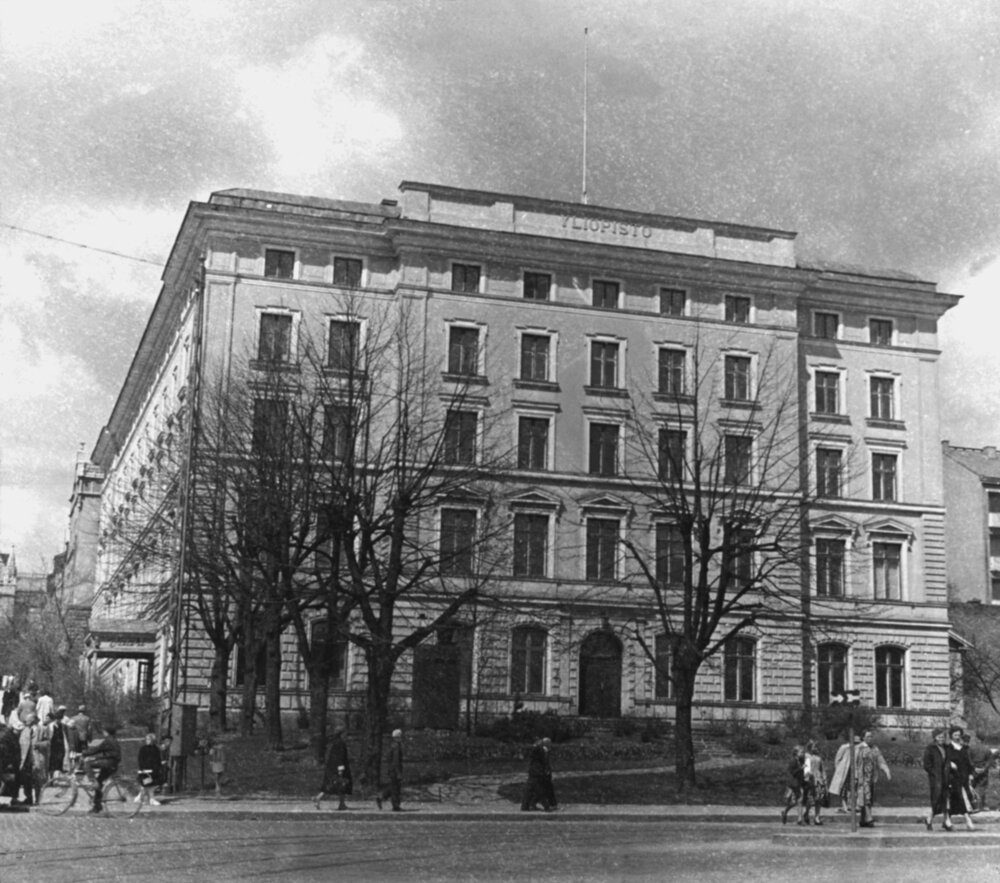
Taking the founding of the chair for English Philology in 1945 as the date of the founding of the Department, it was first located, together with the entire academic community of the new Finnish-speaking university of Turku, in the premises of the old Hotel Phoenix, a colossal late nineteenth-century building on the market square. Phoenix itself no longer exists, for it was demolished 1959.  

The building Phoenix in springtime in mid-1950s (photo from the Central Archives of the University of Turku)

Any available space for the departments in the building, originally designed for an entirely different purpose, must have been very limited, for the many functions of the new establishment, including teaching, administration and library, were housed under the same roof. As a result, there was a pressing need for expansion.

In the next phase, the University makes a move closer to the location of the old Academia Aboensis (1640) around the Cathedral. The oldest of the modern buildings on the current University hill date back to the 1950s. The Library was completed 1954 and the Main building 1958. From the mid-fifties until the mid-seventies, the English Department had its own library in three of the seminar rooms on the top floor of the Library building, within the space of present Feeniks library. In addition, there may have been some temporary space available for office hours, and the like, on the second floor of the Main building until the early 1960s.

Along with the increasing numbers of students and staff in the English Department during the 1960s, there was an acute need for more office space. At this point in the mid-1960s, the premises in Hämeenkatu 1, previously occupied by the Department of Dentistry, became available when a new building for dentistry was completed in Lemminkäisenkatu 2 in 1965.

The premises in Hämeenkatu 1 consisted of one long corridor with a number of rather small rooms on either side, originally designed for the needs of dental practices. The rooms were shared between several humanities departments, including history and philosophy. English had four rooms. One of them was the department office, and another was reserved for a visiting Fulbright professor. The other two were mostly used for office hours and consultation. Working at (and from) home was very much the norm for the staff at the time, and any joint meetings of staff and students were held elsewhere on campus.

Many of the long-standing problems of inadequate facilities and insufficient working and teaching space were resolved when a whole new building was constructed for the Humanities in Henrikinkatu 2 in 1975. The H-shaped building was originally called Humaniora II, Humaniora I having been Fennicum in Henrikinkatu 3, completed 1969. Humaniora II was renamed Juslenia, and it became a home for the Department until 2012. For the first time, most of the Indo-European language departments came to be in the same building, together with several other humanities subjects from archaeology and history to literature and cultural studies.

Having individual offices for the members of staff was one of the highly appreciated innovations of Juslenia. Also, having several teaching rooms close by in the same corridor was another welcome novelty we had not experienced earlier. Similarly, there was an easy access to the seminar library on the same floor as the Department. Yet another big change was the much-needed social space for the staff in the form of a coffee-room. With its iconic round table, this new facility had a lasting and enormously important positive impact on our social and academic interaction.

Over the years, with our initial enthusiasm gradually waning, we became more and more aware of the shortcomings of the building. Many of these had their origin in the stark contrast between the original design of the building and its practical realisation. As a result of an economic setback coinciding with the building project, the University was unable to carry out the construction, as originally envisaged. Among other things, one entire floor, containing a cafeteria/restaurant, had to be deleted from the plan altogether. Also, the surface area of each of the remaining floors had to be drastically reduced. Consequences of such dysfunctional adjustments could not pass unnoticed. They would be apparent, for example, in an awkward organization of the space, just as well as the crudish design of the interior and the limitations of available facilities. In the end, the pros for tearing down the entire building outweighed the cons for repairing it.

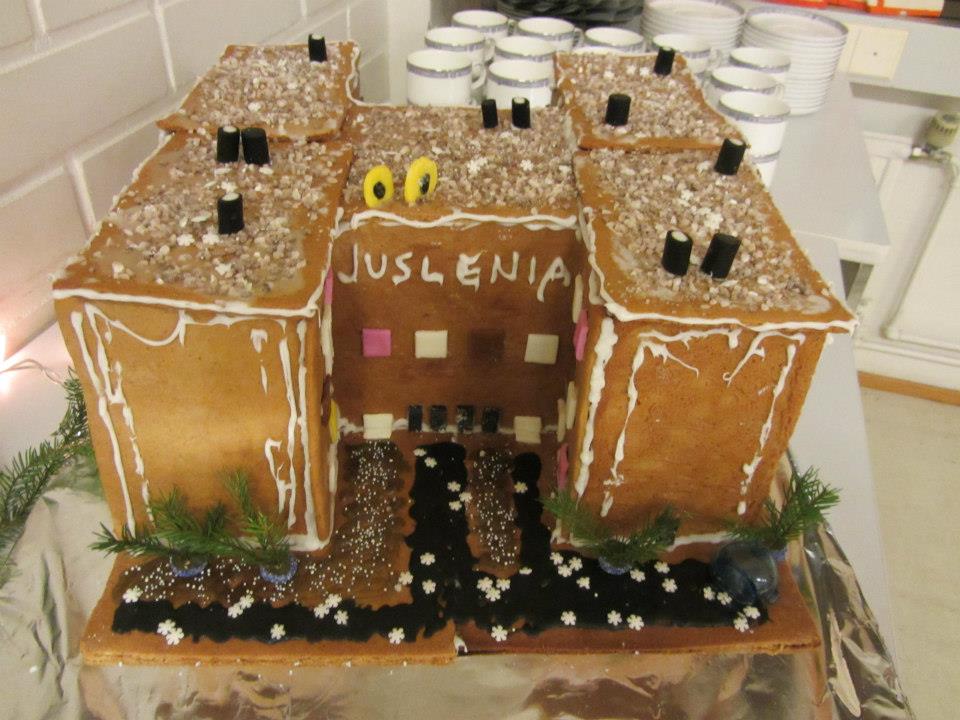
Still, in spite of its unevenness and roughness, Juslenia always brings to mind happy and pleasant memories, probably because we stayed there for such a long time, close to forty years. The final fall of Juslenia was complete in 2019, but in the Department, we had already lived through the upcoming loss by ceremonially cutting a gingerbread replica of the building into pieces of cookies at a Christmas party before leaving the building.   

Gingerbread Juslenia (photo by Mari-Liisa Varila)

Our penultimate stop before Arcanum takes us to Rosetta and its sister-building Signum, both charming old buildings from the turn of the twentieth century. After the property had become part of the University, it was renovated on several occasions for different purposes, most recently for housing the departments of English, French and German translation. Both buildings had offices and teaching rooms, and a joint library of the translation departments in Signum. After the merger of the translation departments with the respective philologies in 2010, the latter, with English among them, moved into Rosetta/Signum a couple of years after. All departments moved out of these premises by the end of 2022.  

There are many positive things to be said about Rosetta/Signum as a workplace. First and foremost, there was an atmosphere of a handsome old building about them, which was very nice. The staff rooms varied in size, but were on the whole quite comfortable, and much the same can be said about the teaching rooms. There was also a joint common room for those working in the building. My impression is that colleagues were generally quite pleased with the place and what it had to offer.

One aspect of the Rosetta building that was sometimes criticised had to do with the interior of its architecture, especially the number of doors everywhere. With the offices aligned along both sides of the numerous corridors with separating doors at both ends made the building a bit like a labyrinth, where students and visitors might have had difficulties finding their way around.

Aerial view of Rosetta and Signum (behind). Photo by Hanna Oksanen, copyright University of Turku Communications

Finally, we’ll get to Arcanum. From what I have seen so far, the building is superior to all the earlier ones in a number of ways. It is not only a modern building to begin with, but one that has been very recently renovated and refurbished completely for the needs of its users. Everything is conveniently accessible and close at hand. The teaching rooms are pleasant and spacious with excellent, up-to-date facilities. Another truly great improvement is the fact that all departments of the current Faculty of Humanities are for the first time in the very same building. This is a tremendous asset for the spirit of cross-disciplinary interaction and cooperation and will, no doubt, amply prove its worth in the years to come. 

Arcanum in winter. Photo by Suvi Harvisalo, copyright University of Turku Communications

It has sometimes been said that the walls are less important in Academia; it’s more important what goes on within the walls. This is true, of course, but only up to a point. The splendid premises of Arcanum rather indicate a very close interaction between the outside and inside. When the walls are constructed in harmony with the wishes, efforts and needs of the people inside, they connect rather than separate. It is a great joy to see that our long journey from Phoenix has been brought to such a happy close in Arcanum.

P.S. I am grateful to Teppo Jakonen and Janne Skaffari for their help in the preparation of this contribution. Teppo very kindly assisted in finding the photographic illustrations.

Text by Risto Hiltunen

Becoming an English teacher in Namibia and Finland

This autumn, the School of Languages and Translation Studies has had a visitor from the University of Namibia (UNAM), Dr Meameno Shiweda, who is a specialist in teacher education. In this blog post, Meameno and Janne Skaffari talk about similarities and differences in what and whom they teach and, more broadly, in the educational systems of our two countries.

Janne: How does one become an English teacher in Namibia?

Meameno: Anyone with an interest in teaching English can enrol in a teacher training program for junior/senior primary or junior/senior secondary levels, provided that they have good grades in five subjects, and a minimum of a C grade in English at Namibia Senior Secondary Certificate. A minimum C grade in another language is also a requirement. C is roughly the same as cum laude or magna in your matriculation exam.

J: It is quite different from Finland, where you apply to study English as your major or minor at university, and teacher training is basically a minor subject that corresponds to one year’s work. It is often completed as part of the MA degree. This route is for secondary-school English teachers, but for primary schools, you do not necessarily need more than a primary-school teacher’s university degree in Education. When does English begin in your program? Our majors do English Department courses from the first semester on.

M: Throughout their four years of teacher training, our students receive a mix of English modules and teaching-methods training. English majors also commence from the first semester onwards, and they are taught by English subject specialists from various departments in the School of Education. The first year begins with phonetics, phonology and children’s literature, and in the second year they focus on speaking and youth literature. The third year is reading and writing, while the fourth and final year is adult literature and grammar.

J: Oh, grammar comes that late! What kinds of observations have you made about teaching and studying during your visit?

M: The length of time a student studies English before having to determine whether or not they want to become English instructors is an important observation I have made here. Additionally, I have learned that prospective teacher-training students are interviewed to gauge their level of preparedness for the teaching profession, as opposed to our practice at UNAM.

J: We think it is important that students have time to become familiar with their major and minor subjects at the BA stage and then focus more on a particular career during MA studies.

M: I’ve learned from my experiences here and from talking to colleagues that getting extensive English training before concentrating on a teaching job is more realistic.

J: Yes, we really hope it helps! Students also get to see that there are other career opportunities.

M & J: We wish all our students – in Namibia and Finland – good luck with their studies and future careers!

Text by Meameno Shiweda & Janne Skaffari

Photo by Teppo Jakonen

A year of remote learning – and cats

What a year it has been! This could easily be a long blog post about the effects of the pandemic on teaching and learning and what pedagogical solutions have been implemented and experimented with at the department, but today we have more important things to discuss. We need to talk about cats.

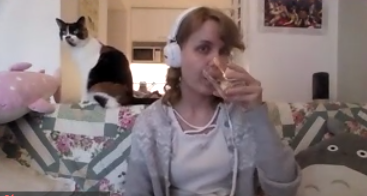
This year has been extremely active for all our cat students and cat faculty members. They seem to thrive particularly in Zoom environments and have throughout the year been a mainstay for remote learners and teachers. Let’s hear from notable cat members of the English department community – and one dog. Email interviews have been facilitated by each cat’s staff.

Kiki via Vilma Lindroos:

Due to remote learning this year, I have seized the opportunity to constantly remind Vilma that the most important thing in her life are not her studies, but me. She reports that my ears perk up at the slightest sound of conversation, ready to disrupt yet another lecture that dares to take her attention from me even for a minute. Petting me in her lap does serve her as a great stress relief when she is tackling a particularly intimidating task, so I always win.

Behold as I conquer, says Kiki.

Alma, Hilja, Lohtu and Kulju via Elina Valovirta:

Elina works from an old renovated outbuilding at our country home. We use it as our Signum’s Kaffila or Rosetta’s coffee room. Whenever Elina heads to the outbuilding to work, we follow, eager to not help. A collective napping session might ensue; Alma the opera singer might decide to belt out an aria, or Hilja and Kulju decide a wrestling match is in order right in the middle of Elina’s lecture. Lohtu begs for treats on the work desk. We have done our very best in not helping at all, and what’s not to love about that?

I can haz treat?
I can haz treat? Says Lohtu.

Elo and Fox via Minna Hjort

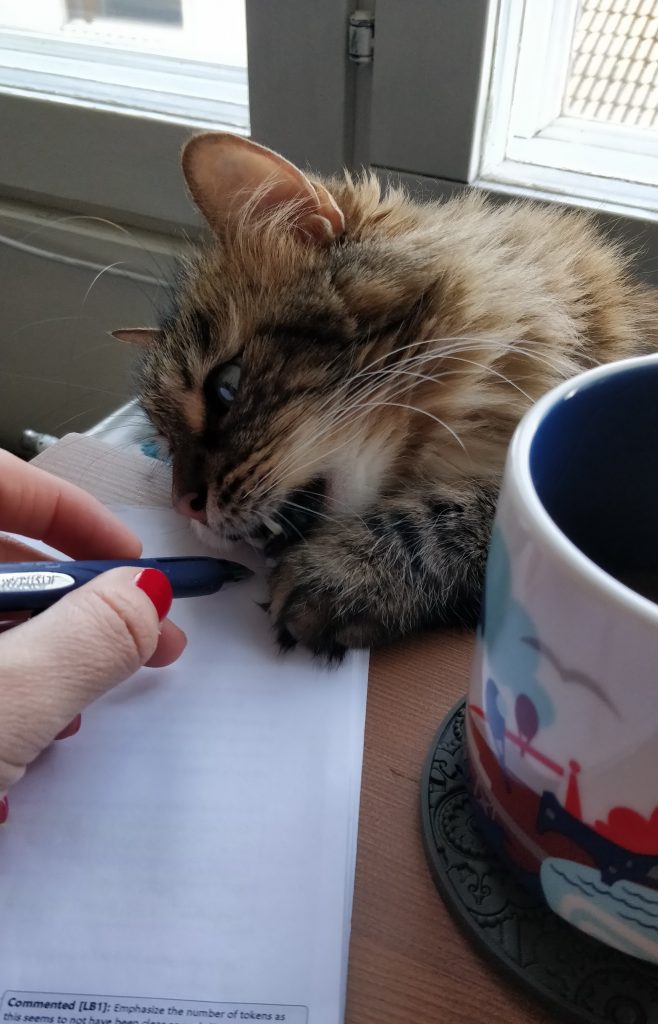
Fox has been an active co-teacher throughout the pandemic. He has not been afraid to speak his mind about a variety of topics, including the shocking fact that the department offers no classes on dog-human translation. Elo, the cat that she is, has been less interested. Although once she did find it necessary to position her butt right in front of the camera in the middle of a lesson. Occasionally she also assumes the role of reviewer 3 (see picture) and engages in document disposal management (shredding papers).

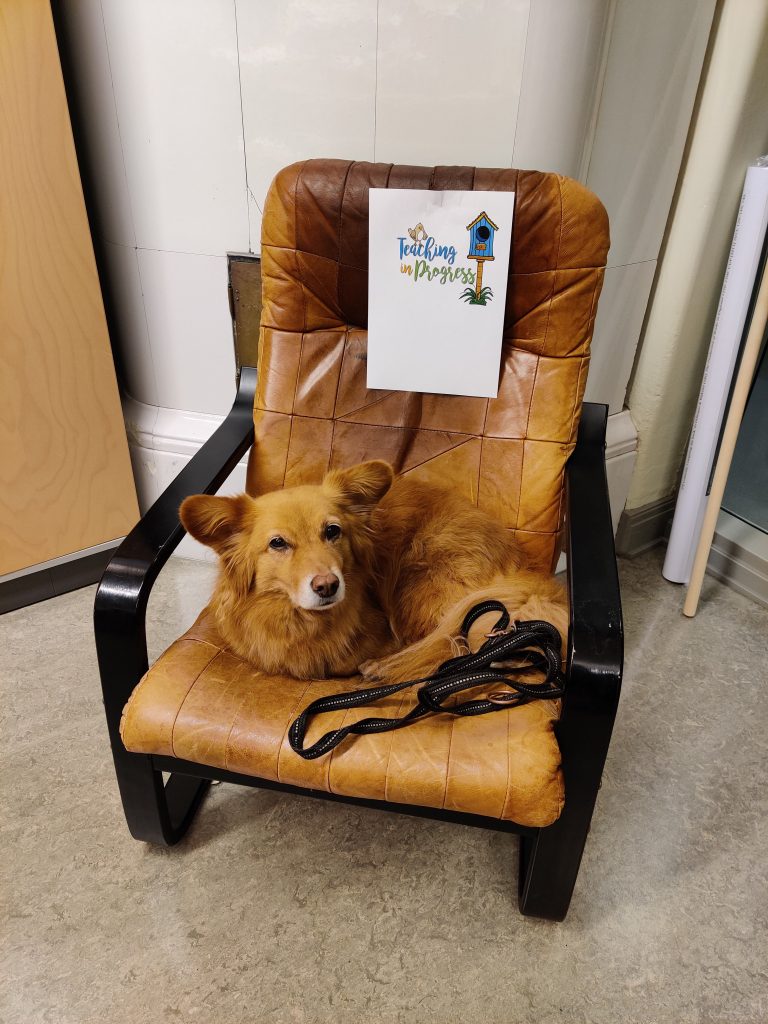
Teaching in progress. Don’t disturb me, says Fox.
I am destroyer of all papers.

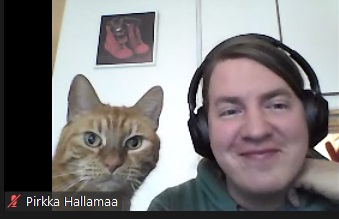
Finally, Pirkka Hallamaa, has found a way to look his best on camera: his photogenic cat provides the ultimate Zoom accessory: the cat filter.

Don’t hate me because I am beautiful.

Text by Elina Valovirta

Photos by staff and screen grab.

Eating elephants

Nearly 1.5 years into my doctoral studies, I have already encountered some sort of block. Things are just not progressing the way I would like, something is not working. I feel like I have read every possible piece of available research about my topic but starting the first article seems like a horrendous endeavor. What am I doing? Where do I start? What perspective should I take? Am I prepared enough? Do I have the concepts right? Maybe I should just make another cup of tea…

A couple of days before the event that was to take place on March 21,2019, I received an e-mail stating that there were places still available in the Finding joy and productivity in academic writing lecture and workshop. Guest lecturer Carol Kiriakos, co-author of Tohtoritakuu, was to speak about practical approaches to academic writing. My first thought was, “This is scary!” Can you imagine? This was exactly what I needed, and here it was in my mailbox, and none too soon as the event was in just two days! I was not really sure what the ‘practical approaches’ might entail, but the words ‘joy’ and ‘productivity’ were what really caught my eye. Could I really find joy in my situation of ‘rookie’s block’, and could I ever become productive in my revelry of procrastination?

Carol Kiriakos provided answers to both questions, “Yes and yes.” First, you have to take an inventory of your beliefs; what beliefs do you have about yourself or your writing that keep you from writing? Participants took a few minutes to write down their beliefs, and to my astonishment, we were all struggling with the same issues: getting started, time management, insecurities pertaining to abilities, being prepared, procrastination, lack of inspiration, etc., etc. At this point, the group of participants became a united whole – we were all in the same boat struggling in the same weather to keep it afloat.

Once you are aware of what is keeping you from writing, you need to create a writing habit. At what time of day do you feel the most creative or productive? A rule of thumb is the further the day progresses, the less creative and productive we become because other things begin competing for our attention. How much should you write at one go? Kiriakos warned us not to set ourselves up for failure. If you plan to write 5 pages on a certain day and do not achieve that goal, most likely you are going to feel like you have failed and starting the writing process again may take an unnecessary number of days or weeks.

The third thing, and perhaps the most important, you should do is learn how to eat an elephant. Well? How DO you eat an elephant? According to Kiriakos, the answer is: One bite at a time. For example, if you write in your calendar “PhD thesis” for every day you would have time to work on it (as I have done and now have a lot of erasing to do), you are setting yourself up for failure. Not only is it impossible to write a PhD thesis in a day, but you are also creating the feeling that you never get anything done. A more sensible approach would be to write, “1 page for Section 2.2.”, for example, or simply “one paragraph”. The same idea can be used for setting goals, i.e. break them down into smaller bites. For example: long-term goal (months to years) -> short-term goal (weeks to months) -> daily goal (hours to days).

To combat procrastination, i.e. always waiting for inspiration or the ‘right moment’ to write, Kiriakos suggested free-writing. During the lecture and workshop, we participants engaged in two free-writing sessions, both lasting about ten minutes. Free-writing was a surprisingly good way to get into the ‘habit’ of writing. We were given a topic each time: The Ideal Academic Writer and The Most Important Thing to Me. Both topics also gave us a bone to chew, which helped us to process the beliefs we have of ourselves. When doing free-writing on your own, you do not necessarily need a topic; on the other hand, having a topic may get you put your thoughts in order. You need to set a timer, so you do not have to look at the clock, and then just write about the ideas or topics you have for writing your thesis on that particular day. With free-writing, you can find that inspiration, and the moment you sit down to free-write is exactly the ‘right moment’ you keep waiting for.
I left the workshop feeling I had eaten my elephant, or at least cut it down into smaller, more manageable pieces. Feeling inspired by Kiriakos and getting the push I needed to start writing, I decided to share my experience here. I recommend reading Tohtoritakuu to BA students , MA students, even to the experts whose doctoral hat is worn around the edges and whose sword has defended truth and knowledge many times over. It contains useful strategies for anyone contending with an elephant…. One bite at a time.

Text by Judi Rose

Philological fieldwork in London and Turku

If you trust Wikipedia, fieldwork refers to “the collection of information outside a laboratory, library or workplace setting”. However, philological ‘fieldwork’ often takes place within a library – but instead of reading secondary literature, we examine primary materials. I’m currently a visiting scholar at Queen Mary University of London. During my stay here, I work on 16th-century manuscripts and printed books in the British Library.

Although early materials are increasingly accessible in digital form, and many early texts are made available in editions, not all research questions can be asked of these substitutes. Codicological, palaeographical, and bibliographical research methods entail close examination of books and texts as material objects. Analysing the physical construction of a book or the scribal hands present in a manuscript, for example, may also provide crucial evidence for studying the contents of a book.

To access special collections, one usually needs to register as a reader (instructions can be found on library websites). After registering, you can then order items to study them in reading rooms. You can bring your laptop, notes, and pencils, but nothing that might damage the books such as pens or sharp implements. White gloves, although sometimes seen on TV, may also cause damage to the books. They are thus generally not used in professional libraries. Clean, dry, and careful hands are the better option!

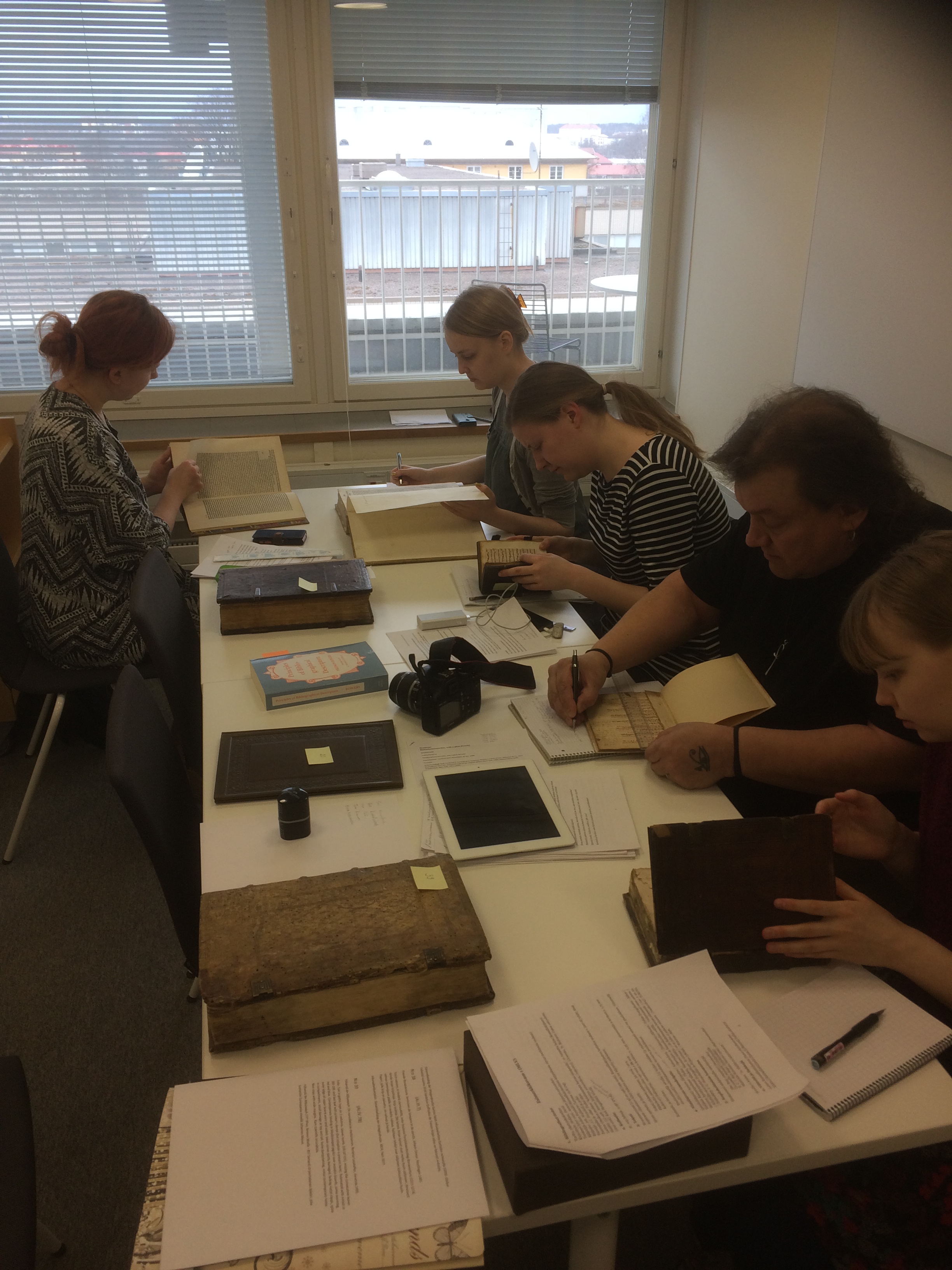
The University of Turku library also holds early materials. Last spring, students taking the Book History course organised by the Departments of English and European and World History had the chance to try their hand at being book detectives. My small group studied a selection of incunabula (books printed before 1501), practising the specialised skill of writing bibliographical descriptions of early books. Here they are at work!

Text and photo by Mari-Liisa Varila

My Days as a Conference Assistant

The Finnish Society for the Study of English (FINSSE) held its eighth biannual conference here in Turku this summer. Having never attended a conference before, I leapt at the opportunity to work as an assistant at the event and get credits for my Master’s internship. I’m glad I did, for The FINSSE-8 conference, “What’s in a Century?”, turned out to be the highlight of my academic year.

The whole experience was very positive. The organising committee welcomed me with open arms; I was given clear instructions as to what was expected of me and in moments of doubt I could simply ask for help. It soon became clear that organising a conference takes hours and hours of planning and preparation. Even I, a mere assistant, sat through several meetings and wrote countless emails. Those in charge certainly had a lot of work on their hands! Funding, venues, catering, timetables, name tags – all the meticulous work done in advance resulted in a successful conference.

During the event I took care of odd jobs here and there: I put up info signs, greeted people at the registration, carried water bottles and whatnot. I dabbled with things that may seem small, but, in the end, helped create a smooth conference experience. I was being useful and I liked it!

Amidst the work and responsibilities there were fun surprises and major perks. For example, during the first conference day we were treated to a small music number. The memory of conference participants, postgrads and professors alike, swirling around and dancing to the tunes of a violin will probably stay with me forever. Most importantly, though, I got a glimpse into the inner circle of English research in Finland: I felt like a little sponge soaking up knowledge and ideas. I had the opportunity to attend some interesting paper sessions and meet people working in fascinating fields of research – the conference even provided me with help for my upcoming MA thesis. The research community felt warm and supportive and people seemed to enjoy the conference. I’m lucky I got to be a part of it.

Text by Lilli Laine