
Academic festivities are there for a reason: they help us remember that we are part of a long scholarly tradition which is our cultural and intellectual heritage. That is where we belong. Not to mention the fact that they are extremely fun and enjoyable! 136 young doctors and 12 honorary doctors participated in a two-day conferment ceremony at the University of Turku towards the end of May. Our department was involved in two important ways: Professor Kenneth Hyltenstam from the University of Stockholm, a prominent scholar who has published widely on bilingualism and SLA and who has had a strong impact on research conducted in our department, had been invited to receive the title of honorary doctor on our initiative, and our very own Mari-Liisa Varila was among the young doctors on whom the doctoral degree was conferred in the ceremony (see Mari-Liisa’s own words below).
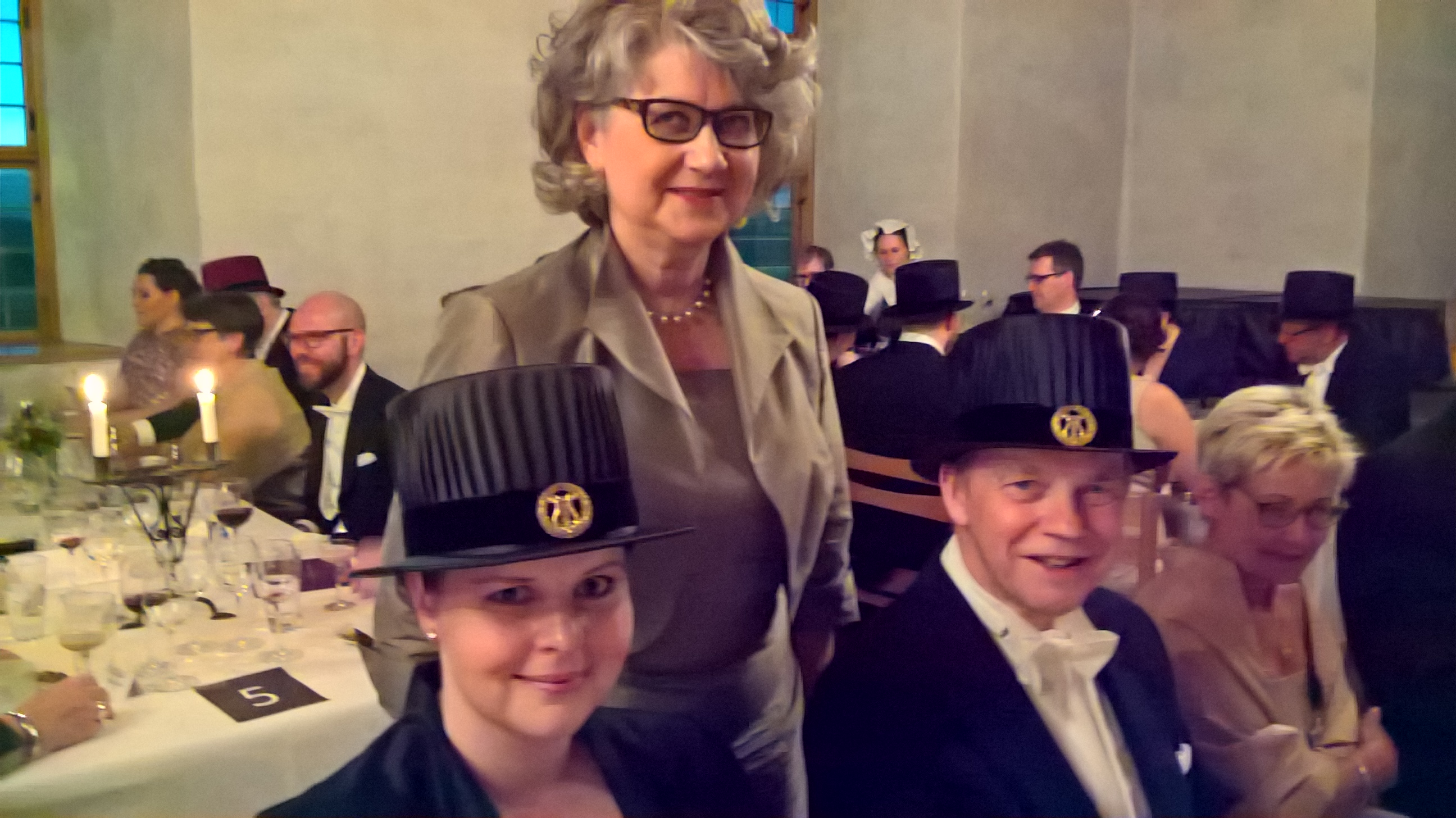
Mari-Liisa Varila, Päivi Pietilä and Kenneth Hyltenstam celebrating at Turku Castle.
It must have felt like two rather hectic days for our esteemed honorary doctors. All practical arrangements had been planned carefully beforehand by the organizing committee, including a fitting session on the morning of the first day, to make sure the white tie was the right size (the dress code is notably very strict on these occasions!), and transportation from the hotel to the various events and back again. The events consisted of a rehearsal at the Concert Hall, a sword-sharpening ceremony on the eve of the big day, the conferment ceremony itself, an academic procession from the Concert Hall to the Cathedral, a service at the Cathedral, a banquet at Turku Castle in the evening, and finally a ball at the Turku VPK House. In earlier years, the festivities went on even longer, as there was a boat trip to Naantali and lunch at Kaivohuone. Maybe it is not such a bad thing that the programme has been cut slightly; it is rather exhausting to be festive for two entire days, let alone three! But on the other hand, the two days were thoroughly enjoyable, and even the weather was better than anyone could have wished for: sunshine and a bright blue sky.
Text by Päivi Pietilä
The doctor in the hat
My doctoral degree was awarded already in June 2016, but the ceremonial conferment of doctoral degrees is only organised once every two or three years. To officially receive my hat, sword, and doctoral diploma, I participated in the festivities this year. It is not obligatory to take part in the ceremonial conferment, but I felt that it was a good way to stop for a moment and celebrate my achievement together with the other young doctors, the honorary doctors, and our academic community.
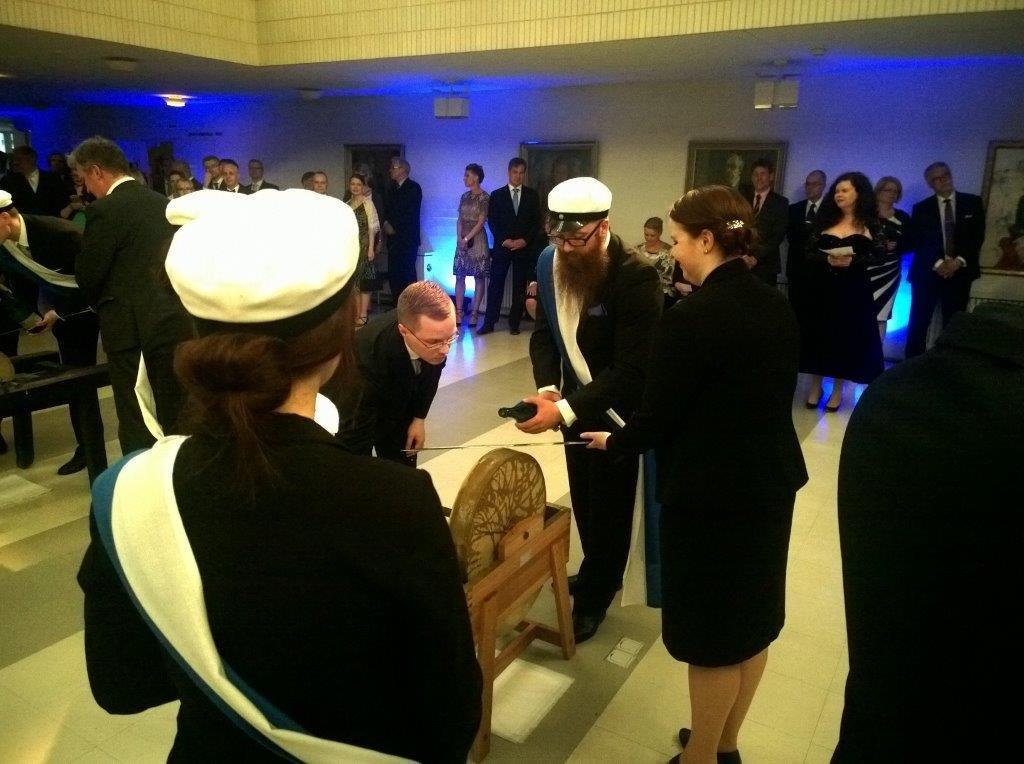
In the rehearsal on Thursday afternoon, we practised solemnly walking in pairs, receiving the sword, and bowing to the conferrer without dropping our hats. Excitement filled the air. In the sword-sharpening ceremony on Thursday evening, we symbolically honed our blades for the big day. Our avecs turned the grindstones while the heralds poured some bubbly on the swords.
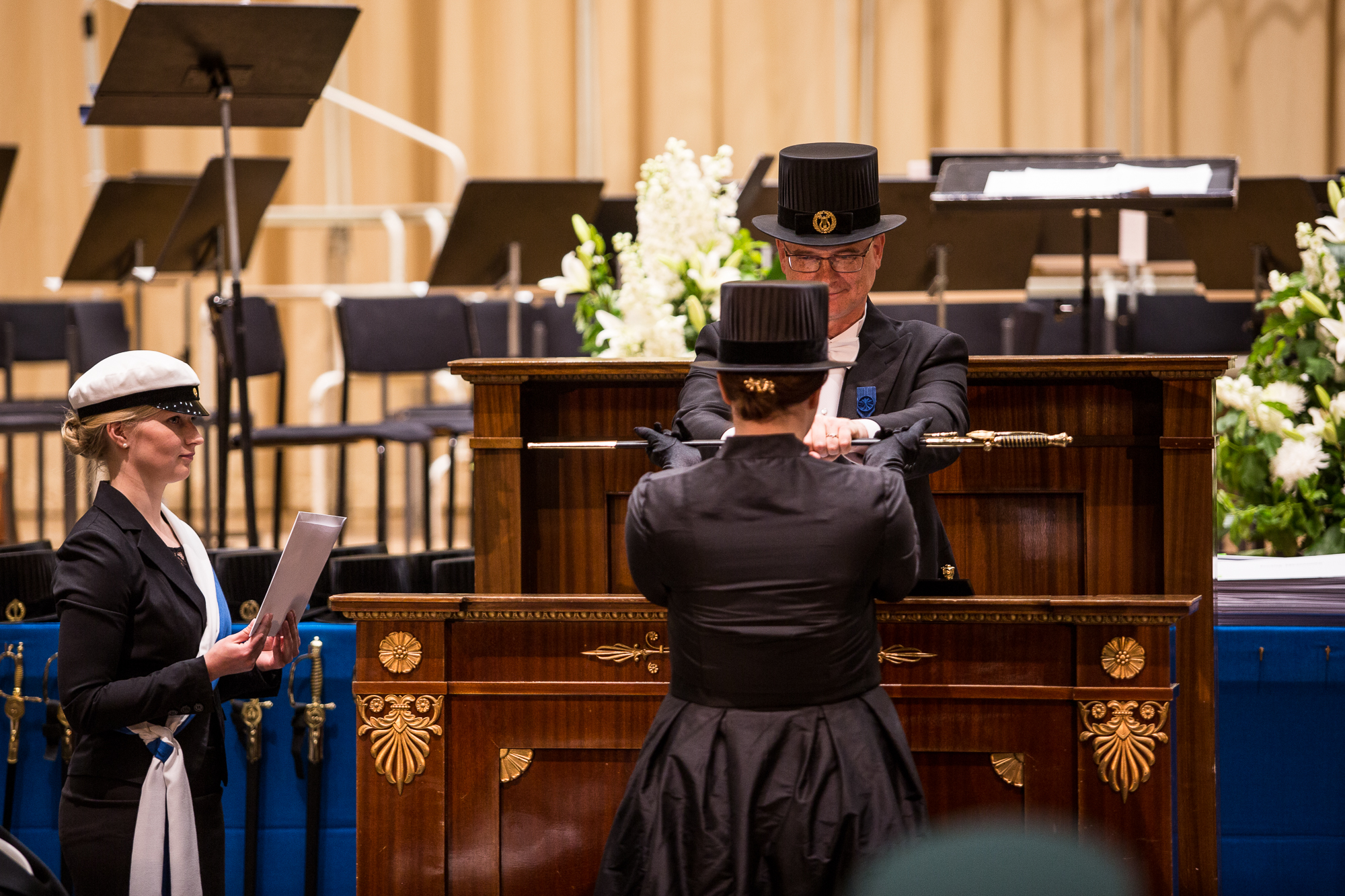
Mari-Liisa Varila receiving her sword.
On Friday noon we gathered to the Concert Hall, all in tailcoats or long black dresses. At quarter past twelve, the procession entered the hall. We sat down in the front of the room, waiting for our turn to receive the hat and sword. Each conferrer stepped up to the podium in their turn, delivering their trilingual speech – Finnish, English, and Latin. They pressed the hats on our heads and presented us with our swords and (Latin) diplomas. After the ceremony, our procession moved from the Concert Hall to the Cathedral where a bilingual service was held. Our day was made even more special by the beautiful singing of the Turku University Choir.

In the evening, we gathered to the Turku Castle. We were served a three-course dinner, interspersed with speeches and some more singing. I was honoured to have been asked to deliver the speech to the honorary doctors. We then moved to the VPK house for a polonaise and a waltz, with music provided by Sohon Torwet. Our evening ended, very appropriately, in a speech to the sun.
Text by Mari-Liisa Varila
Photos by Miikka Varila and Markku Hakala