What’s that MA Thesis all about?

On 8 April 2025, students and staff members of the Department of English gathered for the annual MA Thesis Symposium. The event has been organized since 2013, so one could safely say that it is turning into a true tradition of the English Department.

The MA Thesis Symposium showcases MA research done at the department. Major students who have just completed or are about to complete their MA Thesis give a short presentation where they talk about their thesis topic, methodologies and key findings, and often also about what it is like to write an MA Thesis. The symposium is specifically aimed for students starting their MA Thesis seminar, who might wonder about topic selection and the process in general, and BA level students, who are thinking about what to specialize in in their MA studies. The symposium also gives the speakers an opportunity to talk about their research and gain public speaking experience in a relaxed and friendly environment.

This year, we were lucky to have speakers from each of the Department’s MA tracks: philology, discourse, second language acquisition, literature, and multilingual translation studies. The level of maturity, professionalism and enthusiasm of the presenters was impressive. Each outlined their topic with confidence and was well-versed in academic language and presenting style, all the while making their varied topics accessible to everyone in the audience. The presenters carried themselves well through the lively discussions and answered questions from the audience knowledgeably. The event certainly served as encouragement to those still a bit apprehensive about writing an MA Thesis.
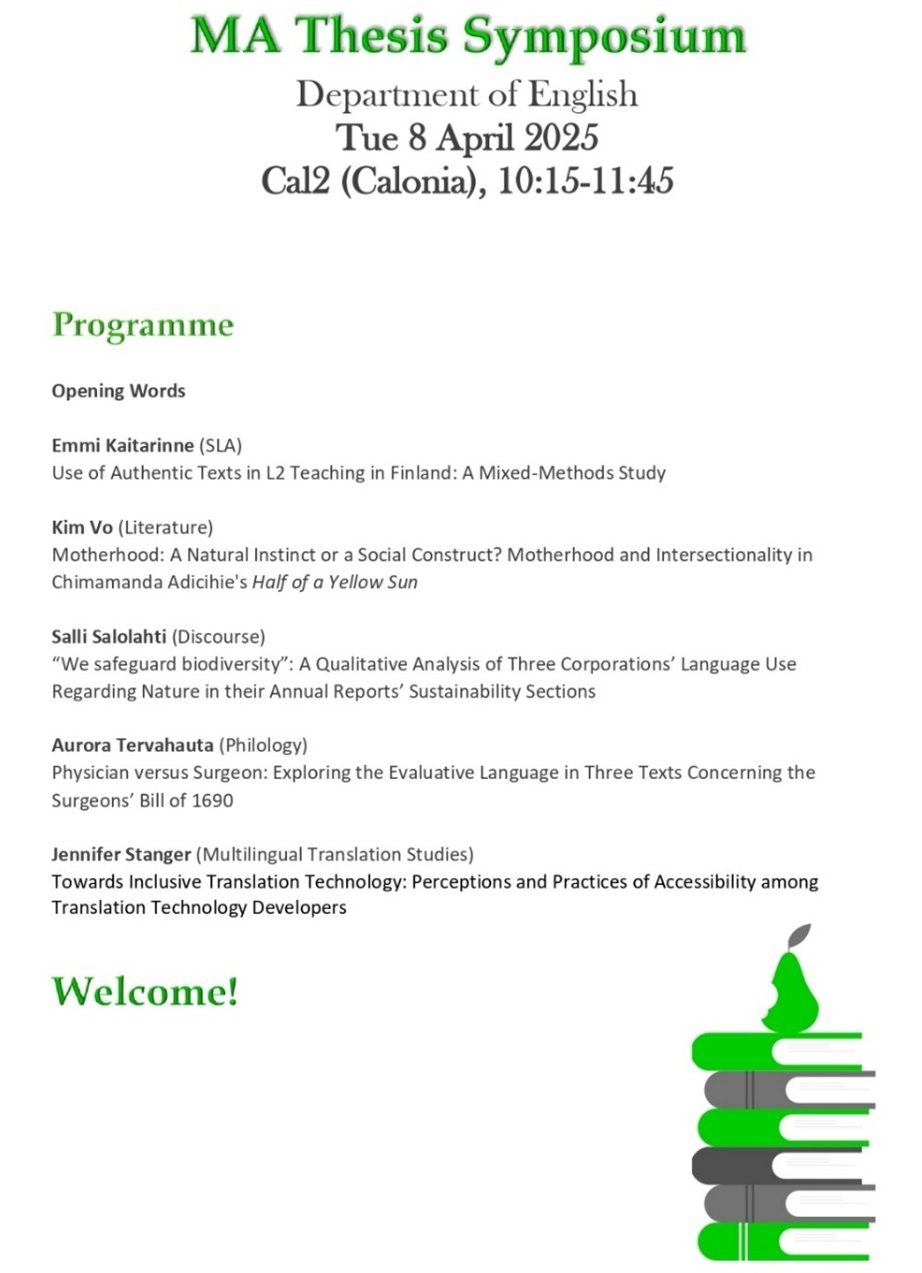
The program for MA Thesis Symposium held at Department of English on Tuesday 8 April 2025 Programme: Opening Words Emmi Kaitarinne (SLA) Use of Authentic Texts in L2 Teaching in Finland: A Mixed-Methods Study Kim Vo (Literature) Motherhood: A Natural Instinct or a Social Construct? Motherhood and Intersectionality in Chimamanda Adicihie's Half of a Yellow Sun Salli Salolahti (Discourse) “We safeguard biodiversity”: A Qualitative Analysis of Three Corporations’ Language Use Regarding Nature in their Annual Reports’ Sustainability Sections Aurora Tervahauta (Philology) Physician versus Surgeon: Exploring the Evaluative Language in Three Texts Concerning the Surgeons’ Bill of 1690 Jennifer Stanger (Multilingual Translation Studies) Towards Inclusive Translation Technology: Perceptions and Practices of Accessibility among Translation Technology Developers
This year’s MA Thesis Symposium had speakers from all of the Department’s MA Tracks.

I asked the presenters to join me in writing this blog, and Salli Salolahti and Kim Vo hopped onboard. Here they reflect on their experience of writing an MA Thesis and creating a short presentation based on it. They also touch on what it felt like to talk about their research in front of a live audience.

Salli Salolahti (Discourse track):

The MA thesis process definitely taught me a lot more than I initially thought it would! I perhaps naively thought that I would just get it done and that the biggest obstacle would be writing a paper this extensive. However, it turned out that for me the biggest obstacle to overcome was not the writing or any theory – it was perfectionism!

To make progress in the MA thesis process, you have to go through different steps like turning in your topic proposal, research plan, first draft, and so on. I had to accept that these would be less than perfect and that the whole process is simultaneously about showing what I have already learned and learning something new. I spent a lot of time experimenting with different approaches before finding the ones that I could make work. While this was at times frustrating, it was also great to realise that I was able to reflect on and solve many of the issues myself.

When it came time to present my thesis, I assumed squeezing it into a ten-minute presentation would be easy, but it turned out that was not the case. It had been a while since I submitted my thesis, and I had promptly forgotten how much ground it covered! While ten minutes initially sounded like plenty of time, in the end it went really fast.

I was both excited and nervous to present my research. Speaking in front of a live audience did not make me nervous, as I am used to it, but the idea of possibly misrepresenting something about my own research, methods, or theories stressed me. But I needn’t have worried about it: as soon as I started talking, it felt like I remembered everything. It was actually quite nice to talk about something that I myself had done and was proud of and also knew more about than anyone else in the room!
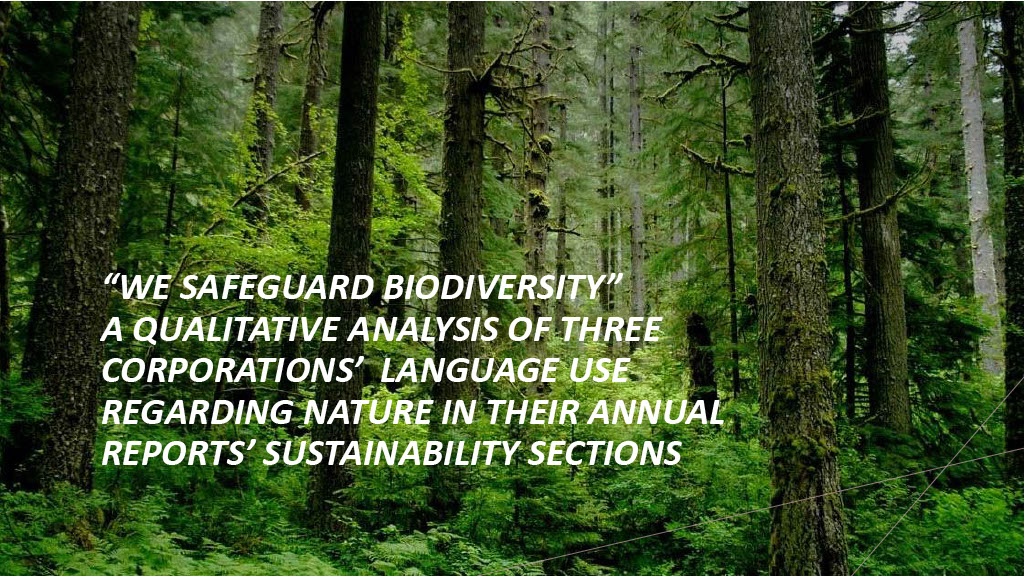
The title slide from Salli Salolahti's powerpoint presentation, depicting the title of the presentation (“We safeguard biodiversity”: A Qualitative Analysis of Three Corporations’ Language Use Regarding Nature in their Annual Reports’ Sustainability Sections) in white in front of a picture of a forest
In her MA Thesis, Salli Salolahti used ecolinguistics, critical discourse analysis and transitivity analysis from systemic functional grammar to analyze the language different corporations use when they talk about nature.

Kim Vo (Literature track):

My MA thesis explores a deceptively simple question: is motherhood an innate, natural instinct — or a social construct shaped by culture and expectation? As it turns out, writing about motherhood felt a lot like… well, becoming a mother.

The early days of thesis writing were filled with anticipation – glowing, even. I was excited, full of ideas, and ready to dive in. Then came the “morning sickness” phase: nausea-inducing literature reviews, endless source hunting, and the creeping dread that maybe I’d bitten off more than I could chew. But just like in pregnancy, there were those magical kicks – moments when my analysis clicked, and I felt the baby (read: thesis) growing into something real.

The final stretch? Labor. Pure, exhausting, deadline-driven labor. Pulling everything together felt like pushing through contractions – painful, but with a purpose. And finally, there it was: a fully formed thesis, screaming for attention and citations.

Presenting my work was another surprise. Despite two years of teaching experience, I still felt butterflies facing a new audience. But once I started talking, the nerves melted away. Ten minutes flew by – barely enough time to scratch the surface – but I was proud to share my research and answer questions.

This journey taught me that writing a thesis isn’t just academic – it’s deeply personal, occasionally chaotic, and ultimately rewarding. And like any proud parent, I’m just glad it’s finally out in the world.
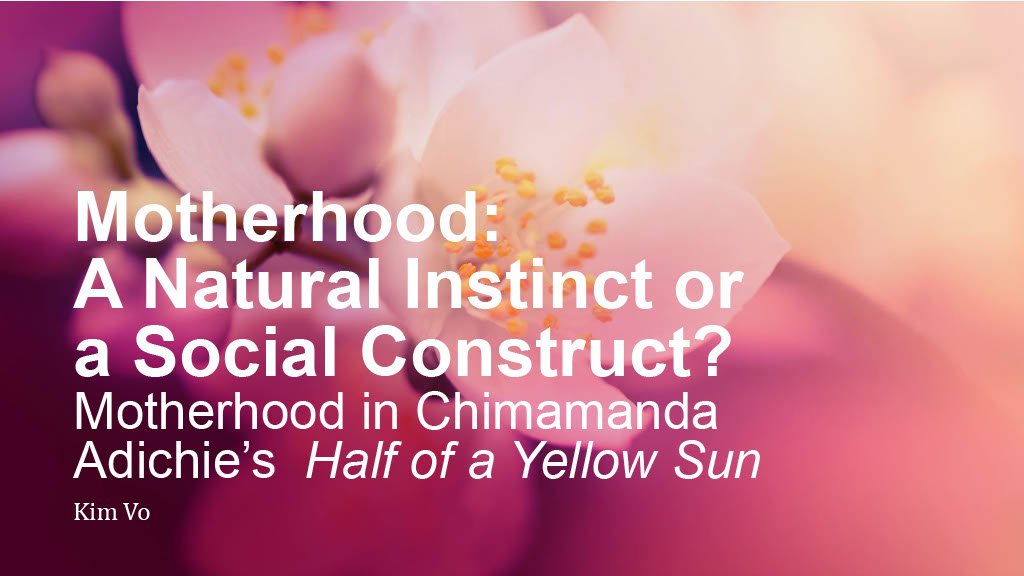
The title slide from Kim Vo's powerpoint presentation, depicting the title of the presentation (Motherhood: A Natural Instinct or a Social Construct? Motherhood and Intersectionality in Chimamanda Adicihie's Half of a Yellow Sun) in white in front of a picture of flowers
In her MA Thesis, Kim Vo explored the many types of motherhood present in Chimamanda Adichie’s depiction of post-colonial Nigeria and concluded that motherhood exists as a dynamic interplay between instinct, choice, and social influence.

Text and photos by Ira Hansen, Salli Salolahti and Kim Vo
International collaboration facilitates research on interactional fluency

L2 interactional fluency across contexts (ILFACT) is a research project focused on second language (L2) fluency in interactive settings. The project is conducted by members of the FlowLang research group and is funded by the Research Council of Finland (2024–2028). The project aims to provide information about interactional fluency and the factors that affect it, which can help to develop methods for assessing fluency in interactional contexts.

Data collection visit to Germany

Data collection for this project started in Finland earlier this year and continued in May with a visit to Marburg, Germany, where we collected the other half of the data for this project. The data were collected on three consecutive days by the PI Pauliina Peltonen, project researcher Saara Naapila, and a local doctoral researcher, Carmen Kraft, at Philipps University Marburg. The data collection was a success, thanks to our collaborators who hosted us and assisted us in collecting the data. The help of the project’s German collaborator, Professor Sandra Götz, in particular, was invaluable in making the data collection possible. We are also grateful to the local students and their teachers, Victoria Gath and Aoife Holmes-Rein, who volunteered their time to contribute to this project.

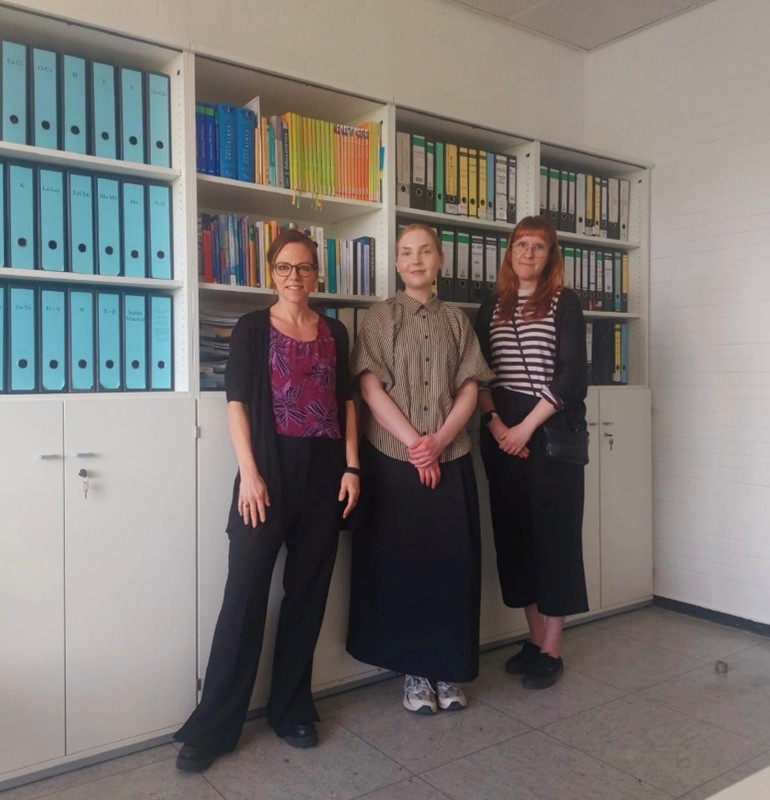
ILFACT team members professor Sandra Götz, Saara Naapila, and Pauliina Peltonen standing in front of bookshelves
The data collection in Marburg was made possible with the help of our collaborator, Professor Sandra Götz (on the left).

Support from the Research Council of Finland allowed Pauliina Peltonen to stay in Germany for four weeks not only to oversee and complete the data collection, but also to visit another project collaborator, Dr. Loulou Kosmala, and to give a guest lecture on social approaches to language learning at Philipps University Marburg.

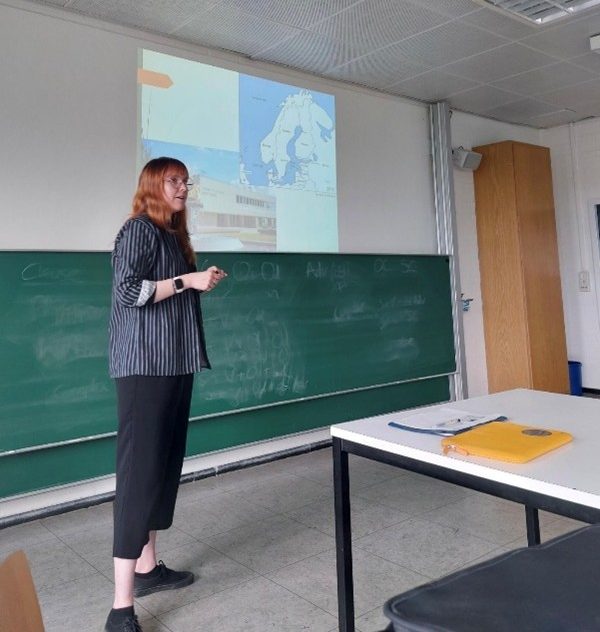
Pauliina Peltonen giving a lecture in a classroom in front of a blackboard and a projected screen depicting the map of the Baltic countries and the main building of the University of Turku
Pauliina Peltonen giving the guest lecture at Philipps University Marburg.

Researching interactional fluency

The data for the ILFACT project consists of interactional speech samples collected from advanced learners of English in Finland and Germany. The students complete two tasks in pairs in their first language (L1) and in their L2, English. One of the tasks is a problem-solving task where the goal is to reach an agreement on the order of importance of certain items and to solve a problem through discussion. The other task is a topic-based discussion, where the students can freely discuss a topic that they are given.

These interactions are audio and video recorded, and the data are analyzed with a multimodal mixed-methods approach. Due to the multimodal nature of the data, the impact of visual cues on interactional fluency, such as facial expressions and gestures, can be analyzed in addition to more traditional spoken features of (dis)fluency, such as pauses.

The focus on interactional fluency in the project provides a new perspective to L2 fluency research. Fluency is an important part of L2 proficiency, and fluency research has often focused on individuals’ fluency from the perspectives of learning, teaching, and assessment. However, there is little research on interactional fluency, even though everyday language use is often interactive in nature.

Going forward

The project will continue with analysis of the data that has been collected. In a later stage of the project, the data will also be used to analyze perceived fluency with the help of fluency assessments, also collected from advanced learners of English. This part of the project aims to increase understanding of the factors that influence the assessment of interactional fluency, especially with respect to the speaker’s personal speaking style and multimodality.

Overall, the project contributes to research on L2 fluency, the assessment of language skills, and L2 teaching. The results of the project can, therefore, be used to support the development of L2 teaching methods. The project also produces important information on the assessment of language skills, which can be used to develop more reliable and equitable assessment practices.

Text by Saara Naapila and Pauliina Peltonen

Photos by Sandra Götz

Visualising knowledge: reflections from the Reading Visual Devices conference

On 22 May, the foyer of Arcanum buzzed with anticipation as attendees gathered for the Reading Visual Devices conference organized by the Early Modern Graphic Literacies (EModGraL) project. The event began with a warm welcome from Marjo Kaartinen, Rector of the University of Turku and a member of the EModGraL project. Rector Kaartinen highlighted the city’s rich late medieval and early modern heritage, noting that there could hardly be a more fitting location for a conference focused on early modern graphic devices. She concluded her opening remarks by expressing the university’s pride in the project.

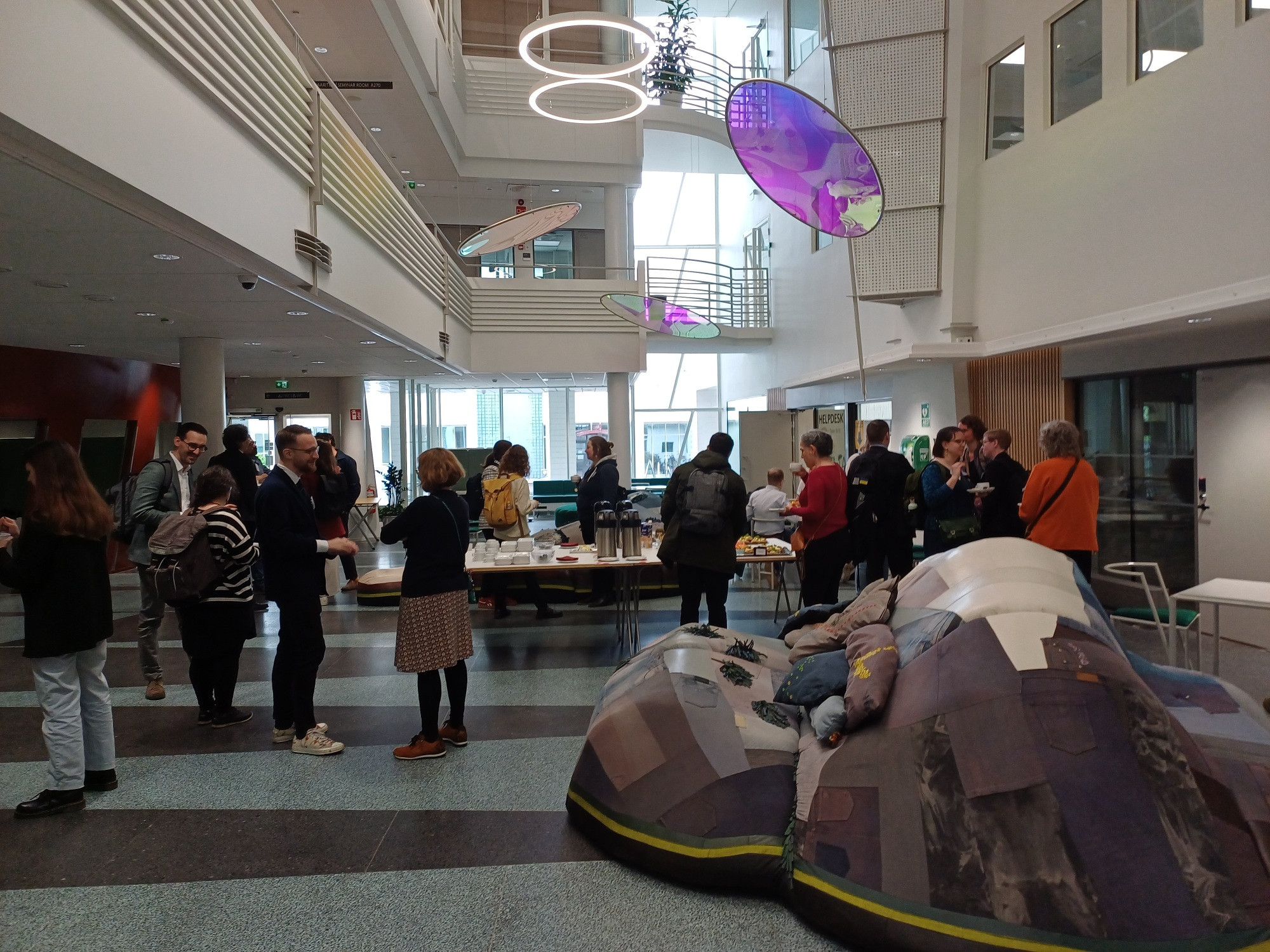
Attendees enjoying coffee and conversations between sessions in the lobby of Arcanum

Next to take the stage was Professor Matti Peikola, the principal investigator of the EModGraL project. He extended thanks to the project’s primary funders – the Research Council of Finland and the City of Turku. As the four-year project draws to a close this summer, the conference marked a significant milestone in its final phase. In attendance were two of the project’s key collaborators: Professor Wendy Scase (University of Birmingham) and Dr Carla Suhr (University of Helsinki), both of whom gave keynote speeches. A third keynote was presented by Professor Andrew Riggsby (University of Texas).

The multidisciplinary conference brought together researchers interested in late medieval and early modern visual devices such as images, diagrams, charts, and tables that convey information alongside text. Over the course of three days, the programme featured three keynote lectures and 25 paper presentations, covering topics ranging from diagrams in early modern grammar textbooks to witchcraft pamphlets and medical manuscripts. Together, the papers offered insight into how graphic devices were used, understood, and employed to visualise knowledge in the late medieval and early modern periods.

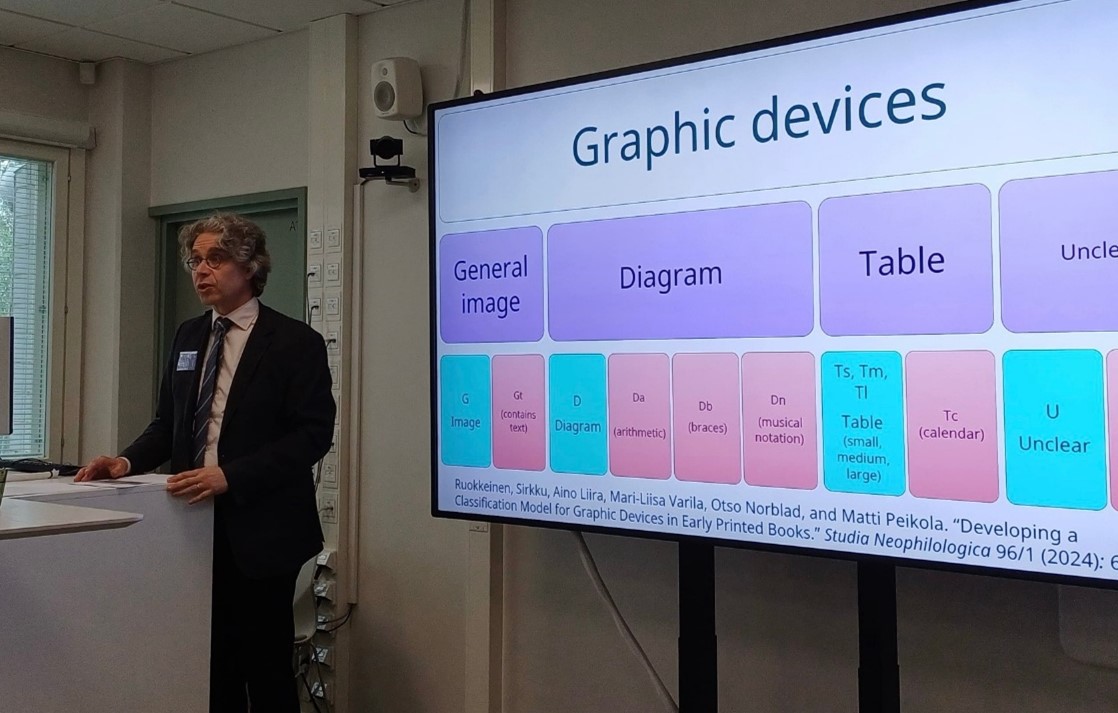
Professor Matti Peikola presenting findings from the EModGraL project

The international conference drew approximately 40 attendees from a range of academic disciplines. As a student assistant, it was inspiring to observe professionals in action – presenting their findings and exchanging ideas. For me personally, the most rewarding aspect was witnessing the academic community that the project has built over the years.

Finally, on behalf of all the student assistants, I would like to thank Dr Sirkku Ruokkeinen, whose support and guidance helped ensure the smooth organisation of the event. Reading Visual Devices was a successful three-day conference, hosted by what Rector Kaartinen described as a “particularly fabulous project.” As heard in the discussion following Dr Mari-Liisa Varila’s paper on the first conference day, one cannot help but wonder: what’s next? Perhaps, a well-earned holiday for the EModGraL team.

Text by Maria Tervakangas

Photos by Pinja Miettinen