L2 interactional fluency across contexts (ILFACT) is a research project focused on second language (L2) fluency in interactive settings. The project is conducted by members of the FlowLang research group and is funded by the Research Council of Finland (2024–2028). The project aims to provide information about interactional fluency and the factors that affect it, which can help to develop methods for assessing fluency in interactional contexts.
Data collection visit to Germany
Data collection for this project started in Finland earlier this year and continued in May with a visit to Marburg, Germany, where we collected the other half of the data for this project. The data were collected on three consecutive days by the PI Pauliina Peltonen, project researcher Saara Naapila, and a local doctoral researcher, Carmen Kraft, at Philipps University Marburg. The data collection was a success, thanks to our collaborators who hosted us and assisted us in collecting the data. The help of the project’s German collaborator, Professor Sandra Götz, in particular, was invaluable in making the data collection possible. We are also grateful to the local students and their teachers, Victoria Gath and Aoife Holmes-Rein, who volunteered their time to contribute to this project.
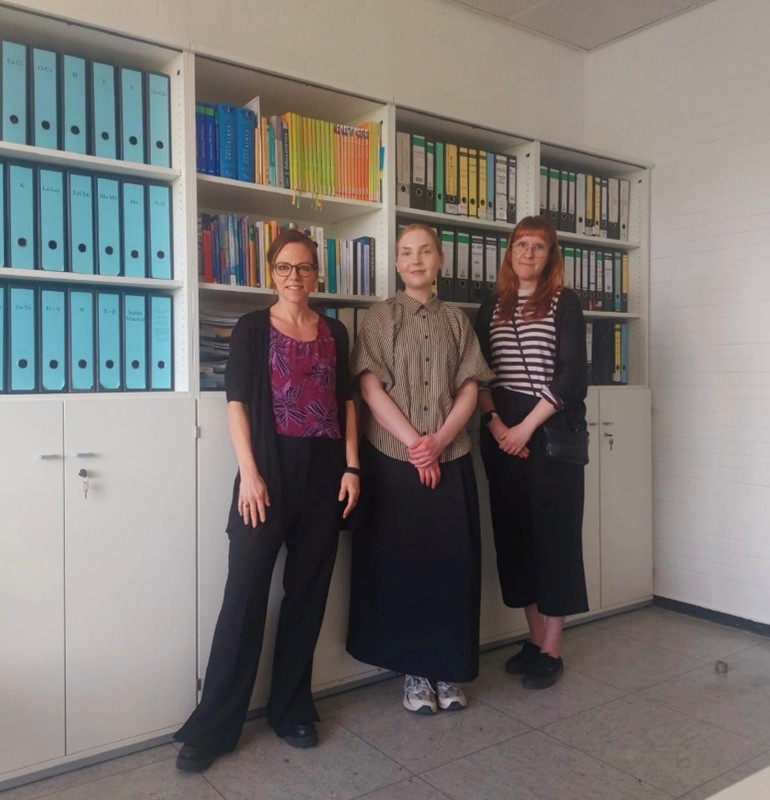
The data collection in Marburg was made possible with the help of our collaborator, Professor Sandra Götz (on the left).
Support from the Research Council of Finland allowed Pauliina Peltonen to stay in Germany for four weeks not only to oversee and complete the data collection, but also to visit another project collaborator, Dr. Loulou Kosmala, and to give a guest lecture on social approaches to language learning at Philipps University Marburg.
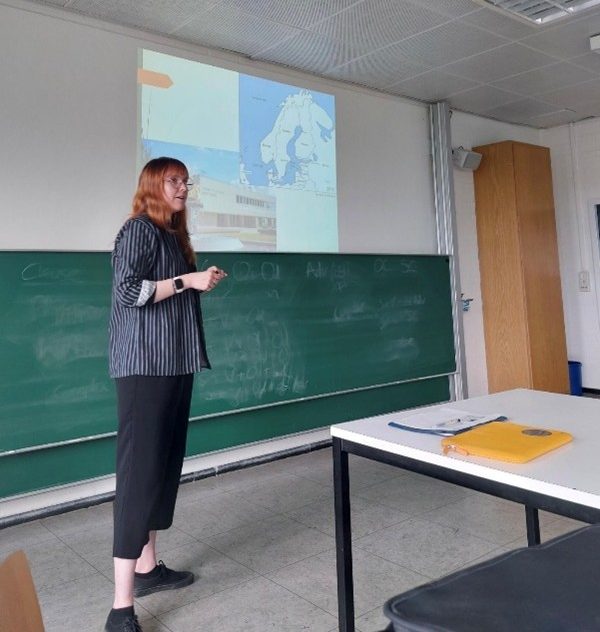
Pauliina Peltonen giving the guest lecture at Philipps University Marburg.
Researching interactional fluency
The data for the ILFACT project consists of interactional speech samples collected from advanced learners of English in Finland and Germany. The students complete two tasks in pairs in their first language (L1) and in their L2, English. One of the tasks is a problem-solving task where the goal is to reach an agreement on the order of importance of certain items and to solve a problem through discussion. The other task is a topic-based discussion, where the students can freely discuss a topic that they are given.
These interactions are audio and video recorded, and the data are analyzed with a multimodal mixed-methods approach. Due to the multimodal nature of the data, the impact of visual cues on interactional fluency, such as facial expressions and gestures, can be analyzed in addition to more traditional spoken features of (dis)fluency, such as pauses.
The focus on interactional fluency in the project provides a new perspective to L2 fluency research. Fluency is an important part of L2 proficiency, and fluency research has often focused on individuals’ fluency from the perspectives of learning, teaching, and assessment. However, there is little research on interactional fluency, even though everyday language use is often interactive in nature.
Going forward
The project will continue with analysis of the data that has been collected. In a later stage of the project, the data will also be used to analyze perceived fluency with the help of fluency assessments, also collected from advanced learners of English. This part of the project aims to increase understanding of the factors that influence the assessment of interactional fluency, especially with respect to the speaker’s personal speaking style and multimodality.
Overall, the project contributes to research on L2 fluency, the assessment of language skills, and L2 teaching. The results of the project can, therefore, be used to support the development of L2 teaching methods. The project also produces important information on the assessment of language skills, which can be used to develop more reliable and equitable assessment practices.
On 22 May, the foyer of Arcanum buzzed with anticipation as attendees gathered for the Reading Visual Devices conference organized by the Early Modern Graphic Literacies (EModGraL) project. The event began with a warm welcome from Marjo Kaartinen, Rector of the University of Turku and a member of the EModGraL project. Rector Kaartinen highlighted the city’s rich late medieval and early modern heritage, noting that there could hardly be a more fitting location for a conference focused on early modern graphic devices. She concluded her opening remarks by expressing the university’s pride in the project.
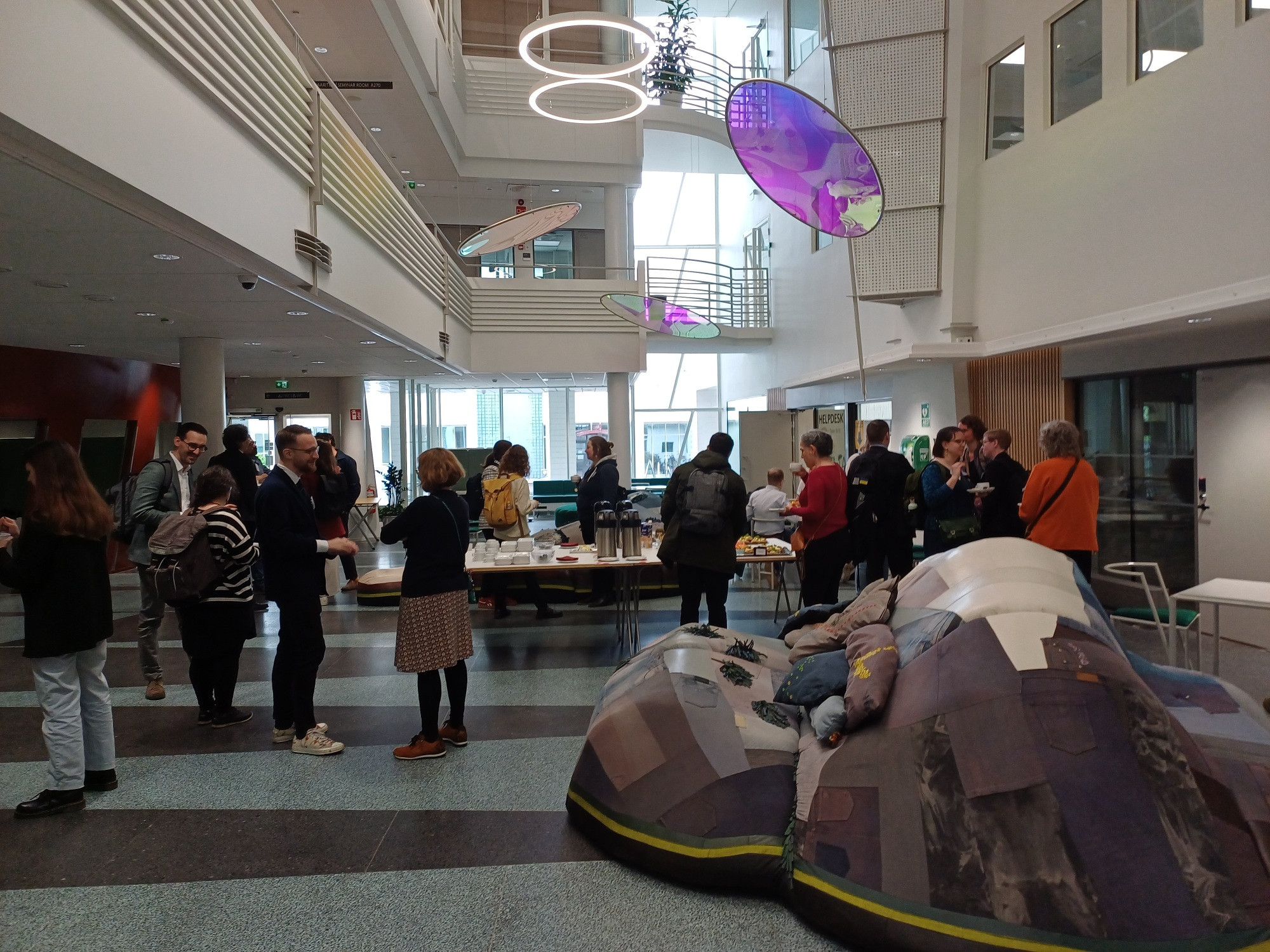
Attendees enjoying coffee and conversations between sessions in the lobby of Arcanum
Next to take the stage was Professor Matti Peikola, the principal investigator of the EModGraL project. He extended thanks to the project’s primary funders – the Research Council of Finland and the City of Turku. As the four-year project draws to a close this summer, the conference marked a significant milestone in its final phase. In attendance were two of the project’s key collaborators: Professor Wendy Scase (University of Birmingham) and Dr Carla Suhr (University of Helsinki), both of whom gave keynote speeches. A third keynote was presented by Professor Andrew Riggsby (University of Texas).
The multidisciplinary conference brought together researchers interested in late medieval and early modern visual devices such as images, diagrams, charts, and tables that convey information alongside text. Over the course of three days, the programme featured three keynote lectures and 25 paper presentations, covering topics ranging from diagrams in early modern grammar textbooks to witchcraft pamphlets and medical manuscripts. Together, the papers offered insight into how graphic devices were used, understood, and employed to visualise knowledge in the late medieval and early modern periods.
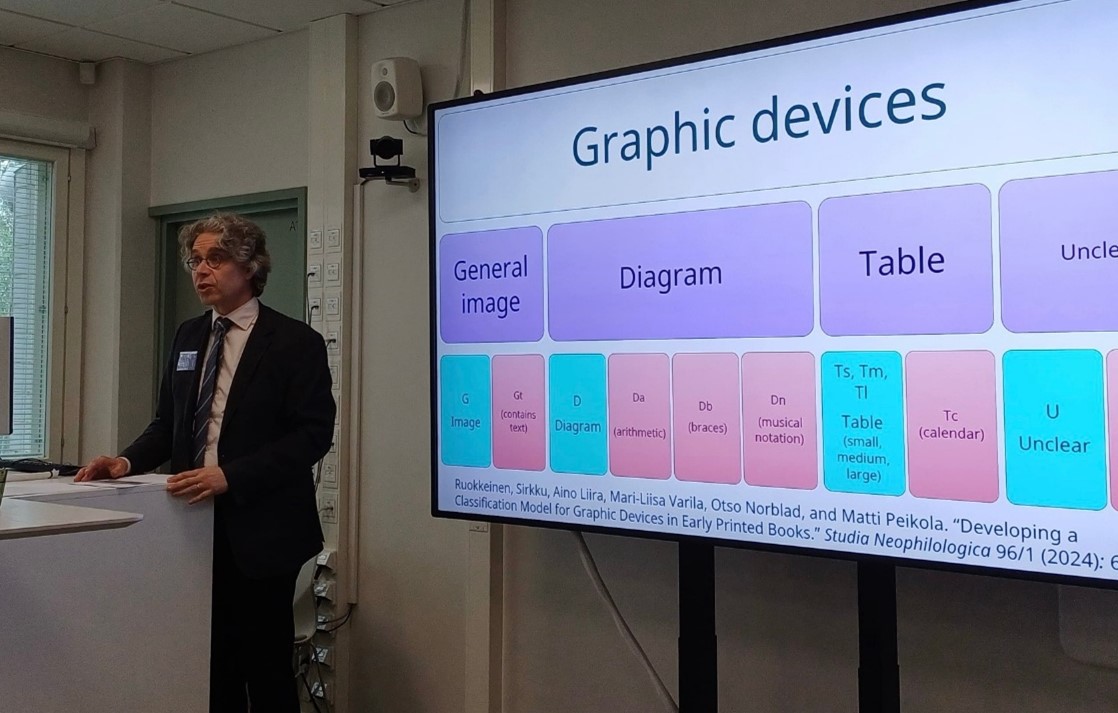
Professor Matti Peikola presenting findings from the EModGraL project
The international conference drew approximately 40 attendees from a range of academic disciplines. As a student assistant, it was inspiring to observe professionals in action – presenting their findings and exchanging ideas. For me personally, the most rewarding aspect was witnessing the academic community that the project has built over the years.
Finally, on behalf of all the student assistants, I would like to thank Dr Sirkku Ruokkeinen, whose support and guidance helped ensure the smooth organisation of the event. Reading Visual Devices was a successful three-day conference, hosted by what Rector Kaartinen described as a “particularly fabulous project.” As heard in the discussion following Dr Mari-Liisa Varila’s paper on the first conference day, one cannot help but wonder: what’s next? Perhaps, a well-earned holiday for the EModGraL team.
On 26 March, the Department of English celebrated over coffee and cake the latest publication of the Early Modern Graphic Literacies (EModGraL) research project: an edited peer-reviewed volume entitled Graphic Practices and Literacies in the History of English. The 350-page book is published by the Belgium-based international academic publisher Brepols and edited by Matti Peikola, Jukka Tyrkkö and Mari-Liisa Varila. The chapter authors come from Estonia, Finland, the Netherlands, Norway, Spain, Sweden, Switzerland, UK and USA. They include Aino Liira, Matti Peikola, Janne Skaffari, Hanna Salmi and Mari-Liisa Varila from the Department of English at the University of Turku.
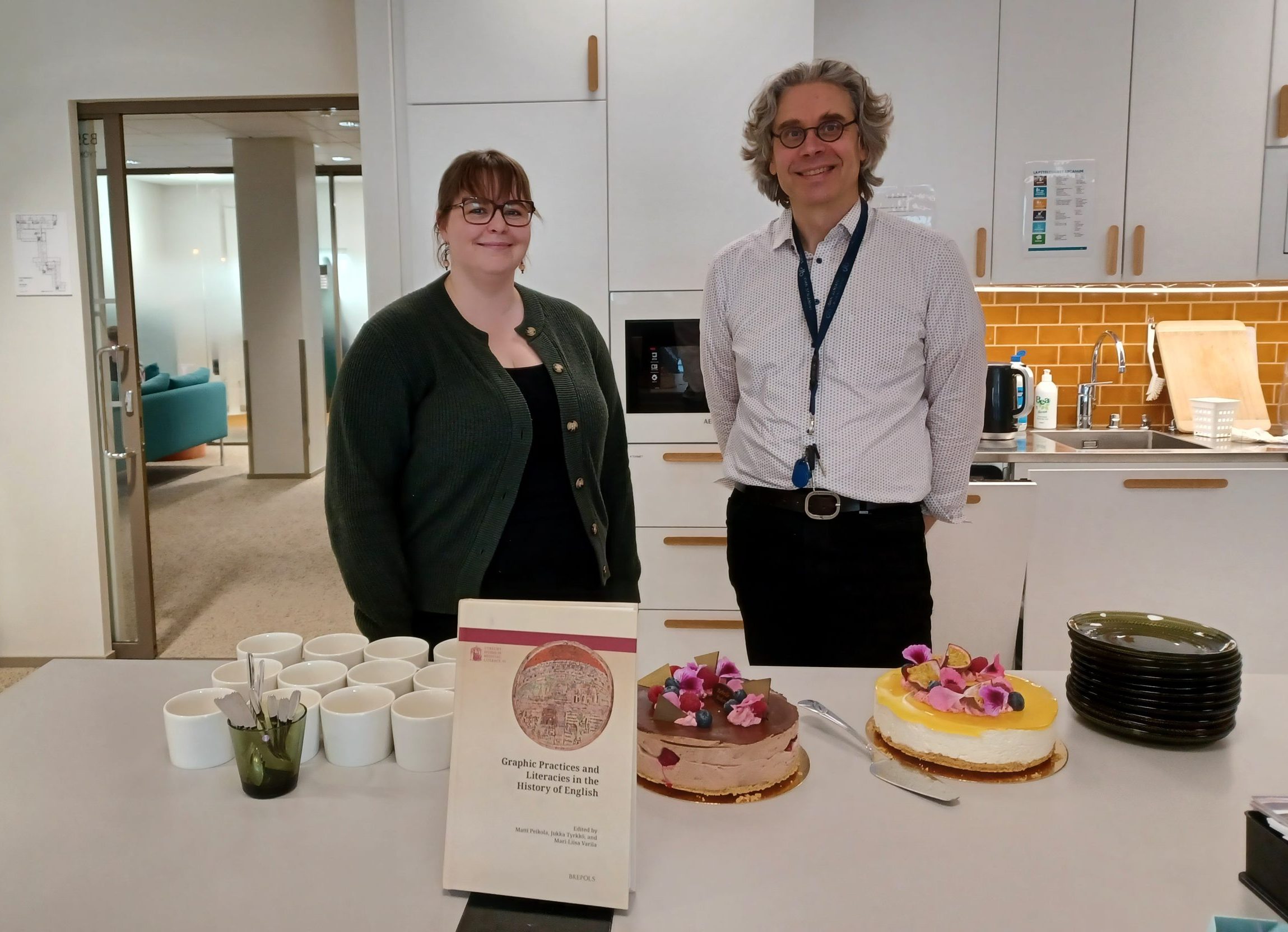
Editors Mari-Liisa Varila and Matti Peikola celebrated the publication of their new book, ‘Graphic Practices and Literacies in the History of English’, over coffee and cake.
Work towards the book started already in 2021 with the workshop ‘Graphic literacy in the history of English’ that we organised in the 21st International Conference on English Historical Linguistics (ICEHL) in Leiden – or, more precisely, in a virtual conference space provided by the University of Leiden during the COVID-19 restrictions. At the time of the conference, EModGraL had not yet started, but we had already received the great news about our four-year funding from the Research Council of Finland. This allowed us to plan the book thematically as a project publication from the start.
A potential reader who comes across the book in the Utrecht Studies in Medieval Literacy series (vol. 61) might think that it focuses on the Middle Ages. The chronological range of the contributions, however, spans from the fourteenth to the eighteenth century. In addition to Middle English, also Early and Late Modern English materials are discussed in the volume with regard to their graphic practices and literacies. It was important for us to find a publishing series that would allow us to foreground themes that run across the chapters without requiring us to confine ourselves to a specific historical period or a specific medium like manuscript or print. We are grateful to Professor Marco Mostert for providing us with a place in his renowned Utrecht series.
Like the whole EModGraL project, also the new book starts from the premise that graphic features of communication (such as tables or diagrams) require literacy skills and competencies that differ from the reading of ‘monomodal’ verbal text. In the context of the project and the book, we are particularly interested in finding out how and for what purposes graphic features of communication were historically used in texts targeted at English-language readers. We also want to see how readers were instructed in these graphic practices and in the acquisition of the literacy skills they entail. In addition to finding out more about the history of multimodal communication in English, our research also targets the early history of data visualisation in a vernacular context. At the same time, we also learn more about how various graphic practices were instrumental in the transmission of information and the construction of knowledge in late medieval and early modern English books.
The new volume may be placed under the broad umbrella of historical pragmatics, a developing and expanding multidisciplinary field. The book has two main parts plus an introductory chapter by the editors and an afterword by Professor Emeritus Jeremy J. Smith (University of Glasgow). Part I (five chapters) addresses graphic features of text that in various ways contribute to the construction of meaning and the organisation of information on the page, such as layout, colour, punctuation and abbreviations. Part II (six chapters) focuses on the use of specific graphic devices like tables, diagrams and representative images. Overall, the chapters examine an impressive range of primary sources of different domains: medical texts, history writing, instructive and didactic texts, administrative accounts and letter-writing.
Those interested in the topic area of this book are warmly welcome to attend the Reading Visual Devices in Early Books conference organised by the EModGraL project on 22–24 May 2025 in Turku. For further information about the programme and registration, please see https://blogit.utu.fi/emodgral/events/.
When the staff of the English Department have just moved into their brand-new premises in the newly renovated Arcanum building on the University’s lower campus at the beginning of 2023, this may be a convenient moment to take a brief look at the previous oases on the itinerary of the departmental caravan from its beginnings to the present day. There have been altogether five stops on the way to Arcanum.
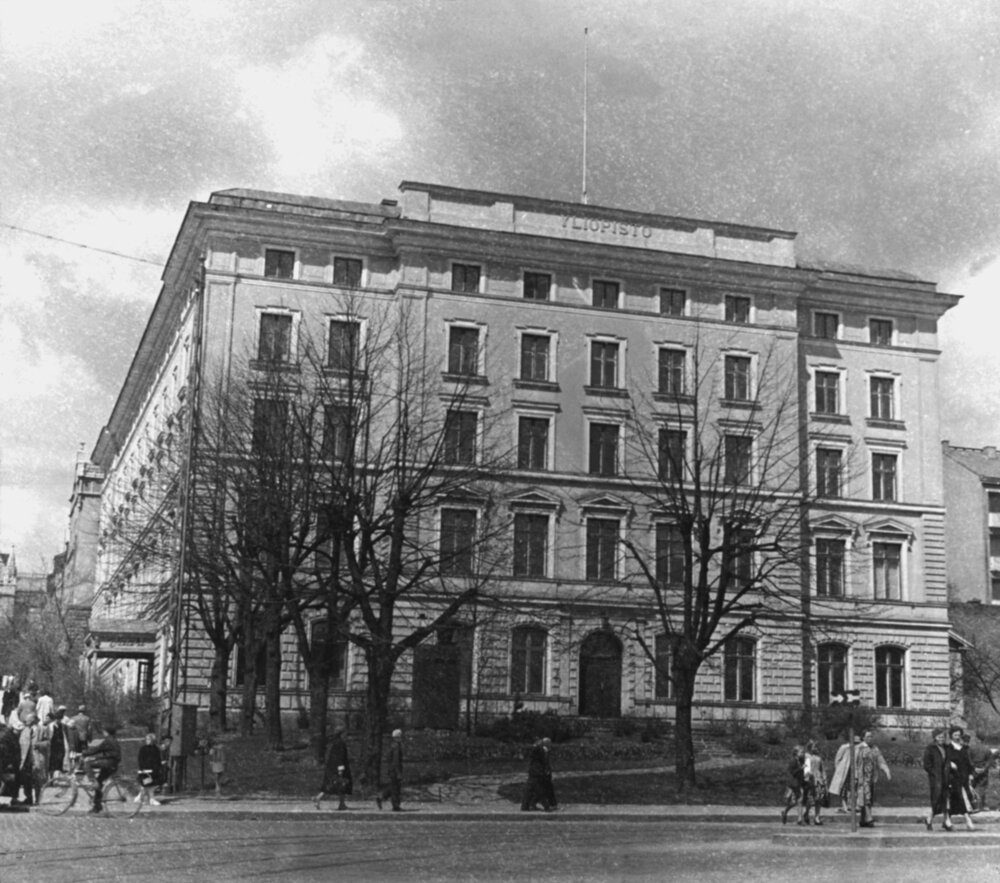
Taking the founding of the chair for English Philology in 1945 as the date of the founding of the Department, it was first located, together with the entire academic community of the new Finnish-speaking university of Turku, in the premises of the old Hotel Phoenix, a colossal late nineteenth-century building on the market square. Phoenix itself no longer exists, for it was demolished 1959.
The building Phoenix in springtime in mid-1950s (photo from the Central Archives of the University of Turku)
Any available space for the departments in the building, originally designed for an entirely different purpose, must have been very limited, for the many functions of the new establishment, including teaching, administration and library, were housed under the same roof. As a result, there was a pressing need for expansion.
In the next phase, the University makes a move closer to the location of the old Academia Aboensis (1640) around the Cathedral. The oldest of the modern buildings on the current University hill date back to the 1950s. The Library was completed 1954 and the Main building 1958. From the mid-fifties until the mid-seventies, the English Department had its own library in three of the seminar rooms on the top floor of the Library building, within the space of present Feeniks library. In addition, there may have been some temporary space available for office hours, and the like, on the second floor of the Main building until the early 1960s.
Along with the increasing numbers of students and staff in the English Department during the 1960s, there was an acute need for more office space. At this point in the mid-1960s, the premises in Hämeenkatu 1, previously occupied by the Department of Dentistry, became available when a new building for dentistry was completed in Lemminkäisenkatu 2 in 1965.
The premises in Hämeenkatu 1 consisted of one long corridor with a number of rather small rooms on either side, originally designed for the needs of dental practices. The rooms were shared between several humanities departments, including history and philosophy. English had four rooms. One of them was the department office, and another was reserved for a visiting Fulbright professor. The other two were mostly used for office hours and consultation. Working at (and from) home was very much the norm for the staff at the time, and any joint meetings of staff and students were held elsewhere on campus.
Many of the long-standing problems of inadequate facilities and insufficient working and teaching space were resolved when a whole new building was constructed for the Humanities in Henrikinkatu 2 in 1975. The H-shaped building was originally called Humaniora II, Humaniora I having been Fennicum in Henrikinkatu 3, completed 1969. Humaniora II was renamed Juslenia, and it became a home for the Department until 2012. For the first time, most of the Indo-European language departments came to be in the same building, together with several other humanities subjects from archaeology and history to literature and cultural studies.
Having individual offices for the members of staff was one of the highly appreciated innovations of Juslenia. Also, having several teaching rooms close by in the same corridor was another welcome novelty we had not experienced earlier. Similarly, there was an easy access to the seminar library on the same floor as the Department. Yet another big change was the much-needed social space for the staff in the form of a coffee-room. With its iconic round table, this new facility had a lasting and enormously important positive impact on our social and academic interaction.
Over the years, with our initial enthusiasm gradually waning, we became more and more aware of the shortcomings of the building. Many of these had their origin in the stark contrast between the original design of the building and its practical realisation. As a result of an economic setback coinciding with the building project, the University was unable to carry out the construction, as originally envisaged. Among other things, one entire floor, containing a cafeteria/restaurant, had to be deleted from the plan altogether. Also, the surface area of each of the remaining floors had to be drastically reduced. Consequences of such dysfunctional adjustments could not pass unnoticed. They would be apparent, for example, in an awkward organization of the space, just as well as the crudish design of the interior and the limitations of available facilities. In the end, the pros for tearing down the entire building outweighed the cons for repairing it.
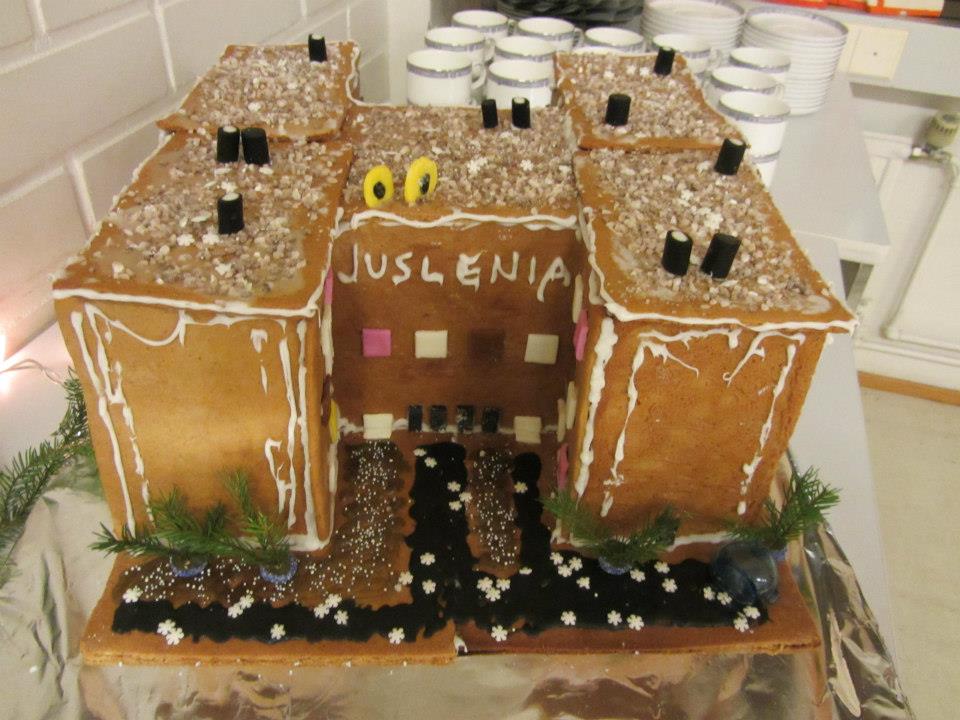
Still, in spite of its unevenness and roughness, Juslenia always brings to mind happy and pleasant memories, probably because we stayed there for such a long time, close to forty years. The final fall of Juslenia was complete in 2019, but in the Department, we had already lived through the upcoming loss by ceremonially cutting a gingerbread replica of the building into pieces of cookies at a Christmas party before leaving the building.
Gingerbread Juslenia (photo by Mari-Liisa Varila)
Our penultimate stop before Arcanum takes us to Rosetta and its sister-building Signum, both charming old buildings from the turn of the twentieth century. After the property had become part of the University, it was renovated on several occasions for different purposes, most recently for housing the departments of English, French and German translation. Both buildings had offices and teaching rooms, and a joint library of the translation departments in Signum. After the merger of the translation departments with the respective philologies in 2010, the latter, with English among them, moved into Rosetta/Signum a couple of years after. All departments moved out of these premises by the end of 2022.
There are many positive things to be said about Rosetta/Signum as a workplace. First and foremost, there was an atmosphere of a handsome old building about them, which was very nice. The staff rooms varied in size, but were on the whole quite comfortable, and much the same can be said about the teaching rooms. There was also a joint common room for those working in the building. My impression is that colleagues were generally quite pleased with the place and what it had to offer.
One aspect of the Rosetta building that was sometimes criticised had to do with the interior of its architecture, especially the number of doors everywhere. With the offices aligned along both sides of the numerous corridors with separating doors at both ends made the building a bit like a labyrinth, where students and visitors might have had difficulties finding their way around.
Aerial view of Rosetta and Signum (behind). Photo by Hanna Oksanen, copyright University of Turku Communications
Finally, we’ll get to Arcanum. From what I have seen so far, the building is superior to all the earlier ones in a number of ways. It is not only a modern building to begin with, but one that has been very recently renovated and refurbished completely for the needs of its users. Everything is conveniently accessible and close at hand. The teaching rooms are pleasant and spacious with excellent, up-to-date facilities. Another truly great improvement is the fact that all departments of the current Faculty of Humanities are for the first time in the very same building. This is a tremendous asset for the spirit of cross-disciplinary interaction and cooperation and will, no doubt, amply prove its worth in the years to come.
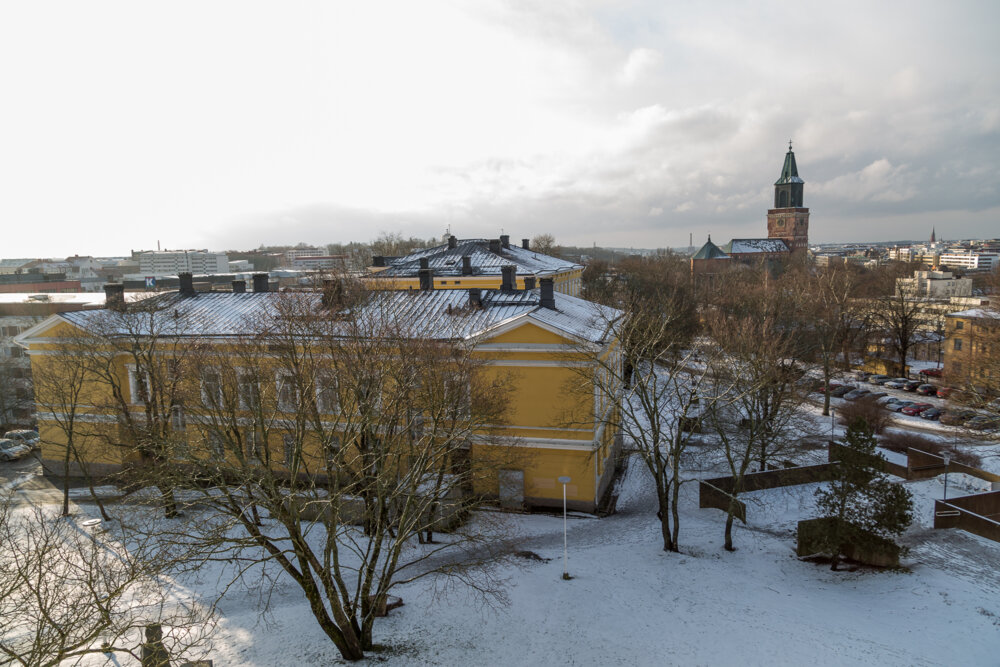
Arcanum in winter. Photo by Suvi Harvisalo, copyright University of Turku Communications
It has sometimes been said that the walls are less important in Academia; it’s more important what goes on within the walls. This is true, of course, but only up to a point. The splendid premises of Arcanum rather indicate a very close interaction between the outside and inside. When the walls are constructed in harmony with the wishes, efforts and needs of the people inside, they connect rather than separate. It is a great joy to see that our long journey from Phoenix has been brought to such a happy close in Arcanum.
P.S. I am grateful to Teppo Jakonen and Janne Skaffari for their help in the preparation of this contribution. Teppo very kindly assisted in finding the photographic illustrations.
A doctoral defense is the final part of postgraduate studies: it is the end of one process, but also the beginning of another phase, postdoctoral studies. Defending your PhD is both exciting and nerve-wracking. You finally have the chance to talk about your research and what you have been working on for years. However, the opponent asks the questions, and the task is to react to those questions in the best way possible. Custos is the chair of the public examination of a dissertation and often the supervisor of the doctoral candidate. Normally the custos has to do three things: say one sentence to start the examination, another one to end it, and most importantly, sit quietly but stay awake during the examination—not always an easy task!
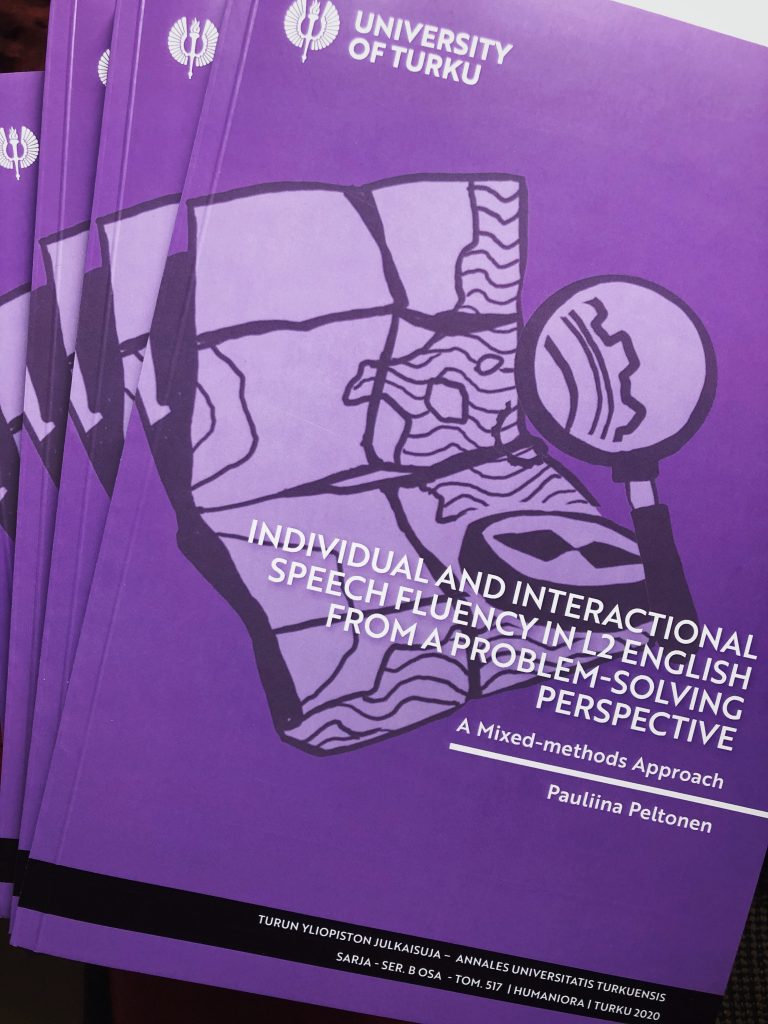
Pauliina’s dissertation addresses a central aspect of second language (L2) proficiency and speaking skills: fluency. In the dissertation, she examines L2 speech fluency and learners’ resources for maintaining it based on monologue and dialogue speech samples. Fluency is analyzed with a variety of traditional temporal measures (e.g., speech rate and silent pauses), but also from the perspective of so-called fluency resources that can help to maintain speech fluency (e.g., filled pauses, such as uh/um, and repetitions).
The findings show that L2 speech fluency is a multifaceted phenomenon. Fluency should be studied with a combination of quantitative and qualitative methods: the mixed-methods approach provides a more comprehensive picture of fluency than either approach alone. The study also shows that fluency can be viewed as a collaborative phenomenon, while traditionally, fluency has mostly been examined from an individual’s perspective based on monologue data. The study demonstrated that in interaction, learners maintain the flow of speech collaboratively across turns, for instance, by minimizing pause time.
The study provides new insights into L2 speech fluency—a topic that has become a key area of study in the Department of English in recent years. We also collaborate with other fluency researchers in the School of Languages and Translation Studies. Two fluency research projects have been launched just this autumn in the department: Fluency across Multilingual Speakers (MultiFluency; funded by the Swedish Cultural Foundation in Finland 2020–2021) and Fluency and Disfluency Features in L2 Speech (FDF2, funded by the Academy of Finland 2020–2024), both led by Dr Pekka Lintunen. So when one phase is soon over for Pauliina, the next phase will begin in these research projects. We are looking forward to continuing our collaboration and gaining more insights into L2 speech fluency in the near future!
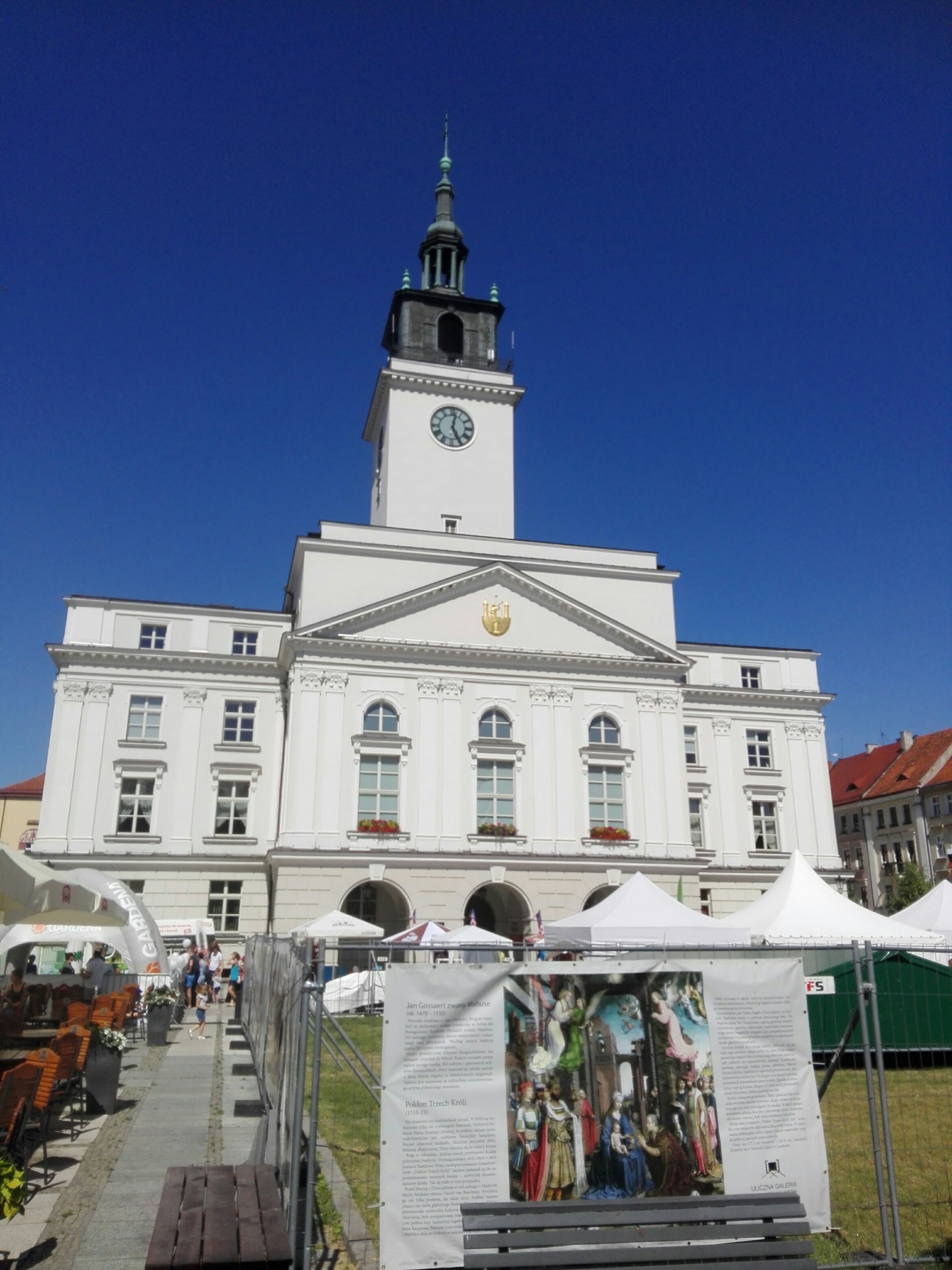
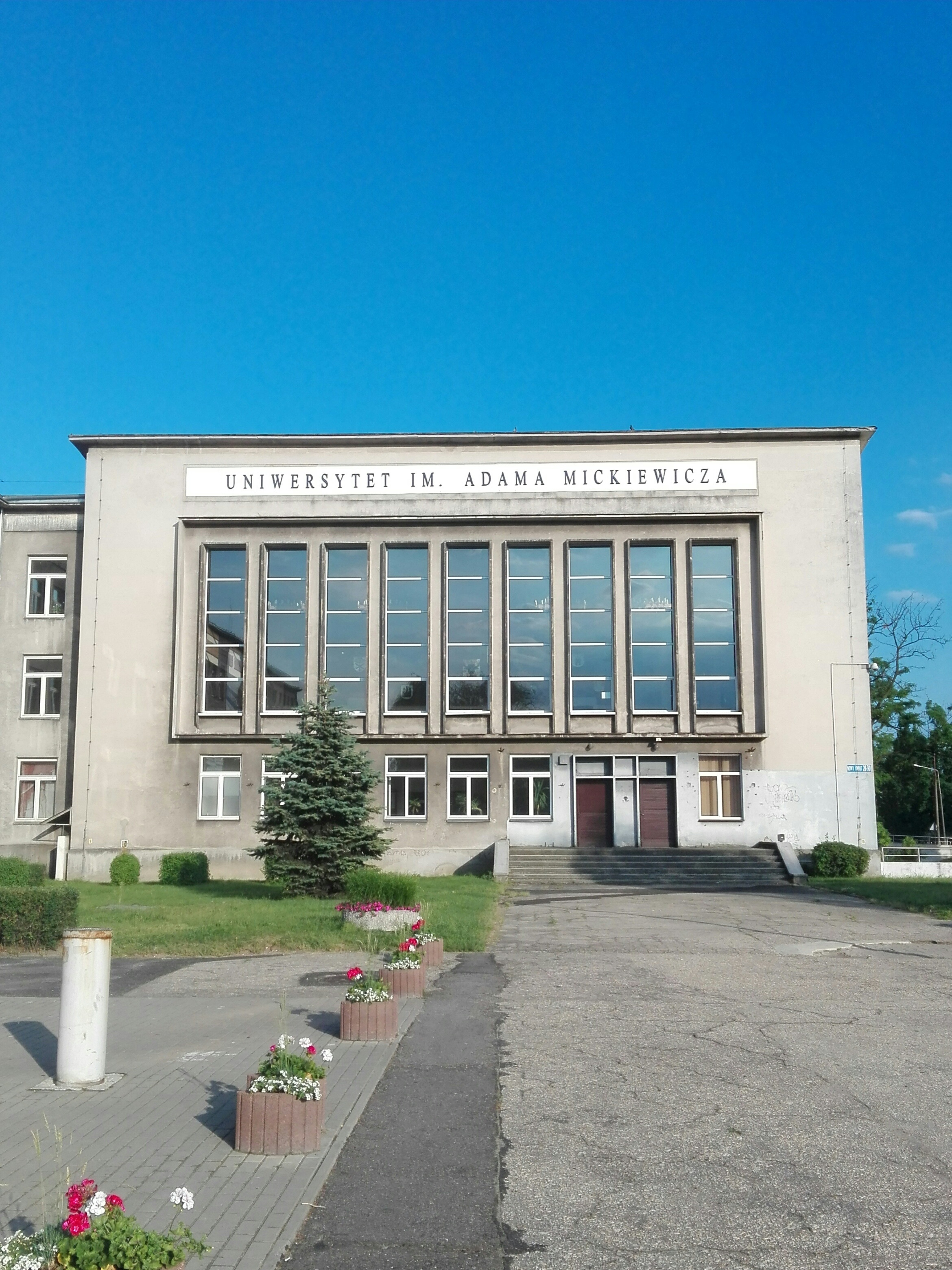
This spring has been very memorable, as I have had the pleasure of being a Visiting Professor in Kalisz, Poland. A visiting professor can refer to various kinds of things in the academic world. In this case, I was invited to the Faculty of Pedagogy and Fine Arts of the Adam Mickiewicz University in Poznań. This Faculty is located in Kalisz and educates, among others, students of English and pedagogy whose career goal is to become a teacher of English.
The fascinating thing about Kalisz is that it is considered the oldest city in Poland. Coming from the oldest city in Finland, this gave me a nice opening to all my meetings with the students. Due to my work responsibilities in Turku, I was not able to stay in Kalisz for longer periods at once. Instead, my teaching was intense: 6-8 hours of teaching while I was there. I led a workshop on Teaching and Learning Spoken English for third year students and a Workshop on Effective Learning for three first year groups of students. In addition, I met many members of staff for informal discussions on the Finnish education system and our shared research interests. I was lucky to visit Kalisz, as second language acquisition is a prominent research field at their Faculty.
My visit was part of their University of the Future programme that is funded by the EU. As part of this project, they invite international scholars to educate their students. Compared to Finnish students, the Polish students I met were mostly one step more shy and one step more insecure about their English skills, but fortunately I am familiar with both of these emotions. Much of my time was spent on convincing that making mistakes in a foreign language is ok and I thought that their English was very good. One first year student said that I was the first foreign person he had ever used English with (as they do not have native speakers as teachers). The students were very concerned with their grammar and pronunciation skills. Poznań is famous for their intense pronunciation teaching, as they spend two years on pronunciation skills. It was interesting that the materials they use are mostly the same as we have used at our university.
Towards the end, the students started to feel more relaxed with me. During our final meeting, when students presented their own projects, they even tested my pronunciation skills. I had to pronounce, for instance, trzy, wszystkiego, źdźbło and Szczebrzeszyn – and I did! I also got to discuss Kimi Räikkönen’s career, Finnish heavy metal music scene, and the lyrics to “Ievan polkka” (one student had learnt to sing it in Finnish earlier but did not understand what it meant). The most difficult question in my final exam was “Describe why you are a good learner of English”. Local teachers told me that traditionally Polish people like to focus more on what they do not know – another thing that I understand well coming from the Finnish setting. I look back on my time in Poland with fond memories.
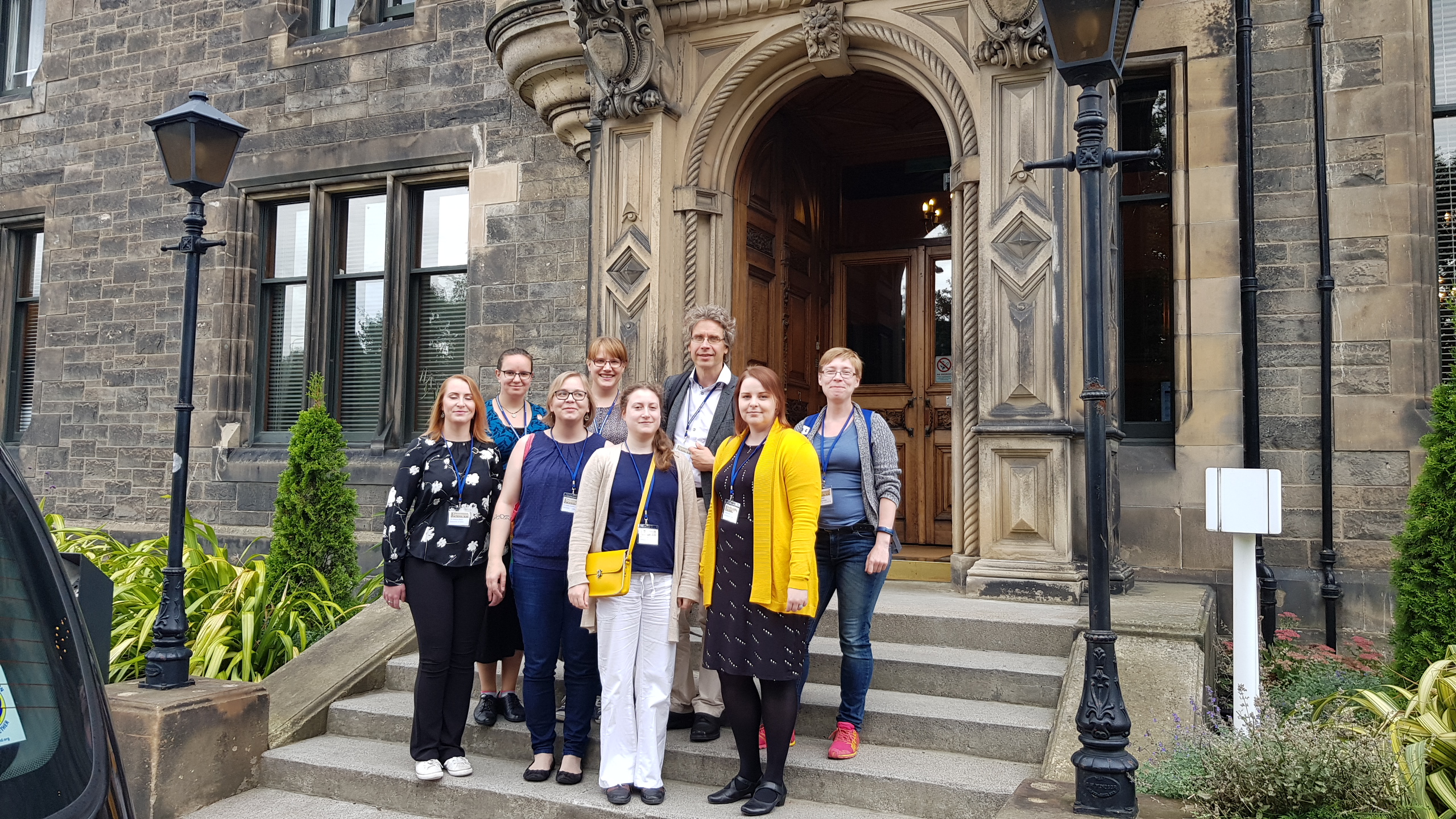
The International Conference on English Historical Linguistics (ICEHL) was organised for the 20th time in Edinburgh on 27–30 August. The conference gathers together English scholars from around the world, studying English from Old to Late Modern.
Almost all of our researchers from the Philological Track made it to ICEHL. Matti Peikola, Mari-Liisa Varila, Hanna Salmi (currently at the University of Stockholm), Aino Liira, and Sirkku Ruokkeinen gave papers in the workshop “Paratextual Communication in a Historical Linguistic Perspective”, organised by Matti Peikola and Birte Bös (University of Duisburg-Essen). Matti Peikola and Peter Grund (University of Kansas) presented a paper on orthographical variation together with Johanna Rastas. Aleksi Mäkilähde gave a paper on the metatheory of pragmaphilology. Susanna Mäkinen gave a paper on references to fugitives in runaway slave notices. I gave a paper on the different translations of The Mirror of Alchemy. We were a busy lot!
This was my first ICEHL, but I hope it won’t be the last. The conference was packed astonishingly full of great papers and interesting discussions; the programme can be found here. I have never been to a conference with so many excellent papers on fascinating topics that were relevant for my own research. I was especially excited by papers on topics such as medieval Latin-English code-switching, spelling variation and standardisation in the early modern period, and multilingualism in late modern medical discourse.
Despite the busy academic programme, there was also time for social events. The conference ceilidh on Tuesday 28 August was especially memorable: it was wonderful to dance and to watch a crowd of other scholars skipping merrily along to the live traditional music. Lots of us also found time to climb up to Arthur’s Seat, the majestic hill right next to the conference location.
ICEHL also involved a final day of activities on Friday 31st August. Most of us Turku philologists – unsurprisingly – chose to go to Lindisfarne, the monastic Holy Island where the Anglo-Saxon Lindisfarne Gospels were produced. The weather was astoundingly warm and sunny; we had a glorious day trip filled with island beauty, the island’s old history, and clean sea wind. It was a fitting and excellent ending to a week’s worth of English historical linguistics.
If you trust Wikipedia, fieldwork refers to “the collection of information outside a laboratory, library or workplace setting”. However, philological ‘fieldwork’ often takes place within a library – but instead of reading secondary literature, we examine primary materials. I’m currently a visiting scholar at Queen Mary University of London. During my stay here, I work on 16th-century manuscripts and printed books in the British Library.
Although early materials are increasingly accessible in digital form, and many early texts are made available in editions, not all research questions can be asked of these substitutes. Codicological, palaeographical, and bibliographical research methods entail close examination of books and texts as material objects. Analysing the physical construction of a book or the scribal hands present in a manuscript, for example, may also provide crucial evidence for studying the contents of a book.
To access special collections, one usually needs to register as a reader (instructions can be found on library websites). After registering, you can then order items to study them in reading rooms. You can bring your laptop, notes, and pencils, but nothing that might damage the books such as pens or sharp implements. White gloves, although sometimes seen on TV, may also cause damage to the books. They are thus generally not used in professional libraries. Clean, dry, and careful hands are the better option!
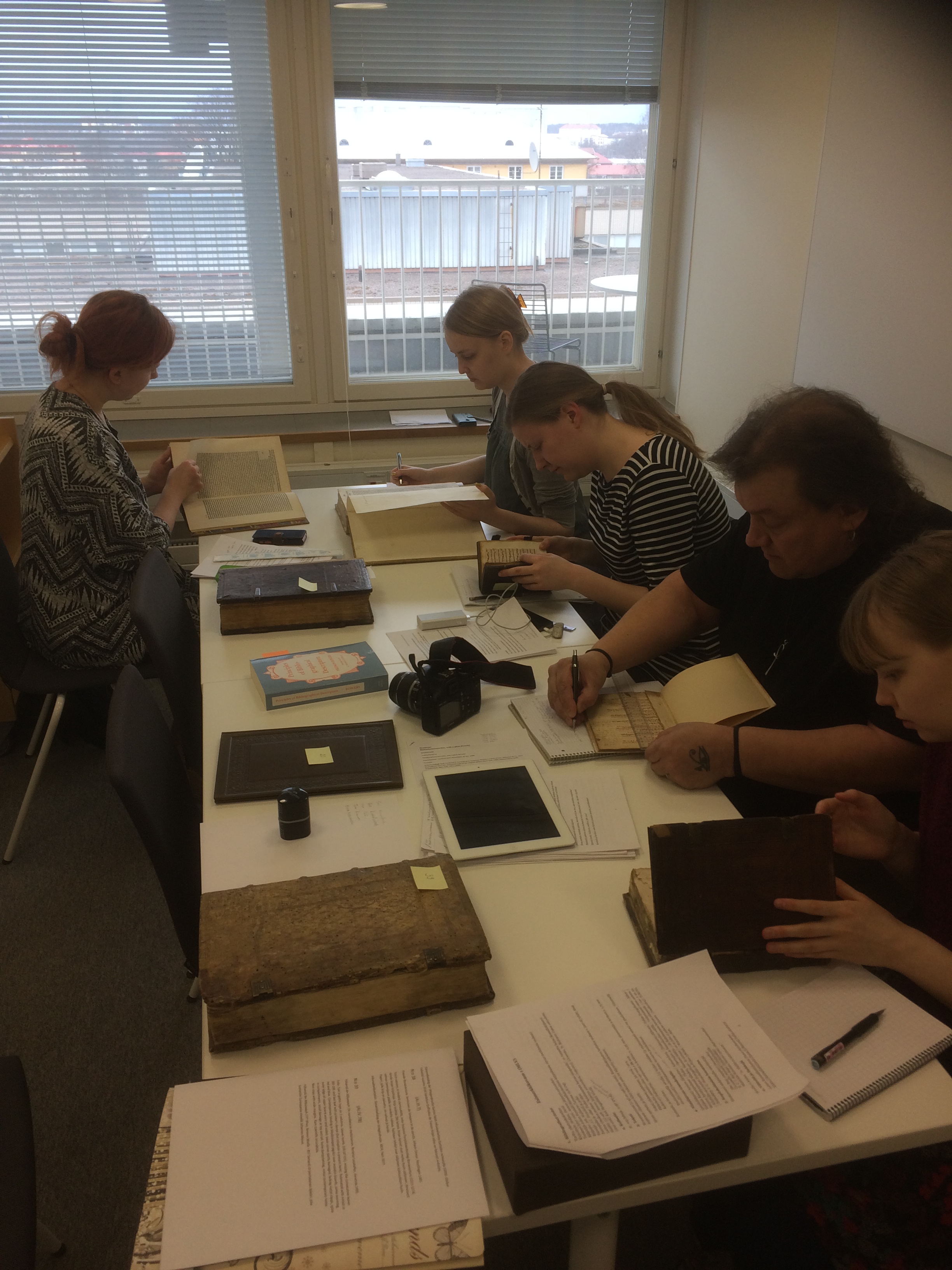
The University of Turku library also holds early materials. Last spring, students taking the Book History course organised by the Departments of English and European and World History had the chance to try their hand at being book detectives. My small group studied a selection of incunabula (books printed before 1501), practising the specialised skill of writing bibliographical descriptions of early books. Here they are at work!
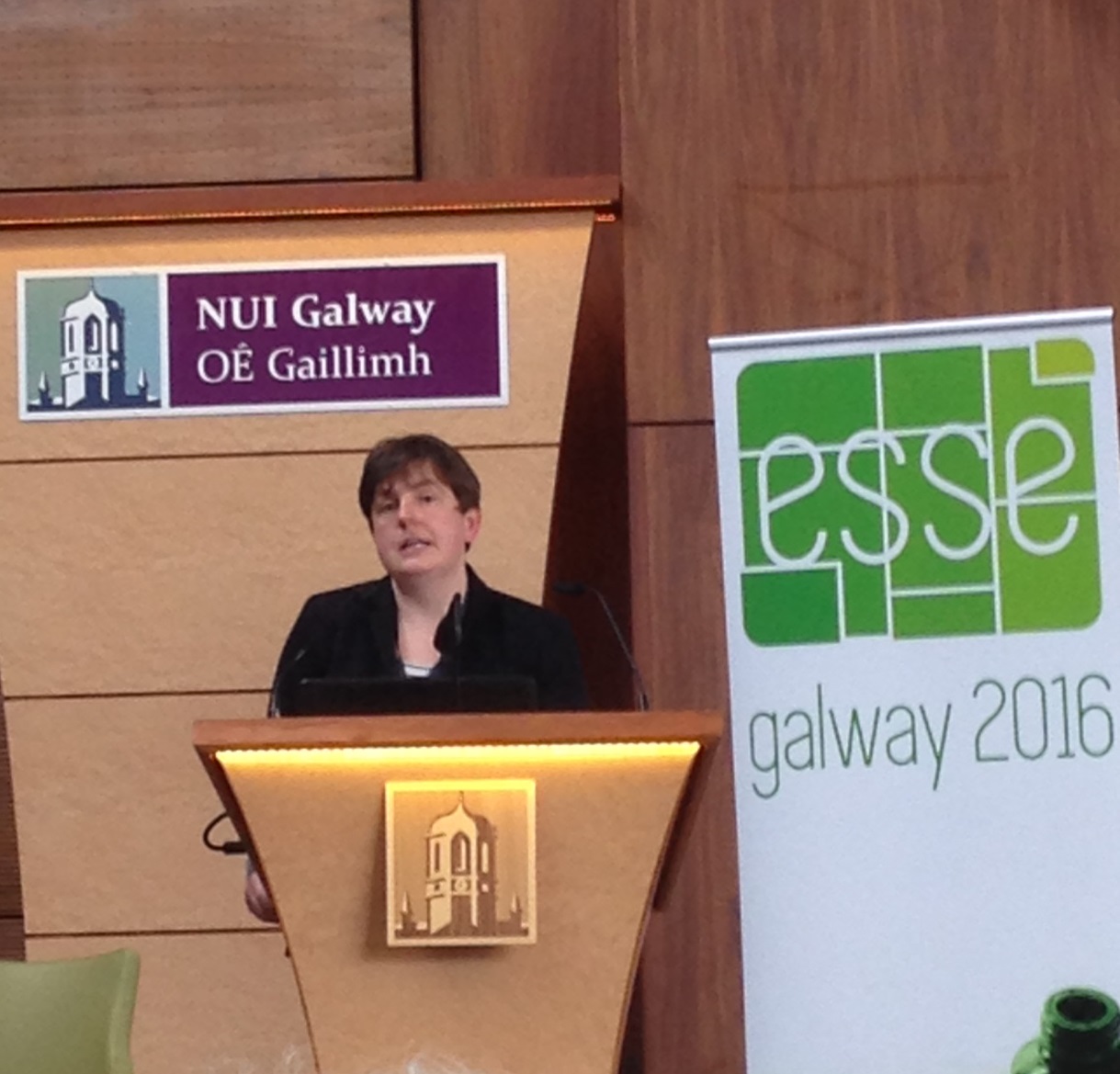
While our historical linguists were enjoying the heatwave in Essen, another delegation from the English department went on a similar mission to a place with just one letter’s difference: ESSE – the European Society for the Study of English biannual conference in gorgeous Galway, Ireland. Our research project funded by the Academy of Finland, Out of the Ordinary: Challenging Commonplace Concepts in Anglophone Literature, hosted a round table debate on the topic of competition for research funding in Europe and its consequences for English Studies. Visions were similar from all over Europe: competition for research funding is fierce, resources are diminishing, but everybody is making it work one way or another. Cautiously optimistic could perhaps be seen as the general attitude in the end of the discussion: after all, we have platforms like ESSE in and from which to push the English Studies agenda further. Besides the round table, the five-day conference with over seven hundred participants held numerous highlights, both intra- and extracurricular.
The conference began and ended with prestigious keynote lectures, the first by Emma Smith, Professor of Shakespeare Studies at Oxford. Her discussion on the changes, annotations, and scribbles made by previous owners to copies of Shakespeare’s First Folio denotes the very material quality of books as writing — they are not just stories but also stories about people who have owned or handled them. Smith is further known for her pedagogical efforts, not least of which is the Approaching Shakespeare podcast series, a very accessible way to get to know the Bard of Avon.
The conference ended on another high note, when Professor and author Colm Tóibín in his keynote, titled “As Things Fall Apart: The Response to Violence in the work of W.B. Yeats and James Joyce”, discussed Irish political history and literary analysis hand in hand, with a plot and detailed characterization as only a novelist/scholar could tell it. Thrilling treat, indeed!
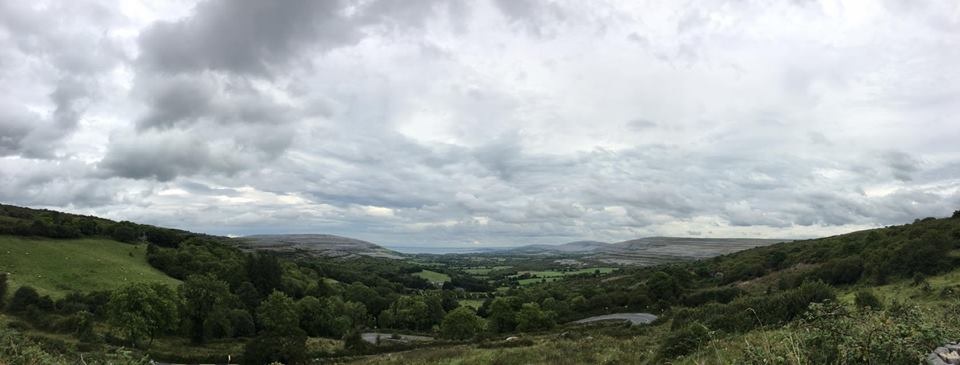
With storytellers like Tóibín hailing from Ireland, it is no wonder that Galway will be the European Capital of Culture in 2020. The beautiful Atlantic scenery, seafood, music, culture, grazing sheep, ponies, and cattle in the green valleys make it an ideal destination for anyone looking to fall in love with places like the historical Kylemore Abbey pictured below. The Gothic castle and Victorian walled garden are now home to the Benedictine community, who welcome visitors to take in the peaceful atmosphere by the lake, which can only be described in the words of the Irish poet, Patrick Kavanagh: “Tranquillity walk with me/And no care/O, the quiet ecstasy/Like a prayer”.
Text by Elina Valovirta
Photos by Ira Hansen and Elina Valovirta.
p.s. The next ESSE conference will be held in Brno, Czech Republic, in 2018. For more photos about ESSE, see the ESSE website and for another conference report from a participant in the very successful panel on children’s literature, see here.
For university faculty, summer does not simply equal vacation. It is also a prime time for international conferences that are part of our work as researchers. In the end of August, historical linguists flocked to Essen, Germany for the 19th biennial ICEHL conference (22–26 August). ICEHL stands for “International Conference on English Historical Linguistics”.
The four conference days were packed with excellent plenaries and fascinating papers on all aspects of English historical linguistics – for example pragmatics, speech representation, syntax, variation, language contact, phonology and semantics. Together, the papers covered a millennium of the story of English, from Old English to Late Modern English. You can take a look at the programme here.
Our Philological Track was well represented in the conference. Hanna Salmi gave a paper on verse and prose debates in early modern England. Aleksi Mäkilähde discussed his pragmaphilological approach to the study of language choice in Early Modern English school drama. Janne Skaffari also dealt with multilingual practices in a paper he gave together with Arja Nurmi from the University of Tampere. Finally, Matti Peikola and I discussed early sixteenth-century title-pages as sites of textual discourse. We were delighted to be in the same session with our former Turku colleague Carla Suhr (currently University of Helsinki) who also explored early English title-pages in her talk.
While the other members of our team are frequent ICEHL delegates, this was my first (but probably not the last) ICEHL conference. I really enjoyed my time in Essen, and the heat wave that struck us during the conference was a welcome break after the chilly Finnish summer. The next ICEHL will be hosted by the University of Edinburgh in 2018. As that is the 20th ICEHL conference, organised during the famous Fringe festival in August, I am sure it will be a festive experience indeed!