What’s that MA Thesis all about?

On 8 April 2025, students and staff members of the Department of English gathered for the annual MA Thesis Symposium. The event has been organized since 2013, so one could safely say that it is turning into a true tradition of the English Department.

The MA Thesis Symposium showcases MA research done at the department. Major students who have just completed or are about to complete their MA Thesis give a short presentation where they talk about their thesis topic, methodologies and key findings, and often also about what it is like to write an MA Thesis. The symposium is specifically aimed for students starting their MA Thesis seminar, who might wonder about topic selection and the process in general, and BA level students, who are thinking about what to specialize in in their MA studies. The symposium also gives the speakers an opportunity to talk about their research and gain public speaking experience in a relaxed and friendly environment.

This year, we were lucky to have speakers from each of the Department’s MA tracks: philology, discourse, second language acquisition, literature, and multilingual translation studies. The level of maturity, professionalism and enthusiasm of the presenters was impressive. Each outlined their topic with confidence and was well-versed in academic language and presenting style, all the while making their varied topics accessible to everyone in the audience. The presenters carried themselves well through the lively discussions and answered questions from the audience knowledgeably. The event certainly served as encouragement to those still a bit apprehensive about writing an MA Thesis.
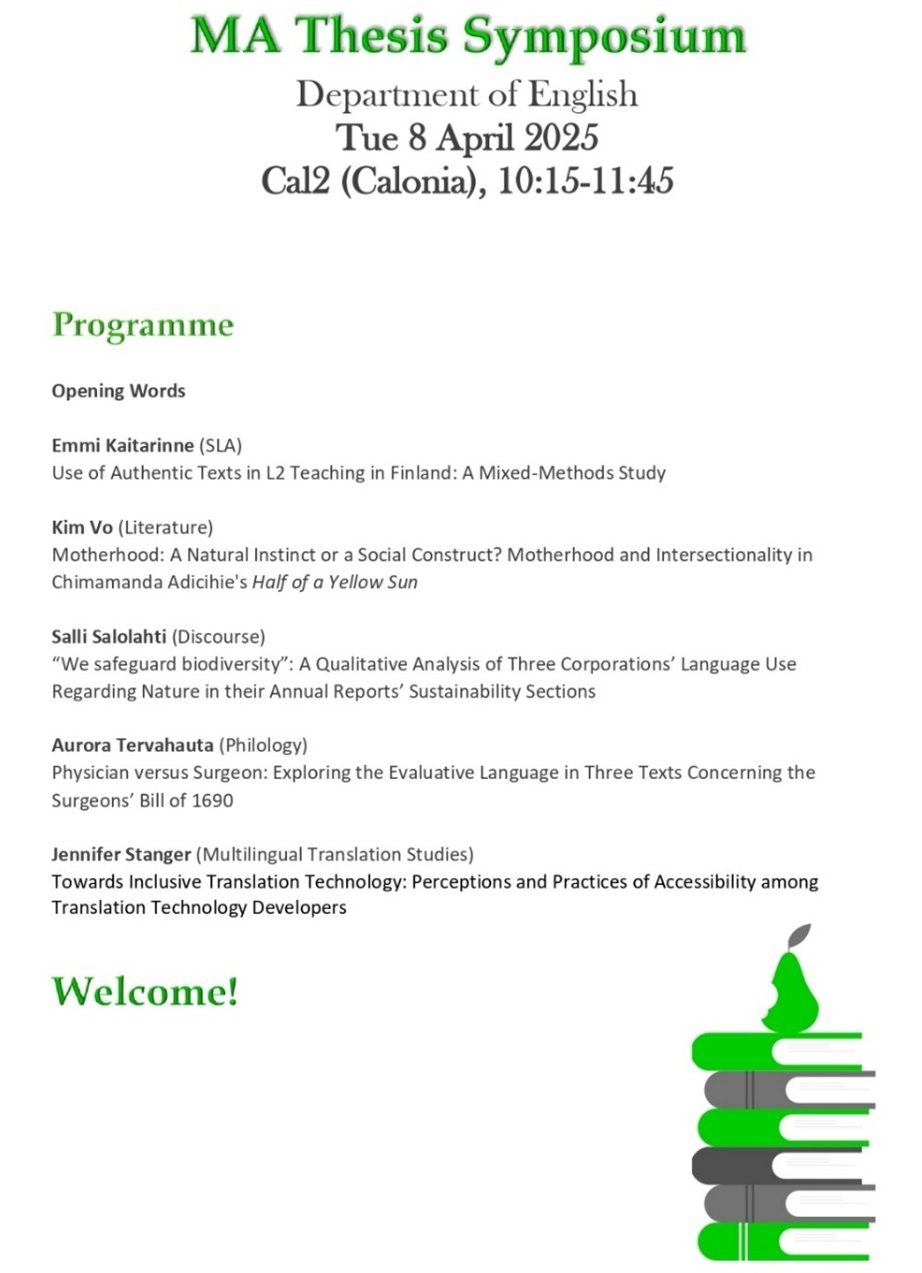
The program for MA Thesis Symposium held at Department of English on Tuesday 8 April 2025 Programme: Opening Words Emmi Kaitarinne (SLA) Use of Authentic Texts in L2 Teaching in Finland: A Mixed-Methods Study Kim Vo (Literature) Motherhood: A Natural Instinct or a Social Construct? Motherhood and Intersectionality in Chimamanda Adicihie's Half of a Yellow Sun Salli Salolahti (Discourse) “We safeguard biodiversity”: A Qualitative Analysis of Three Corporations’ Language Use Regarding Nature in their Annual Reports’ Sustainability Sections Aurora Tervahauta (Philology) Physician versus Surgeon: Exploring the Evaluative Language in Three Texts Concerning the Surgeons’ Bill of 1690 Jennifer Stanger (Multilingual Translation Studies) Towards Inclusive Translation Technology: Perceptions and Practices of Accessibility among Translation Technology Developers
This year’s MA Thesis Symposium had speakers from all of the Department’s MA Tracks.

I asked the presenters to join me in writing this blog, and Salli Salolahti and Kim Vo hopped onboard. Here they reflect on their experience of writing an MA Thesis and creating a short presentation based on it. They also touch on what it felt like to talk about their research in front of a live audience.

Salli Salolahti (Discourse track):

The MA thesis process definitely taught me a lot more than I initially thought it would! I perhaps naively thought that I would just get it done and that the biggest obstacle would be writing a paper this extensive. However, it turned out that for me the biggest obstacle to overcome was not the writing or any theory – it was perfectionism!

To make progress in the MA thesis process, you have to go through different steps like turning in your topic proposal, research plan, first draft, and so on. I had to accept that these would be less than perfect and that the whole process is simultaneously about showing what I have already learned and learning something new. I spent a lot of time experimenting with different approaches before finding the ones that I could make work. While this was at times frustrating, it was also great to realise that I was able to reflect on and solve many of the issues myself.

When it came time to present my thesis, I assumed squeezing it into a ten-minute presentation would be easy, but it turned out that was not the case. It had been a while since I submitted my thesis, and I had promptly forgotten how much ground it covered! While ten minutes initially sounded like plenty of time, in the end it went really fast.

I was both excited and nervous to present my research. Speaking in front of a live audience did not make me nervous, as I am used to it, but the idea of possibly misrepresenting something about my own research, methods, or theories stressed me. But I needn’t have worried about it: as soon as I started talking, it felt like I remembered everything. It was actually quite nice to talk about something that I myself had done and was proud of and also knew more about than anyone else in the room!
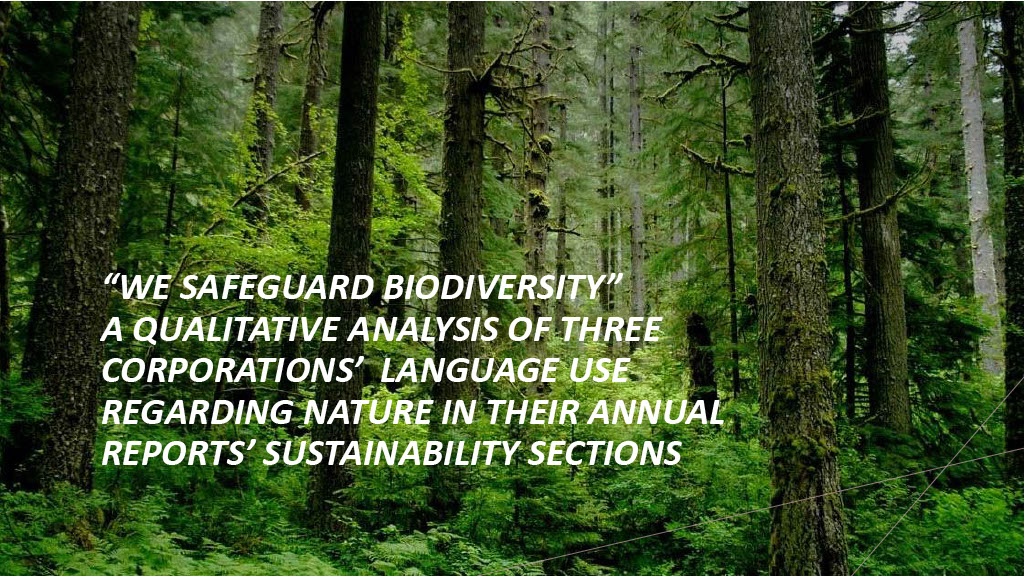
The title slide from Salli Salolahti's powerpoint presentation, depicting the title of the presentation (“We safeguard biodiversity”: A Qualitative Analysis of Three Corporations’ Language Use Regarding Nature in their Annual Reports’ Sustainability Sections) in white in front of a picture of a forest
In her MA Thesis, Salli Salolahti used ecolinguistics, critical discourse analysis and transitivity analysis from systemic functional grammar to analyze the language different corporations use when they talk about nature.

Kim Vo (Literature track):

My MA thesis explores a deceptively simple question: is motherhood an innate, natural instinct — or a social construct shaped by culture and expectation? As it turns out, writing about motherhood felt a lot like… well, becoming a mother.

The early days of thesis writing were filled with anticipation – glowing, even. I was excited, full of ideas, and ready to dive in. Then came the “morning sickness” phase: nausea-inducing literature reviews, endless source hunting, and the creeping dread that maybe I’d bitten off more than I could chew. But just like in pregnancy, there were those magical kicks – moments when my analysis clicked, and I felt the baby (read: thesis) growing into something real.

The final stretch? Labor. Pure, exhausting, deadline-driven labor. Pulling everything together felt like pushing through contractions – painful, but with a purpose. And finally, there it was: a fully formed thesis, screaming for attention and citations.

Presenting my work was another surprise. Despite two years of teaching experience, I still felt butterflies facing a new audience. But once I started talking, the nerves melted away. Ten minutes flew by – barely enough time to scratch the surface – but I was proud to share my research and answer questions.

This journey taught me that writing a thesis isn’t just academic – it’s deeply personal, occasionally chaotic, and ultimately rewarding. And like any proud parent, I’m just glad it’s finally out in the world.
The title slide from Kim Vo's powerpoint presentation, depicting the title of the presentation (Motherhood: A Natural Instinct or a Social Construct? Motherhood and Intersectionality in Chimamanda Adicihie's Half of a Yellow Sun) in white in front of a picture of flowers
In her MA Thesis, Kim Vo explored the many types of motherhood present in Chimamanda Adichie’s depiction of post-colonial Nigeria and concluded that motherhood exists as a dynamic interplay between instinct, choice, and social influence.

Text and photos by Ira Hansen, Salli Salolahti and Kim Vo
Visualising knowledge: reflections from the Reading Visual Devices conference

On 22 May, the foyer of Arcanum buzzed with anticipation as attendees gathered for the Reading Visual Devices conference organized by the Early Modern Graphic Literacies (EModGraL) project. The event began with a warm welcome from Marjo Kaartinen, Rector of the University of Turku and a member of the EModGraL project. Rector Kaartinen highlighted the city’s rich late medieval and early modern heritage, noting that there could hardly be a more fitting location for a conference focused on early modern graphic devices. She concluded her opening remarks by expressing the university’s pride in the project.

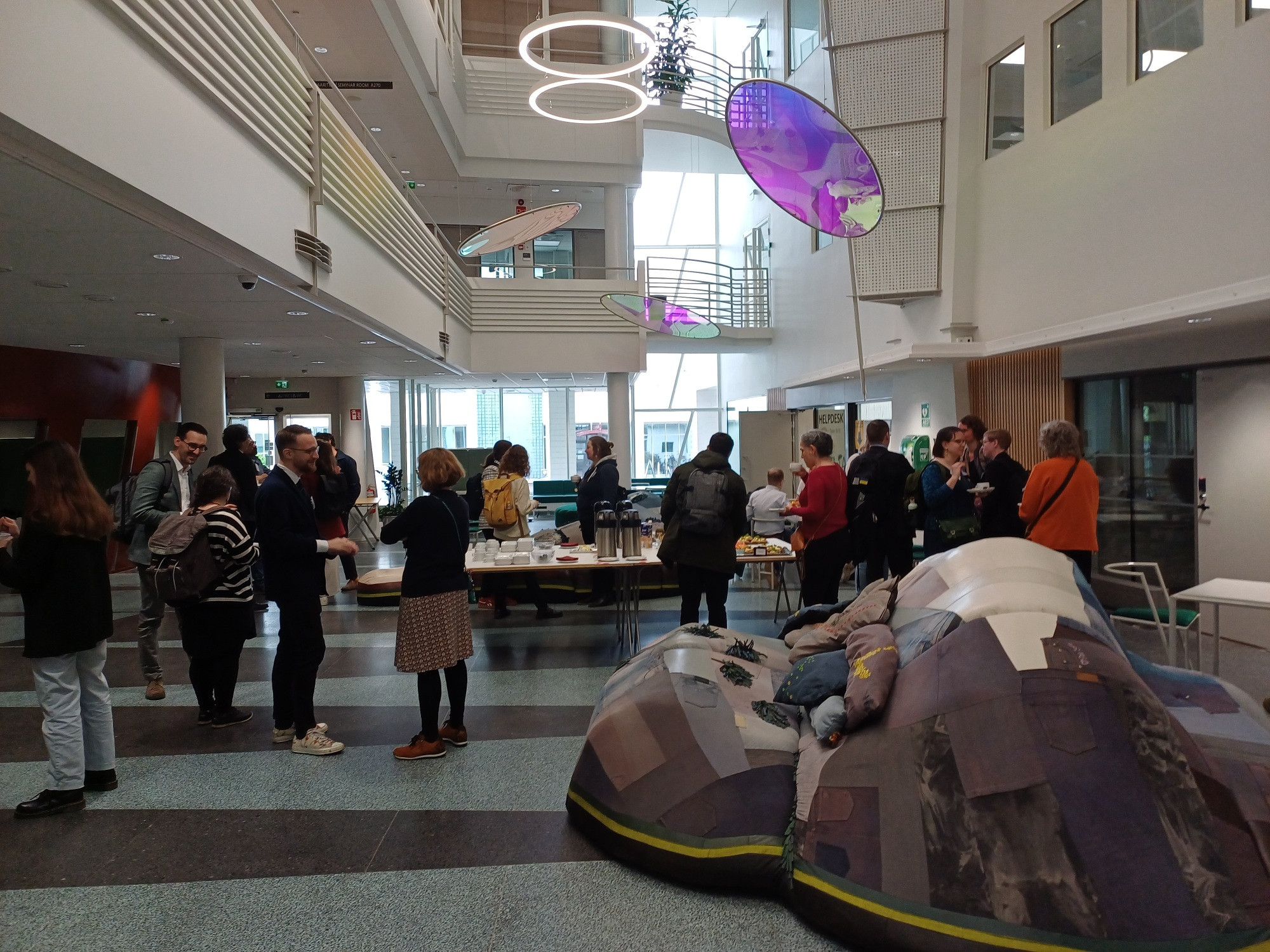
Attendees enjoying coffee and conversations between sessions in the lobby of Arcanum

Next to take the stage was Professor Matti Peikola, the principal investigator of the EModGraL project. He extended thanks to the project’s primary funders – the Research Council of Finland and the City of Turku. As the four-year project draws to a close this summer, the conference marked a significant milestone in its final phase. In attendance were two of the project’s key collaborators: Professor Wendy Scase (University of Birmingham) and Dr Carla Suhr (University of Helsinki), both of whom gave keynote speeches. A third keynote was presented by Professor Andrew Riggsby (University of Texas).

The multidisciplinary conference brought together researchers interested in late medieval and early modern visual devices such as images, diagrams, charts, and tables that convey information alongside text. Over the course of three days, the programme featured three keynote lectures and 25 paper presentations, covering topics ranging from diagrams in early modern grammar textbooks to witchcraft pamphlets and medical manuscripts. Together, the papers offered insight into how graphic devices were used, understood, and employed to visualise knowledge in the late medieval and early modern periods.

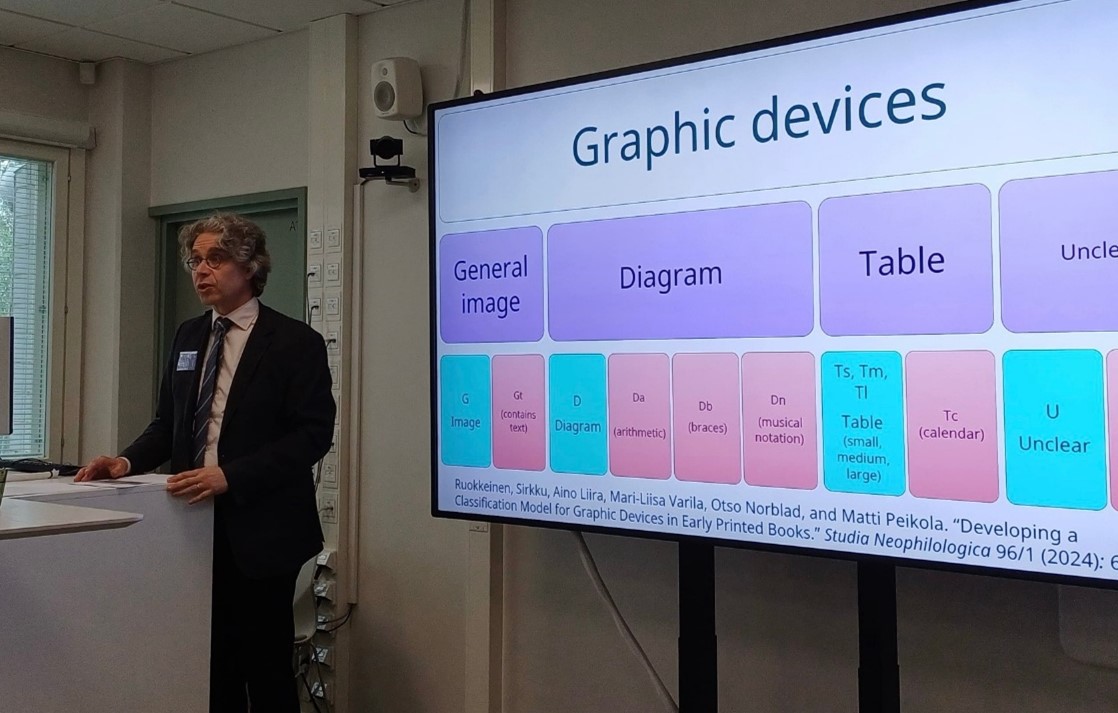
Professor Matti Peikola presenting findings from the EModGraL project

The international conference drew approximately 40 attendees from a range of academic disciplines. As a student assistant, it was inspiring to observe professionals in action – presenting their findings and exchanging ideas. For me personally, the most rewarding aspect was witnessing the academic community that the project has built over the years.

Finally, on behalf of all the student assistants, I would like to thank Dr Sirkku Ruokkeinen, whose support and guidance helped ensure the smooth organisation of the event. Reading Visual Devices was a successful three-day conference, hosted by what Rector Kaartinen described as a “particularly fabulous project.” As heard in the discussion following Dr Mari-Liisa Varila’s paper on the first conference day, one cannot help but wonder: what’s next? Perhaps, a well-earned holiday for the EModGraL team.

Text by Maria Tervakangas

Photos by Pinja Miettinen

TiTaRa: Between Science and Magic Symposium Through the Eyes of an Assistant

The TiTaRa: Between Science and Magic Symposium was a great success! The symposium was held on 10–11 October here in Turku together with the Finnish Network of Magic Studies to explore topics such as Western esotericism, magic, witchcraft and early sciences bordering them (such as alchemy and astrology). Participants arrived from around the world, and the topics varied from medieval England all the way to Finland in the 19th century and everything in between.

There were three of us assistants, and in addition to assisting at the symposium, there was a variety of things to do both before and after the event: checking the symposium’s emails, designing and setting up signposts and nameplates, compiling a book of abstracts of all the presentations and making social media posts… Some of these sounded a little intimidating at first for someone with no prior experience on such things but it turned out to not be too difficult after all because we had such a great team. Help was always available, and it was easy to divide some of the work between the three of us. During the symposium, our main responsibilities were working at the reception and assisting with the technology (thankfully no issues arose with the computer!).

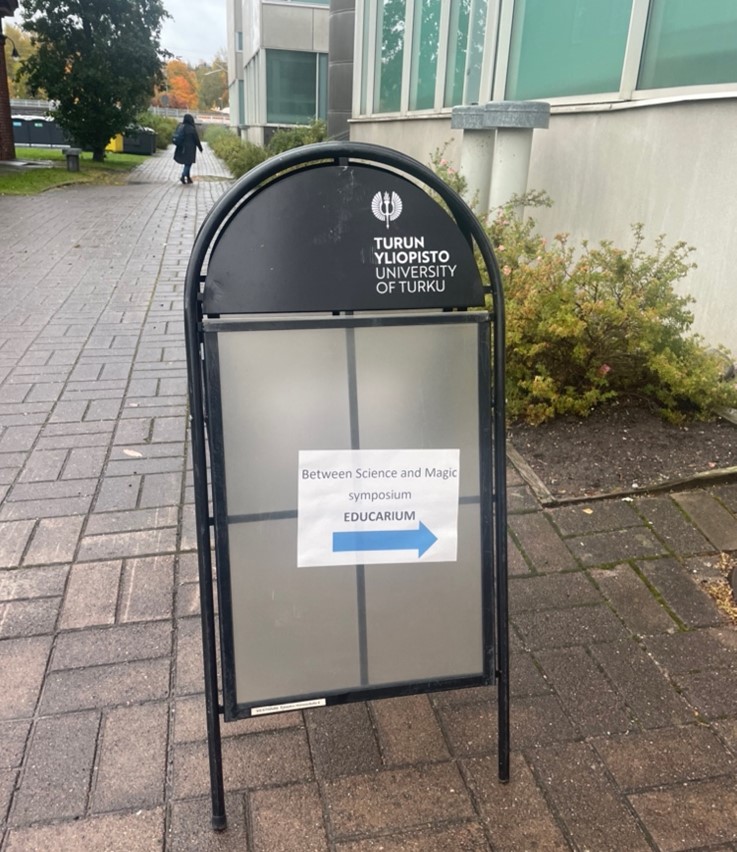
The signpost guiding our guests in

Day 1 of the symposium started bright and early on a rainy October morning for us assistants and other organizers of the event. The first things to do were putting up signs outside so that all of our guests could find their way in and making sure the presentations of the day were set up and ready to go. Attendees started arriving a bit before 9 a.m., and our job was to welcome everyone at the reception and hand out nameplates. At 9:15 it was time to officially start the symposium! The first presentation was one of our two keynote speakers, Professor Egil Asprem from Stockholm University. The presentation was about Romani magic and the sexism & racism involved in it with most fortune tellers at the time being women, as well as the stereotypes surrounding it being fraud.

After the first presentation, we had a quick coffee break and then continued with two more presentations before lunch. As assistants, we divided the work so that one or two of us stayed at the reception and the other(s) helped with setting up the presentations (and had the perk of listening to them!). Hearing many of the presentations was honestly one of the best parts about being an assistant at a symposium with such an interesting theme! After lunch, there were three more presentations, and then it was time for coffee once more, followed later in the evening by a City of Turku reception and a dinner at Brewery Restaurant Koulu. After the coffee, we made sure everything was in order for the second day. The first day went by very quickly and left me more excited.

Day 2 started quite similarly for us as the first day. Friday’s first presentation was another one of our keynote speakers, Carla Suhr from the University of Helsinki, whose topic was witchcraft and medicine in early modern English witchcraft pamphlets. The presentation focused on the visual features of the pamphlets, advertisements of proprietary medicines and how they were presented to the audience.  The second day passed by just as quickly as the first, with a total of six presentations in addition to Carla Suhr’s presentation. There was so much to learn, and everyone’s presentation added new perspectives to the theme of the symposium; I learned about the role of magic (and science) in astronomy & astrology, dance, dreams & nightmares and so much more! In a flash, the second day was finished too. Everything went even better than I had anticipated; we had no major issues and everyone seemed to enjoy themselves.

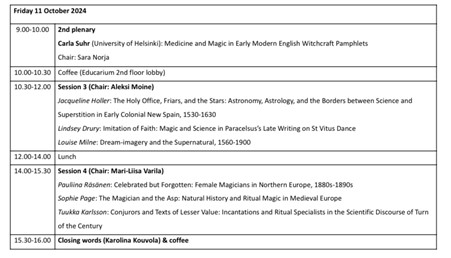
The schedule of day 2

It was a great experience to learn about all that goes into organizing an event like this, and it felt inspiring to see how passionate everyone seemed to be about their own presentations, and all the discussion each presentation sparked among the attendees. During coffee breaks, it was nice to hear bits and pieces of conversations the attendees were having, often inspired by the previous presentations. I would recommend an assistant internship like this to everyone! It was such an interesting way to meet new people and to learn how academic events are organized. The topics were interesting, everyone was extremely kind, and it hardly felt like work at all. A big thank you to everyone who was part of the symposium!

Text and photos by Maija Riikonen

Tracing the Complicities of Colonial Violence

On a warm Saturday morning, on 24 August 2024, a small audience gathered to celebrate Amin Beiranvand as he defended his doctoral dissertation Gendered Sexual Violence and Complicity: A Postcolonial Study of Selected Works by J. M. Coetzee. Professor Joel Kuortti acted as custos and adjunct professor John Stotesbury from the University of Eastern Finland as the opponent.

The viva began with Amin’s lectio praecursoria, in which he outlined the historical and cultural context and the main research questions of his dissertation. He ambitiously investigates the fiction of the critically acclaimed Noble Prize winning Coetzee, whose fiction has dealt with, among other themes, the legacy of colonialism and its violent power relations in human and animal encounters. This underlies also Amin’s research, in which he focuses on Coetzee’s portrayals of gender-based violence against racially and ethnically marginalised women in three novels, Dusklands (1974), Waiting for the Barbarians (1980) and Disgrace (1999).

All’s well that ends well. The opponent accepts the PhD dissertation.

The opponent presented his questions and criticisms in an approachable and captivating way. The questions began with a lengthy discussion on the dissertation title and specifically the many implications of the word complicity. The effects of colonial violence and its legacy are more far-reaching than those confined into the pages of Coetzee’s novels. This inspired the opponent to ask about Amin’s choice of the term “gender-based” when discussing violence in a setting where it springs as much from the colonial power structures and the racial hierarchies portrayed in the fiction.

The rest of the viva dealt with each novel individually and focused specifically on themes of violence, imagination, history, anger and the effects of silences that deny the voice of the oppressed. On this point, the opponent created an immersive experience for everyone in the room by staying silent for a disturbingly long time. Overall, the atmosphere of the viva was relaxed and the opponent told many entertaining anecdotes from his own career, for example being invited to dinner at Coetzee’s house and the introverted author then failing to show up.

The successful viva resulted in an accepted doctoral dissertation and we congratulate the new Doctor of Philosophy, Amin Beiranvand.

Text by Ira Hansen & Suvi Seppälä

Photo by Damon Tringham

A harmony of work and play – Working as a conference assistant in the Trextuality conference

Serving as a conference assistant and project intern is an excellent decision. Please, let me tell you why!

The info desk of the Trextuality conference, occupied by two conference assistants (taken by the Trextuality social media team)

I attended the Trextuality conference as an assistant and project intern. The conference was aimed at scholars working in translation studies and textual criticism, as well as neighbouring disciplines, such as literary studies and book history. The conference was held 7–9 September 2023 at the University of Turku in the recently renovated Arcanum building and in Educarium. The presenters’ topics were very varied, so you were bound to find something interesting. Personally, I was most interested in seeing how a conference would be organised. In addition, there were several presentation topics that intrigued me. For example, reference module 2B in the image below.

The afternoon schedule of the second day of the conference

Now that you’ve had a glance at just one of the days of the conference, you’ll probably see why I wholeheartedly recommend grabbing the next opportunity to be a conference assistant! Should you not have the time to dedicate to an internship of three or five study points, you get to participate in the lectures held by the attendees for free. If even that somehow fails to entice you to join, let it also be mentioned the food was very good and very free. I will reiterate, there is no need for a commitment to a project internship. You can just be a conference assistant with no strings attached, and these regular assistants were the majority of our numbers. Should you have the time and inclination for an internship, keep reading. If not, keep reading anyway.

So, you want study points for your efforts. You can get a project internship and three study points for your efforts if you put in around 81 hours of work. You get five study points if you put in 135 hours of work, as with regular courses. The 80-hour mark is pretty easy to achieve, whereas the 135-hour mark will require some special arrangements with your supervisor.

There are usually several different ways to help around, be it before, during, or after the conference. I will mostly be talking with this conference in mind, but much of this applies to project internships done as a part of other types of events as well. For instance, before the conference there were signposts to be set up and the lecture rooms had to be rearranged to suit the conference’s needs. Some of us were a part of the photography and social media teams that created content about the conference during the event. I was a part of the shift list team. Our planning made sure every room and the help desk were always occupied by at least one assistant. 

During the conference, the social media team and help desk and lecture room assistant duties offered a chance to pitch in. In addition, simply attending the presentations held by the attendees counted towards the hour threshold. Due to sick calls, I had to go a little light on attending presentations. I spent most of the conference manning the information desk, ready to help conference guests with whatever questions or needs they might have.

After the conference, there is the option of writing about your experiences for publications, which is exactly what I’m doing right now! These publications can be magazines read by linguists or blogs, such as the one you’re reading this text on.

We, the assistants, were called the T-rex team. The working spirit of the T-rex team impressed me. There were quite a few cases of illness that popped up during the conference among the assistants. Despite this, our line held, and we fulfilled our duties.

A group photo of some of the conference assistants (taken by the Trextuality social media team)

Our supervisors, the actual organisers of the conference, were the masterminds behind the whole operation, pulling it off like the true academics they are. Many occasions needed quick solutions and creative problem-solving that only the organisers had the authority to do. Say, helping with luggage forgotten by the attendees. Whenever we, the assistants, were at our wits’ end, asking our supervisors didn’t leave us on the rocks. We, the helping hands, were in good hands ourselves.

What for me personally made the entire conference was how kind and patient the guests were. If they needed help with something, they were polite, and if we had to find something out for our guests, they waited calmly, without rushing us. Their demeanour was professional and pleasant all around. We also received a great deal of kind words from the attendees in the form of emails sent to the organisers after the conference, which I personally found very heart-warming to hear.

To summarise, if interested, the next time you get an email saying that conference organisers are looking for assistants, grab a friend and volunteer. Do it for the study points, the experience, just to help out if nothing else. The worst that can happen is getting free food and a chance to meet fun people. Doesn’t sound like a bad deal to me.

Text by Ali Lamminen

A year of remote learning – and cats

What a year it has been! This could easily be a long blog post about the effects of the pandemic on teaching and learning and what pedagogical solutions have been implemented and experimented with at the department, but today we have more important things to discuss. We need to talk about cats.

This year has been extremely active for all our cat students and cat faculty members. They seem to thrive particularly in Zoom environments and have throughout the year been a mainstay for remote learners and teachers. Let’s hear from notable cat members of the English department community – and one dog. Email interviews have been facilitated by each cat’s staff.

Kiki via Vilma Lindroos:

Due to remote learning this year, I have seized the opportunity to constantly remind Vilma that the most important thing in her life are not her studies, but me. She reports that my ears perk up at the slightest sound of conversation, ready to disrupt yet another lecture that dares to take her attention from me even for a minute. Petting me in her lap does serve her as a great stress relief when she is tackling a particularly intimidating task, so I always win.

Behold as I conquer, says Kiki.

Alma, Hilja, Lohtu and Kulju via Elina Valovirta:

Elina works from an old renovated outbuilding at our country home. We use it as our Signum’s Kaffila or Rosetta’s coffee room. Whenever Elina heads to the outbuilding to work, we follow, eager to not help. A collective napping session might ensue; Alma the opera singer might decide to belt out an aria, or Hilja and Kulju decide a wrestling match is in order right in the middle of Elina’s lecture. Lohtu begs for treats on the work desk. We have done our very best in not helping at all, and what’s not to love about that?

I can haz treat?
I can haz treat? Says Lohtu.

Elo and Fox via Minna Hjort

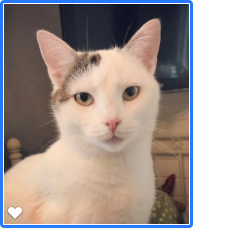
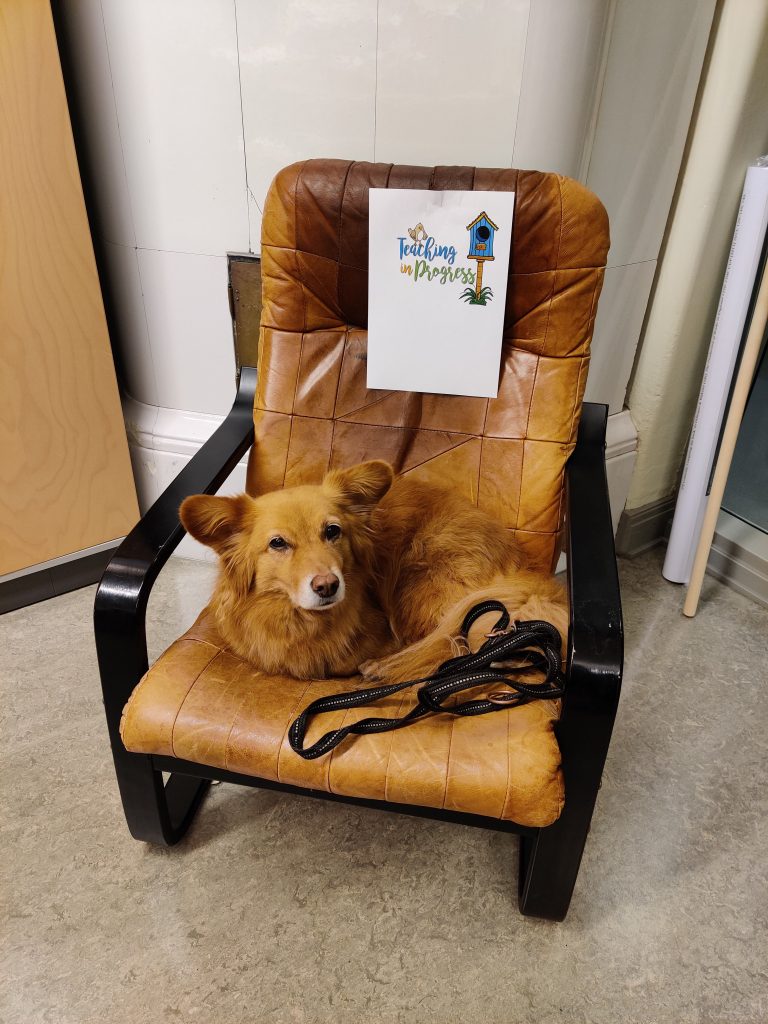
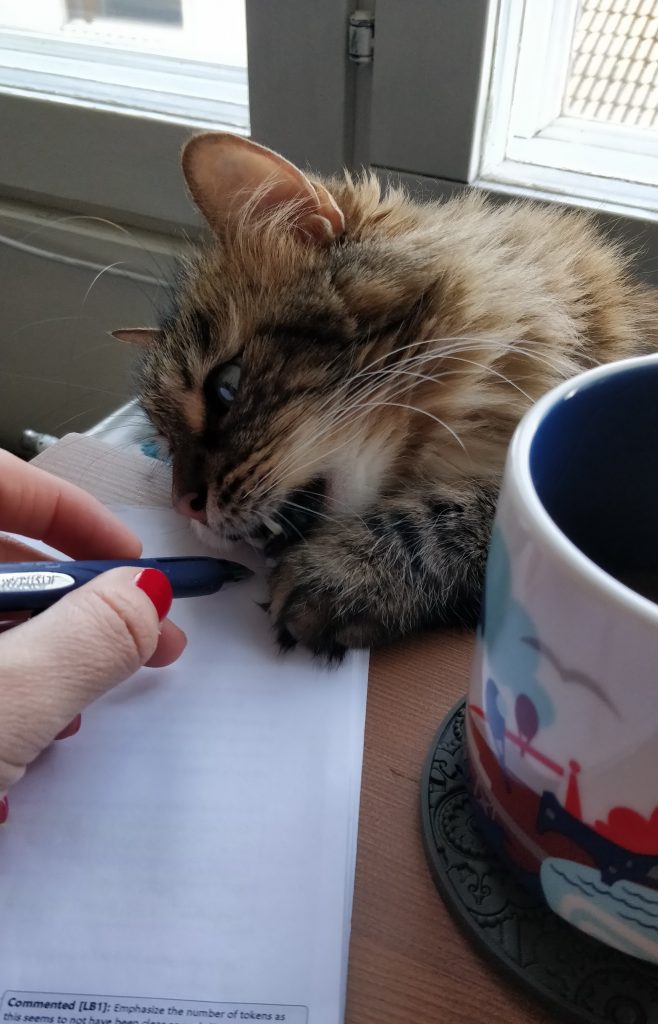
Fox has been an active co-teacher throughout the pandemic. He has not been afraid to speak his mind about a variety of topics, including the shocking fact that the department offers no classes on dog-human translation. Elo, the cat that she is, has been less interested. Although once she did find it necessary to position her butt right in front of the camera in the middle of a lesson. Occasionally she also assumes the role of reviewer 3 (see picture) and engages in document disposal management (shredding papers).

Teaching in progress. Don’t disturb me, says Fox.
I am destroyer of all papers.

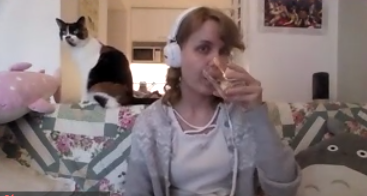
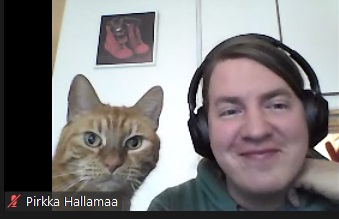
Finally, Pirkka Hallamaa, has found a way to look his best on camera: his photogenic cat provides the ultimate Zoom accessory: the cat filter.

Don’t hate me because I am beautiful.

Text by Elina Valovirta

Photos by staff and screen grab.

Philology, pragmatics and code-switching: My first viva

I had never been to a doctoral defence also known as a viva before, so I was immediately interested when I heard there was one taking place with our very own Aleksi Mäkilähde on the hot seat. Aleksi’s doctoral dissertation is called The Philological-Pragmatic Approach: A Study of Language Choice and Code-Switching in Early Modern English School Performances and as the title suggests, it examines code-switching in plays and poems by school boys at the King’s School, Canterbury, in 1665–1684. Eager to learn more about the subject, I decided to attend the viva, which took place 5 December 2019.

This being my first viva, I wasn’t quite sure how I should dress. The event soon starting at the Quantum Auditorium, I hastily did a few Google searches and found out that as an audience member, one is not expected to wear anything too fancy. I didn’t want to go under-dressed, so I took off my hoodie, put on a smart shirt and off I went. As I arrived at Quantum, I saw the candidate himself pacing around in the hall. I grabbed a copy of the thesis and sat at the back of the room. I looked at the people around me and judged my choice of clothes to be fitting.

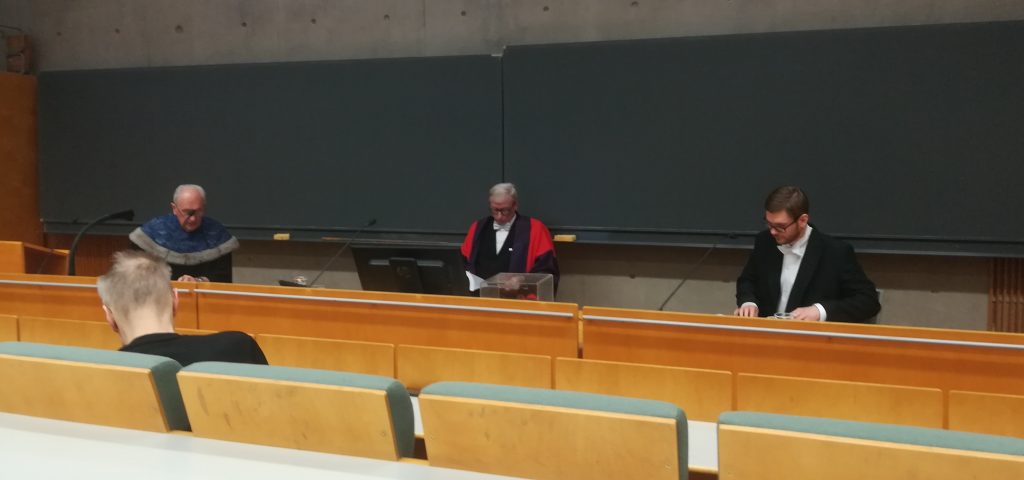
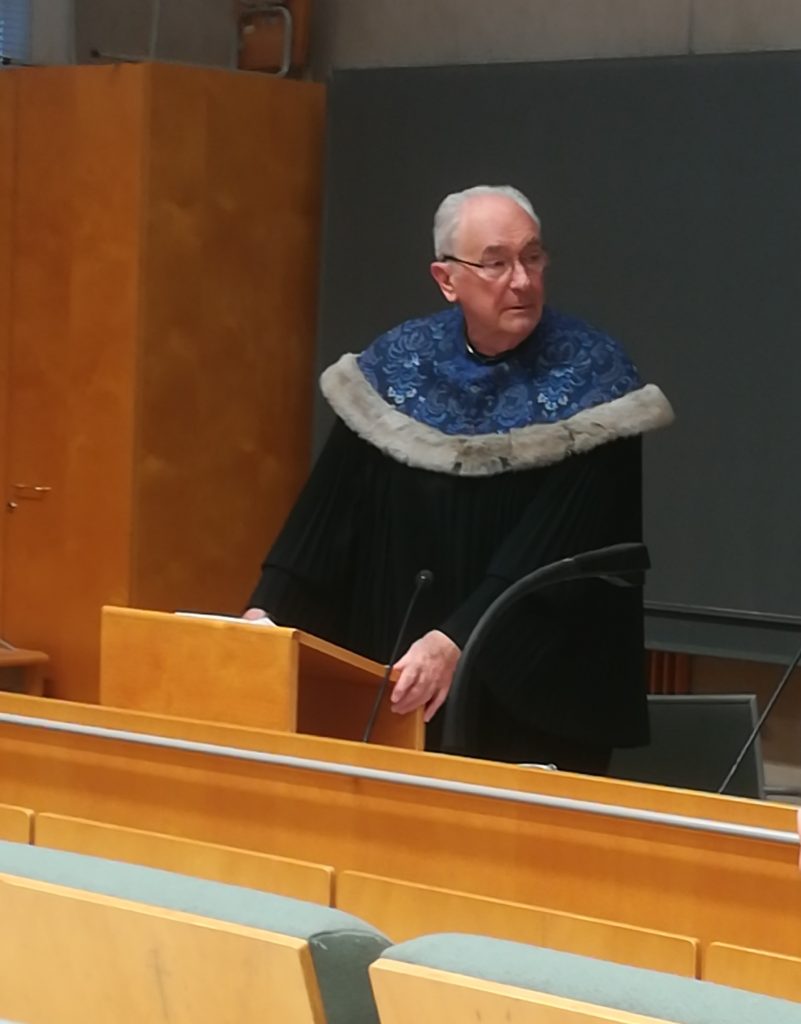
A few minutes passed. Suddenly everyone jumped up as the candidate walked in, followed by the custos, Professor Emeritus Risto Hiltunen, and the opponent, Professor Emeritus Herbert Schendl from the University of Vienna. The custos and the opponent were wearing colourful old-timey robes, which I assumed were customary, but later learned differ depending on the university.

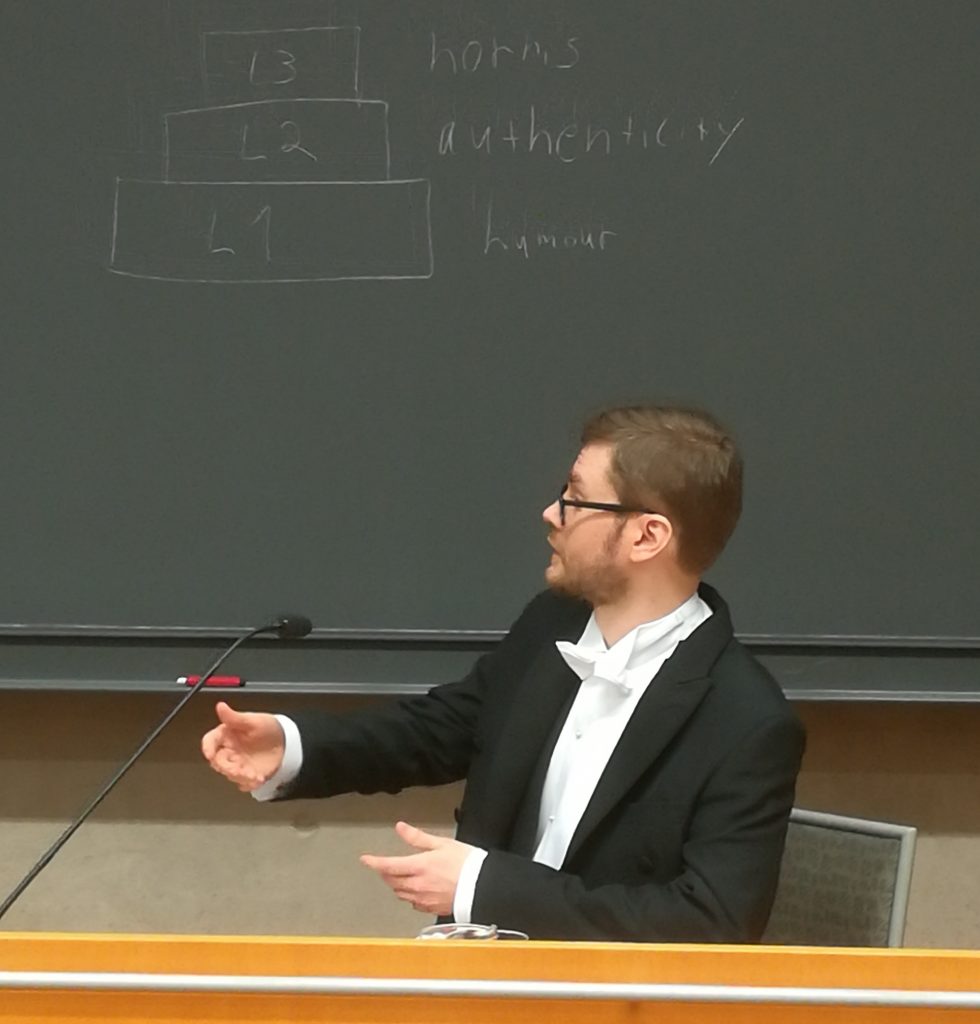
The custos spoke a few words, the candidate briefly presented his thesis in Finnish and then it was time for the opponent to ask his questions. The discussion was more informal and relaxed than I had anticipated. Some questions were more hard-hitting, but mostly it was a friendly discussion about the difference between a code-switch and a loanword, and what kind of consequences code-switching could have. I have to be honest; the discussion went quite deep into the nitty-gritty and at times, I had a hard time following. The highlight of the discussion was when Aleksi got up to the blackboard and drew something resembling a wedding cake to illustrate the complex nature of a play-within-a-play.

Some two hours after it began, the discussion ended, and the opponent gave his finishing statement. He commended the candidate’s hard work of developing a new philological-pragmatic approach and his detailed analysis of code-switching in the school plays. The custos, who had remained silent the whole time (which is customary) declared the viva to be over. Outside the auditorium, hands were shaken, gifts were given, and cake was had. To my disappointment, there was not a top hat nor sword in sight. I guess those were saved for later.

Gratulationes to Aleksi on his achievement and all the best in his future career!

Text by Otto Tarkka

Photos by Janne Skaffari

A month in northern England

The bleak midwinter is approaching, so isn’t a throwback to last spring a wonderful idea? At the end of April, I left Turku to spend a month in the north-east of England. I had visited Durham for two days in 2015, transcribing little bits of English surviving in some Latin manuscripts, and written in my notes: “I’d like to come back”. This became possible when I got a library fellowship from the Durham University Institute of Medieval and Early Modern Studies.

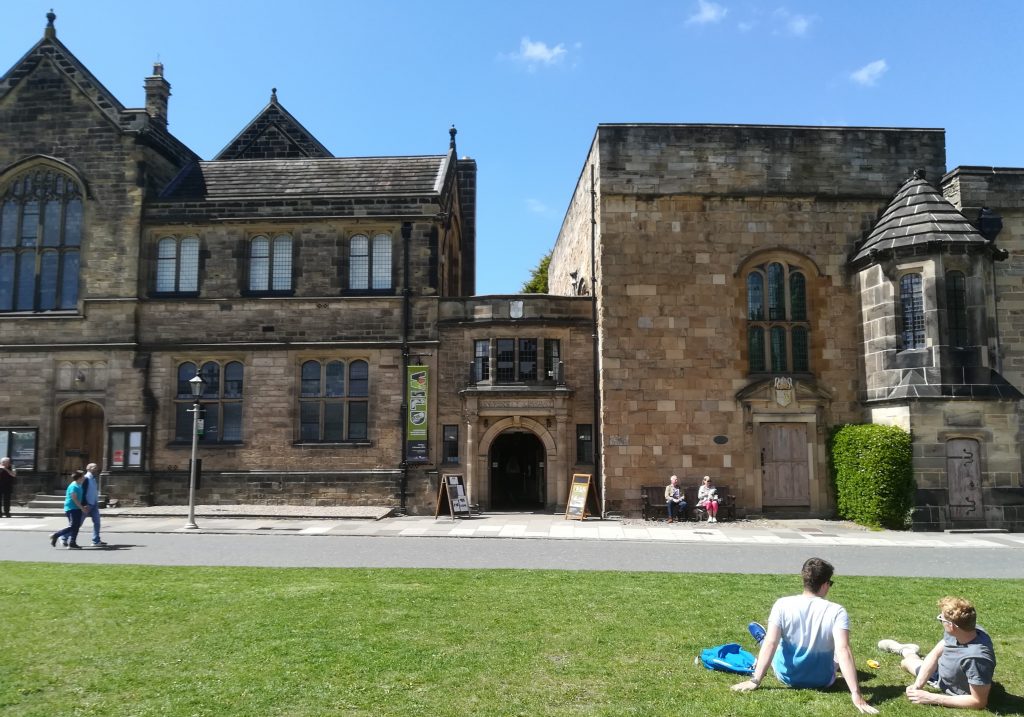
This was definitely an intense work trip, but I did have time to explore the city as well. Although Durham is small, with a population of about 50,000, it bears many similarities to a city the readers of this blog know well: there is a large medieval cathedral, a river and a castle, and a disproportionately large number of students. Durham is full of instagrammable spots, and getting to know the pathways and shortcuts particularly around Palace Green Library, located between the cathedral and the castle, was an absolute pleasure.

Durham University is one of the oldest in the UK and ranks among the top 100 universities in the world. It has about 18,000 students. Since it was Easter term – reserved for examinations – they seemed to spend most of their time reading in libraries. As I resided in college, I was able to make other observations about undergraduate life, too. It is quite different from Finland, particularly as college accommodation means you spend a lot more time together with the other students, starting with breakfast each morning. There was a pleasant sense of community, which I hope the students appreciated.

In addition to doing research and enjoying life in a beautiful old town, I was also able to make weekend trips to cities like Newcastle and Manchester and to smaller places such as Bishop Auckland and Tynemouth. A particular highlight was Hadrian’s Wall, which runs across the north of England. Having spent hours and hours examining 800-year-old manuscripts indoors, a bit of more ancient history out in the country towards the end of my trip was, quite literally, a breath of fresh air.

I would like to thank Durham University, IMEMS and the Library Fellowship for making this trip possible.

Text and photos by Janne Skaffari

More pictures on Instagram; look for captions mentioning a certain ‘Dr X’.

My Days as a Conference Assistant

The Finnish Society for the Study of English (FINSSE) held its eighth biannual conference here in Turku this summer. Having never attended a conference before, I leapt at the opportunity to work as an assistant at the event and get credits for my Master’s internship. I’m glad I did, for The FINSSE-8 conference, “What’s in a Century?”, turned out to be the highlight of my academic year.

The whole experience was very positive. The organising committee welcomed me with open arms; I was given clear instructions as to what was expected of me and in moments of doubt I could simply ask for help. It soon became clear that organising a conference takes hours and hours of planning and preparation. Even I, a mere assistant, sat through several meetings and wrote countless emails. Those in charge certainly had a lot of work on their hands! Funding, venues, catering, timetables, name tags – all the meticulous work done in advance resulted in a successful conference.

During the event I took care of odd jobs here and there: I put up info signs, greeted people at the registration, carried water bottles and whatnot. I dabbled with things that may seem small, but, in the end, helped create a smooth conference experience. I was being useful and I liked it!

Amidst the work and responsibilities there were fun surprises and major perks. For example, during the first conference day we were treated to a small music number. The memory of conference participants, postgrads and professors alike, swirling around and dancing to the tunes of a violin will probably stay with me forever. Most importantly, though, I got a glimpse into the inner circle of English research in Finland: I felt like a little sponge soaking up knowledge and ideas. I had the opportunity to attend some interesting paper sessions and meet people working in fascinating fields of research – the conference even provided me with help for my upcoming MA thesis. The research community felt warm and supportive and people seemed to enjoy the conference. I’m lucky I got to be a part of it.

Text by Lilli Laine

English – think of the possibilities

We’ve pretty much all studied the English language for many years already in our lives before making decisions about third level education. That English is a whole different beast than the one that’s studied in universities. Earlier you’ve simply studied how to use the language. When studying English at a university, you will get the chance to see the power of language up close.

You can take up the quest of learning the intricacies of literature and how it affects the reader. You can critically analyse media texts and through them power structures prevalent in society. You can see for yourself how the English language came about through its infancy to the present lingua franca and how the history is funneled to the present day. You will have the chance to study simply how the language itself is constructed. Perhaps you will want to delve in to the peculiar process of translation, where the diversity of different cultures and languages will become apparent and you will see why language is such a strong identity builder. Naturally, you can also learn the specifics of teaching a language to others, how language acquisition works, why language is such a special human feature, and how its best transferred to others for the benefit of us all.

While having the chance to do all this, you will also have a chance to join the merriest bunch of people out there that makes all the aforementioned studying just that much more fun. I’m of course talking about the student organization for English students in the University of Turku – Anglica. Anglica is a very open, welcoming and active organization that organizes a variety of events for students. These can include anything like board game nights, movie nights, various sports events, sitz and nightclub parties, visits to a theater and other cultural events as well as just casual hangouts. The best thing about these events is after all the people.

There seems to be a kind of a kindred spirit among Anglicans. We’re all different of course but it feels like there’s something similar about us all. That makes it easy to get on board and meet new people. I am one of the two members in the board of Anglica responsible for events and I can tell that I am already looking forward to seeing many new faces in the events to come next autumn.
Text and photo by Teemu Helenius

students
English students exploring a world of possibilities.