Tracing the Complicities of Colonial Violence

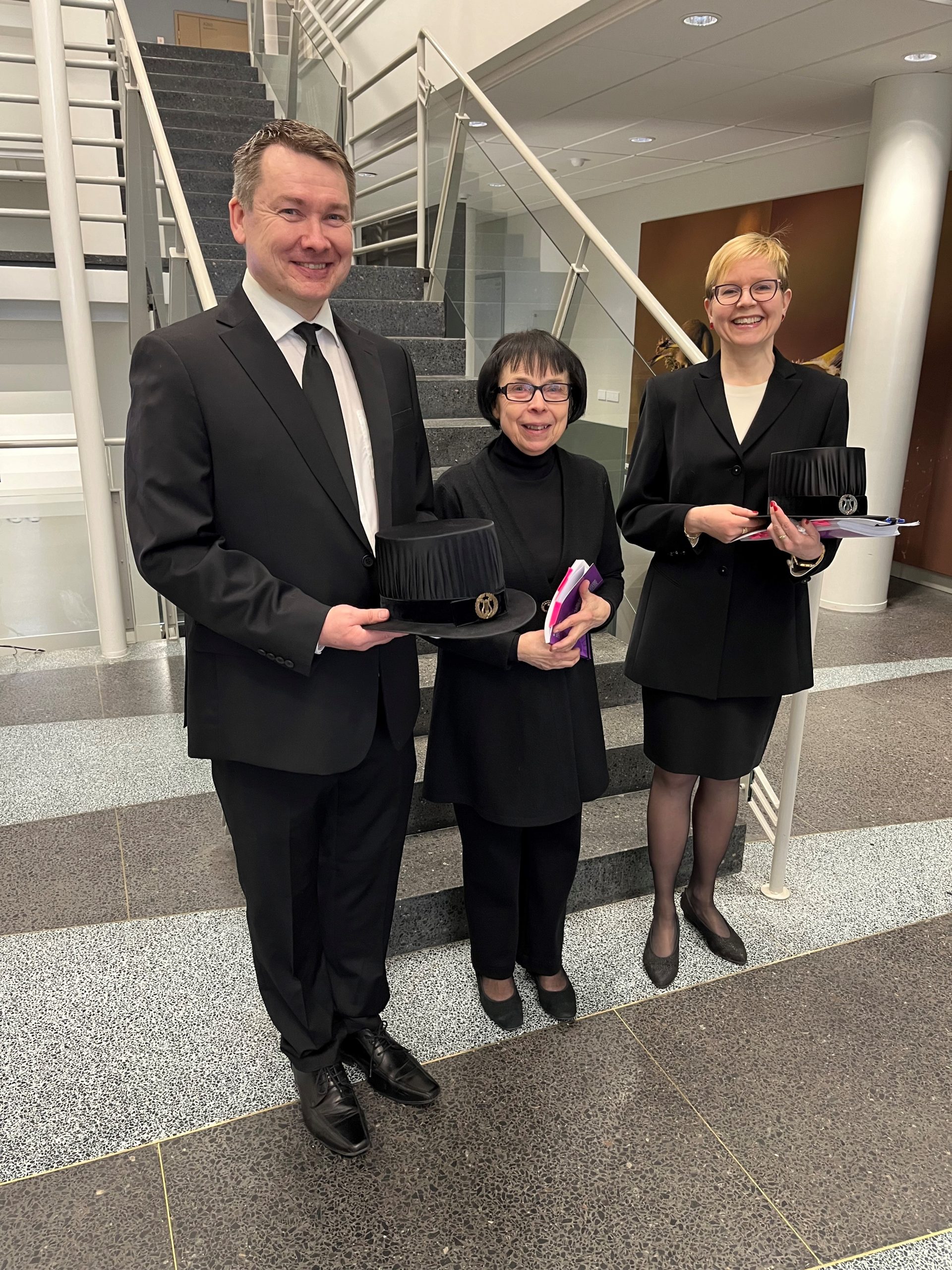
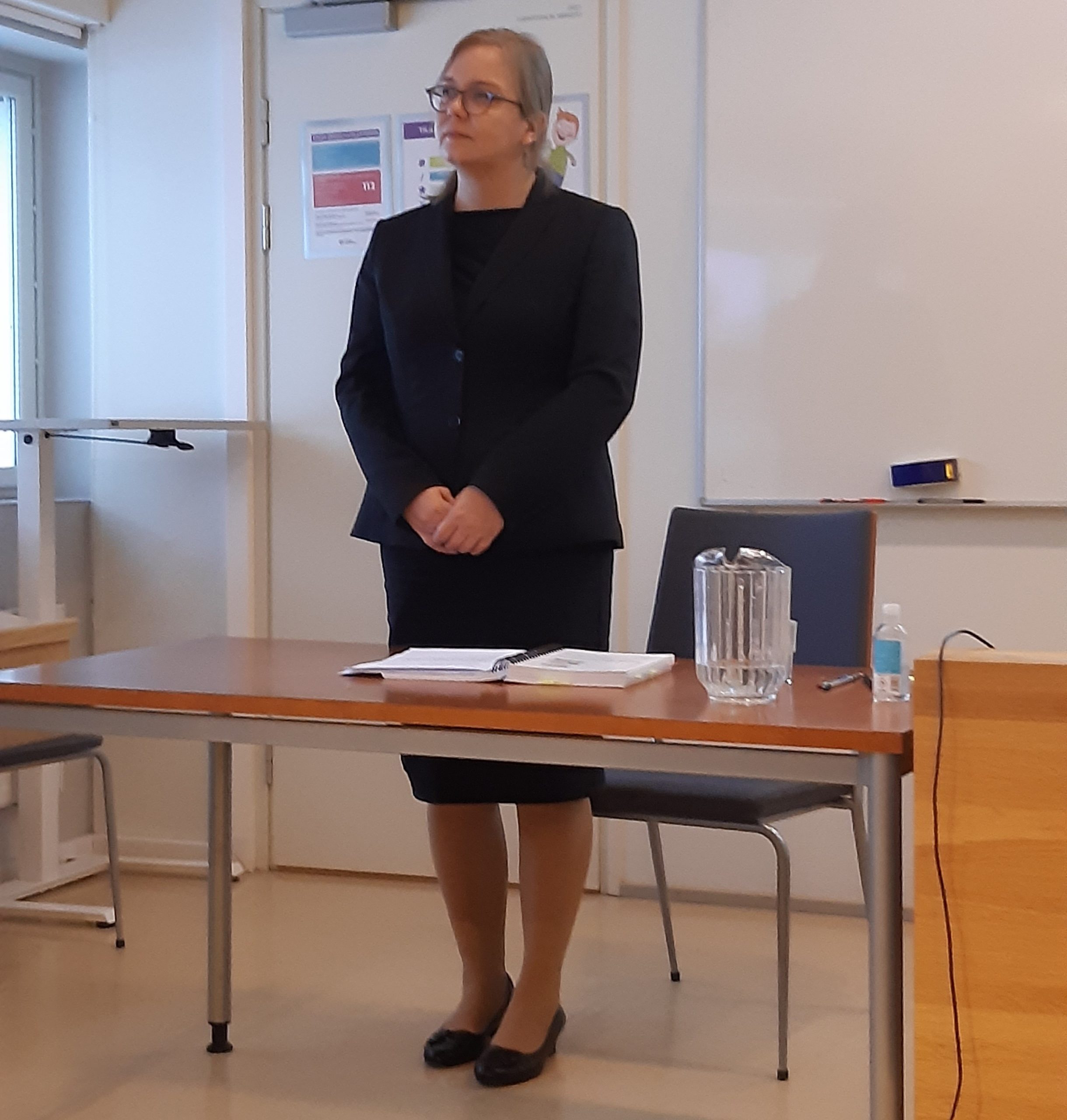
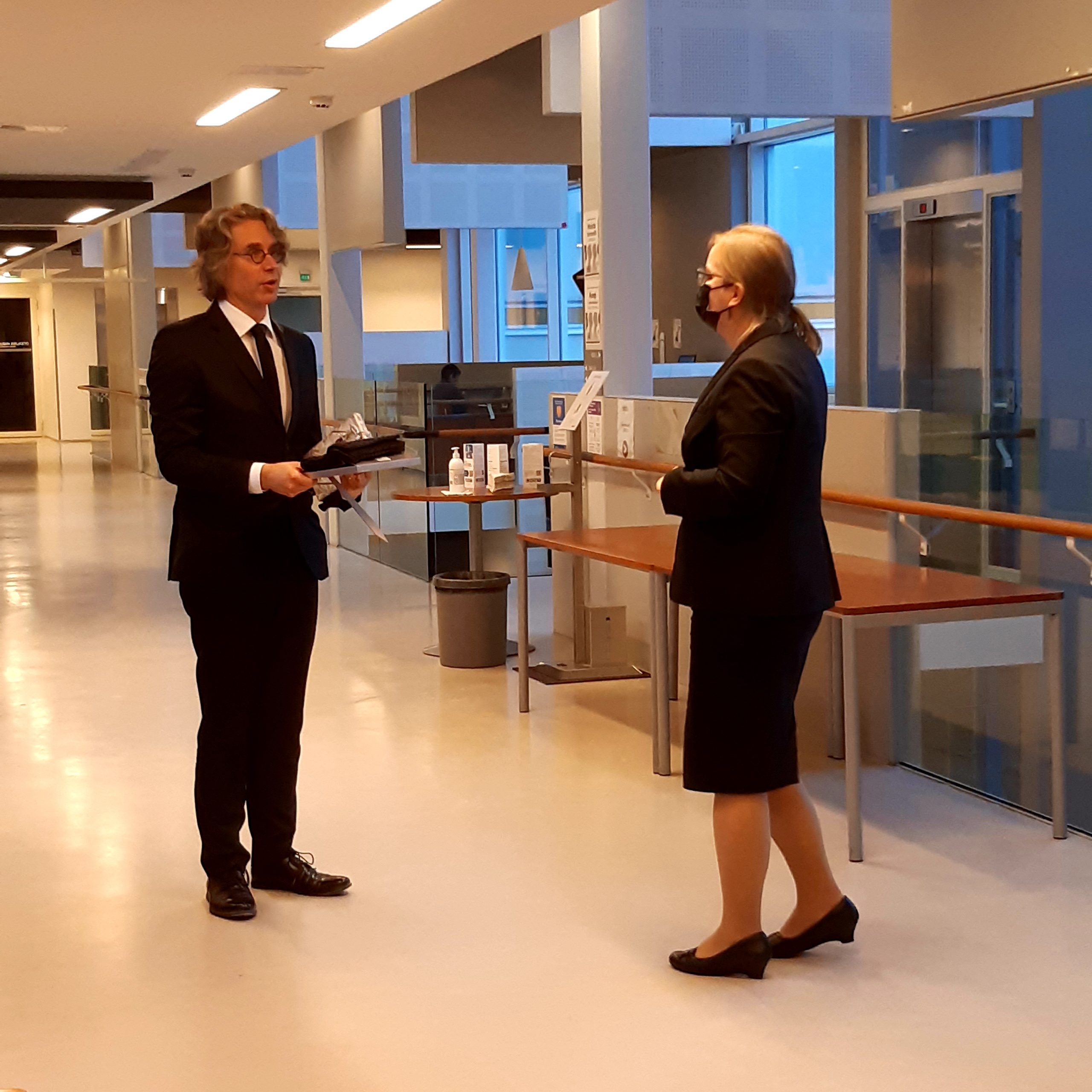
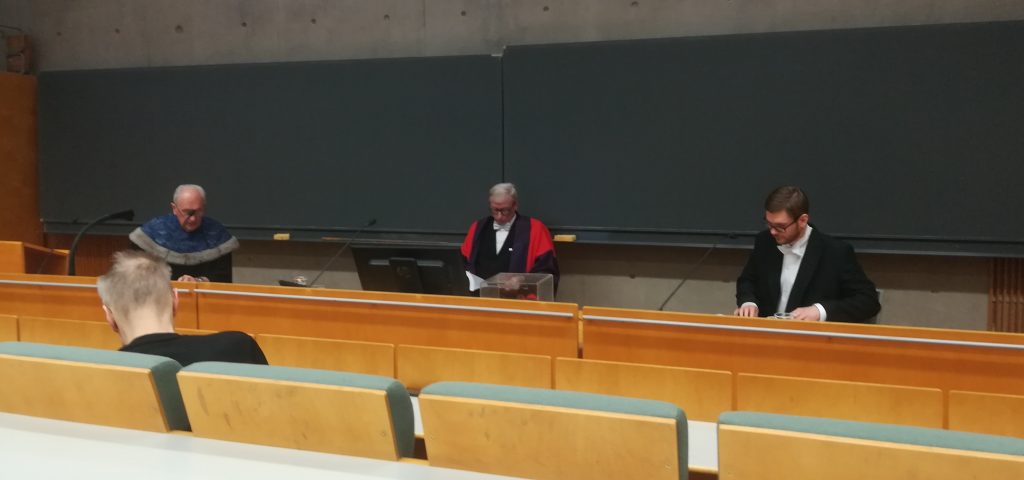
On a warm Saturday morning, on 24 August 2024, a small audience gathered to celebrate Amin Beiranvand as he defended his doctoral dissertation Gendered Sexual Violence and Complicity: A Postcolonial Study of Selected Works by J. M. Coetzee. Professor Joel Kuortti acted as custos and adjunct professor John Stotesbury from the University of Eastern Finland as the opponent.

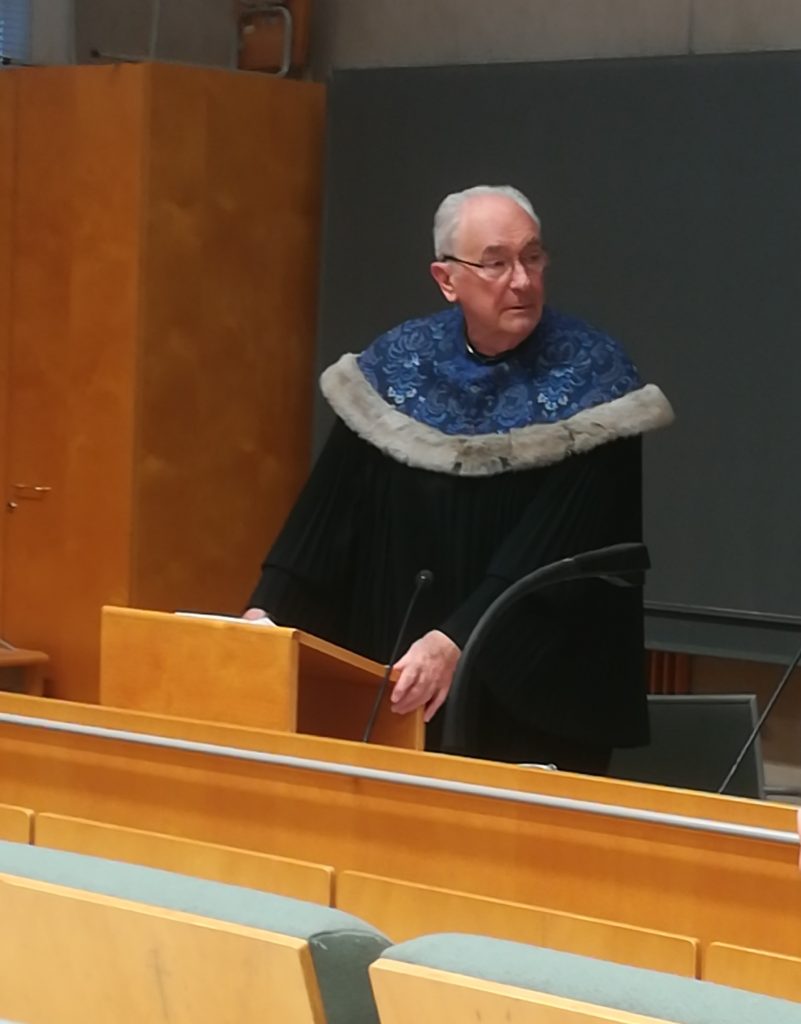
The viva began with Amin’s lectio praecursoria, in which he outlined the historical and cultural context and the main research questions of his dissertation. He ambitiously investigates the fiction of the critically acclaimed Noble Prize winning Coetzee, whose fiction has dealt with, among other themes, the legacy of colonialism and its violent power relations in human and animal encounters. This underlies also Amin’s research, in which he focuses on Coetzee’s portrayals of gender-based violence against racially and ethnically marginalised women in three novels, Dusklands (1974), Waiting for the Barbarians (1980) and Disgrace (1999).

All’s well that ends well. The opponent accepts the PhD dissertation.

The opponent presented his questions and criticisms in an approachable and captivating way. The questions began with a lengthy discussion on the dissertation title and specifically the many implications of the word complicity. The effects of colonial violence and its legacy are more far-reaching than those confined into the pages of Coetzee’s novels. This inspired the opponent to ask about Amin’s choice of the term “gender-based” when discussing violence in a setting where it springs as much from the colonial power structures and the racial hierarchies portrayed in the fiction.

The rest of the viva dealt with each novel individually and focused specifically on themes of violence, imagination, history, anger and the effects of silences that deny the voice of the oppressed. On this point, the opponent created an immersive experience for everyone in the room by staying silent for a disturbingly long time. Overall, the atmosphere of the viva was relaxed and the opponent told many entertaining anecdotes from his own career, for example being invited to dinner at Coetzee’s house and the introverted author then failing to show up.

The successful viva resulted in an accepted doctoral dissertation and we congratulate the new Doctor of Philosophy, Amin Beiranvand.

Text by Ira Hansen & Suvi Seppälä

Photo by Damon Tringham

Doctoral researcher exploring the FINSSE-11 conference: What is the role of non-human animals when it comes to sustainability in English studies?

FINSSE, the Finnish Society for the Study of English, was founded in 1998 “to advance university-level research and teaching in Finland of the English language, literatures in English and cultures of English-speaking peoples”. Biennially, a FINSSE conference is organised “to bring together university teachers, scholars and advanced students from all fields of English studies.” This year’s conference was held in Helsinki 13‒14 June, with the theme “Sustainability in English Studies”.

When I read the Call for Papers in February, I was very happy to see that the theme of this year’s conference would be sustainability. The CFP started by defining sustainability as comprising environmental, social and economic sustainability and asking what it has to do with language and literature. The role of language was seen as a tool through which the viability of communities is sustained and sustainability goals are negotiated, and literature as one through which alternative and more sustainable worlds can be explored. Also, the question of ensuring that research practices in English studies are sustainable was addressed. In addition to the general introduction to the theme, there were topic suggestions related to for example language resources, language policy, ELF, language teaching, translation, equality, identity, health, ecolinguistics, environmental humanities and several approaches to literature.

Besides being excited about the theme in general, I was curious to see how it would be approached in the presentations; which perspectives of sustainability would be discussed, and maybe most importantly, who would be considered being part of the group that the sustaining is done for—humans only, or sentient beings in general. Typically, the current (mainstream) definitions of sustainability exclude sentient beings other than humans as having moral value, but there has been an increasing call for defining sustainability as including non-human animals as ends in themselves. However, there was no mention of them in the CFP, and the United Nations’ Sustainability Development Goals, which were mentioned briefly in the CFP, are extremely anthropocentric. In the SDGs, non-human animals are treated as either resources for human consumption or, at the species level, as worth conserving in order to keep providing humans with ecosystem services.

In total, the conference program included one plenary presentation, 30 individual presentations, four poster presentations and a panel discussion during the two conference days. In addition, a meeting for doctoral students was arranged the day before the actual conference. I attended 13 presentations and the panel discussion. Using the abstracts as my guide, I aimed to see all those presentations that in one way or the other were connected to sustainability. When there were no such options available, I made my choice based on other reasons, such as my personal interests or the expected relevance to my own research.

I found all the presentations I heard interesting and having scientific, social or practical significance, and the panel discussion on the future of English studies teaching was excellent—both content- and entertainment-wise. Sustainability itself, however, was discussed relatively rarely—and sometimes the term seemed to be used more as a buzzword than in connection with the actual concept—but there were some thought-provoking exceptions. Those presentations were related to the sustainability of language resources; connections between the global environmental crisis and trains in literature and film; researchers’ more sustainable travelling practices; the consequences and possibilities of Caribbean romance literature for environmental and cultural sustainability; and the cost of sustainability in Margaret Atwood’s MaddAddam. All in all, while there were several interesting connections made to sustainability, the question of non-human animals mentioned above was left to be addressed.

After the conference, I would say that FINSSE-11 was definitely worth attending. The atmosphere was very warm and welcoming, and the program was varied. The next FINSSE conference will be organised in two years, and I warmly encourage everybody working in the field of English studies at any English department in Finland to participate. And if you are not yet a member of FINSSE, or just want to know more about the society, click here!

Anna Runsio

The author is a doctoral researcher at the Department of English, University of Turku. Her doctoral dissertation deals with the linguistic representation of research animals’ agency in historical materials. She is particularly interested in combining linguistics with historical critical animal studies, i.e. using linguistic methods for investigating the exploitation of non-human animals in the past and its consequences today.
Unraveling the Complexities of Competence

Earlier this spring, I had the opportunity to attend an eye-opening event on the “complexities of competence”, namely, Marja-Leena Niitemaa’s doctoral defense on Complexities of Competence: A Study on Finnish Upper-secondary Lexical Development and Use of L2 English. I had no idea what to expect, other than it was a formal event, and, I imagined, a very nerve-racking one, at least for the doctoral candidate.

The viva voce is the ultimate climax of years of hard work, i.e., blood, sweat and tears for many. Finally, the day has arrived when you can present to the public the cornucopia of knowledge you have acquired along your PhD journey. The grace and dignity of the event was humbling.

Marja-Leena’s viva began with an introduction by the Custos, Professor Pekka Lintunen. Senior Lecturer Katja Mäntylä of the University of Jyväskylä was Marja-Leena’s Opponent (thesis examiner). Marja-Leena’s lucid lectio praecursoria captured the audience’s interest from the start because the topic of her dissertation is perhaps something many people can relate to, i.e., acquiring and applying foreign language skills through digital means. The complexities Marja-Leena spoke of refer to the multifarious and interweaving ways in which young people acquire English today. Learning English is no longer limited to the classroom only; rather, students draw upon the resources their environment offers, e.g., internet and television. 

Marja-Leena Niitemaa together with Custos Professor Pekka Lintunen and Opponent Senior Lecturer Katja Mäntylä

The event was indeed a learning experience, having struggled with my own complexities along my PhD journey. For example, how do you navigate around unexpected results, results that controvert decades of previous research? This can really multiply your symptoms of imposter syndrome! How do you get your head around statistics when your brain has not been wired for such things—let alone interpreting them! How do you balance work and tend to your PhD brainchild? How can you tell procrastination to go pound sand? The answers to these questions are, of course, different for everyone. Perseverance and determination certainly help, keeping your eye on your target and thinking back to why you began your PhD journey in the first place also help.

For me, experiencing Marja-Leena’s viva helped me to garner the much-needed faith I needed to invest in myself. I was able to witness first-hand the culmination of hard work, determination and learning processes that go into writing a dissertation. This, if anything, gave me a nudge to keep working towards the goal I set so many years ago. So, if you are contemplating about getting a PhD or struggling to finish one, go to a viva—you’ll get all the inspiration you need!

Text: Judi Rose

Photo: Pauliina Peltonen

So-Swiss-ticated in Zurich

Switzerland. The home of cheese, chocolate, the Alps… and a bustling English Department at the University of Zurich with an overwhelmingly well-stocked library that I could have lived in for the entirety of my four-week stay and I still wouldn’t have even scratched the surface, and a staff that welcomed me with open arms?

As it turned out, yes.

After two years of part-time PhD work, the stars finally aligned and as funding was secured, the distant dream of a research visit to the home Department of one of my supervisors came to fruition. I arrived in Zurich in late April and was immediately met with extreme kindness and willingness to help with anything and everything from everyone I met at my host Department.

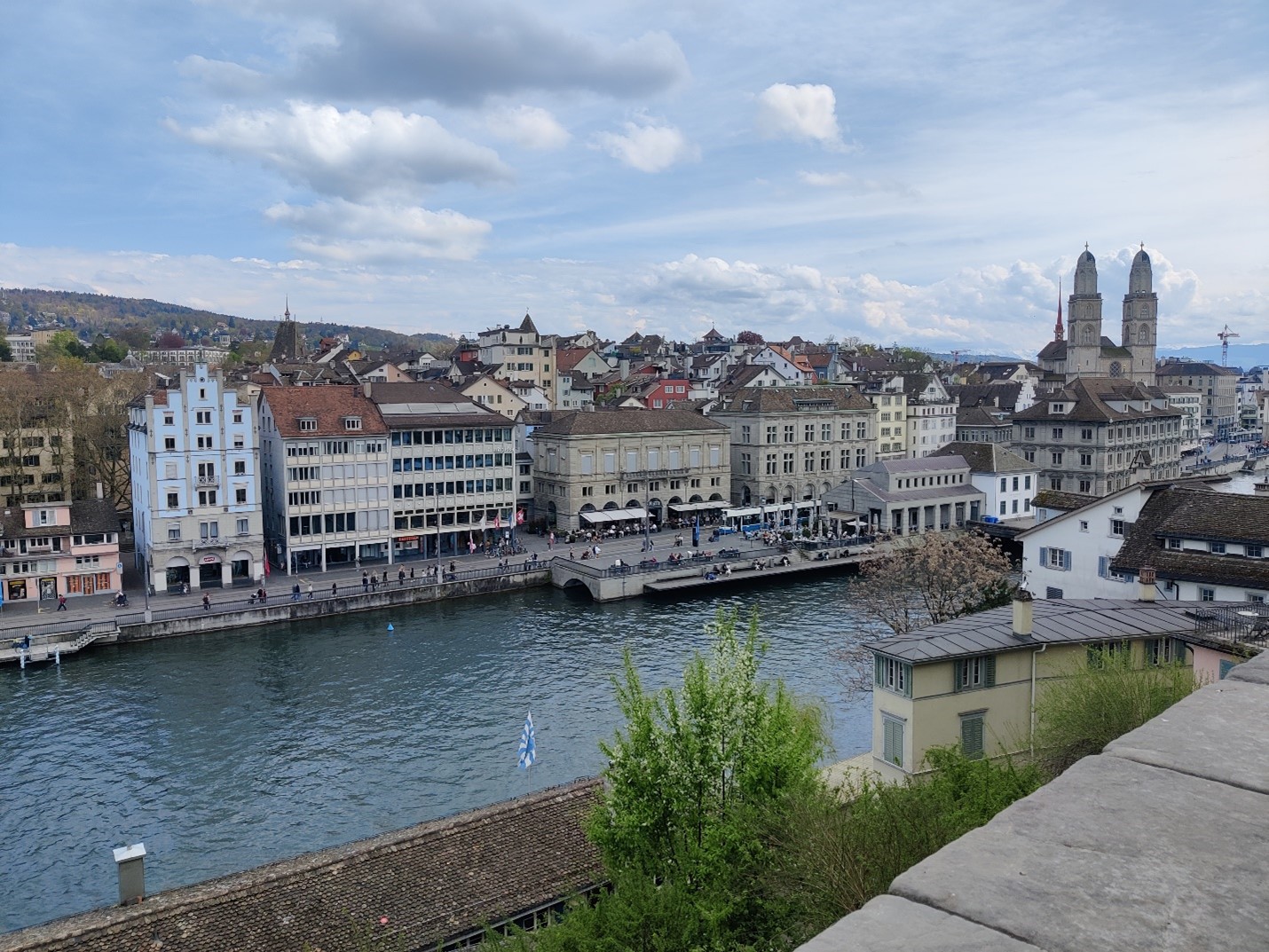
A view of the Limmat river from Lindenhof, the former site of a Roman fort and, later, Charlemagne’s grandson’s palace.

My weeks were spent with my nose firmly planted in both primary and secondary sources of my dissertation as well as discussing my research with my supervisor and getting to know some of the rest of the staff more closely. I also had a chance to present my research at one of the Department’s Lunch Talks, where the audience enjoys their lunch while listening to presentations.

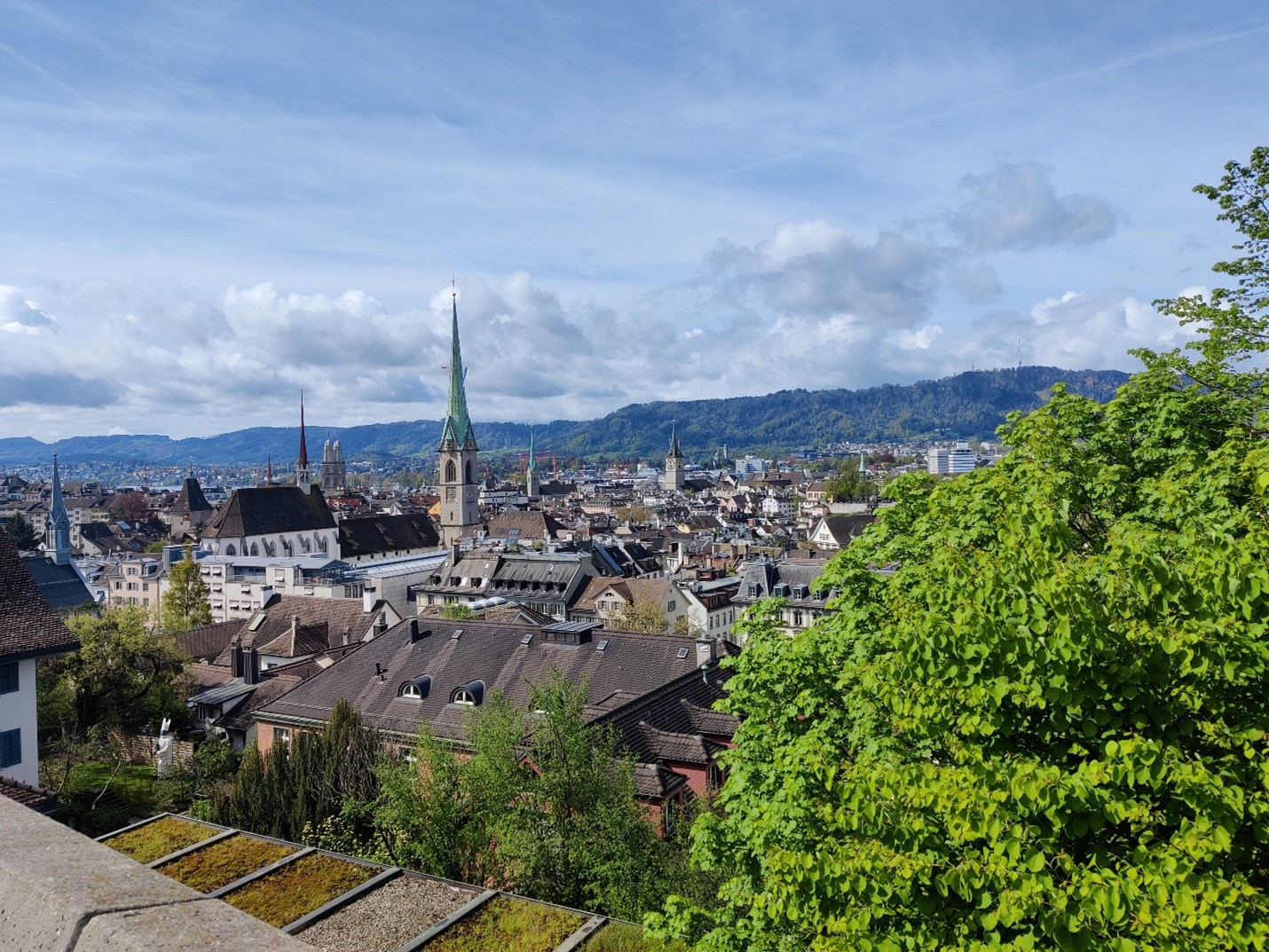
The rooftops and church towers of Zurich.

The weekends were for exploring. I wandered the streets of the medieval Altstadt (Old Town) and visited its various churches, including the Fraumünster, the founding charter of which is from 853 and on display in the church’s crypt (not going to lie, this was maybe the most exciting single thing I encountered). I explored the National Museum, the Kunsthaus (art museum), and paleontological and archeological museums, as well as the local zoo. Venturing south, I visited the town of Rapperswil to get a better view of the Alps. Fun fact: Rapperswil is home to the longest wooden bridge in Switzerland!

Lake Zürich, the Rapperswil-Hurden wooden bridge, and the Alps in the distance.

Another fun fact: If you decide to cross Lake Zürich via said bridge and take the train back to Zurich from the other side, once the wooden bridge ends after 841 meters, you are actually nowhere near the closest train station and you might find yourself walking for 5 kilometers in 23 degree heat, growing increasingly desperate and losing hope of ever reaching your destination with each step.

Against all odds, I survived to tell the tale.

All in all, I enjoyed my visit immensely. In addition to achieving all of my academic goals, I became a huge fan of Swiss bakery culture and the efficiency of public transport, expanded my knowledge of Swiss chocolate brands, and discovered that melted cheese, mashed potatoes and pickled onions make a delicious combination.

I would like to thank the English Department of the University of Zurich and the Kone Foundation for making this visit possible.

Text and photos by Ida Meerto

Finding the Right Answers in Fiction

Nana Arjopalo gave an outstanding performance defending her doctoral dissertation Narrating Deliverance: The Literary Double in the Writing of Chitra Banerjee Divakaruni, Jhumpa Lahiri, and Bharati Mukherjee on Friday, February 24, 2023. The viva was a true celebration of literature and the impact it has on humanity.

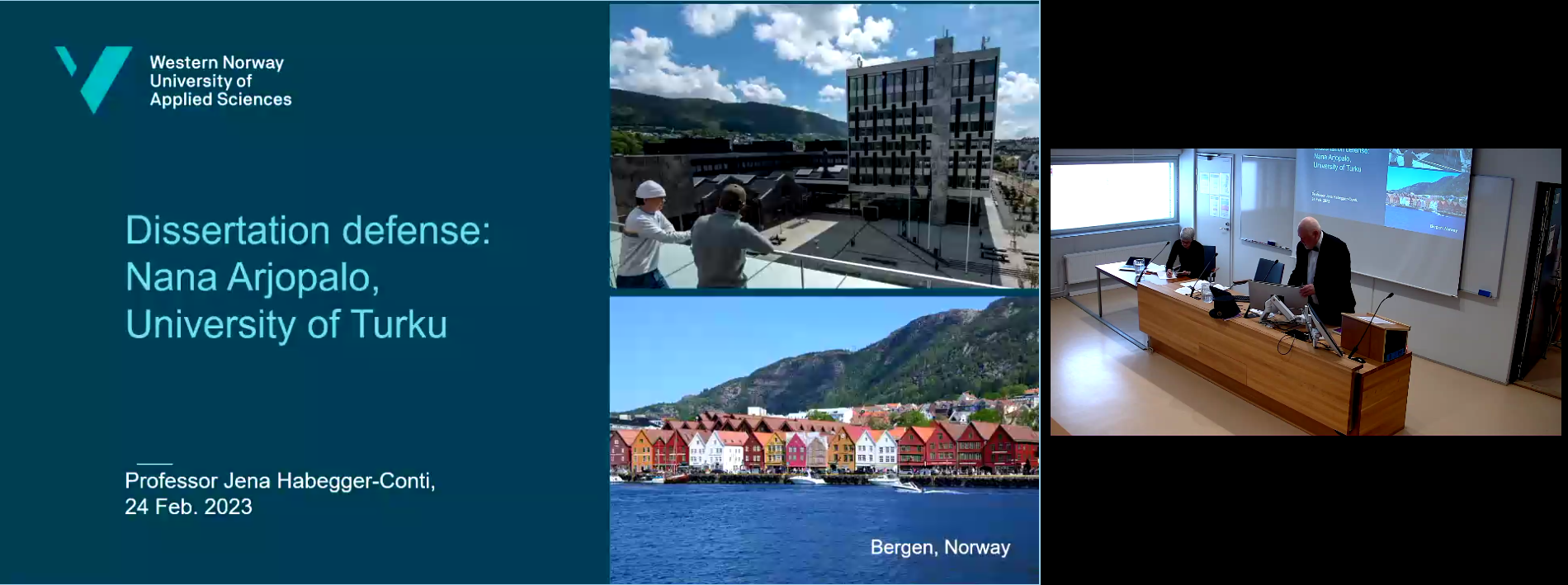
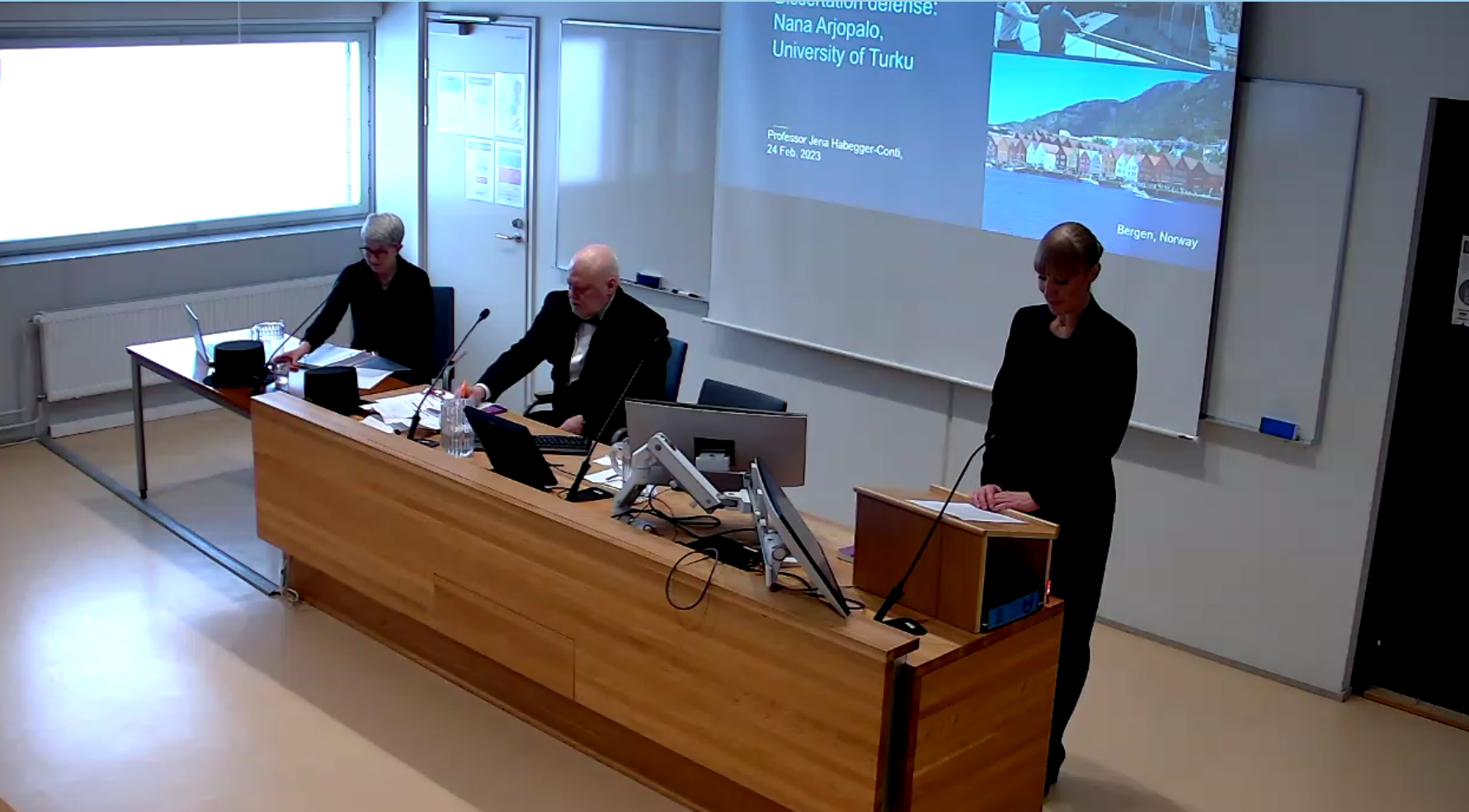
Professor Joel Kuortti testing the connection, picture and sound. Screenshot by Olga Harrison

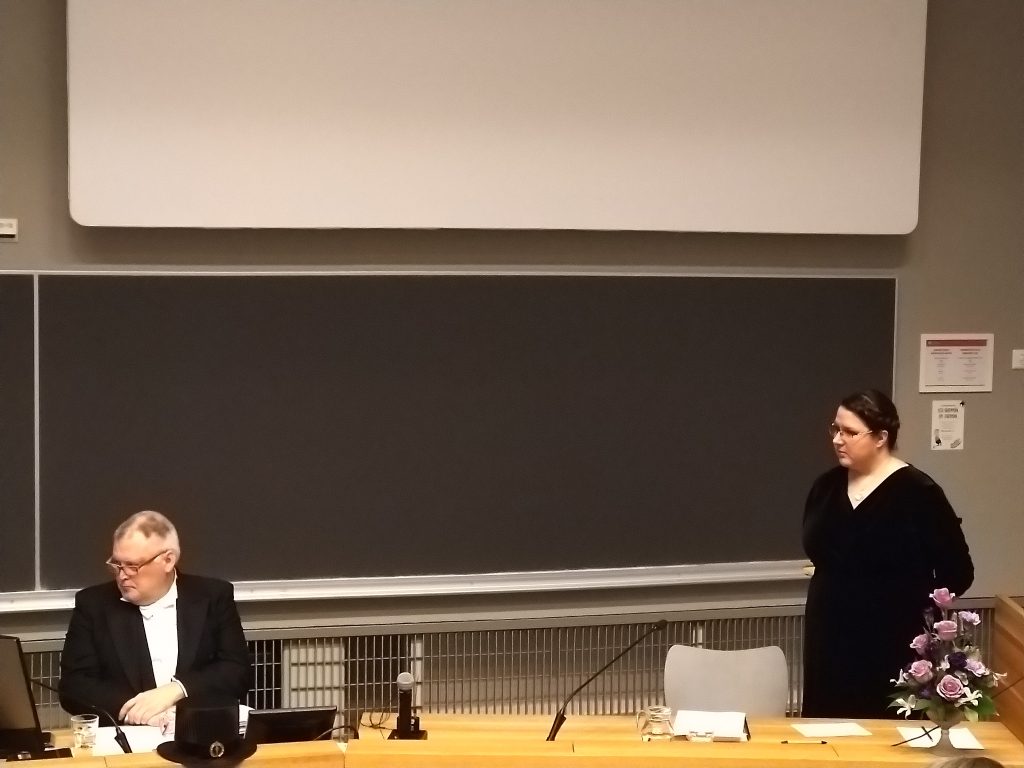
The event was kindly streamed online via Echo360, the connection allowing remote viewers such as I to watch and listen to it closely. The broadcast began around 30 minutes before the actual event, and the early viewers had a chance to follow final preparations of the ceremony. The defense itself began at 12:15 with Nana Arjopalo proceeding to her microphone, followed by Professor Joel Kuortti acting as custos and Professor Jena Lee Habegger-Conti as the opponent.

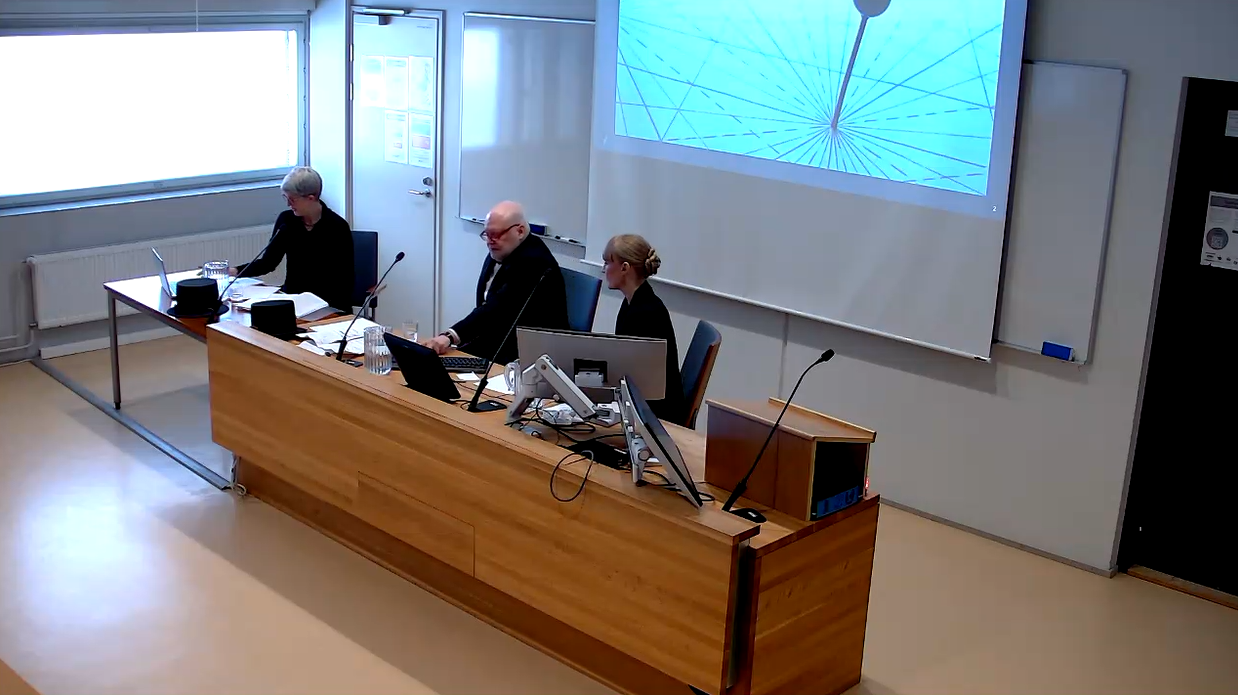
Doctoral Candidate Nana Arjopalo giving her lectio praecursoria. Screenshot by Olga Harrison

Arjopalo gave the lectio praecursoria in Finnish, covering both personal and theoretical aspects of her dissertation. Arjopalo has been an avid reader ever since discovering the fascinating world of fairy tales in her childhood. In her speech she emphasized the significance of literature to humanity. The viewers learned how fiction may offer a space to process life even better than biographical literature, as it helps one to work on personal and collective trauma, and offers a connection to others, even if one is physically away from a community. Arjopalo concluded that the right answers emerge when one asks the right questions.

The questions followed, in English, as the opponent presented her assessment and critique of the dissertation. Professor Habegger-Conti was interested in an array of subjects from the positioning to critical regionalism. Despite the range of the issues covered, the conversation flowed smoothly. There was a great deal of agreement between the opponent and the doctoral candidate, and even some terminology discrepancies were resolved without a major dispute. In her concluding words, Arjopalo stated that the discussion was reflective of the work that she had done, and that she had succeeded in making the reader draw specific conclusions from her dissertation.

Professor Jena Lee Habegger-Conti discussing Positioning. Screenshot by Teppo Jakonen

Professor Habegger-Conti was evidently pleased to read and discuss the thesis, and ultimately recommended the faculty to accept the doctoral dissertation. As there were no questions from the audience to add to an hour-and-a-half long discussion, Professor Kuortti declared the event concluded. The newly-proclaimed Doctor of Philosophy Nana Arjopalo received congratulations from the numerous audience members on-site, and invited everyone present to further celebrate outside the lecture hall, where Echo360, unfortunately, did not follow.

That set aside, it was, indeed, a pleasure to follow the doctoral defense in literature and to be reminded about the importance of asking the right questions. Congratulations to Nana Arjopalo, Ph.D., and best wishes for her future endeavors!

Text by Olga Harrison

A DOCTORATE will be given for the completion and defense of a dissertation

Susanna Mäkinen defended her doctoral dissertation, Stability and variation in the genre of runaway slave notices in American newspapers 1704-1865, on Friday 20 May 2022. While the never-tiring doctoral researchers of the English department have produced quite a few dissertation and vivas to accompany them in the recent years, Susanna was the first one to enjoy the full traditional experience of a doctoral defense, complete with the opponent actually present in the same room and a karonkka (held at the iconic Turku Castle, an excellent choice of location by the way), since the beginning of the pandemic.

The opponent, custos, and candidate

The viva took place in the Tauno Nurmela hall and drew in quite a crowd. The viva was also streamed on Echo for those unable to attend in person. The viva started right on time at 12.15, with Professor Matti Peikola as custos, even though the arrival of the opponent Professor Terry Walker (Mittuniversitetet, Sweden) had been slightly delayed (if nothing goes wrong, did the event even happen?).

With everyone present and accounted for, Professor Peikola welcomed everyone to the viva. Susanna delivered the lectio praecursoria, a short oral presentation of the research and its significance. Susanna and Professor Walker then proceeded to have a lively discussion on the dissertation. The discussion ranged from the terms used in the dissertation to the choice of a chapter title and the reasoning behind choices made regarding the material (which includes 2603 runaway slave notices), methods and analysis. While Professor Walker presented Susanna with several tough questions, Susanna handled them beautifully. The discussion was relaxed throughout the defense and both the opponent and the doctoral candidate seemed to truly enjoy themselves, which was a joy to watch. The discussion took about an hour and a half, but the time seemed to fly by (at least for yours truly, whether the candidate agrees is unclear at this time).

Defending your dissertation is fun!

The viva marks the end of an often long and significant period in a researcher’s life. Years of work has been poured into the dissertation, which is then publicly defended. When asked what she would do differently now that she has gone through those years of labor, Susanna lamented on her apparently less than ideal note-taking, but noted that when it comes to the dissertation itself, “I’m pretty happy with what I’ve done.”

What more could a researcher at their doctoral defense ask for than a dissertation they are happy with? Not much comes to mind.

Congratulations to Susanna on this amazing achievement and the best of luck in your future endeavors! 

Text by Ida Meerto

Photos by Timo Savela

Defenses during Covid: Traditions and pandemics

Sirkku Ruokkeinen defended her doctoral dissertation, Historical appraisal analysis: evaluation of the book in sixteenth-century England, on Saturday 4 December 2021. The defense is a culmination of years of work, and as such, often a stressful event. While the dissertation itself is naturally the focus of the years prior, the event itself has its own traditions and challenges, especially during covid. Below, Sirkku Ruokkeinen writes about defenses, traditions, and her experiences thereof.

My defense in December 2021 was the sixth the University of Turku English department has had during covid times. The pandemic influences any events at the university, and the defenses are no exception, so there were some minor changes to the defense to follow the University Covid guidelines.

Preceding the defense, there is a long list of practical matters to tend to. The candidate must have the dissertation printed and distributed. The press releases are written by the candidate and delivered to the university communication services. The electronics and connections in the space reserved for the defense have to be checked. There is also some limited communication between the candidate and the opponent – in this case Prof. Claudia Claridge of Universität Augsburg – about the practicalities such as setting up the defense practice Zoom event and the defense Zoom event itself. The opponent also needs to be informed of any changes to the dissertation made based on the pre-examiner comments, so that they know how the issues pointed out have been resolved, and may address them further in the defense with the full knowledge of what the candidate has said on the topic.

The defense itself took place through Zoom, but also had open admittance for a live audience. This two-media aspect brought its own challenges. For example, the traditional formulae of the lectio praecursoria and defense invitations had to be well thought out, with special consideration given to who is being addressed: the audience in the room, the audience at home, or the opponent in zoom. Issues of digital and technical nature had to be considered in advance, so as to be prepared to fix any issues as quickly as possible. I was fortunate to have knowledge and experience on my side, as the custos and marshal (Prof. Matti Peikola and Dr Janne Skaffari) had participated in several pre- and post-covid defenses and could advise me on best practices.

The defense is a rather formal affair, which I always felt was a quite sharp contrast to the generally laid-back atmosphere in the Finnish universities. This, of course, reflects the importance of the event as the threshold to the highest available academic degree. The customs are largely dictated by the university. For example, the presence of a custos, who acts as the master of ceremonies, is degreed by the University guidelines. Other customs are more specific to the department or school, such as agreements about the dress code and the setup of the auditorium.

There are some traditions for the evening party as well. The karonkka – a party thrown by the candidate in celebration of the opponent – is traditional in all Finnish universities. Unfortunately, my opponent could not be present, and hence no karonkka in her honor could be arranged. Instead, I enjoyed some bubbly after the defense with my closest colleagues and friends. Although the karonkka could not be arranged due to the present situation, I was able to enjoy the English department traditions. Firstly, I received a most magnificent new cover design for my dissertation from the department. The new design is made with one goal in mind: to joke around with the doctor in spe under the guise of popularizing the research. The alternative covers have been prepared for all new doctors within the department since 1983 – a tradition that began with Professor Emeritus Risto Hiltunen’s cover. I also got to enjoy Historical Appraisal Analysis: THE MOVIE, prepared by the Philological Colloquium. This tradition, particular to the philologists of the department, involves the preparation of a play or other new rendition of materials found within the dissertation.

All in all, although the pandemic offered some complications to the arrangements, the event itself went well, the celebration afterwards was lovely. Most importantly, the evaluation committee recommended that the dissertation be awarded the grade “pass”, and I could begin my Christmas holidays.

Text by Sirkku Ruokkeinen

Photos by Janne Skaffari

Defending alchemy

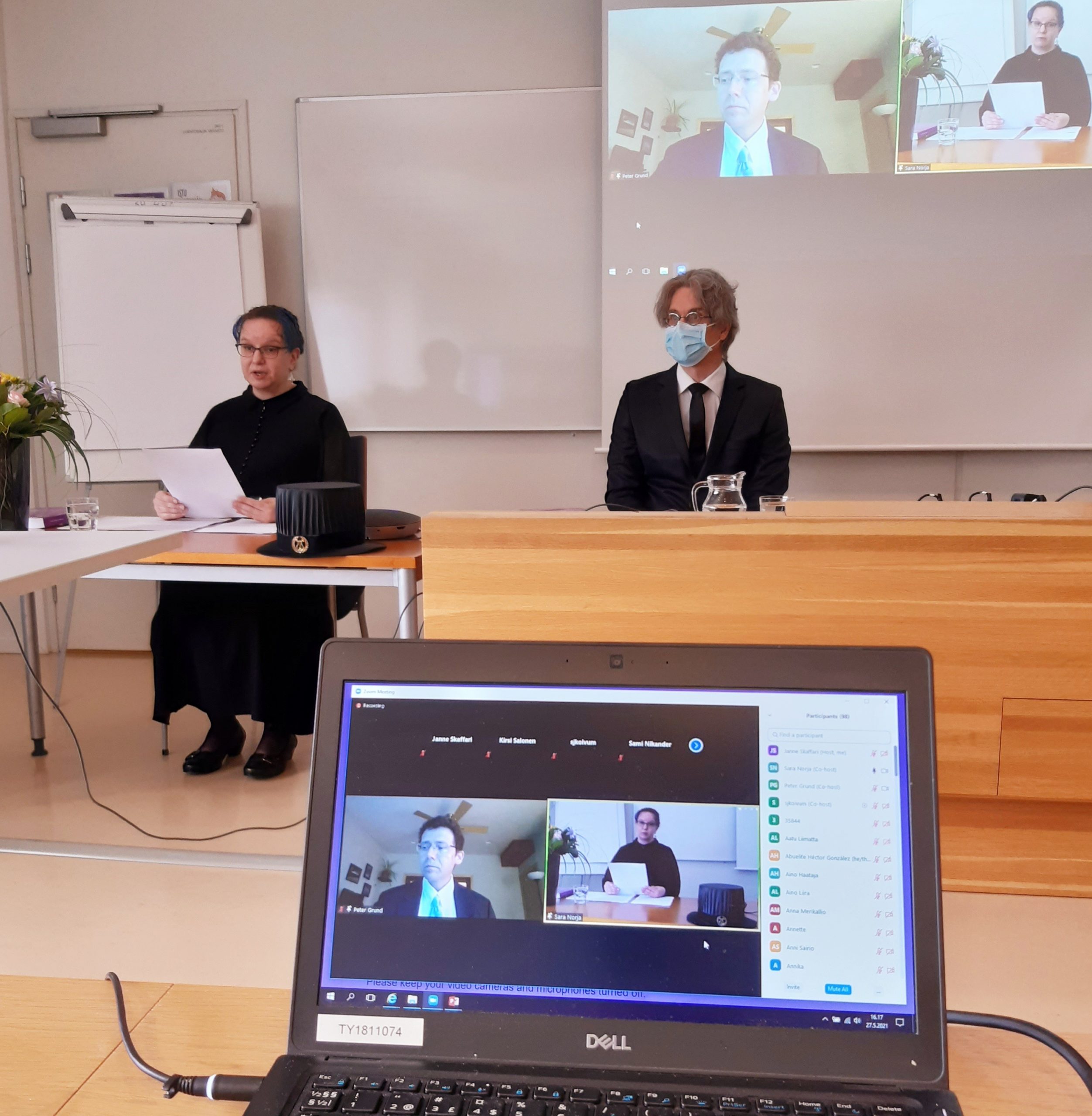
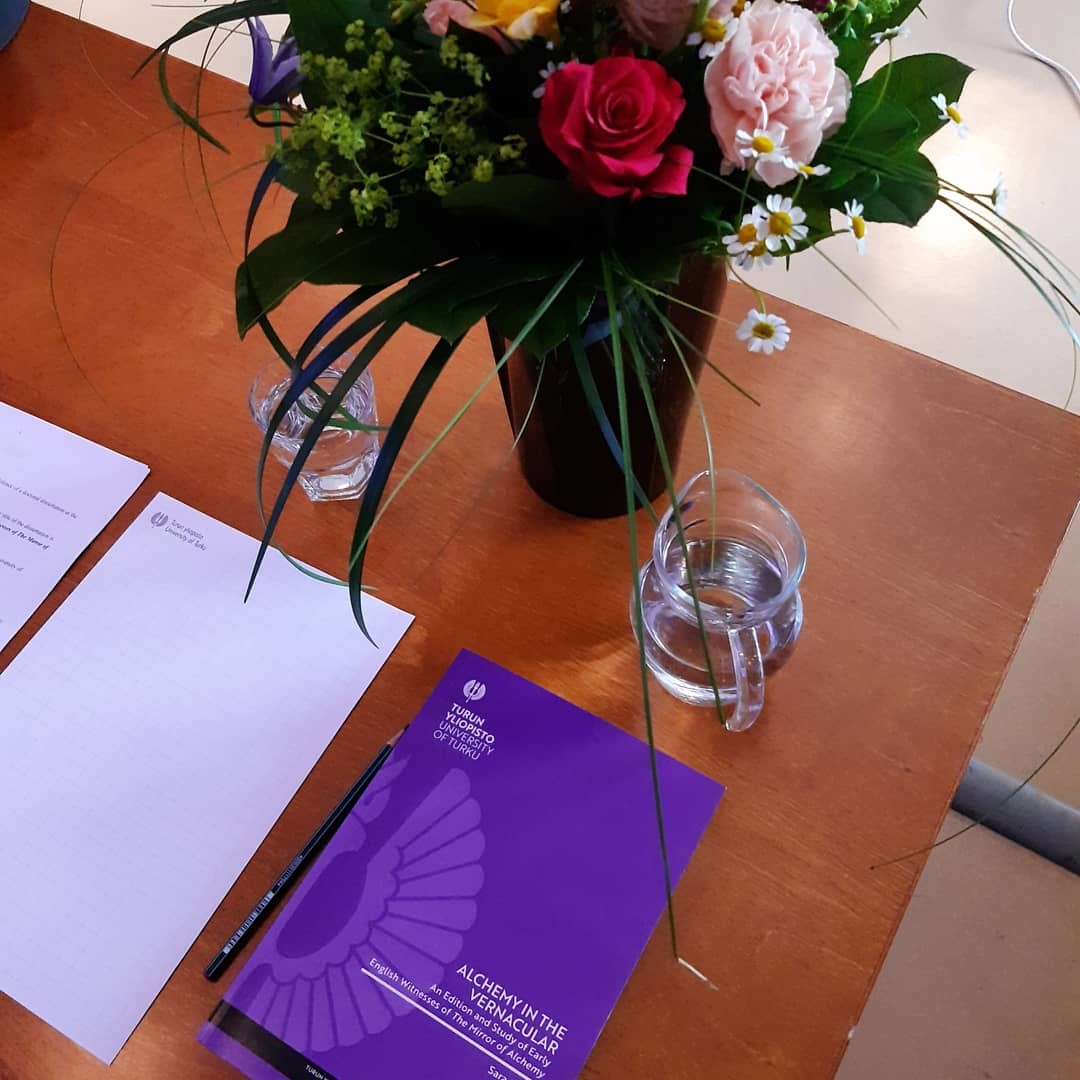
Doctor in spe Sara Norja defended her doctoral dissertation, Alchemy in the Vernacular: An Edition and Study of Early English Witnesses of The Mirror of Alchemy, on Thursday 27 May 2021. Here, she writes about the viva and the days leading up to it.

Due to the pandemic the viva was on Zoom, so the arrangements were a little different from usual. I wasn’t able to have a karonkka – the traditional academic afterparty following a viva. I can’t deny I would have loved to have one, but having fewer things to organise before the viva was also a relief, as the week of my defence was a busy one.

On Monday we had a Zoom rehearsal in the Educarium lecture hall where the viva would be broadcast from. Professor Matti Peikola and Dr Janne Skaffari (my PhD supervisors) were there with me in person, as Matti was the custos and Janne was the marshal (airut) in charge of Zoom proceedings during the viva. We had a short Zoom call with my opponent Professor Peter J. Grund (University of Kansas), and sorted out all the technical matters. It was a relief to see the room I would defend my dissertation in, and to make sure that the connections all worked!

On Thursday 27th, the day of the viva, the nerves hit me. It was good that the viva was as late as 16.00 (due to the time difference with Kansas), because despite the gnawing feeling in my belly, I even managed to eat lunch before it. However, once I was actually in Educarium and the viva was about to commence, I calmed down. The final minutes before turning on the video and sound on Zoom were the longest I’ve ever known, though!

The custos Professor Matti Peikola and I sat down in front of the camera, facing the lecture hall with six other people in it (our technical support Satu Koivumäki, Janne, and four of my family members). Quite different from the experience of sitting in front of a bigger live audience! However, I knew there were lots of people watching through Zoom, so the audience online was huge. I tried not to concentrate on that, though, but to focus on my opponent, who I could see on the screen set up opposite me.

I felt unreal – was this major event actually happening after seven years of working on my dissertation? But once the viva officially started with the customary opening words, and I began giving my lectio praecursoria (the traditional speech given by the PhD candidate at the start), everything started to flow. I gave my lectio, and asked Professor Grund to present his criticisms of my dissertation. He gave his opening statement, and then we proceeded into the questions.

I had been told previously that once the defence actually starts, it can be a delightful experience as well as a scary one. This was certainly true for me. Professor Grund asked some pretty tough questions, but I discovered that it was incredibly rewarding and fun to answer them and to discuss my dissertation with him. He was the best opponent I could have hoped for. By the time Professor Grund had given his concluding statement and the viva was over, I was fizzing with excitement and pent-up nerves. The defence was concluded by the custos, and we could proceed to congratulations.

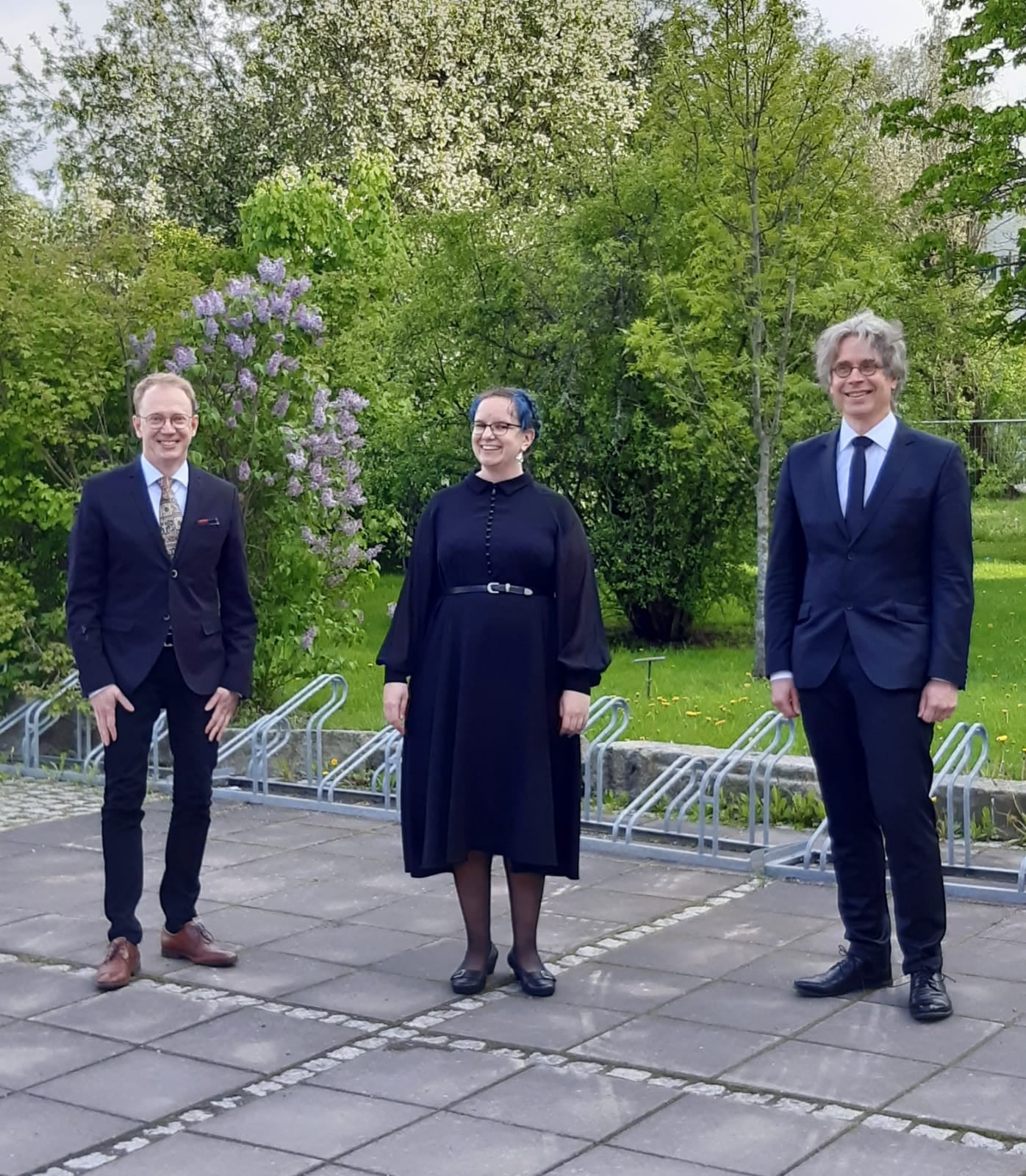
Relieved smiles after the ordeal!

Even though the pandemic meant I couldn’t have a proper karonkka, we rounded off the evening with a lovely outdoors event with a small number of my colleagues from the Department. Some excellent traditions were upheld despite the pandemic, and overall the day will stand out as a landmark event in my life.

Text by Sara Norja

Photos by Janne Skaffari and Mari-Liisa Varila

Translating multilingual texts

Another PhD defence in just under two months! A number of doctoral candidates of the English Department are now finishing their research projects. On 24 January, it was Laura Ekberg’s big day.

Laura’s research topic combines translation studies and literature and focuses on a phenomenon also studied in linguistics. As it happens, code-switching was at the heart of the previous viva as well. The title of her dissertation is Heterolingualism and Cultural integrity in Finnish Translations of Anglophone Caribbean Novels; it is available online. The members of Laura’s team of supervisors were Outi Paloposki, Elina Valovirta and Joel Kuortti – who acted as custos – and the opponent was Professor Simona Bertacco from the University of Louisville. The viva started with the important question of which field of research the dissertation belongs to (answer: translation studies). Overall, we witnessed a remarkably friendly discussion by two experts, which really is the best kind of viva. The opponent found the material examined in the dissertation sufficient and representative and was very happy with what Laura had discovered and the poise with which she brought in multiple perspectives.

Professor Simona Bertacco giving her assessment of Laura’s dissertation.

I attended the viva as Laura’s colleague, a former teacher of hers, and a linguist with a keen interest in different approaches to code-switching and, more broadly, multilingual practices. Colleagues attending doctoral defences are always excited for the candidate, hoping their support radiates from the audience to the front of the room. Having known Laura since she was a BA student, I was happy about the confidence with which she brought together language, literature and translation – the three main topics of the Department – and about the fact that the varied training showed in the research. As a code-switching researcher myself, I was particularly interested in the recent campaign for not italicising code-switches in Caribbean literature, which goes against the common practice of separating the ‘other’ language from the main language of the text by using italics. Not italicising suggests that multilingual language use is not an aberration but something ordinary; there is no need to draw the readers’ attention to it.

Custos and Doctor in spe listening to the Opponent’s addresss.

Laura said in the viva that she became interested in Caribbean literature in the MA thesis seminar. The things that catch your eye as a student may take you a long way.

A relieved smile at the karonkka-party.

Text by Janne Skaffari

Photos by Damon Tringham

Philology, pragmatics and code-switching: My first viva

I had never been to a doctoral defence also known as a viva before, so I was immediately interested when I heard there was one taking place with our very own Aleksi Mäkilähde on the hot seat. Aleksi’s doctoral dissertation is called The Philological-Pragmatic Approach: A Study of Language Choice and Code-Switching in Early Modern English School Performances and as the title suggests, it examines code-switching in plays and poems by school boys at the King’s School, Canterbury, in 1665–1684. Eager to learn more about the subject, I decided to attend the viva, which took place 5 December 2019.

This being my first viva, I wasn’t quite sure how I should dress. The event soon starting at the Quantum Auditorium, I hastily did a few Google searches and found out that as an audience member, one is not expected to wear anything too fancy. I didn’t want to go under-dressed, so I took off my hoodie, put on a smart shirt and off I went. As I arrived at Quantum, I saw the candidate himself pacing around in the hall. I grabbed a copy of the thesis and sat at the back of the room. I looked at the people around me and judged my choice of clothes to be fitting.

A few minutes passed. Suddenly everyone jumped up as the candidate walked in, followed by the custos, Professor Emeritus Risto Hiltunen, and the opponent, Professor Emeritus Herbert Schendl from the University of Vienna. The custos and the opponent were wearing colourful old-timey robes, which I assumed were customary, but later learned differ depending on the university.

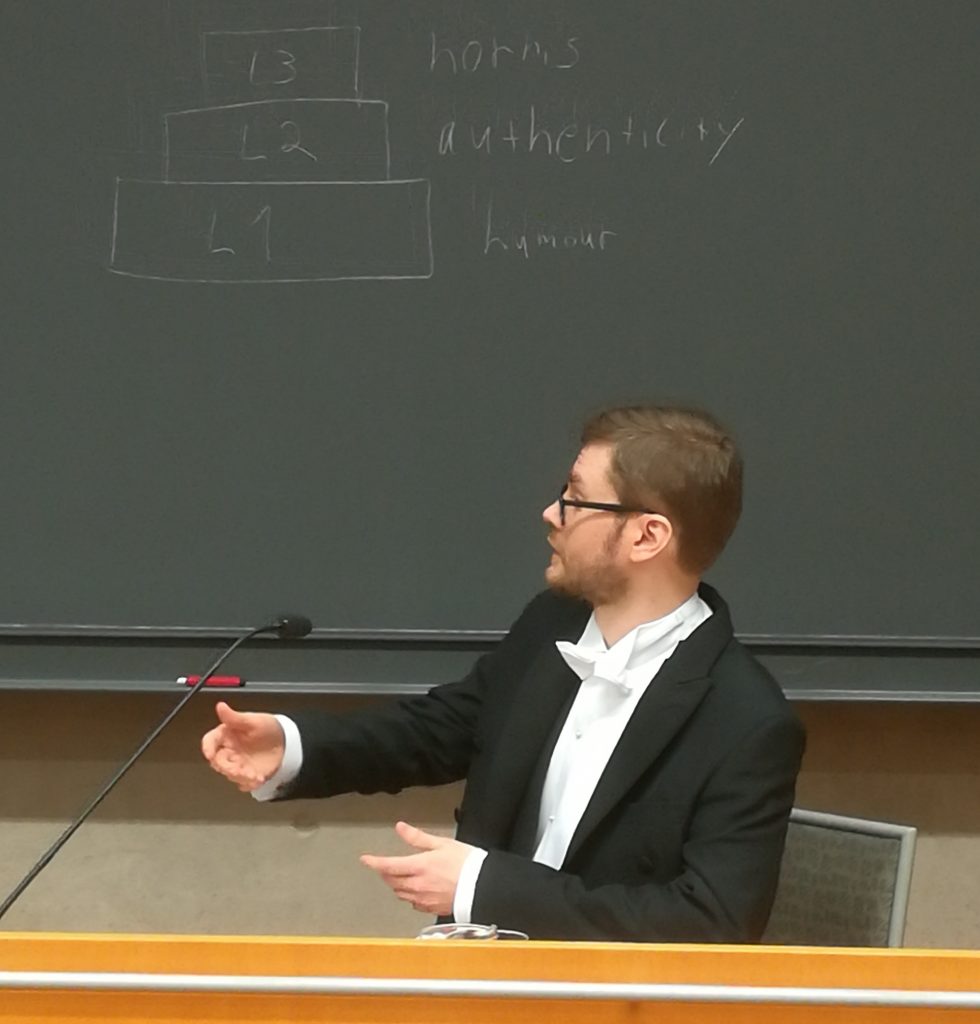
The custos spoke a few words, the candidate briefly presented his thesis in Finnish and then it was time for the opponent to ask his questions. The discussion was more informal and relaxed than I had anticipated. Some questions were more hard-hitting, but mostly it was a friendly discussion about the difference between a code-switch and a loanword, and what kind of consequences code-switching could have. I have to be honest; the discussion went quite deep into the nitty-gritty and at times, I had a hard time following. The highlight of the discussion was when Aleksi got up to the blackboard and drew something resembling a wedding cake to illustrate the complex nature of a play-within-a-play.

Some two hours after it began, the discussion ended, and the opponent gave his finishing statement. He commended the candidate’s hard work of developing a new philological-pragmatic approach and his detailed analysis of code-switching in the school plays. The custos, who had remained silent the whole time (which is customary) declared the viva to be over. Outside the auditorium, hands were shaken, gifts were given, and cake was had. To my disappointment, there was not a top hat nor sword in sight. I guess those were saved for later.

Gratulationes to Aleksi on his achievement and all the best in his future career!

Text by Otto Tarkka

Photos by Janne Skaffari