Defending alchemy

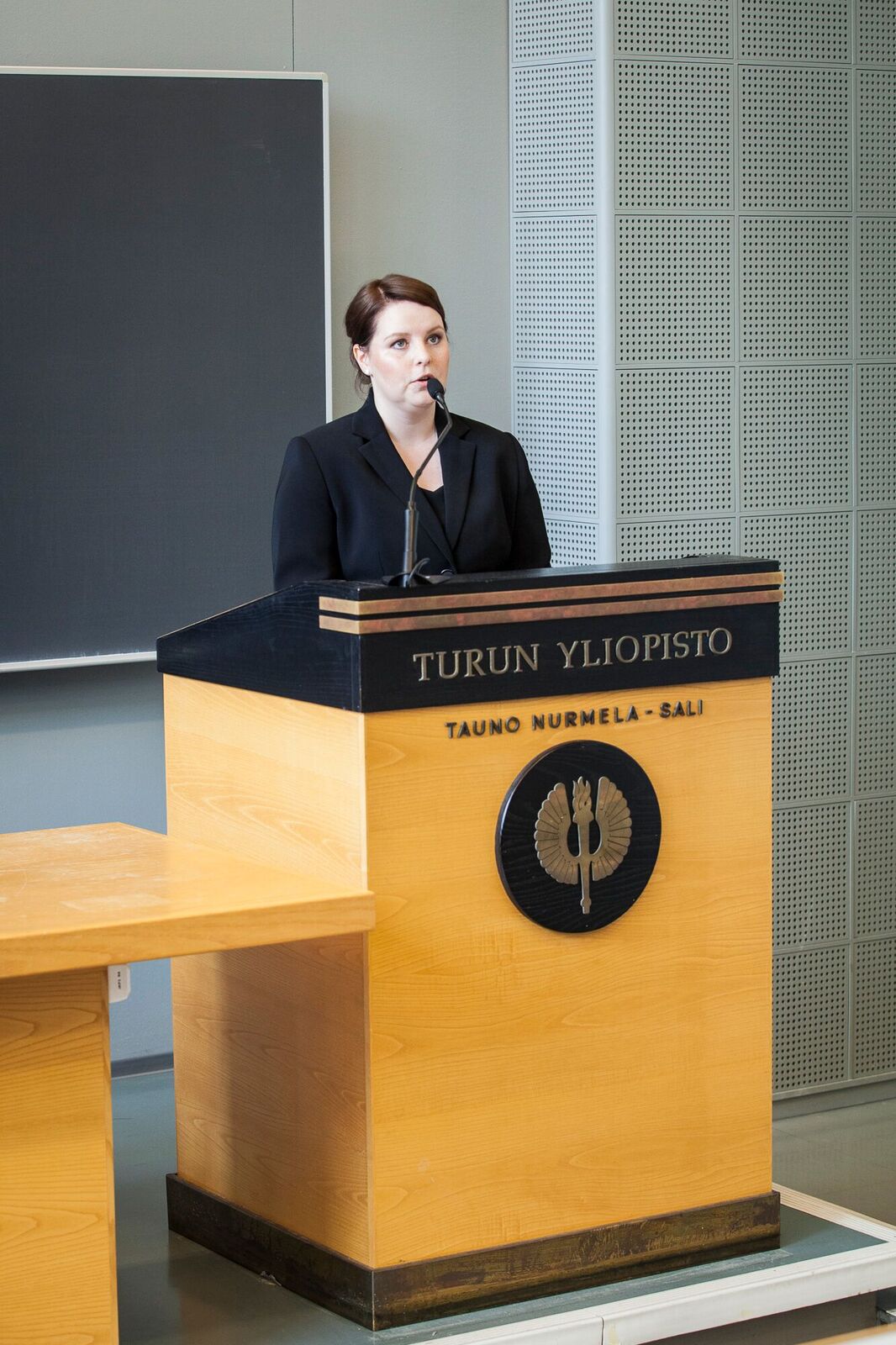
Doctor in spe Sara Norja defended her doctoral dissertation, Alchemy in the Vernacular: An Edition and Study of Early English Witnesses of The Mirror of Alchemy, on Thursday 27 May 2021. Here, she writes about the viva and the days leading up to it.
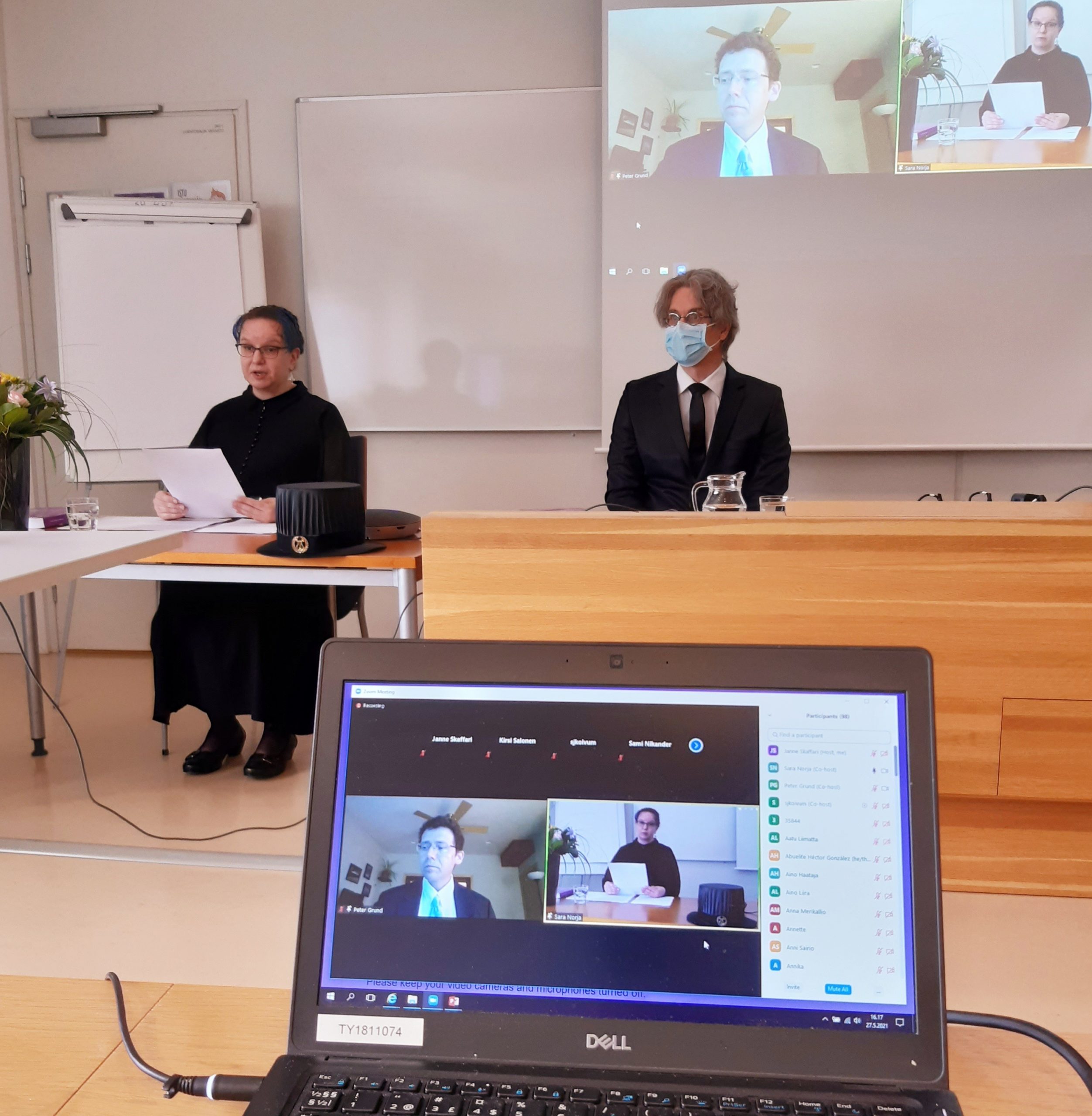
Due to the pandemic the viva was on Zoom, so the arrangements were a little different from usual. I wasn’t able to have a karonkka – the traditional academic afterparty following a viva. I can’t deny I would have loved to have one, but having fewer things to organise before the viva was also a relief, as the week of my defence was a busy one.

On Monday we had a Zoom rehearsal in the Educarium lecture hall where the viva would be broadcast from. Professor Matti Peikola and Dr Janne Skaffari (my PhD supervisors) were there with me in person, as Matti was the custos and Janne was the marshal (airut) in charge of Zoom proceedings during the viva. We had a short Zoom call with my opponent Professor Peter J. Grund (University of Kansas), and sorted out all the technical matters. It was a relief to see the room I would defend my dissertation in, and to make sure that the connections all worked!
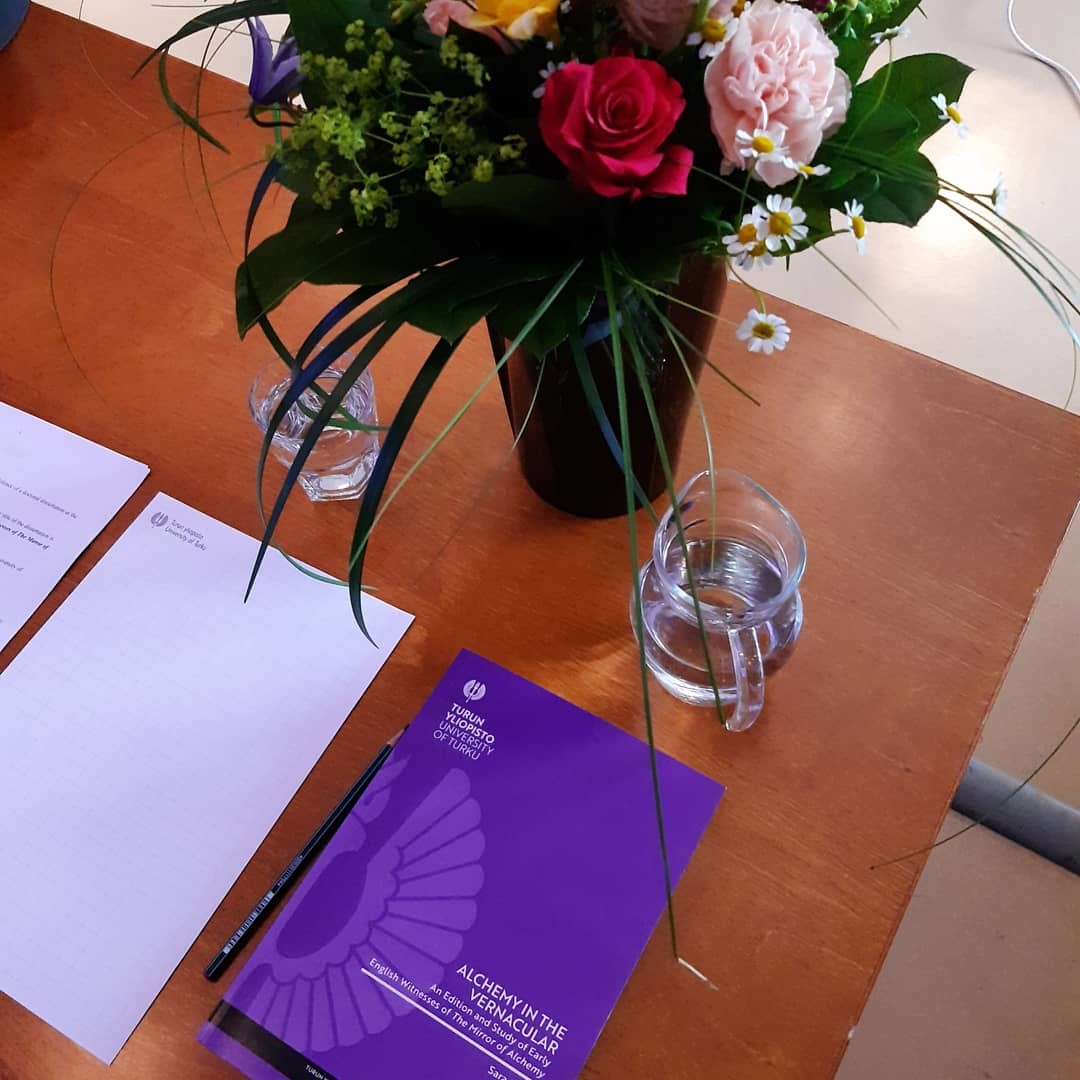
On Thursday 27th, the day of the viva, the nerves hit me. It was good that the viva was as late as 16.00 (due to the time difference with Kansas), because despite the gnawing feeling in my belly, I even managed to eat lunch before it. However, once I was actually in Educarium and the viva was about to commence, I calmed down. The final minutes before turning on the video and sound on Zoom were the longest I’ve ever known, though!

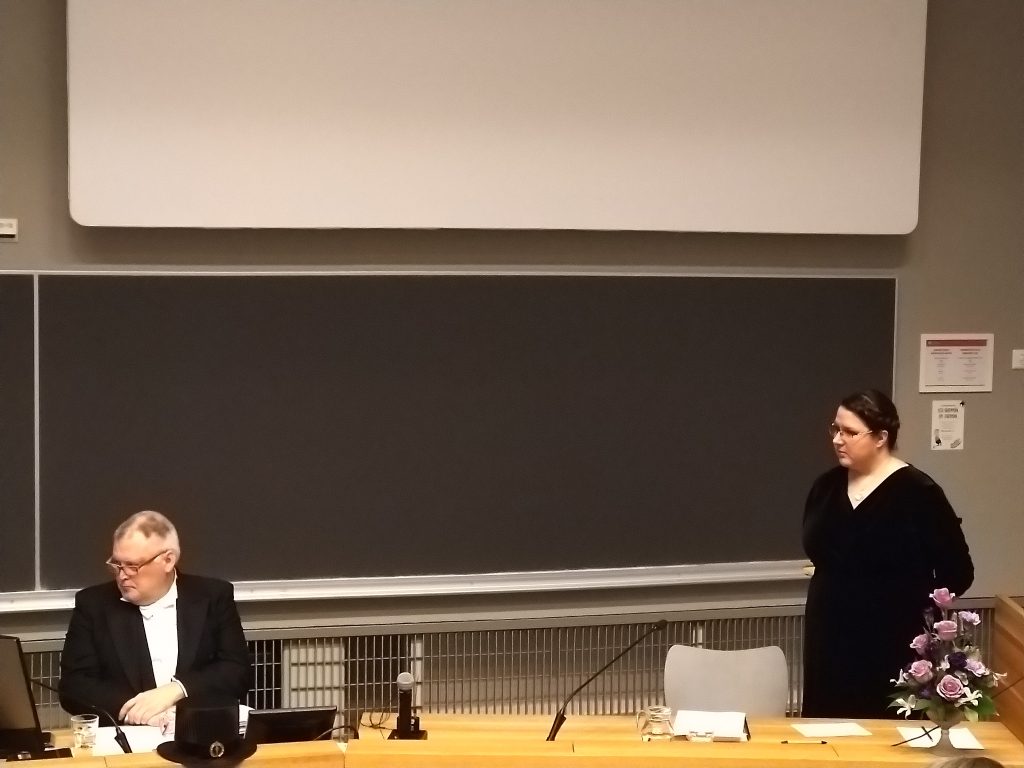
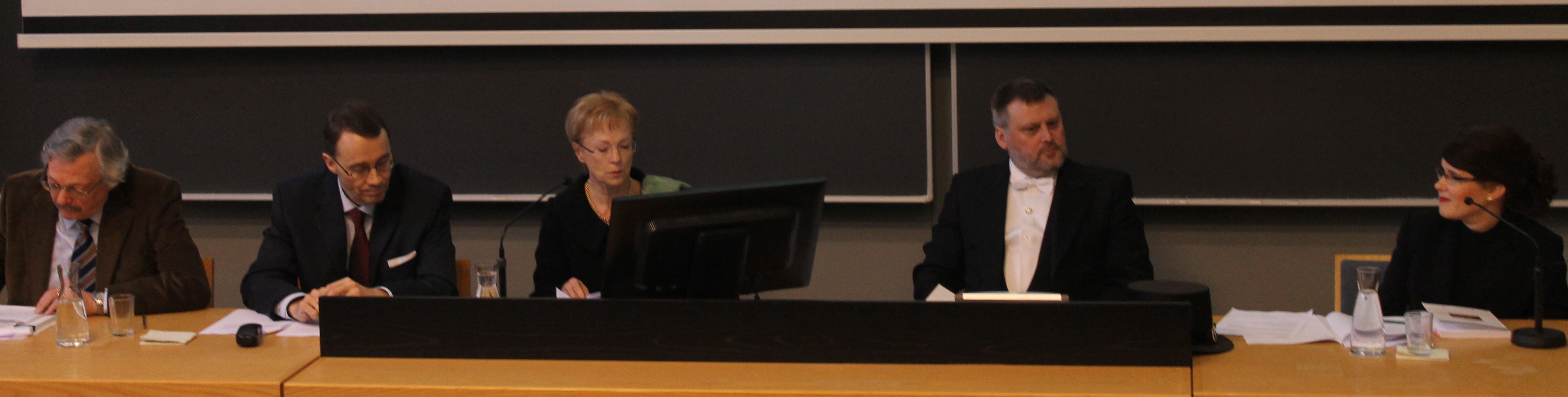
The custos Professor Matti Peikola and I sat down in front of the camera, facing the lecture hall with six other people in it (our technical support Satu Koivumäki, Janne, and four of my family members). Quite different from the experience of sitting in front of a bigger live audience! However, I knew there were lots of people watching through Zoom, so the audience online was huge. I tried not to concentrate on that, though, but to focus on my opponent, who I could see on the screen set up opposite me.

I felt unreal – was this major event actually happening after seven years of working on my dissertation? But once the viva officially started with the customary opening words, and I began giving my lectio praecursoria (the traditional speech given by the PhD candidate at the start), everything started to flow. I gave my lectio, and asked Professor Grund to present his criticisms of my dissertation. He gave his opening statement, and then we proceeded into the questions.

I had been told previously that once the defence actually starts, it can be a delightful experience as well as a scary one. This was certainly true for me. Professor Grund asked some pretty tough questions, but I discovered that it was incredibly rewarding and fun to answer them and to discuss my dissertation with him. He was the best opponent I could have hoped for. By the time Professor Grund had given his concluding statement and the viva was over, I was fizzing with excitement and pent-up nerves. The defence was concluded by the custos, and we could proceed to congratulations.
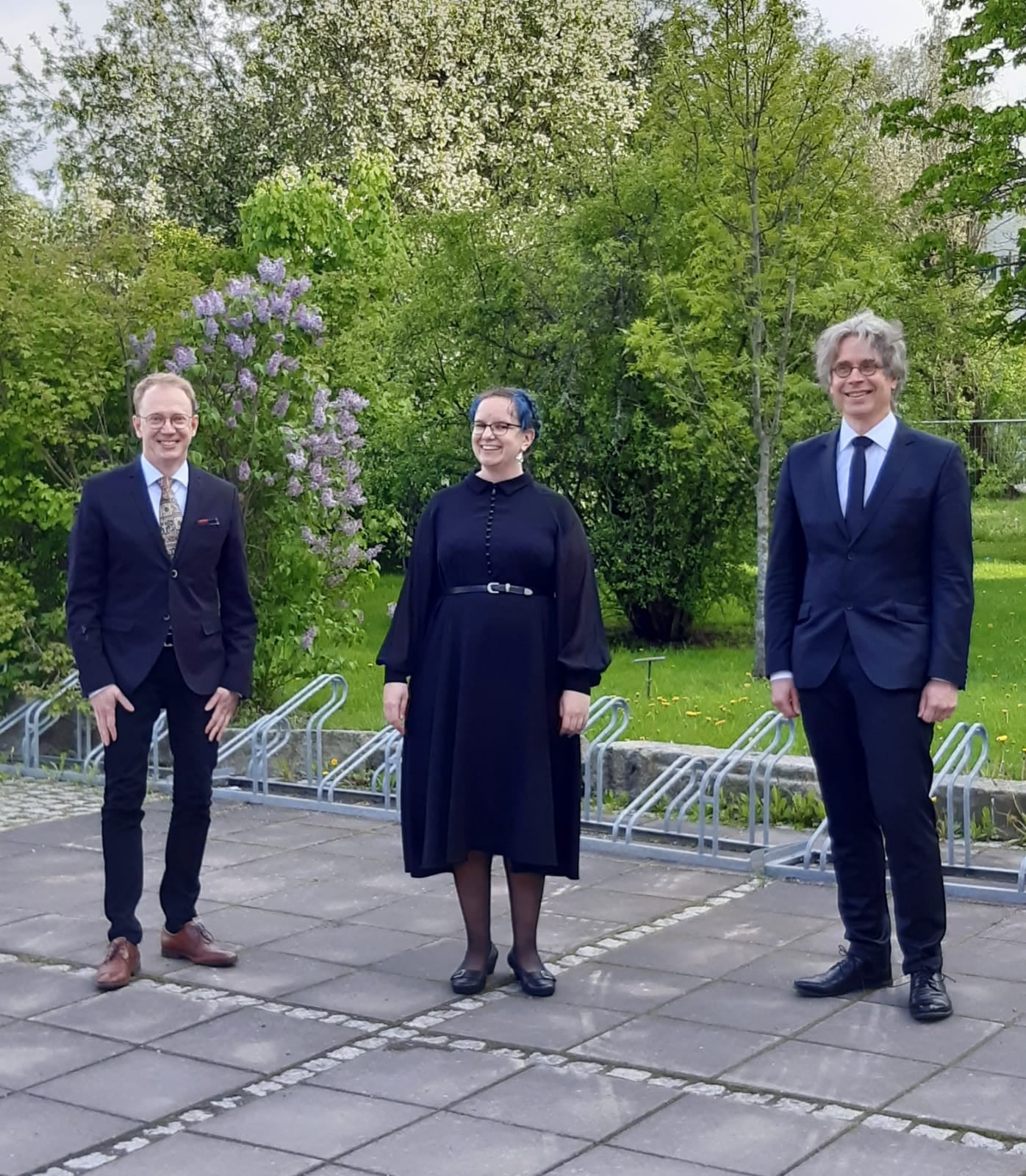
Relieved smiles after the ordeal!

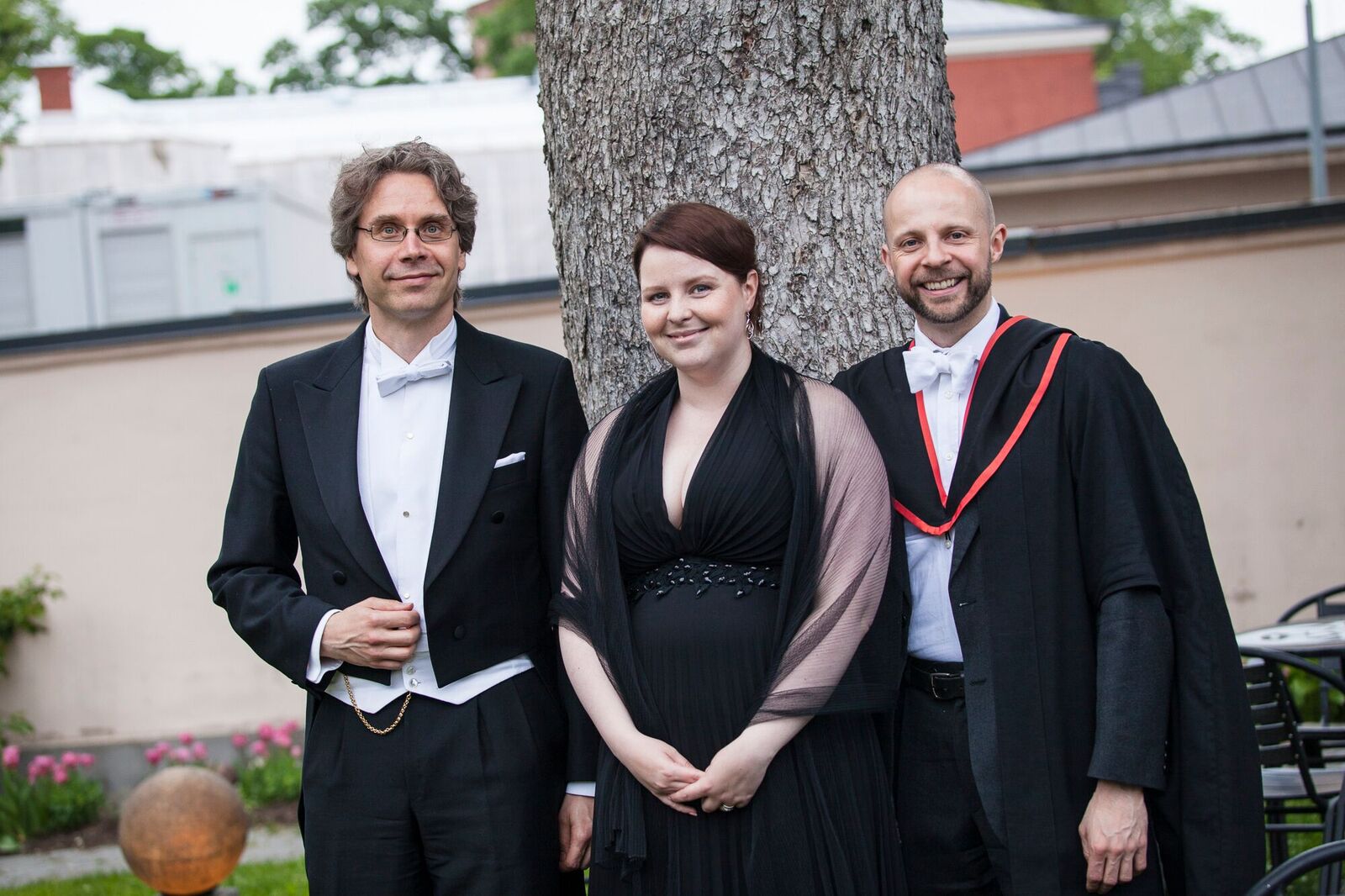
Even though the pandemic meant I couldn’t have a proper karonkka, we rounded off the evening with a lovely outdoors event with a small number of my colleagues from the Department. Some excellent traditions were upheld despite the pandemic, and overall the day will stand out as a landmark event in my life.

Text by Sara Norja

Photos by Janne Skaffari and Mari-Liisa Varila

Translating multilingual texts

Another PhD defence in just under two months! A number of doctoral candidates of the English Department are now finishing their research projects. On 24 January, it was Laura Ekberg’s big day.

Laura’s research topic combines translation studies and literature and focuses on a phenomenon also studied in linguistics. As it happens, code-switching was at the heart of the previous viva as well. The title of her dissertation is Heterolingualism and Cultural integrity in Finnish Translations of Anglophone Caribbean Novels; it is available online. The members of Laura’s team of supervisors were Outi Paloposki, Elina Valovirta and Joel Kuortti – who acted as custos – and the opponent was Professor Simona Bertacco from the University of Louisville. The viva started with the important question of which field of research the dissertation belongs to (answer: translation studies). Overall, we witnessed a remarkably friendly discussion by two experts, which really is the best kind of viva. The opponent found the material examined in the dissertation sufficient and representative and was very happy with what Laura had discovered and the poise with which she brought in multiple perspectives.

Professor Simona Bertacco giving her assessment of Laura’s dissertation.

I attended the viva as Laura’s colleague, a former teacher of hers, and a linguist with a keen interest in different approaches to code-switching and, more broadly, multilingual practices. Colleagues attending doctoral defences are always excited for the candidate, hoping their support radiates from the audience to the front of the room. Having known Laura since she was a BA student, I was happy about the confidence with which she brought together language, literature and translation – the three main topics of the Department – and about the fact that the varied training showed in the research. As a code-switching researcher myself, I was particularly interested in the recent campaign for not italicising code-switches in Caribbean literature, which goes against the common practice of separating the ‘other’ language from the main language of the text by using italics. Not italicising suggests that multilingual language use is not an aberration but something ordinary; there is no need to draw the readers’ attention to it.

Custos and Doctor in spe listening to the Opponent’s addresss.

Laura said in the viva that she became interested in Caribbean literature in the MA thesis seminar. The things that catch your eye as a student may take you a long way.

A relieved smile at the karonkka-party.

Text by Janne Skaffari

Photos by Damon Tringham

Philology, pragmatics and code-switching: My first viva

I had never been to a doctoral defence also known as a viva before, so I was immediately interested when I heard there was one taking place with our very own Aleksi Mäkilähde on the hot seat. Aleksi’s doctoral dissertation is called The Philological-Pragmatic Approach: A Study of Language Choice and Code-Switching in Early Modern English School Performances and as the title suggests, it examines code-switching in plays and poems by school boys at the King’s School, Canterbury, in 1665–1684. Eager to learn more about the subject, I decided to attend the viva, which took place 5 December 2019.

This being my first viva, I wasn’t quite sure how I should dress. The event soon starting at the Quantum Auditorium, I hastily did a few Google searches and found out that as an audience member, one is not expected to wear anything too fancy. I didn’t want to go under-dressed, so I took off my hoodie, put on a smart shirt and off I went. As I arrived at Quantum, I saw the candidate himself pacing around in the hall. I grabbed a copy of the thesis and sat at the back of the room. I looked at the people around me and judged my choice of clothes to be fitting.

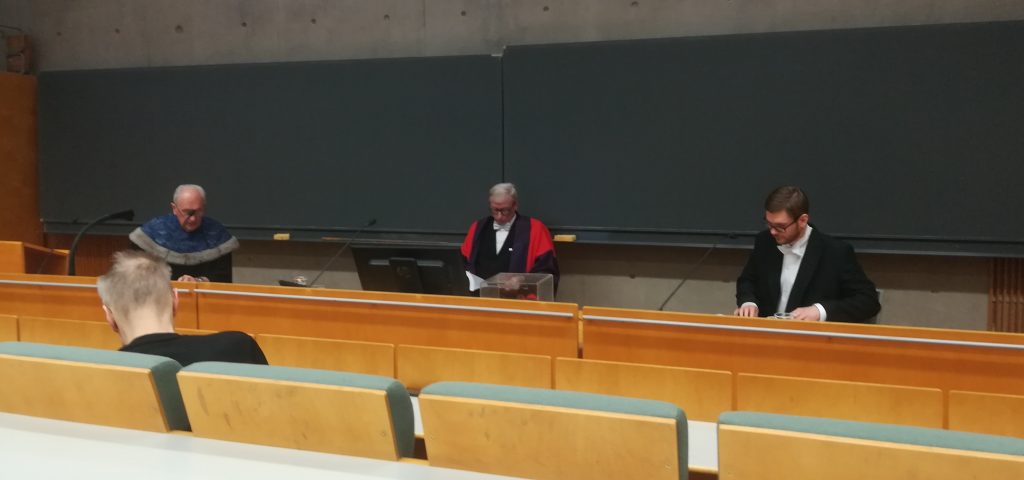
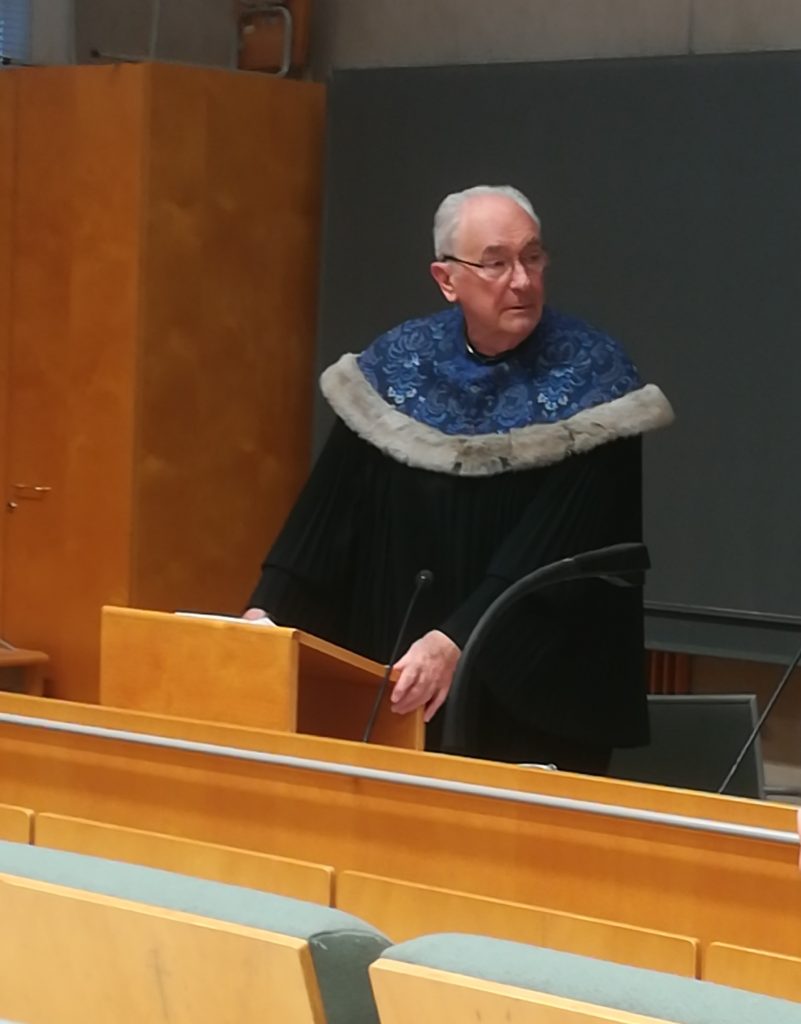
A few minutes passed. Suddenly everyone jumped up as the candidate walked in, followed by the custos, Professor Emeritus Risto Hiltunen, and the opponent, Professor Emeritus Herbert Schendl from the University of Vienna. The custos and the opponent were wearing colourful old-timey robes, which I assumed were customary, but later learned differ depending on the university.

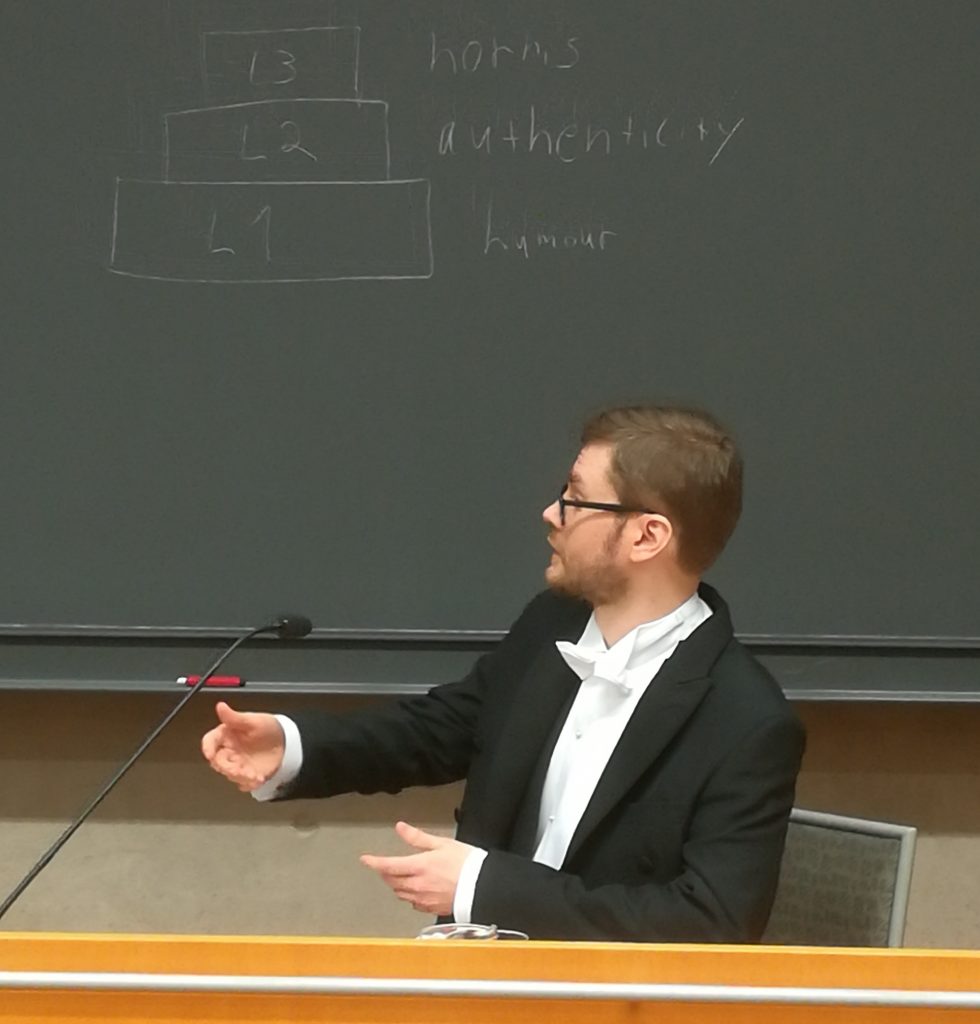
The custos spoke a few words, the candidate briefly presented his thesis in Finnish and then it was time for the opponent to ask his questions. The discussion was more informal and relaxed than I had anticipated. Some questions were more hard-hitting, but mostly it was a friendly discussion about the difference between a code-switch and a loanword, and what kind of consequences code-switching could have. I have to be honest; the discussion went quite deep into the nitty-gritty and at times, I had a hard time following. The highlight of the discussion was when Aleksi got up to the blackboard and drew something resembling a wedding cake to illustrate the complex nature of a play-within-a-play.

Some two hours after it began, the discussion ended, and the opponent gave his finishing statement. He commended the candidate’s hard work of developing a new philological-pragmatic approach and his detailed analysis of code-switching in the school plays. The custos, who had remained silent the whole time (which is customary) declared the viva to be over. Outside the auditorium, hands were shaken, gifts were given, and cake was had. To my disappointment, there was not a top hat nor sword in sight. I guess those were saved for later.

Gratulationes to Aleksi on his achievement and all the best in his future career!

Text by Otto Tarkka

Photos by Janne Skaffari

Postmodern feminist challenging of dominant discourses: Mehdi Ghasemi’s doctoral defence

The second one of the two doctoral defences at the Department of English in the spring 2016 was Mehdi Ghasemi’s “Quest/ion of Identities in African American Feminist Postmodern Drama: A Study of Selected Plays by Suzan-Lori Parks”. The public examination of the dissertation took place at the University of Turku on 10 June, 2016. The candidate’s performance in the defence was eloquent and he was able to justify his choices and elaborate on the points that he was requested to clarify. Despite it being a Friday afternoon in June, the defence was attended by more than thirty people – and it was conducted in an orderly fashion.
mehdi
Mehdi Ghasemi’s doctoral dissertation is a study of three plays by Parks from the standpoints of postmodern drama and African American feminism with a focus on the terrains that reflect the quest and question of identities for African Americans, especially African American women. The study is a reading of three plays by Suzan Lori-Parks – The Death of the Last Black Man in the Whole Entire World (1990), Venus (1996) and Fucking A (2000). Ghasemi’s interpretetations of the three plays offer valuable insights on this understudied playwright and genre. Ghasemi argues that “Parks in these plays uses postmodern drama and African American feminism to encourage reflections on intersectionality in order to reveal the concerns of African Americans, particularly African American women“ (p. i).

The opponent was Professor Jopi Nyman from the University of Eastern Finland, and Professor Joel Kuortti acted as custos. Professor Nyman posed demanding questions on the theoretical issues involved as well as on the particular analyses of the three plays. Mr. Ghasemi replied confidently, resulting in an engaging discussion that – judging from their reactions – was also appreciated by the audience. Finally, the opponent gave his final statement. There were no questions from the floor.

Mehdi Ghasemi is from Tehran, Iran and completed his MA on “Walt Whitman’s Loud Voice of Democracy and Individuality” at the Islamic Azad University of Karaj. The dissertation is published electronically in the Annales Universitatis Turkuensis B419.

Text by Professor Joel Kuortti, custos

The transmission of early scientific writing: Mari-Liisa Varila’s doctoral defence

It is always a happy occasion for the whole department when a doctoral candidate defends their dissertation. This spring we were treated to not only one but two public examinations of doctoral dissertations. The first was that of Mari-Liisa Varila. On 28 May 2016, she defended her dissertation titled “In search of textual boundaries: A case study on the transmission of scientific writing in 16th-century England”.

Mari1

Varila’s study concentrates on the text-production practices of scribes and compilers as they copied scientific (in this case, mostly astrological) texts in manuscript form. Early scientific writing has not been researched as much as the extant material would merit; nor has book production in the early sixteenth century been studied extensively, especially the production of manuscript books. Varila’s study helps to bridge both of these gaps in research. Her primary material consists of three English manuscripts including mostly scientific texts. These manuscripts have not been studied in detail before.

Mari2

The opponent was Daniel Wakelin, Jeremy Griffiths Professor of Medieval English Palaeography at the University of Oxford. Professor Matti Peikola acted as custos. Wakelin and Varila engaged in a lively, intriguing discussion on matters scribal, textual and material. The enthusiasm with which both the opponent and the candidate participated in the discussion was palpable to the audience. Wakelin commended Varila on her innovative approach, which combines several disciplines in order to present an accurate picture of her manuscript material and conclusions.

The combination of approaches including manuscript studies, textual scholarship and historical discourse linguistics allows Varila to look at her material in novel ways and to understand the broader contexts behind the manuscripts’ production. She concludes that early scientific texts and works are often flexible in their boundaries. Scribes could copy selectively and the information content was often more important than the linguistic form. Material features are important: the constraints of the physical page can affect the texts being copied. Varila also shows that the connections between manuscripts and early printed material are a fruitful object of study. We were happy to attend such a successful examination, a fitting finale for the years of hard work!

mari4

Text by Sara Norja & Aino Liira
Photos by Miikka Varila

Hard Work Made Easy

On the last day of January, 2014, a fifty-strong crowd gathered in the Tauno Nurmela auditorium to listen to the defence of Elina Siltanen’s doctoral dissertation “Hard Work? Reciprocal Communication in Contemporary American Experimental Poetry”.

IMG_5628

The opponent who discussed the dissertation with Siltanen was professor emeritus Charles Molesworth (Queens College, The City University of New York). An eminent scholar of poetry, he has published The Fierce Embrace: A Study in Contemporary American Poetry, as well as critical books on Marianne Moore, Gary Snyder and Donald Barthelme, and biographies of Alain Locke and, most recently, Countee Cullen (2012). He has also two poetry titles to his name, Common Elegies and Words to That Effect. In the 1970s, he served as a Fulbright Professor in Turku, and the reunion with former colleagues was an amicable one.

In Siltanen’s study, the focus was on the works of three American experimental poets: John Ashbery (born 1927), Lyn Hejinian (1941) and Ron Silliman (1946). A literary critic herself, she proposes – on the basis of the discontinuous and repetitive character of experimental poetry – new ways of reading poetry that do not require clear-cut interpretations nor consistent subjectivity

Siltanen was one of the pioneers in the inter-university scheme Cotutelle, which is an agreement between two universities for a double degree in both universities; in this case the University of Turku and the Luleå University of Technology in Sweden. For the defence, this posed a technological challenge as the event was simultaneously videoed to Luleå, and the Swedish grading committee was present in Turku and took part in the discussion after the opponent.

IMG_5633

The respondent was very lucid in her comments to the questions posed to her first by the opponent and then the committee. Afterwards, several audience members commended the discussion for its clarity, and especially the approachability of the introductory lecture by the doctoral candidate (lectio praecursoria) was acclaimed. It made the hard work easier.

It was with satisfaction that I concluded the defence.

Joel Kuortti
custos

IMG_5648
“What a long strange trip it’s been”, is a famous exclamation by Jerry Garcia, which the poet Ron Silliman adapted to his poetry. The sentiment might be shared by Elina and her supervisor, Professor Lydia Kokkkola.