Finding the Right Answers in Fiction

Nana Arjopalo gave an outstanding performance defending her doctoral dissertation Narrating Deliverance: The Literary Double in the Writing of Chitra Banerjee Divakaruni, Jhumpa Lahiri, and Bharati Mukherjee on Friday, February 24, 2023. The viva was a true celebration of literature and the impact it has on humanity.
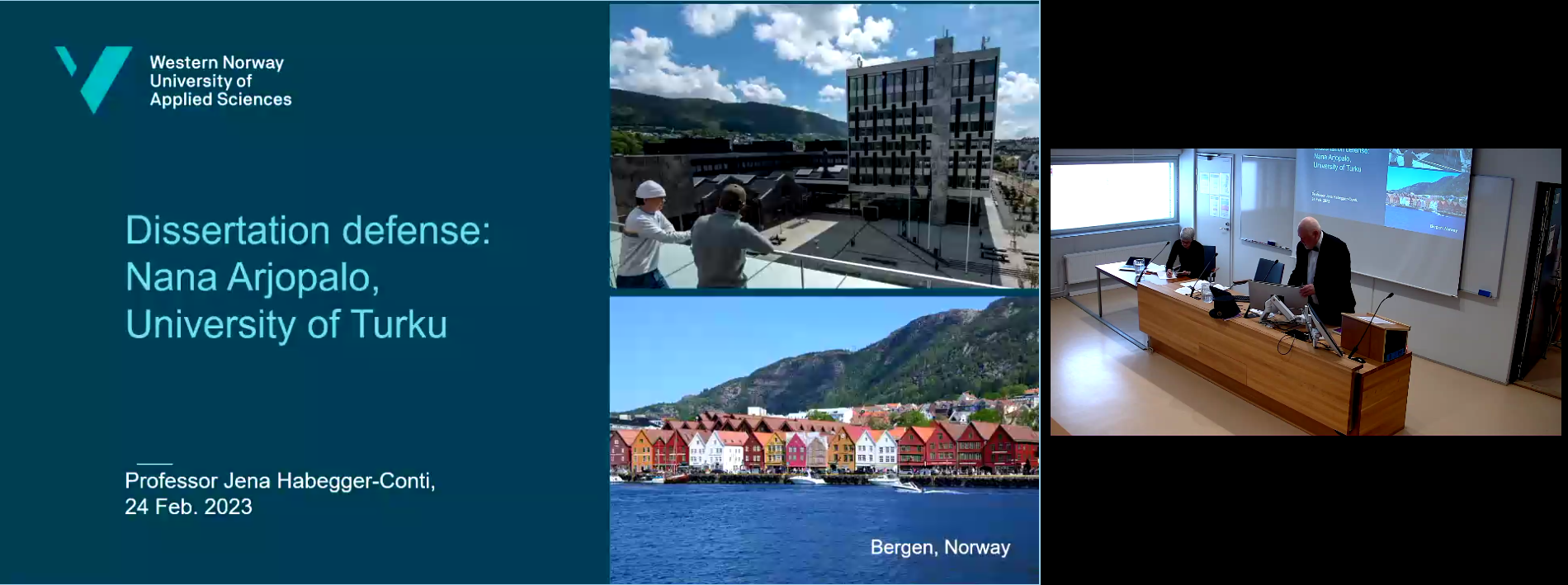
Professor Joel Kuortti testing the connection, picture and sound. Screenshot by Olga Harrison

The event was kindly streamed online via Echo360, the connection allowing remote viewers such as I to watch and listen to it closely. The broadcast began around 30 minutes before the actual event, and the early viewers had a chance to follow final preparations of the ceremony. The defense itself began at 12:15 with Nana Arjopalo proceeding to her microphone, followed by Professor Joel Kuortti acting as custos and Professor Jena Lee Habegger-Conti as the opponent.
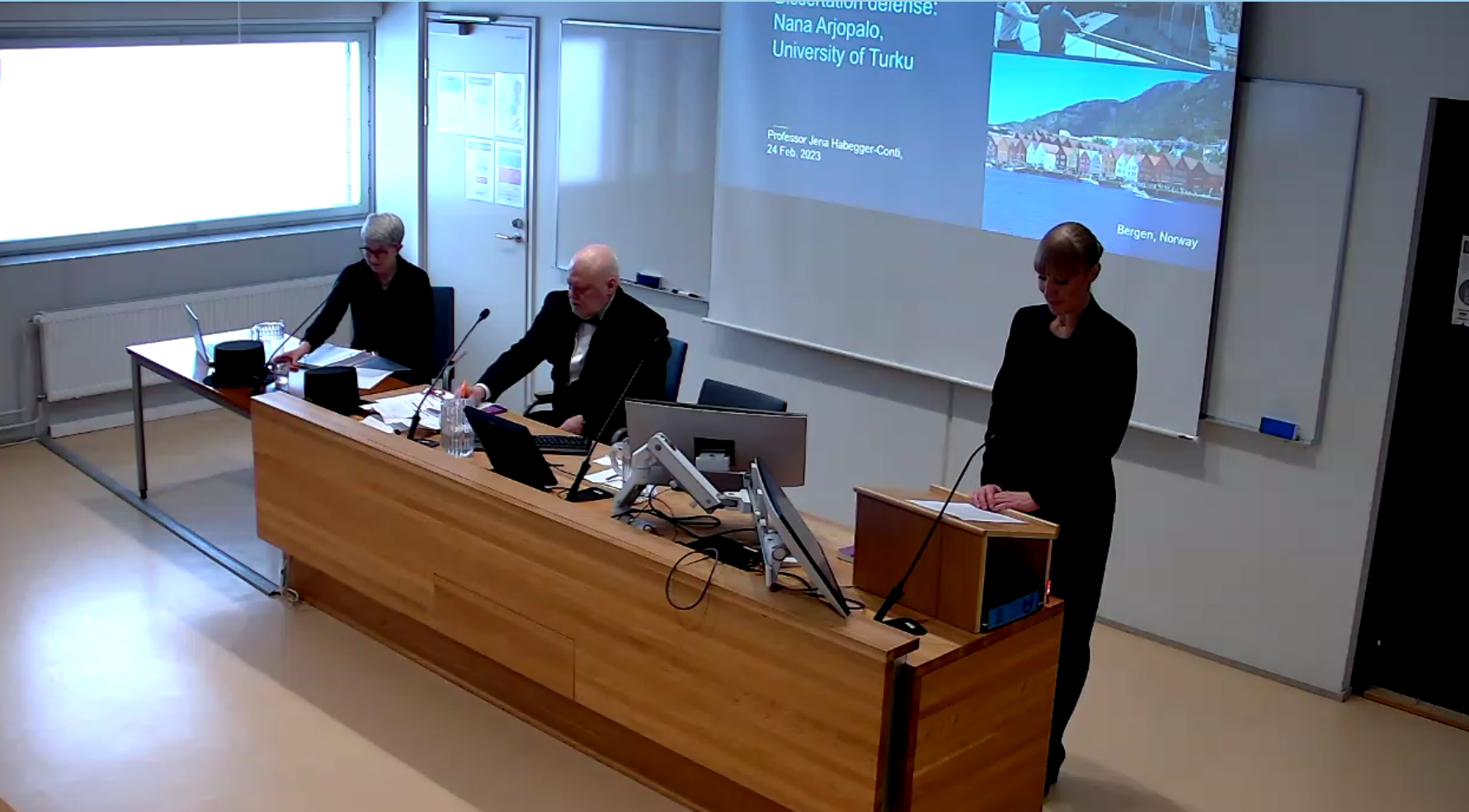
Doctoral Candidate Nana Arjopalo giving her lectio praecursoria. Screenshot by Olga Harrison

Arjopalo gave the lectio praecursoria in Finnish, covering both personal and theoretical aspects of her dissertation. Arjopalo has been an avid reader ever since discovering the fascinating world of fairy tales in her childhood. In her speech she emphasized the significance of literature to humanity. The viewers learned how fiction may offer a space to process life even better than biographical literature, as it helps one to work on personal and collective trauma, and offers a connection to others, even if one is physically away from a community. Arjopalo concluded that the right answers emerge when one asks the right questions.

The questions followed, in English, as the opponent presented her assessment and critique of the dissertation. Professor Habegger-Conti was interested in an array of subjects from the positioning to critical regionalism. Despite the range of the issues covered, the conversation flowed smoothly. There was a great deal of agreement between the opponent and the doctoral candidate, and even some terminology discrepancies were resolved without a major dispute. In her concluding words, Arjopalo stated that the discussion was reflective of the work that she had done, and that she had succeeded in making the reader draw specific conclusions from her dissertation.
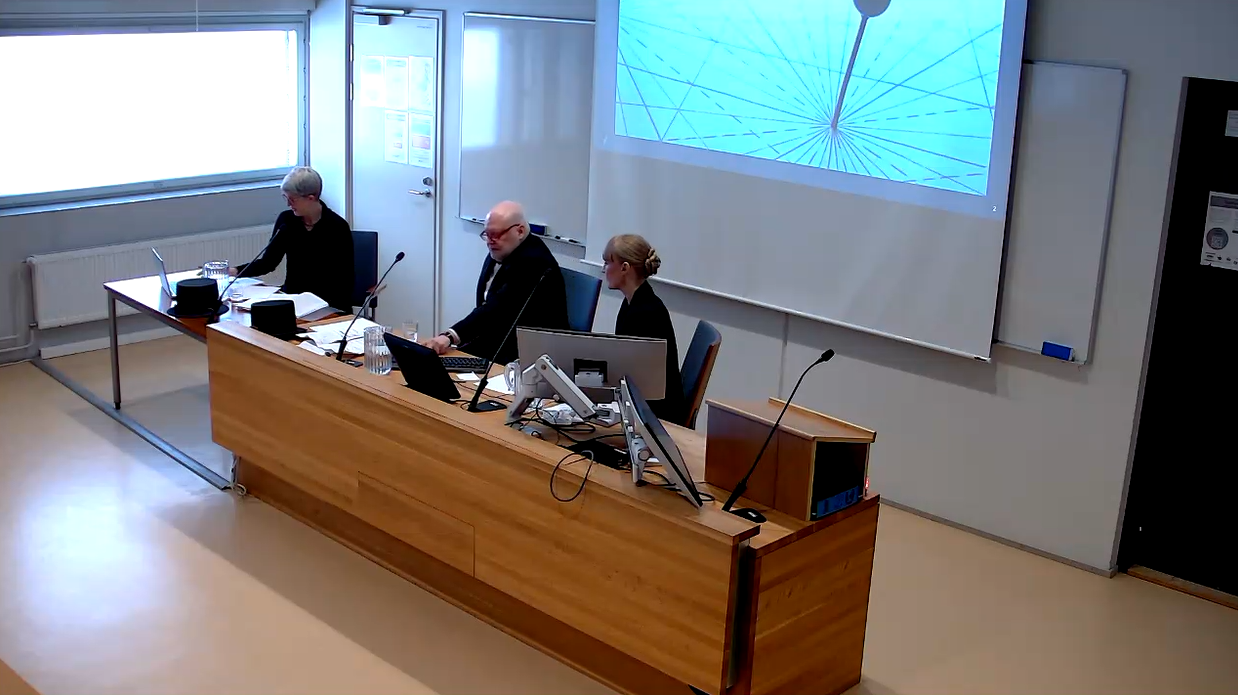
Professor Jena Lee Habegger-Conti discussing Positioning. Screenshot by Teppo Jakonen

Professor Habegger-Conti was evidently pleased to read and discuss the thesis, and ultimately recommended the faculty to accept the doctoral dissertation. As there were no questions from the audience to add to an hour-and-a-half long discussion, Professor Kuortti declared the event concluded. The newly-proclaimed Doctor of Philosophy Nana Arjopalo received congratulations from the numerous audience members on-site, and invited everyone present to further celebrate outside the lecture hall, where Echo360, unfortunately, did not follow.

That set aside, it was, indeed, a pleasure to follow the doctoral defense in literature and to be reminded about the importance of asking the right questions. Congratulations to Nana Arjopalo, Ph.D., and best wishes for her future endeavors!

Text by Olga Harrison
Becoming an English teacher in Namibia and Finland

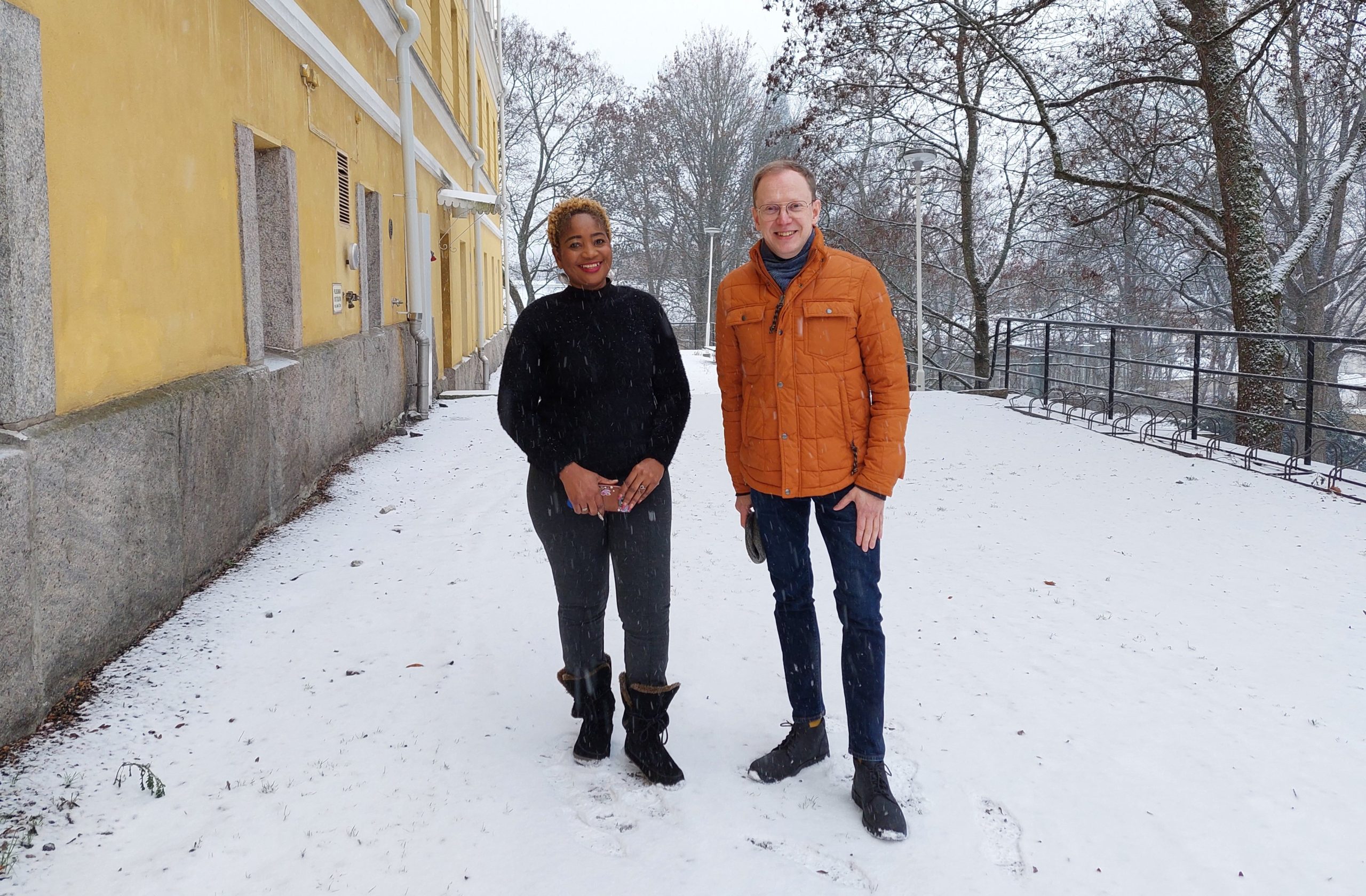
This autumn, the School of Languages and Translation Studies has had a visitor from the University of Namibia (UNAM), Dr Meameno Shiweda, who is a specialist in teacher education. In this blog post, Meameno and Janne Skaffari talk about similarities and differences in what and whom they teach and, more broadly, in the educational systems of our two countries.

Janne: How does one become an English teacher in Namibia?

Meameno: Anyone with an interest in teaching English can enrol in a teacher training program for junior/senior primary or junior/senior secondary levels, provided that they have good grades in five subjects, and a minimum of a C grade in English at Namibia Senior Secondary Certificate. A minimum C grade in another language is also a requirement. C is roughly the same as cum laude or magna in your matriculation exam.

J: It is quite different from Finland, where you apply to study English as your major or minor at university, and teacher training is basically a minor subject that corresponds to one year’s work. It is often completed as part of the MA degree. This route is for secondary-school English teachers, but for primary schools, you do not necessarily need more than a primary-school teacher’s university degree in Education. When does English begin in your program? Our majors do English Department courses from the first semester on.

M: Throughout their four years of teacher training, our students receive a mix of English modules and teaching-methods training. English majors also commence from the first semester onwards, and they are taught by English subject specialists from various departments in the School of Education. The first year begins with phonetics, phonology and children’s literature, and in the second year they focus on speaking and youth literature. The third year is reading and writing, while the fourth and final year is adult literature and grammar.

J: Oh, grammar comes that late! What kinds of observations have you made about teaching and studying during your visit?

M: The length of time a student studies English before having to determine whether or not they want to become English instructors is an important observation I have made here. Additionally, I have learned that prospective teacher-training students are interviewed to gauge their level of preparedness for the teaching profession, as opposed to our practice at UNAM.

J: We think it is important that students have time to become familiar with their major and minor subjects at the BA stage and then focus more on a particular career during MA studies.

M: I’ve learned from my experiences here and from talking to colleagues that getting extensive English training before concentrating on a teaching job is more realistic.

J: Yes, we really hope it helps! Students also get to see that there are other career opportunities.

M & J: We wish all our students – in Namibia and Finland – good luck with their studies and future careers!

Text by Meameno Shiweda & Janne Skaffari

Photo by Teppo Jakonen

A DOCTORATE will be given for the completion and defense of a dissertation

Susanna Mäkinen defended her doctoral dissertation, Stability and variation in the genre of runaway slave notices in American newspapers 1704-1865, on Friday 20 May 2022. While the never-tiring doctoral researchers of the English department have produced quite a few dissertation and vivas to accompany them in the recent years, Susanna was the first one to enjoy the full traditional experience of a doctoral defense, complete with the opponent actually present in the same room and a karonkka (held at the iconic Turku Castle, an excellent choice of location by the way), since the beginning of the pandemic.

The opponent, custos, and candidate

The viva took place in the Tauno Nurmela hall and drew in quite a crowd. The viva was also streamed on Echo for those unable to attend in person. The viva started right on time at 12.15, with Professor Matti Peikola as custos, even though the arrival of the opponent Professor Terry Walker (Mittuniversitetet, Sweden) had been slightly delayed (if nothing goes wrong, did the event even happen?).

With everyone present and accounted for, Professor Peikola welcomed everyone to the viva. Susanna delivered the lectio praecursoria, a short oral presentation of the research and its significance. Susanna and Professor Walker then proceeded to have a lively discussion on the dissertation. The discussion ranged from the terms used in the dissertation to the choice of a chapter title and the reasoning behind choices made regarding the material (which includes 2603 runaway slave notices), methods and analysis. While Professor Walker presented Susanna with several tough questions, Susanna handled them beautifully. The discussion was relaxed throughout the defense and both the opponent and the doctoral candidate seemed to truly enjoy themselves, which was a joy to watch. The discussion took about an hour and a half, but the time seemed to fly by (at least for yours truly, whether the candidate agrees is unclear at this time).

Defending your dissertation is fun!

The viva marks the end of an often long and significant period in a researcher’s life. Years of work has been poured into the dissertation, which is then publicly defended. When asked what she would do differently now that she has gone through those years of labor, Susanna lamented on her apparently less than ideal note-taking, but noted that when it comes to the dissertation itself, “I’m pretty happy with what I’ve done.”

What more could a researcher at their doctoral defense ask for than a dissertation they are happy with? Not much comes to mind.

Congratulations to Susanna on this amazing achievement and the best of luck in your future endeavors! 

Text by Ida Meerto

Photos by Timo Savela