What’s that MA Thesis all about?

On 8 April 2025, students and staff members of the Department of English gathered for the annual MA Thesis Symposium. The event has been organized since 2013, so one could safely say that it is turning into a true tradition of the English Department.

The MA Thesis Symposium showcases MA research done at the department. Major students who have just completed or are about to complete their MA Thesis give a short presentation where they talk about their thesis topic, methodologies and key findings, and often also about what it is like to write an MA Thesis. The symposium is specifically aimed for students starting their MA Thesis seminar, who might wonder about topic selection and the process in general, and BA level students, who are thinking about what to specialize in in their MA studies. The symposium also gives the speakers an opportunity to talk about their research and gain public speaking experience in a relaxed and friendly environment.

This year, we were lucky to have speakers from each of the Department’s MA tracks: philology, discourse, second language acquisition, literature, and multilingual translation studies. The level of maturity, professionalism and enthusiasm of the presenters was impressive. Each outlined their topic with confidence and was well-versed in academic language and presenting style, all the while making their varied topics accessible to everyone in the audience. The presenters carried themselves well through the lively discussions and answered questions from the audience knowledgeably. The event certainly served as encouragement to those still a bit apprehensive about writing an MA Thesis.
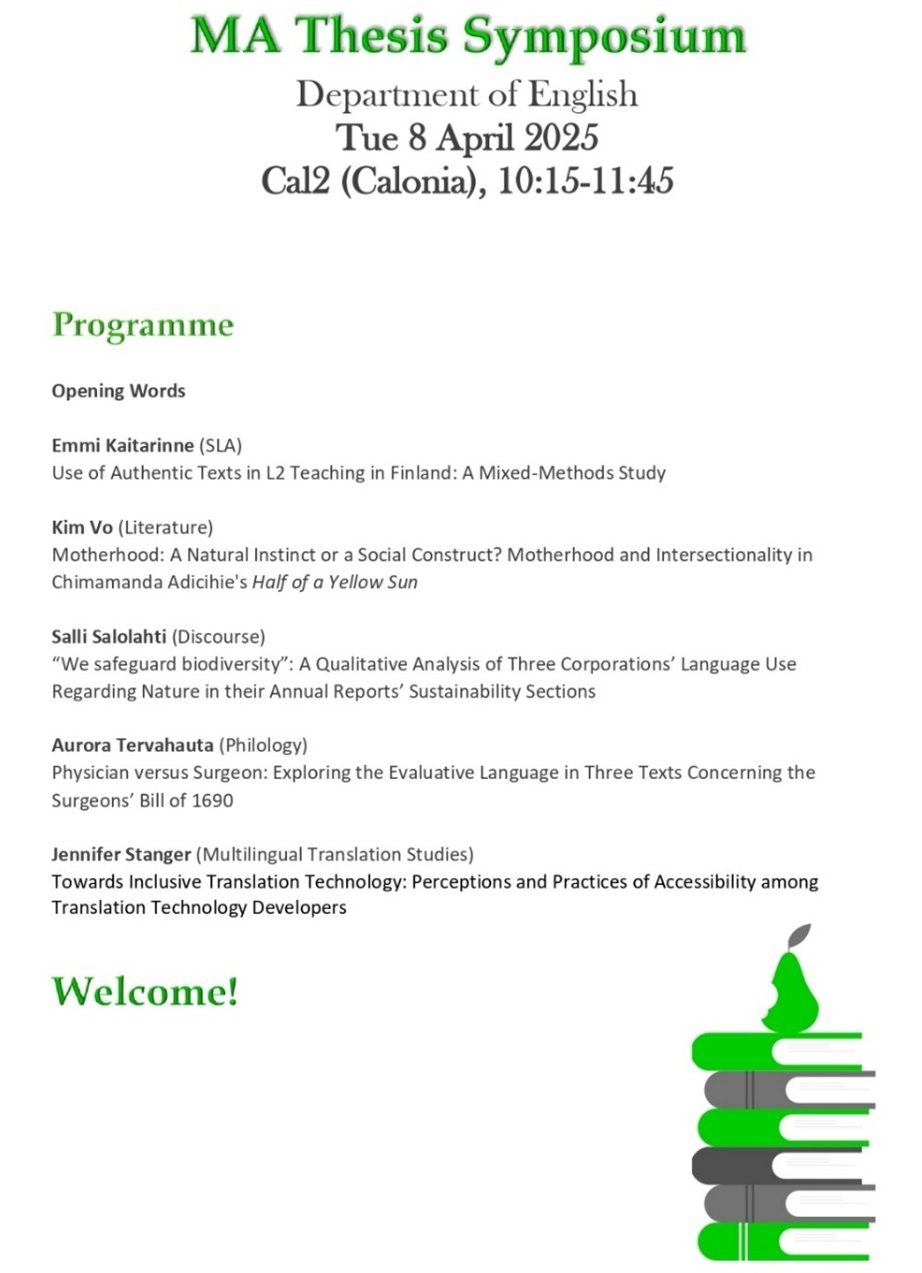
The program for MA Thesis Symposium held at Department of English on Tuesday 8 April 2025 Programme: Opening Words Emmi Kaitarinne (SLA) Use of Authentic Texts in L2 Teaching in Finland: A Mixed-Methods Study Kim Vo (Literature) Motherhood: A Natural Instinct or a Social Construct? Motherhood and Intersectionality in Chimamanda Adicihie's Half of a Yellow Sun Salli Salolahti (Discourse) “We safeguard biodiversity”: A Qualitative Analysis of Three Corporations’ Language Use Regarding Nature in their Annual Reports’ Sustainability Sections Aurora Tervahauta (Philology) Physician versus Surgeon: Exploring the Evaluative Language in Three Texts Concerning the Surgeons’ Bill of 1690 Jennifer Stanger (Multilingual Translation Studies) Towards Inclusive Translation Technology: Perceptions and Practices of Accessibility among Translation Technology Developers
This year’s MA Thesis Symposium had speakers from all of the Department’s MA Tracks.

I asked the presenters to join me in writing this blog, and Salli Salolahti and Kim Vo hopped onboard. Here they reflect on their experience of writing an MA Thesis and creating a short presentation based on it. They also touch on what it felt like to talk about their research in front of a live audience.

Salli Salolahti (Discourse track):

The MA thesis process definitely taught me a lot more than I initially thought it would! I perhaps naively thought that I would just get it done and that the biggest obstacle would be writing a paper this extensive. However, it turned out that for me the biggest obstacle to overcome was not the writing or any theory – it was perfectionism!

To make progress in the MA thesis process, you have to go through different steps like turning in your topic proposal, research plan, first draft, and so on. I had to accept that these would be less than perfect and that the whole process is simultaneously about showing what I have already learned and learning something new. I spent a lot of time experimenting with different approaches before finding the ones that I could make work. While this was at times frustrating, it was also great to realise that I was able to reflect on and solve many of the issues myself.

When it came time to present my thesis, I assumed squeezing it into a ten-minute presentation would be easy, but it turned out that was not the case. It had been a while since I submitted my thesis, and I had promptly forgotten how much ground it covered! While ten minutes initially sounded like plenty of time, in the end it went really fast.

I was both excited and nervous to present my research. Speaking in front of a live audience did not make me nervous, as I am used to it, but the idea of possibly misrepresenting something about my own research, methods, or theories stressed me. But I needn’t have worried about it: as soon as I started talking, it felt like I remembered everything. It was actually quite nice to talk about something that I myself had done and was proud of and also knew more about than anyone else in the room!
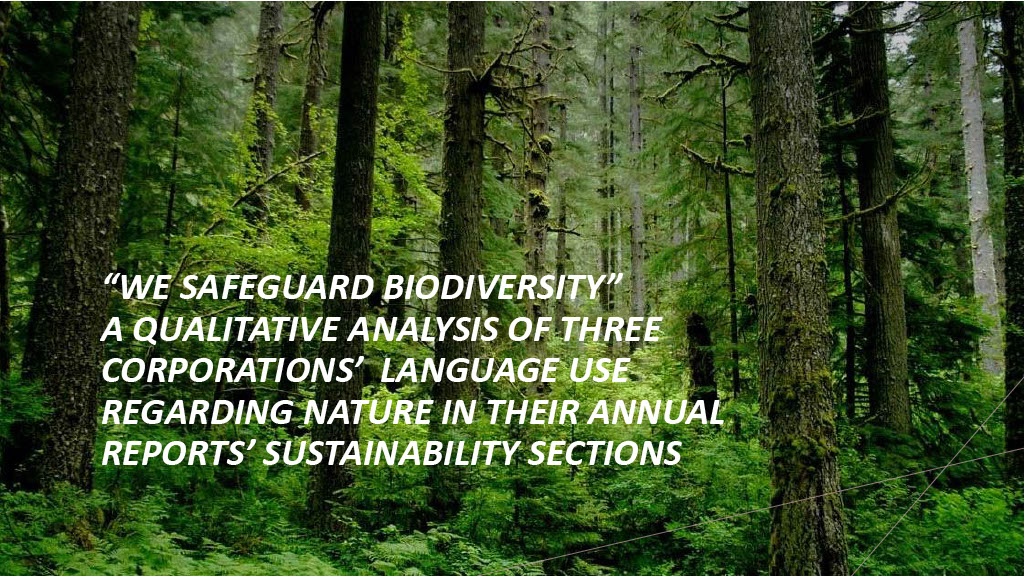
The title slide from Salli Salolahti's powerpoint presentation, depicting the title of the presentation (“We safeguard biodiversity”: A Qualitative Analysis of Three Corporations’ Language Use Regarding Nature in their Annual Reports’ Sustainability Sections) in white in front of a picture of a forest
In her MA Thesis, Salli Salolahti used ecolinguistics, critical discourse analysis and transitivity analysis from systemic functional grammar to analyze the language different corporations use when they talk about nature.

Kim Vo (Literature track):

My MA thesis explores a deceptively simple question: is motherhood an innate, natural instinct — or a social construct shaped by culture and expectation? As it turns out, writing about motherhood felt a lot like… well, becoming a mother.

The early days of thesis writing were filled with anticipation – glowing, even. I was excited, full of ideas, and ready to dive in. Then came the “morning sickness” phase: nausea-inducing literature reviews, endless source hunting, and the creeping dread that maybe I’d bitten off more than I could chew. But just like in pregnancy, there were those magical kicks – moments when my analysis clicked, and I felt the baby (read: thesis) growing into something real.

The final stretch? Labor. Pure, exhausting, deadline-driven labor. Pulling everything together felt like pushing through contractions – painful, but with a purpose. And finally, there it was: a fully formed thesis, screaming for attention and citations.

Presenting my work was another surprise. Despite two years of teaching experience, I still felt butterflies facing a new audience. But once I started talking, the nerves melted away. Ten minutes flew by – barely enough time to scratch the surface – but I was proud to share my research and answer questions.

This journey taught me that writing a thesis isn’t just academic – it’s deeply personal, occasionally chaotic, and ultimately rewarding. And like any proud parent, I’m just glad it’s finally out in the world.
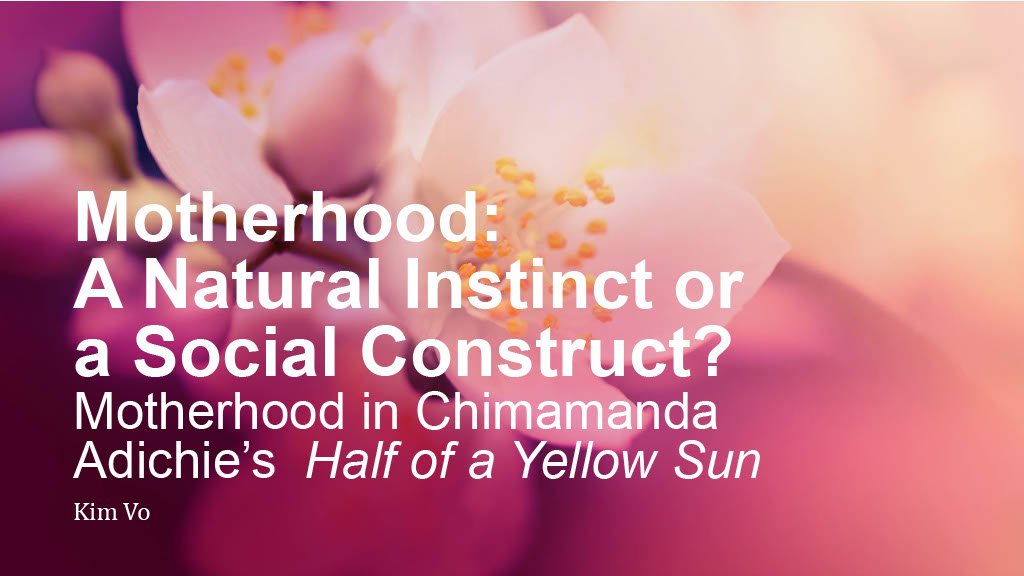
The title slide from Kim Vo's powerpoint presentation, depicting the title of the presentation (Motherhood: A Natural Instinct or a Social Construct? Motherhood and Intersectionality in Chimamanda Adicihie's Half of a Yellow Sun) in white in front of a picture of flowers
In her MA Thesis, Kim Vo explored the many types of motherhood present in Chimamanda Adichie’s depiction of post-colonial Nigeria and concluded that motherhood exists as a dynamic interplay between instinct, choice, and social influence.

Text and photos by Ira Hansen, Salli Salolahti and Kim Vo

Tracing the Complicities of Colonial Violence

On a warm Saturday morning, on 24 August 2024, a small audience gathered to celebrate Amin Beiranvand as he defended his doctoral dissertation Gendered Sexual Violence and Complicity: A Postcolonial Study of Selected Works by J. M. Coetzee. Professor Joel Kuortti acted as custos and adjunct professor John Stotesbury from the University of Eastern Finland as the opponent.

The viva began with Amin’s lectio praecursoria, in which he outlined the historical and cultural context and the main research questions of his dissertation. He ambitiously investigates the fiction of the critically acclaimed Noble Prize winning Coetzee, whose fiction has dealt with, among other themes, the legacy of colonialism and its violent power relations in human and animal encounters. This underlies also Amin’s research, in which he focuses on Coetzee’s portrayals of gender-based violence against racially and ethnically marginalised women in three novels, Dusklands (1974), Waiting for the Barbarians (1980) and Disgrace (1999).

All’s well that ends well. The opponent accepts the PhD dissertation.

The opponent presented his questions and criticisms in an approachable and captivating way. The questions began with a lengthy discussion on the dissertation title and specifically the many implications of the word complicity. The effects of colonial violence and its legacy are more far-reaching than those confined into the pages of Coetzee’s novels. This inspired the opponent to ask about Amin’s choice of the term “gender-based” when discussing violence in a setting where it springs as much from the colonial power structures and the racial hierarchies portrayed in the fiction.

The rest of the viva dealt with each novel individually and focused specifically on themes of violence, imagination, history, anger and the effects of silences that deny the voice of the oppressed. On this point, the opponent created an immersive experience for everyone in the room by staying silent for a disturbingly long time. Overall, the atmosphere of the viva was relaxed and the opponent told many entertaining anecdotes from his own career, for example being invited to dinner at Coetzee’s house and the introverted author then failing to show up.

The successful viva resulted in an accepted doctoral dissertation and we congratulate the new Doctor of Philosophy, Amin Beiranvand.

Text by Ira Hansen & Suvi Seppälä

Photo by Damon Tringham

Doctoral researcher exploring the FINSSE-11 conference: What is the role of non-human animals when it comes to sustainability in English studies?

FINSSE, the Finnish Society for the Study of English, was founded in 1998 “to advance university-level research and teaching in Finland of the English language, literatures in English and cultures of English-speaking peoples”. Biennially, a FINSSE conference is organised “to bring together university teachers, scholars and advanced students from all fields of English studies.” This year’s conference was held in Helsinki 13‒14 June, with the theme “Sustainability in English Studies”.

When I read the Call for Papers in February, I was very happy to see that the theme of this year’s conference would be sustainability. The CFP started by defining sustainability as comprising environmental, social and economic sustainability and asking what it has to do with language and literature. The role of language was seen as a tool through which the viability of communities is sustained and sustainability goals are negotiated, and literature as one through which alternative and more sustainable worlds can be explored. Also, the question of ensuring that research practices in English studies are sustainable was addressed. In addition to the general introduction to the theme, there were topic suggestions related to for example language resources, language policy, ELF, language teaching, translation, equality, identity, health, ecolinguistics, environmental humanities and several approaches to literature.

Besides being excited about the theme in general, I was curious to see how it would be approached in the presentations; which perspectives of sustainability would be discussed, and maybe most importantly, who would be considered being part of the group that the sustaining is done for—humans only, or sentient beings in general. Typically, the current (mainstream) definitions of sustainability exclude sentient beings other than humans as having moral value, but there has been an increasing call for defining sustainability as including non-human animals as ends in themselves. However, there was no mention of them in the CFP, and the United Nations’ Sustainability Development Goals, which were mentioned briefly in the CFP, are extremely anthropocentric. In the SDGs, non-human animals are treated as either resources for human consumption or, at the species level, as worth conserving in order to keep providing humans with ecosystem services.

In total, the conference program included one plenary presentation, 30 individual presentations, four poster presentations and a panel discussion during the two conference days. In addition, a meeting for doctoral students was arranged the day before the actual conference. I attended 13 presentations and the panel discussion. Using the abstracts as my guide, I aimed to see all those presentations that in one way or the other were connected to sustainability. When there were no such options available, I made my choice based on other reasons, such as my personal interests or the expected relevance to my own research.

I found all the presentations I heard interesting and having scientific, social or practical significance, and the panel discussion on the future of English studies teaching was excellent—both content- and entertainment-wise. Sustainability itself, however, was discussed relatively rarely—and sometimes the term seemed to be used more as a buzzword than in connection with the actual concept—but there were some thought-provoking exceptions. Those presentations were related to the sustainability of language resources; connections between the global environmental crisis and trains in literature and film; researchers’ more sustainable travelling practices; the consequences and possibilities of Caribbean romance literature for environmental and cultural sustainability; and the cost of sustainability in Margaret Atwood’s MaddAddam. All in all, while there were several interesting connections made to sustainability, the question of non-human animals mentioned above was left to be addressed.

After the conference, I would say that FINSSE-11 was definitely worth attending. The atmosphere was very warm and welcoming, and the program was varied. The next FINSSE conference will be organised in two years, and I warmly encourage everybody working in the field of English studies at any English department in Finland to participate. And if you are not yet a member of FINSSE, or just want to know more about the society, click here!

Anna Runsio

The author is a doctoral researcher at the Department of English, University of Turku. Her doctoral dissertation deals with the linguistic representation of research animals’ agency in historical materials. She is particularly interested in combining linguistics with historical critical animal studies, i.e. using linguistic methods for investigating the exploitation of non-human animals in the past and its consequences today.

Unraveling the Complexities of Competence

Earlier this spring, I had the opportunity to attend an eye-opening event on the “complexities of competence”, namely, Marja-Leena Niitemaa’s doctoral defense on Complexities of Competence: A Study on Finnish Upper-secondary Lexical Development and Use of L2 English. I had no idea what to expect, other than it was a formal event, and, I imagined, a very nerve-racking one, at least for the doctoral candidate.

The viva voce is the ultimate climax of years of hard work, i.e., blood, sweat and tears for many. Finally, the day has arrived when you can present to the public the cornucopia of knowledge you have acquired along your PhD journey. The grace and dignity of the event was humbling.

Marja-Leena’s viva began with an introduction by the Custos, Professor Pekka Lintunen. Senior Lecturer Katja Mäntylä of the University of Jyväskylä was Marja-Leena’s Opponent (thesis examiner). Marja-Leena’s lucid lectio praecursoria captured the audience’s interest from the start because the topic of her dissertation is perhaps something many people can relate to, i.e., acquiring and applying foreign language skills through digital means. The complexities Marja-Leena spoke of refer to the multifarious and interweaving ways in which young people acquire English today. Learning English is no longer limited to the classroom only; rather, students draw upon the resources their environment offers, e.g., internet and television. 

Marja-Leena Niitemaa together with Custos Professor Pekka Lintunen and Opponent Senior Lecturer Katja Mäntylä

The event was indeed a learning experience, having struggled with my own complexities along my PhD journey. For example, how do you navigate around unexpected results, results that controvert decades of previous research? This can really multiply your symptoms of imposter syndrome! How do you get your head around statistics when your brain has not been wired for such things—let alone interpreting them! How do you balance work and tend to your PhD brainchild? How can you tell procrastination to go pound sand? The answers to these questions are, of course, different for everyone. Perseverance and determination certainly help, keeping your eye on your target and thinking back to why you began your PhD journey in the first place also help.

For me, experiencing Marja-Leena’s viva helped me to garner the much-needed faith I needed to invest in myself. I was able to witness first-hand the culmination of hard work, determination and learning processes that go into writing a dissertation. This, if anything, gave me a nudge to keep working towards the goal I set so many years ago. So, if you are contemplating about getting a PhD or struggling to finish one, go to a viva—you’ll get all the inspiration you need!

Text: Judi Rose

Photo: Pauliina Peltonen

Finding the Right Answers in Fiction

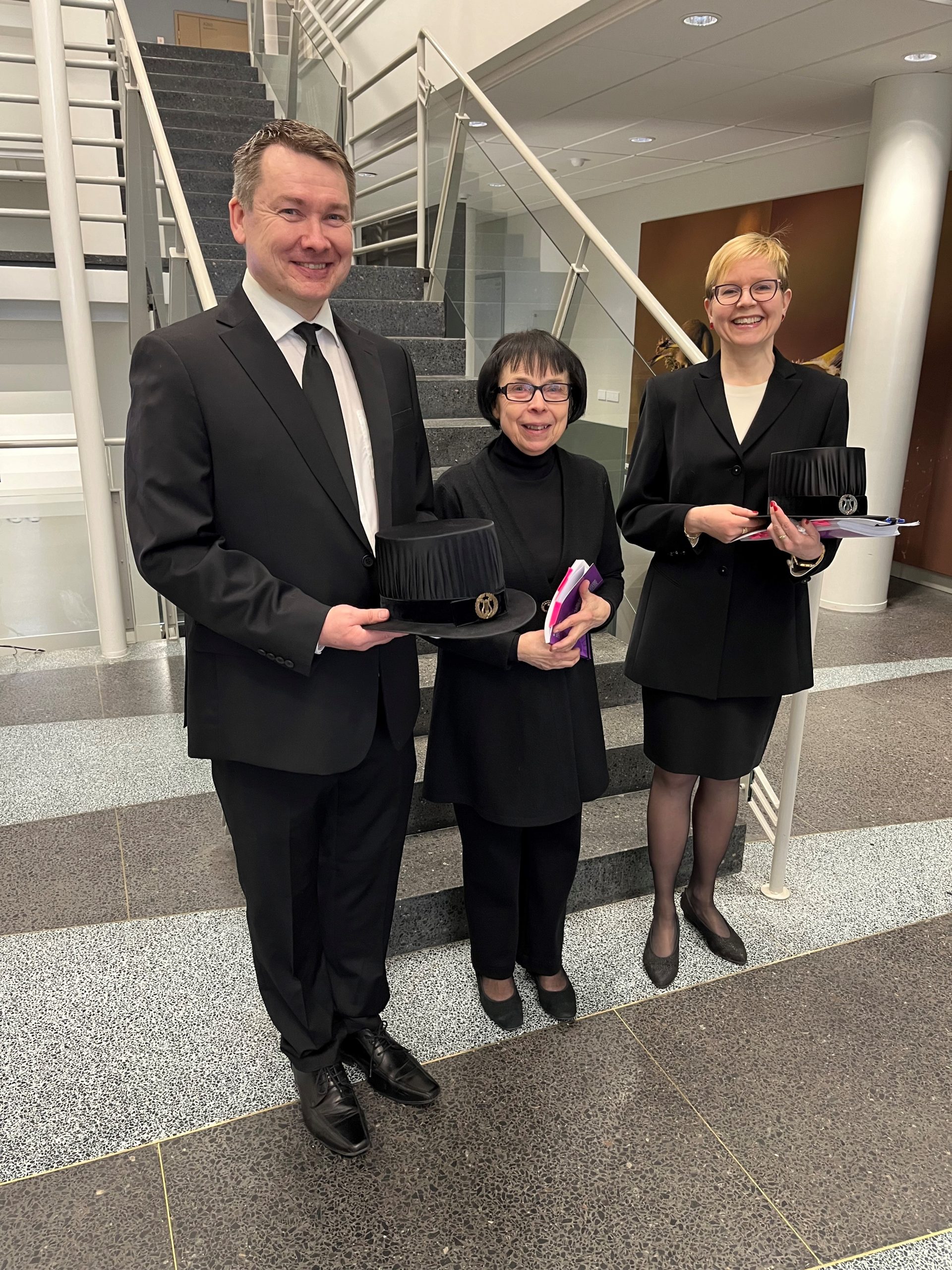
Nana Arjopalo gave an outstanding performance defending her doctoral dissertation Narrating Deliverance: The Literary Double in the Writing of Chitra Banerjee Divakaruni, Jhumpa Lahiri, and Bharati Mukherjee on Friday, February 24, 2023. The viva was a true celebration of literature and the impact it has on humanity.

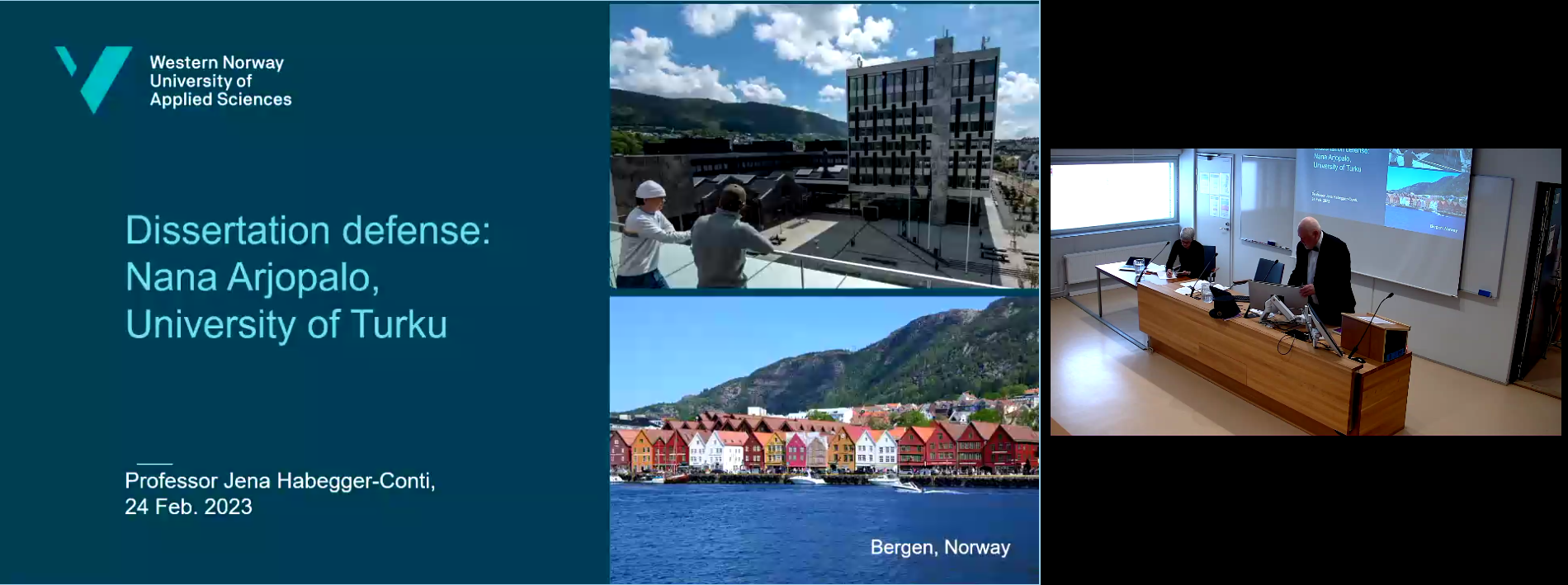
Professor Joel Kuortti testing the connection, picture and sound. Screenshot by Olga Harrison

The event was kindly streamed online via Echo360, the connection allowing remote viewers such as I to watch and listen to it closely. The broadcast began around 30 minutes before the actual event, and the early viewers had a chance to follow final preparations of the ceremony. The defense itself began at 12:15 with Nana Arjopalo proceeding to her microphone, followed by Professor Joel Kuortti acting as custos and Professor Jena Lee Habegger-Conti as the opponent.

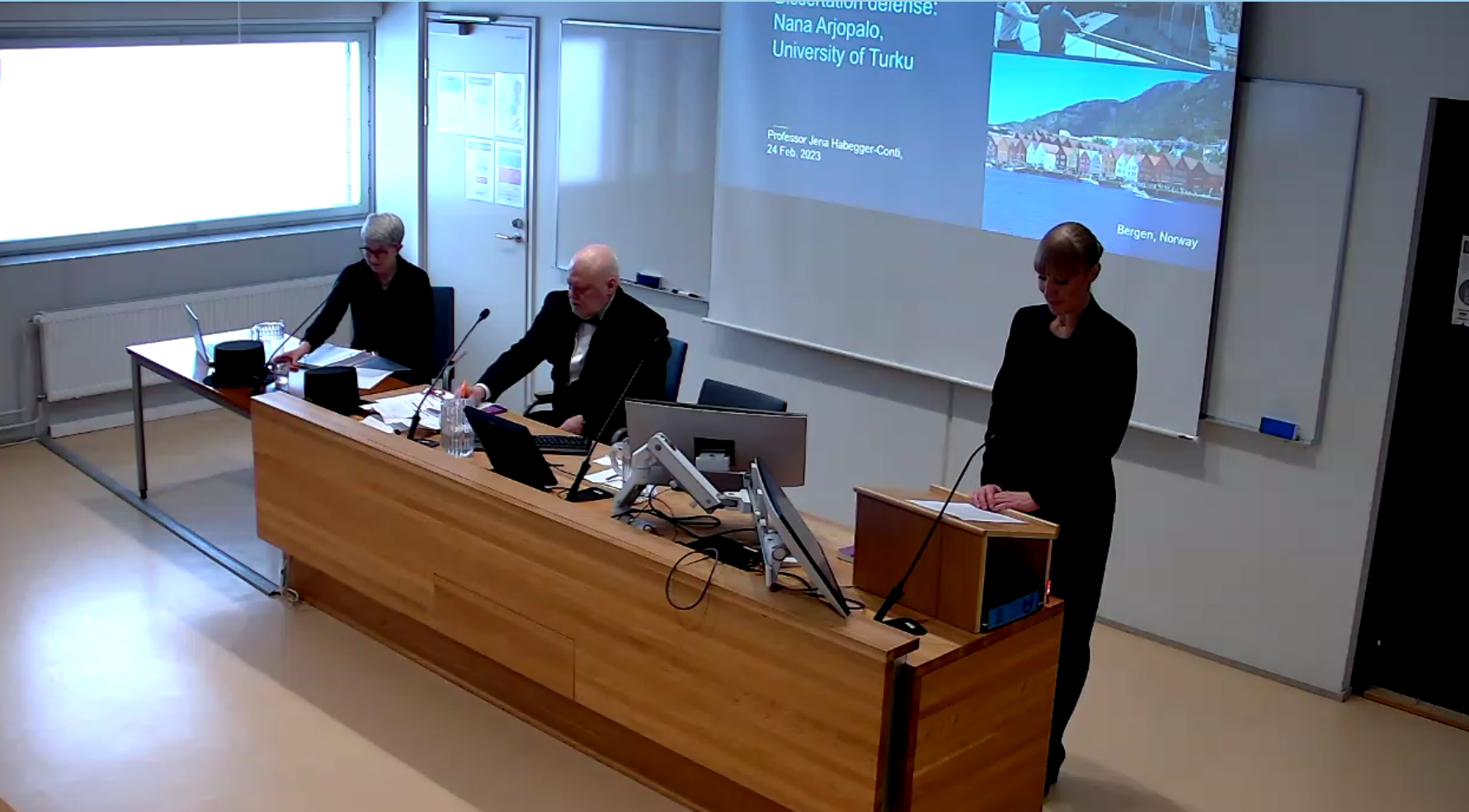
Doctoral Candidate Nana Arjopalo giving her lectio praecursoria. Screenshot by Olga Harrison

Arjopalo gave the lectio praecursoria in Finnish, covering both personal and theoretical aspects of her dissertation. Arjopalo has been an avid reader ever since discovering the fascinating world of fairy tales in her childhood. In her speech she emphasized the significance of literature to humanity. The viewers learned how fiction may offer a space to process life even better than biographical literature, as it helps one to work on personal and collective trauma, and offers a connection to others, even if one is physically away from a community. Arjopalo concluded that the right answers emerge when one asks the right questions.

The questions followed, in English, as the opponent presented her assessment and critique of the dissertation. Professor Habegger-Conti was interested in an array of subjects from the positioning to critical regionalism. Despite the range of the issues covered, the conversation flowed smoothly. There was a great deal of agreement between the opponent and the doctoral candidate, and even some terminology discrepancies were resolved without a major dispute. In her concluding words, Arjopalo stated that the discussion was reflective of the work that she had done, and that she had succeeded in making the reader draw specific conclusions from her dissertation.

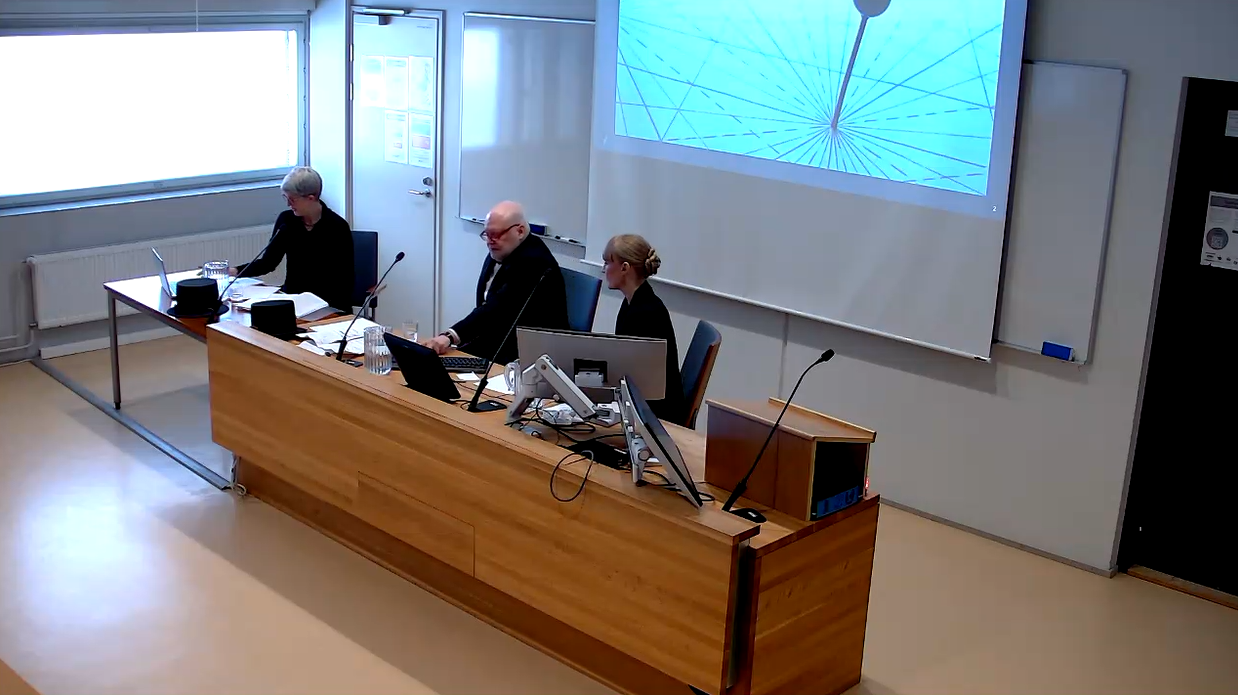
Professor Jena Lee Habegger-Conti discussing Positioning. Screenshot by Teppo Jakonen

Professor Habegger-Conti was evidently pleased to read and discuss the thesis, and ultimately recommended the faculty to accept the doctoral dissertation. As there were no questions from the audience to add to an hour-and-a-half long discussion, Professor Kuortti declared the event concluded. The newly-proclaimed Doctor of Philosophy Nana Arjopalo received congratulations from the numerous audience members on-site, and invited everyone present to further celebrate outside the lecture hall, where Echo360, unfortunately, did not follow.

That set aside, it was, indeed, a pleasure to follow the doctoral defense in literature and to be reminded about the importance of asking the right questions. Congratulations to Nana Arjopalo, Ph.D., and best wishes for her future endeavors!

Text by Olga Harrison

A DOCTORATE will be given for the completion and defense of a dissertation

Susanna Mäkinen defended her doctoral dissertation, Stability and variation in the genre of runaway slave notices in American newspapers 1704-1865, on Friday 20 May 2022. While the never-tiring doctoral researchers of the English department have produced quite a few dissertation and vivas to accompany them in the recent years, Susanna was the first one to enjoy the full traditional experience of a doctoral defense, complete with the opponent actually present in the same room and a karonkka (held at the iconic Turku Castle, an excellent choice of location by the way), since the beginning of the pandemic.

The opponent, custos, and candidate

The viva took place in the Tauno Nurmela hall and drew in quite a crowd. The viva was also streamed on Echo for those unable to attend in person. The viva started right on time at 12.15, with Professor Matti Peikola as custos, even though the arrival of the opponent Professor Terry Walker (Mittuniversitetet, Sweden) had been slightly delayed (if nothing goes wrong, did the event even happen?).

With everyone present and accounted for, Professor Peikola welcomed everyone to the viva. Susanna delivered the lectio praecursoria, a short oral presentation of the research and its significance. Susanna and Professor Walker then proceeded to have a lively discussion on the dissertation. The discussion ranged from the terms used in the dissertation to the choice of a chapter title and the reasoning behind choices made regarding the material (which includes 2603 runaway slave notices), methods and analysis. While Professor Walker presented Susanna with several tough questions, Susanna handled them beautifully. The discussion was relaxed throughout the defense and both the opponent and the doctoral candidate seemed to truly enjoy themselves, which was a joy to watch. The discussion took about an hour and a half, but the time seemed to fly by (at least for yours truly, whether the candidate agrees is unclear at this time).

Defending your dissertation is fun!

The viva marks the end of an often long and significant period in a researcher’s life. Years of work has been poured into the dissertation, which is then publicly defended. When asked what she would do differently now that she has gone through those years of labor, Susanna lamented on her apparently less than ideal note-taking, but noted that when it comes to the dissertation itself, “I’m pretty happy with what I’ve done.”

What more could a researcher at their doctoral defense ask for than a dissertation they are happy with? Not much comes to mind.

Congratulations to Susanna on this amazing achievement and the best of luck in your future endeavors! 

Text by Ida Meerto

Photos by Timo Savela

75 Years of the Joys of English

The Department of English became a subject department at the University of Turku 75 years ago in 1946. In 1980, translation studies were transferred from Language Institutes into the university, and were merged with the philology departments in 2010. We celebrated this anniversary on Tuesday 14 December 2021. The Corona epidemic had postponed the occasion but this did not defeat the festive spirit.

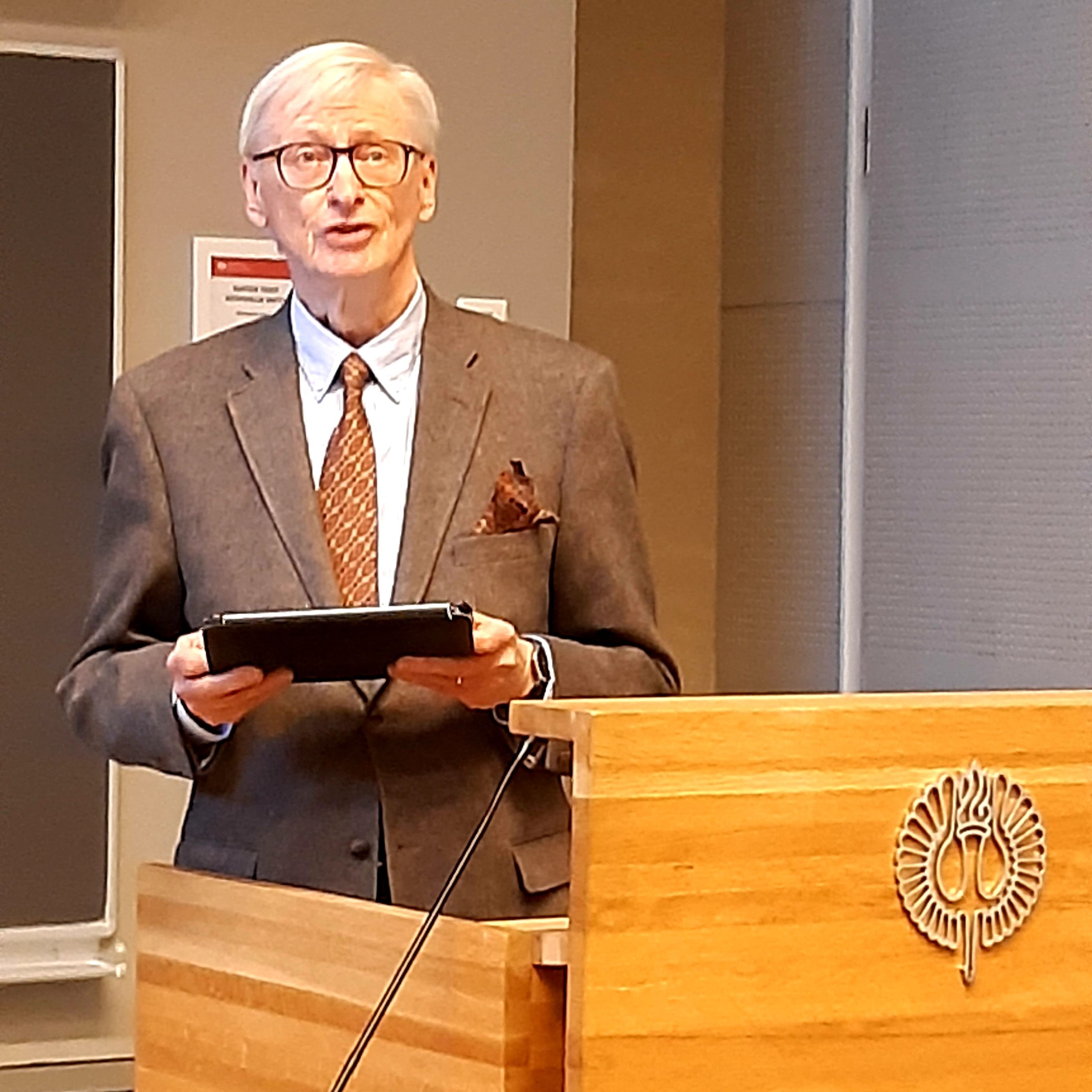
Professor Emeritus Risto Hiltunen chronicling the department’s 75-year history — and beyond.

The programme of the seminar included an overview of the history of the department by Professor Emeritus Risto Hiltunen. He took us through the years from the first chair in English held by Yrjö M. Biese (and even earlier times) to the gradual expansion of the department, the merger of philology and translation departments and the introduction of the 2010 Universities Act that changed the juridical position of Finnish universities, until the present.

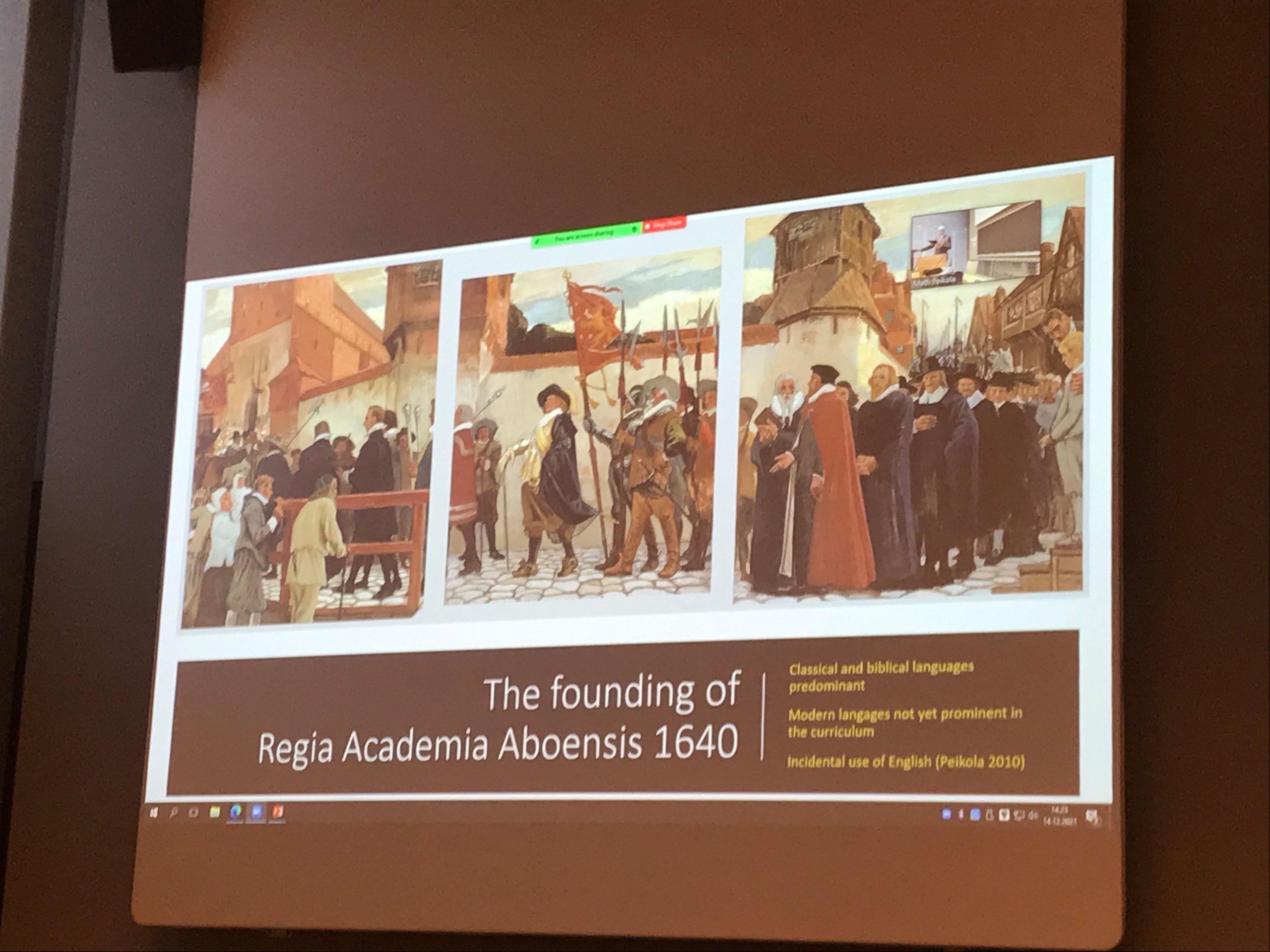
Risto’s speech reached all the way to the history of Academia Aboensis, the origin of university-level study of languages in Turku.

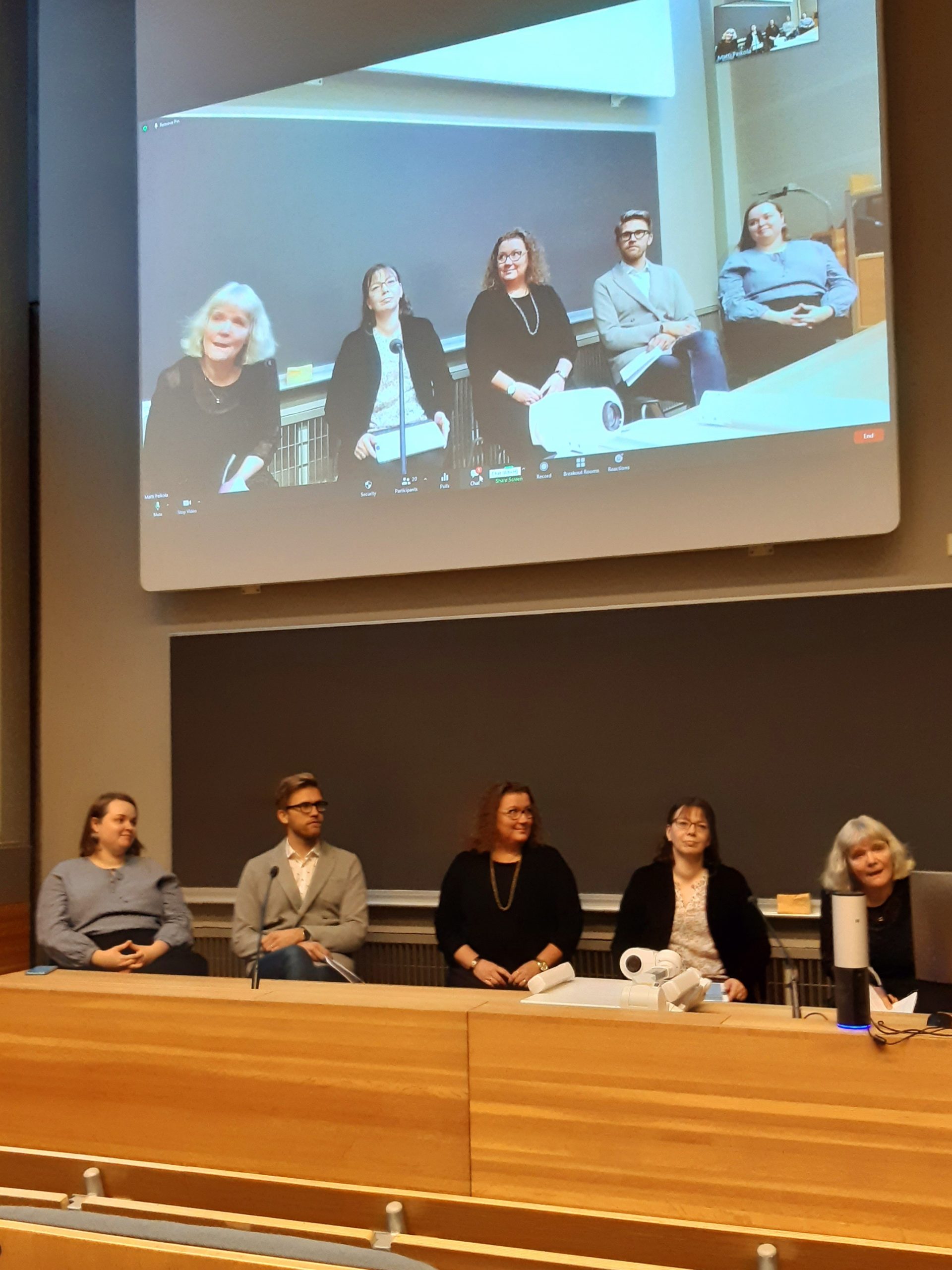
Risto’s presentation was followed by a panel discussion chaired by Professor Matti Peikola, representing our alumni and present students: Taru Savolainen, Miika Katajamäki, Maija S. Peltola, Sanna-Kaisa Tanskanen and Marianna Sunnari. All the panelists had started their studies in different decades, and have had different careers, and were thus a very good cross-section of the Department. The discussion was very lively and higlighted various sides of the Department’s history and the people who had worked and studied there.

The alumni panel offered various views on studying English at Turku. All positive!

One of the highlights of the event was the presence of Professor Emerita Liisa Dahl. Liisa followed Inna Koskenniemi in the first English Assistant Professorship after Inna toook over Yrjö’s Professorship. Another delightful highlight was the tea and coffee service that we had at the end – provided by the ever so wonderful students of Anglica.

At the event, we also witnessed the publication of MM Examina: Two Thousand Theses from the Department of English, University of Turku 1950–2020 edited by Joel Kuortti. This volume, fresh from the printers, follows the former M Examina (edited by Janne Skaffari in 1995) by listing a thousand more theses and dissertations from the Department that have been completed after the 50th anniversary in 1995.

Current head of department, Professor Joel Kuortti, showcasing the new MM Examina bibliography. Professor Outi Paloposki (right) taking a photo in turn!

All in all, the event brought light and joy to a dark winter day in a time otherwise burdened with long-standing and widespread troubles and uncertainties. It gives great pleasure to celebrate with such a great bunch of people – past, present, and future!

Text by Joel Kuortti, Professor, Head of Department

Photos by Janne Skaffari and Elina Valovirta

Eating elephants

Nearly 1.5 years into my doctoral studies, I have already encountered some sort of block. Things are just not progressing the way I would like, something is not working. I feel like I have read every possible piece of available research about my topic but starting the first article seems like a horrendous endeavor. What am I doing? Where do I start? What perspective should I take? Am I prepared enough? Do I have the concepts right? Maybe I should just make another cup of tea…

A couple of days before the event that was to take place on March 21,2019, I received an e-mail stating that there were places still available in the Finding joy and productivity in academic writing lecture and workshop. Guest lecturer Carol Kiriakos, co-author of Tohtoritakuu, was to speak about practical approaches to academic writing. My first thought was, “This is scary!” Can you imagine? This was exactly what I needed, and here it was in my mailbox, and none too soon as the event was in just two days! I was not really sure what the ‘practical approaches’ might entail, but the words ‘joy’ and ‘productivity’ were what really caught my eye. Could I really find joy in my situation of ‘rookie’s block’, and could I ever become productive in my revelry of procrastination?

Carol Kiriakos provided answers to both questions, “Yes and yes.” First, you have to take an inventory of your beliefs; what beliefs do you have about yourself or your writing that keep you from writing? Participants took a few minutes to write down their beliefs, and to my astonishment, we were all struggling with the same issues: getting started, time management, insecurities pertaining to abilities, being prepared, procrastination, lack of inspiration, etc., etc. At this point, the group of participants became a united whole – we were all in the same boat struggling in the same weather to keep it afloat.

Once you are aware of what is keeping you from writing, you need to create a writing habit. At what time of day do you feel the most creative or productive? A rule of thumb is the further the day progresses, the less creative and productive we become because other things begin competing for our attention. How much should you write at one go? Kiriakos warned us not to set ourselves up for failure. If you plan to write 5 pages on a certain day and do not achieve that goal, most likely you are going to feel like you have failed and starting the writing process again may take an unnecessary number of days or weeks.

The third thing, and perhaps the most important, you should do is learn how to eat an elephant. Well? How DO you eat an elephant? According to Kiriakos, the answer is: One bite at a time. For example, if you write in your calendar “PhD thesis” for every day you would have time to work on it (as I have done and now have a lot of erasing to do), you are setting yourself up for failure. Not only is it impossible to write a PhD thesis in a day, but you are also creating the feeling that you never get anything done. A more sensible approach would be to write, “1 page for Section 2.2.”, for example, or simply “one paragraph”. The same idea can be used for setting goals, i.e. break them down into smaller bites. For example: long-term goal (months to years) -> short-term goal (weeks to months) -> daily goal (hours to days).

To combat procrastination, i.e. always waiting for inspiration or the ‘right moment’ to write, Kiriakos suggested free-writing. During the lecture and workshop, we participants engaged in two free-writing sessions, both lasting about ten minutes. Free-writing was a surprisingly good way to get into the ‘habit’ of writing. We were given a topic each time: The Ideal Academic Writer and The Most Important Thing to Me. Both topics also gave us a bone to chew, which helped us to process the beliefs we have of ourselves. When doing free-writing on your own, you do not necessarily need a topic; on the other hand, having a topic may get you put your thoughts in order. You need to set a timer, so you do not have to look at the clock, and then just write about the ideas or topics you have for writing your thesis on that particular day. With free-writing, you can find that inspiration, and the moment you sit down to free-write is exactly the ‘right moment’ you keep waiting for.
I left the workshop feeling I had eaten my elephant, or at least cut it down into smaller, more manageable pieces. Feeling inspired by Kiriakos and getting the push I needed to start writing, I decided to share my experience here. I recommend reading Tohtoritakuu to BA students , MA students, even to the experts whose doctoral hat is worn around the edges and whose sword has defended truth and knowledge many times over. It contains useful strategies for anyone contending with an elephant…. One bite at a time.

Text by Judi Rose

Your thesis in three minutes

Thursday 9 March was an exciting day on campus, as it was the day for the final of the Three Minute Thesis (3MT) competition, which was organized for the first time at the University of Turku.The competition was developed by the University of Queensland and the first 3MT competition was held at UQ in 2008. The idea is that doctoral candidates introduce their research to the public as interestingly as possible in three minutes. I decided to participate because the event offers an excellent opportunity to practice presentation skills. It also helps to understand the essence of your own research when you need to explain it to others in three minutes.

The competition started with two semi-finals in early February. The first semi-final was organized for the doctoral candidates within Humanities, Education, Social Sciences, Law, and Economics, and the other for doctoral candidates within Science and Medicine. From both first rounds five top presentations were selected to the final and I was honored to learn that mine was one of them.

The 3MT final drew a large audience in the Tauno Nurmela hall. The atmosphere was full of excitement and it was very interesting to get to hear of other people’s PhD projects from different fields. There were also good prizes for the best ones. Moreover, the winner gets to participate in the Coimbra Group Competition with the video that was filmed during the final. Three best video recordings of the presentation will continue to compete in a live competition in Edinburgh in the beginning of June.

In addition to the diploma all finalists received at the event, we all gained useful experience in giving a presentation and summing up our research. All in all, the whole experience was very positive and I hope that the University of Turku organizes this event in the future too. I encourage all doctoral candidates to grab the opportunity!

Text: Johanna Rastas
Photos: Johanna Rastas & The University of Turku

ÅboutU seminar: Publishing

In September 2015, Matti Peikola from the University of Turku and Adam Borch from Åbo Akademi University held a seminar for doctoral candidates. In a workshop held after the presentations, the participants called for more contact between doctoral candidates of UTU and ÅAU, and so a committee was created for this purpose. The committee members, Sirkku Ruokkeinen (UTU), Ira Hansen (UTU), Eva Norrman (ÅAU) and Emma Kanckos (ÅAU) named the group ÅboutU – a most clever play on the words Åbo and UTU.

During the past year, ÅboutU has focused on organizing social events and providing opportunities for networking. In addition to the bi-monthly get-togethers at Koulu, ÅboutU organised a seminar for PhD candidates in late September 2016 with the theme ‘publishing’. The seminar had two keynote speakers, Dr. Jason Finch (ÅAU) and Dr. Pekka Lintunen (UTU), who spoke on the processes of writing an article from one’s conference paper, and on acting as a referee, respectively. The PhD candidates then held five-minute presentations on their work of late.

Dr. Finch’s presentation was titled “From Conference Paper to Published Article: Preparing Submissions to Journals and Edited Collections”. Dr. Finch began by pointing out that for those who are planning a career in academia, there is a need to distinguish oneself by writing journal articles. Conference papers are a good starting point.

jason
Dr. Jason Finch (ÅAU)

The most important part of a conference paper as well as an article is a new idea that somehow contributes to your field. However, working that idea into a conference paper or into an article are two different processes. When planning a conference paper that will be turned into an article, you might want to write the full length article first, and then present a shorter version of it at a conference. You can also write the conference paper first, and expand the paper based on the feedback received at the conference. In any case you should have a clear vision of the journal you wish to publish in and edit your text accordingly.

pekka
Dr. Pekka Lintunen (UTU)

Dr. Lintunen’s presentation was titled “The Peer Review Process from the Perspective of the Reviewer”, and it described the do’s and the don’ts of acting as a reviewer. The review process begins with contact: usually the editorial board contacts you through email, sending the title and the abstract of the article. It is a good idea to accept, should your schedule allow it. There is no need to worry about qualifications – if you have been contacted, Lintunen reassured us, you are probably qualified.

The instructions for the reviewers can sometimes be found on the journal’s website. If not, you can email and ask for them. You might also want to check the journal’s instructions for authors. In a review process you should pay attention to the goals of the paper, its theoretical framework, references, and argumentation. You should consider whether the paper is suitable for the journal it has been submitted to. If so, think whether the argument is clearly presented, valid and reliable. Are the results well evaluated and defended? Are the results based on the data? Remember to stick to your own field and expertise when you are giving your feedback.

After the keynotes, thirteen PhD candidates gave five-minute presentations on their ongoing work, for example recent publications or difficulties they had run into during the process. The presentations were followed by discussion. Issues dealing with article publishing were naturally a recurrent theme; Marja-Leena Niitemaa discussed reviewer’s comments she had already received, while Eva Norrman and Aino Liira spoke of the process of co-writing and the content of their articles. Sara Norja and Susanna Mäkinen discussed their articles in preparation; both were writing an article based on a conference paper. Jay Rauhoff, Emma Kanckos and Ira Hansen focused on more specific sections of their dissertations, while Sirkku Ruokkeinen and Cathryn McWilliams used the opportunity to ask for advice concerning their work. Timo Savela, Eva Fjällstöm and Johanna Rastas, who were there for the ÅboutU seminar for the first time, presented the topics of their dissertation work.

aboutu
ÅboutU is looking for new committee members.

The September Seminar was also the venue for selecting a new committee for ÅboutU. Jay Rauhoff, a UTU PhD candidate, has already volunteered. The current committee is searching for two new members from the Åbo Akademi University, and one additional member from University of Turku English Departments. If you’d like to take part in bringing our two departments together, please contact Jay at gajara[at]utu.fi.

The 2016 ÅboutU committee would like to thank the keynote speakers and PhD students from ÅAU and UTU!

Text and photos by Ira Hansen, Emma Kanckos, Eva Norrman and Sirkku Ruokkeinen