Visiting Poland and gaining international experience


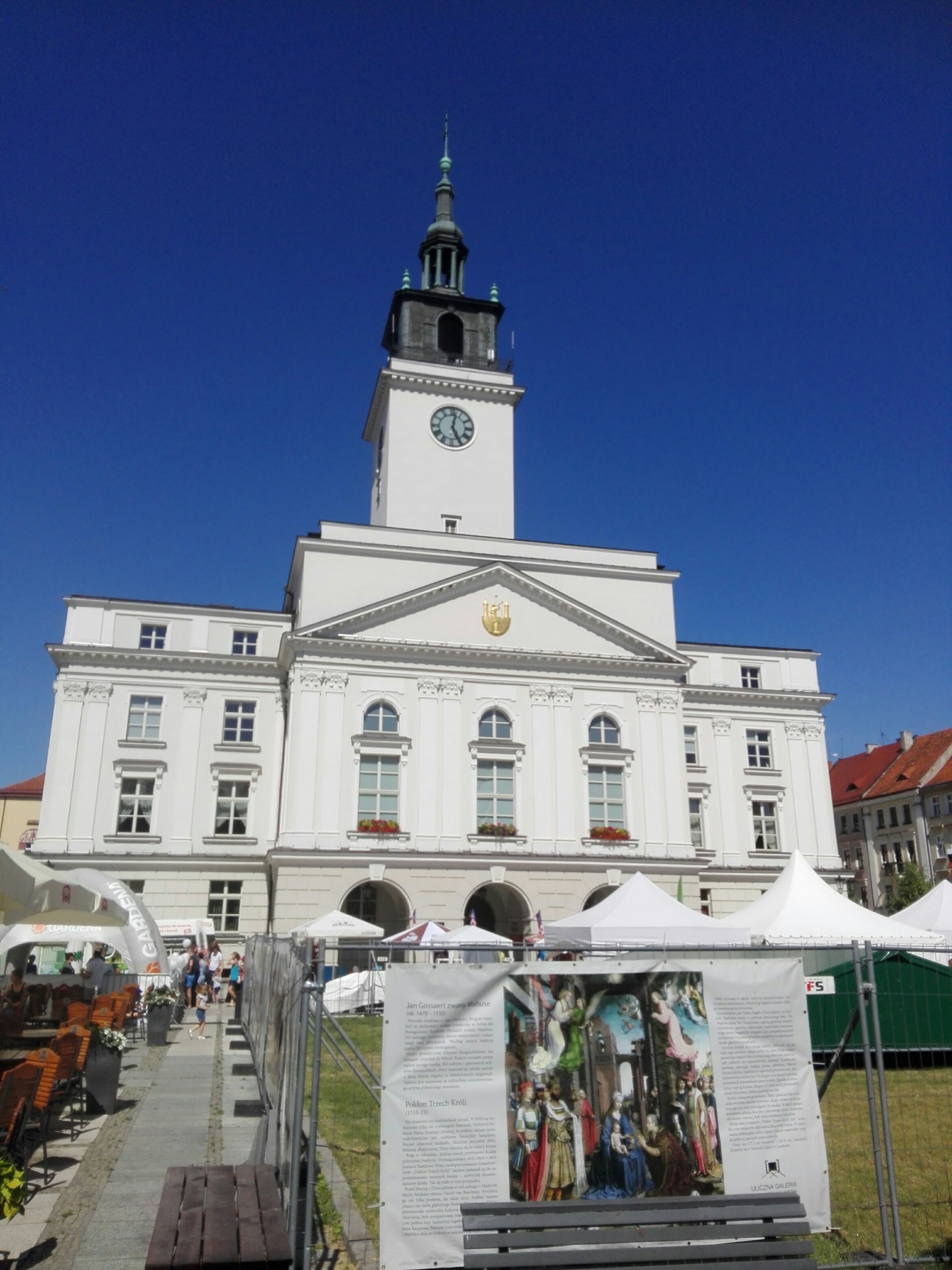
This spring has been very memorable, as I have had the pleasure of being a Visiting Professor in Kalisz, Poland. A visiting professor can refer to various kinds of things in the academic world. In this case, I was invited to the Faculty of Pedagogy and Fine Arts of the Adam Mickiewicz University in Poznań. This Faculty is located in Kalisz and educates, among others, students of English and pedagogy whose career goal is to become a teacher of English.

The fascinating thing about Kalisz is that it is considered the oldest city in Poland. Coming from the oldest city in Finland, this gave me a nice opening to all my meetings with the students. Due to my work responsibilities in Turku, I was not able to stay in Kalisz for longer periods at once. Instead, my teaching was intense: 6-8 hours of teaching while I was there. I led a workshop on Teaching and Learning Spoken English for third year students and a Workshop on Effective Learning for three first year groups of students. In addition, I met many members of staff for informal discussions on the Finnish education system and our shared research interests. I was lucky to visit Kalisz, as second language acquisition is a prominent research field at their Faculty.
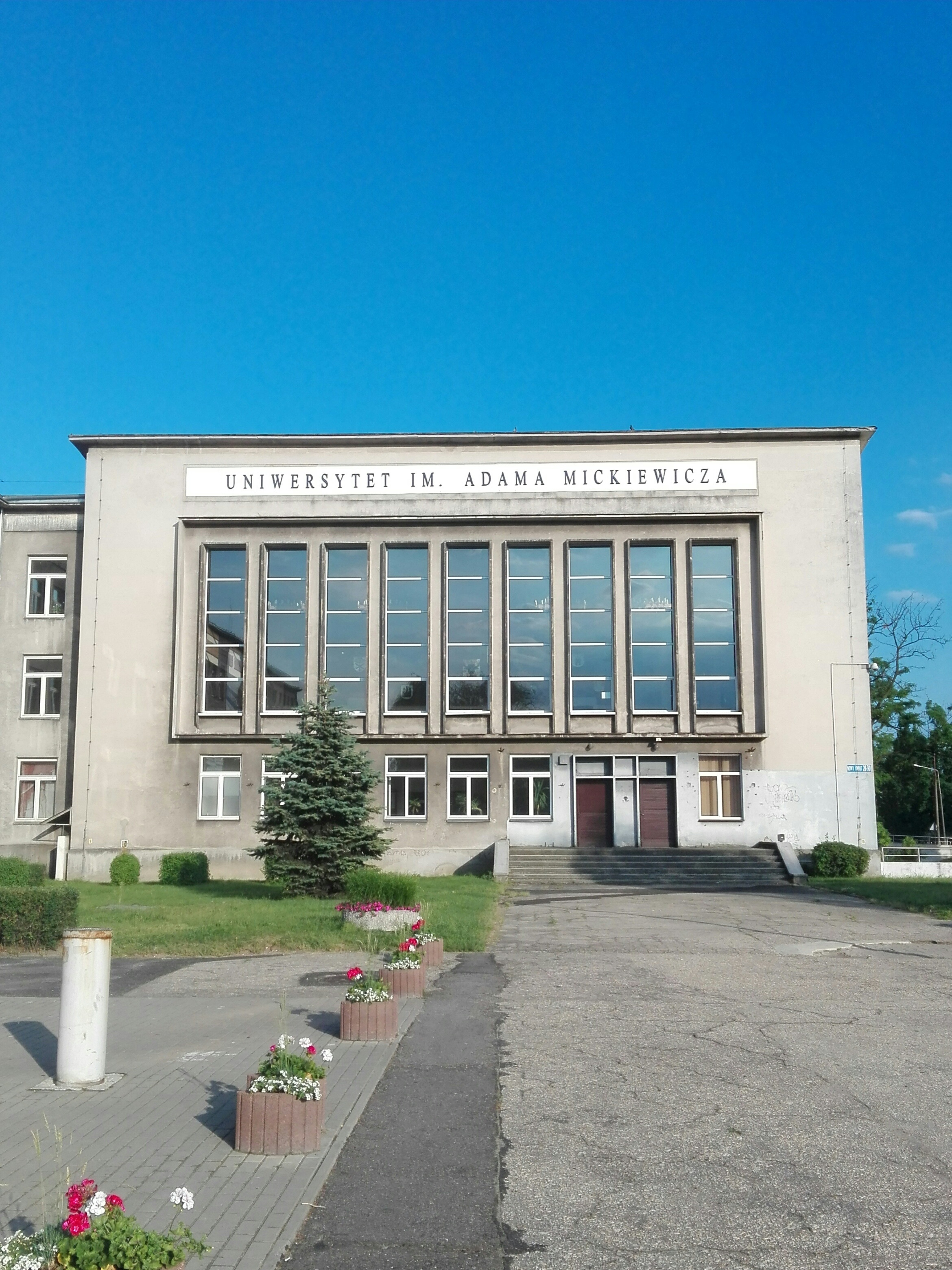
My visit was part of their University of the Future programme that is funded by the EU. As part of this project, they invite international scholars to educate their students. Compared to Finnish students, the Polish students I met were mostly one step more shy and one step more insecure about their English skills, but fortunately I am familiar with both of these emotions. Much of my time was spent on convincing that making mistakes in a foreign language is ok and I thought that their English was very good. One first year student said that I was the first foreign person he had ever used English with (as they do not have native speakers as teachers). The students were very concerned with their grammar and pronunciation skills. Poznań is famous for their intense pronunciation teaching, as they spend two years on pronunciation skills. It was interesting that the materials they use are mostly the same as we have used at our university.

Towards the end, the students started to feel more relaxed with me. During our final meeting, when students presented their own projects, they even tested my pronunciation skills. I had to pronounce, for instance, trzy, wszystkiego, źdźbło and Szczebrzeszyn – and I did! I also got to discuss Kimi Räikkönen’s career, Finnish heavy metal music scene, and the lyrics to “Ievan polkka” (one student had learnt to sing it in Finnish earlier but did not understand what it meant). The most difficult question in my final exam was “Describe why you are a good learner of English”. Local teachers told me that traditionally Polish people like to focus more on what they do not know – another thing that I understand well coming from the Finnish setting. I look back on my time in Poland with fond memories.

Text and photos by Pekka Lintunen
Philological fieldwork in London and Turku

If you trust Wikipedia, fieldwork refers to “the collection of information outside a laboratory, library or workplace setting”. However, philological ‘fieldwork’ often takes place within a library – but instead of reading secondary literature, we examine primary materials. I’m currently a visiting scholar at Queen Mary University of London. During my stay here, I work on 16th-century manuscripts and printed books in the British Library.

Although early materials are increasingly accessible in digital form, and many early texts are made available in editions, not all research questions can be asked of these substitutes. Codicological, palaeographical, and bibliographical research methods entail close examination of books and texts as material objects. Analysing the physical construction of a book or the scribal hands present in a manuscript, for example, may also provide crucial evidence for studying the contents of a book.

To access special collections, one usually needs to register as a reader (instructions can be found on library websites). After registering, you can then order items to study them in reading rooms. You can bring your laptop, notes, and pencils, but nothing that might damage the books such as pens or sharp implements. White gloves, although sometimes seen on TV, may also cause damage to the books. They are thus generally not used in professional libraries. Clean, dry, and careful hands are the better option!

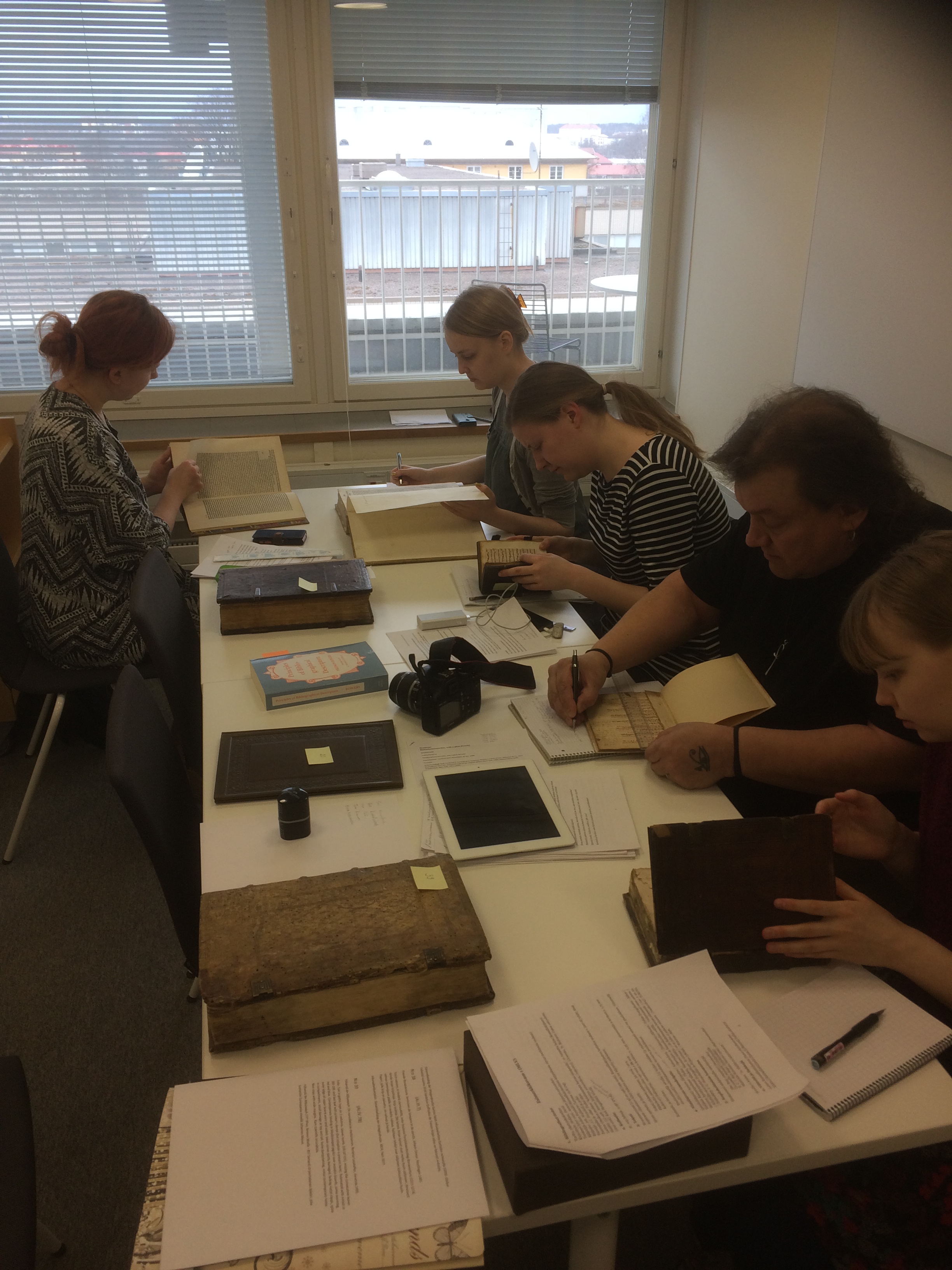
The University of Turku library also holds early materials. Last spring, students taking the Book History course organised by the Departments of English and European and World History had the chance to try their hand at being book detectives. My small group studied a selection of incunabula (books printed before 1501), practising the specialised skill of writing bibliographical descriptions of early books. Here they are at work!

Text and photo by Mari-Liisa Varila

Beyond the ivory tower: Co-operation with a local upper secondary school

When I was in upper secondary school (‘lukio’ in Finnish), two of my teachers organized a “Rome Club” (‘Rooma-kerho’), which could be taken as an optional course. In order to receive credit for the course, we needed to take part in a variety of activities, one of which was attending guest lectures by researchers and PhD students. I always found the lectures fascinating, and I thought that it would be great if, at some point in my life, I could do something like that myself.

In the autumn of 2014 the thought became a reality when I began my lecture series titled “The heirs of Rome” at my old school, Turun klassillinen lukio, where the Rome Club was still going strong. To be sure, the initial idea was to offer a single lecture to the club, but partly due to the nature of my chosen topic and partly due to the enthusiasm of the pupils it became clear that a series of lectures was in order.

The idea behind the series was to show how Roman (and, more generally, classical) culture had been kept alive following the collapse of the Roman Empire. This topic is especially relevant for my ongoing PhD research since I am interested in the status of Latin and Greek in 17th century England. Accordingly, the main focus of the lecture series was on Britain. The titles of the individual lectures were:

1. “The Classical languages in Britain”
2. “The status of the Classical languages in 17th century Britain”
3. “Classical education in the early modern period”

The second lecture was given in conjunction with the school’s 135th anniversary celebration in November. The fourth and final lecture, which will take place at the beginning of May, elaborates on the theme of education with examples drawn from my dissertation material.

I have found the lecture series a refreshing experience, and it seems that the pupils have enjoyed it as well. Although my dissertation focusses on theoretical matters, it has been surprisingly easy to come up with suitable topics for the lectures. One easily forgets that what seems self-evident to oneself may be completely new information to almost everyone else. I have also found it an excellent exercise to try and explain my own research in as simple terms as possible, because this makes it a prerequisite that I actually understand what I am talking about.

Rooma-kerho 3
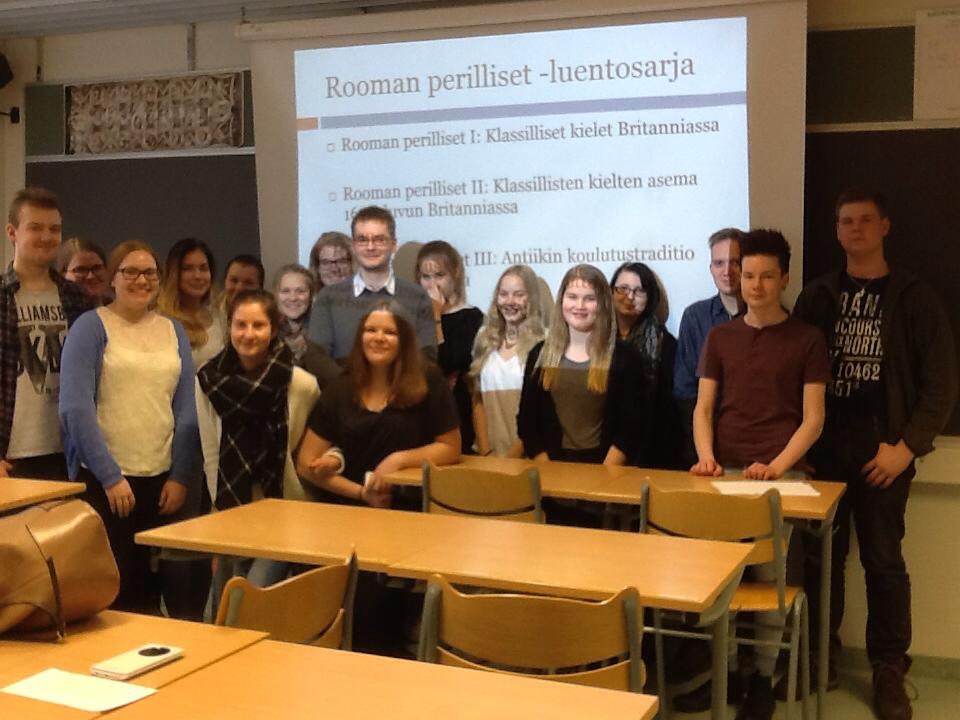
The Rome Club with their visiting teacher, Aleksi.

Text: Aleksi Mäkilähde
Photo: Reija Pentti-Tuomisto