Eating elephants

Nearly 1.5 years into my doctoral studies, I have already encountered some sort of block. Things are just not progressing the way I would like, something is not working. I feel like I have read every possible piece of available research about my topic but starting the first article seems like a horrendous endeavor. What am I doing? Where do I start? What perspective should I take? Am I prepared enough? Do I have the concepts right? Maybe I should just make another cup of tea…

A couple of days before the event that was to take place on March 21,2019, I received an e-mail stating that there were places still available in the Finding joy and productivity in academic writing lecture and workshop. Guest lecturer Carol Kiriakos, co-author of Tohtoritakuu, was to speak about practical approaches to academic writing. My first thought was, “This is scary!” Can you imagine? This was exactly what I needed, and here it was in my mailbox, and none too soon as the event was in just two days! I was not really sure what the ‘practical approaches’ might entail, but the words ‘joy’ and ‘productivity’ were what really caught my eye. Could I really find joy in my situation of ‘rookie’s block’, and could I ever become productive in my revelry of procrastination?

Carol Kiriakos provided answers to both questions, “Yes and yes.” First, you have to take an inventory of your beliefs; what beliefs do you have about yourself or your writing that keep you from writing? Participants took a few minutes to write down their beliefs, and to my astonishment, we were all struggling with the same issues: getting started, time management, insecurities pertaining to abilities, being prepared, procrastination, lack of inspiration, etc., etc. At this point, the group of participants became a united whole – we were all in the same boat struggling in the same weather to keep it afloat.

Once you are aware of what is keeping you from writing, you need to create a writing habit. At what time of day do you feel the most creative or productive? A rule of thumb is the further the day progresses, the less creative and productive we become because other things begin competing for our attention. How much should you write at one go? Kiriakos warned us not to set ourselves up for failure. If you plan to write 5 pages on a certain day and do not achieve that goal, most likely you are going to feel like you have failed and starting the writing process again may take an unnecessary number of days or weeks.
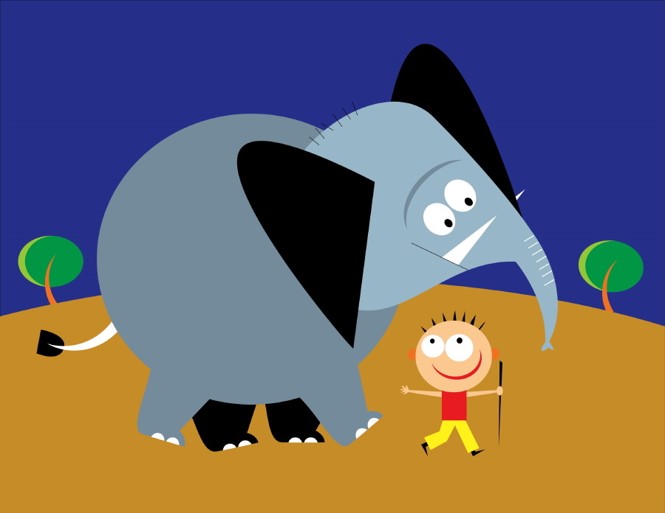
The third thing, and perhaps the most important, you should do is learn how to eat an elephant. Well? How DO you eat an elephant? According to Kiriakos, the answer is: One bite at a time. For example, if you write in your calendar “PhD thesis” for every day you would have time to work on it (as I have done and now have a lot of erasing to do), you are setting yourself up for failure. Not only is it impossible to write a PhD thesis in a day, but you are also creating the feeling that you never get anything done. A more sensible approach would be to write, “1 page for Section 2.2.”, for example, or simply “one paragraph”. The same idea can be used for setting goals, i.e. break them down into smaller bites. For example: long-term goal (months to years) -> short-term goal (weeks to months) -> daily goal (hours to days).

To combat procrastination, i.e. always waiting for inspiration or the ‘right moment’ to write, Kiriakos suggested free-writing. During the lecture and workshop, we participants engaged in two free-writing sessions, both lasting about ten minutes. Free-writing was a surprisingly good way to get into the ‘habit’ of writing. We were given a topic each time: The Ideal Academic Writer and The Most Important Thing to Me. Both topics also gave us a bone to chew, which helped us to process the beliefs we have of ourselves. When doing free-writing on your own, you do not necessarily need a topic; on the other hand, having a topic may get you put your thoughts in order. You need to set a timer, so you do not have to look at the clock, and then just write about the ideas or topics you have for writing your thesis on that particular day. With free-writing, you can find that inspiration, and the moment you sit down to free-write is exactly the ‘right moment’ you keep waiting for.
I left the workshop feeling I had eaten my elephant, or at least cut it down into smaller, more manageable pieces. Feeling inspired by Kiriakos and getting the push I needed to start writing, I decided to share my experience here. I recommend reading Tohtoritakuu to BA students , MA students, even to the experts whose doctoral hat is worn around the edges and whose sword has defended truth and knowledge many times over. It contains useful strategies for anyone contending with an elephant…. One bite at a time.

Text by Judi Rose

Ceremonial Conferment of Doctoral Degrees, 25-26 May 2017

Academic festivities are there for a reason: they help us remember that we are part of a long scholarly tradition which is our cultural and intellectual heritage. That is where we belong. Not to mention the fact that they are extremely fun and enjoyable! 136 young doctors and 12 honorary doctors participated in a two-day conferment ceremony at the University of Turku towards the end of May. Our department was involved in two important ways: Professor Kenneth Hyltenstam from the University of Stockholm, a prominent scholar who has published widely on bilingualism and SLA and who has had a strong impact on research conducted in our department, had been invited to receive the title of honorary doctor on our initiative, and our very own Mari-Liisa Varila was among the young doctors on whom the doctoral degree was conferred in the ceremony (see Mari-Liisa’s own words below).


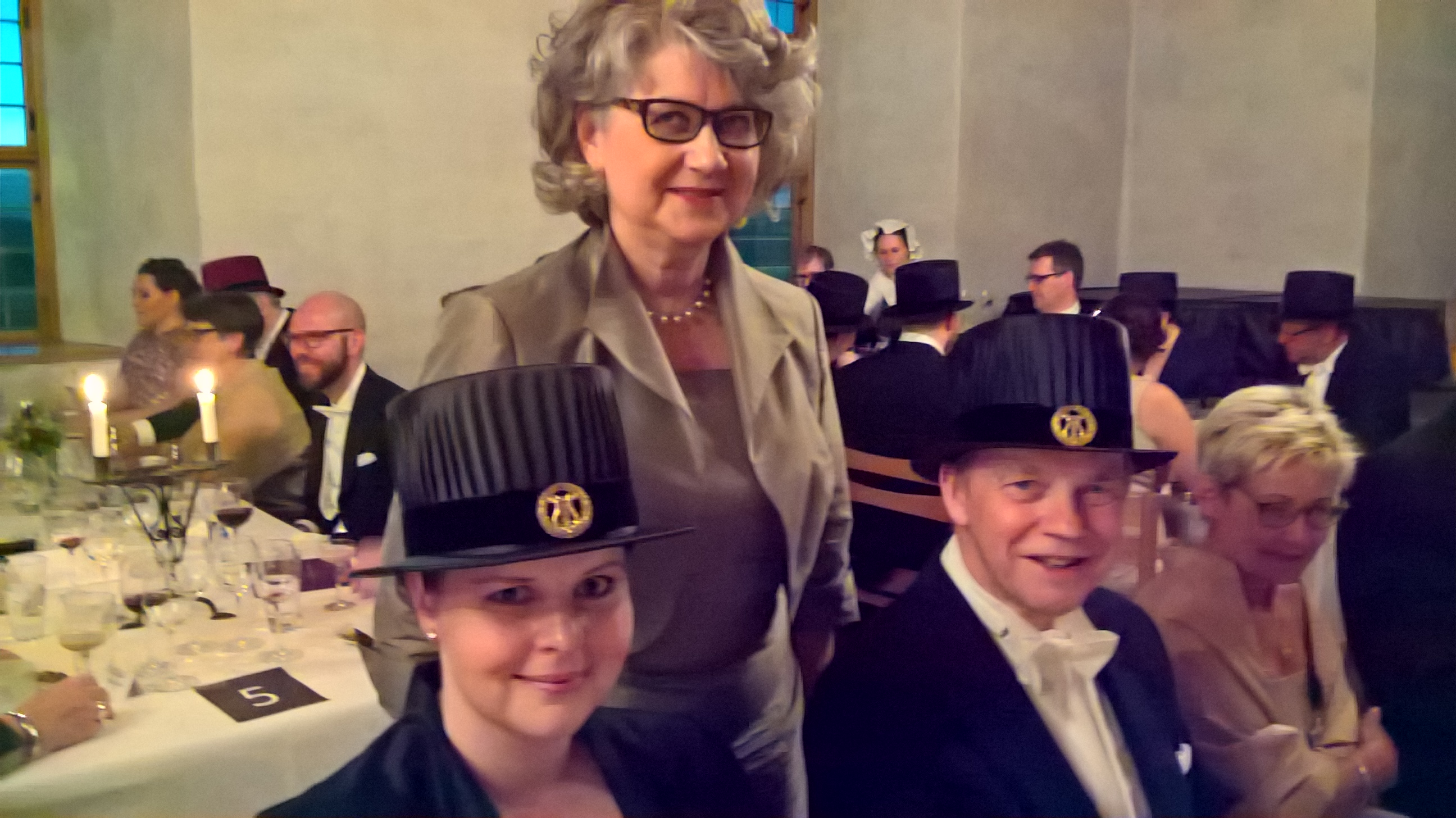
Mari-Liisa Varila, Päivi Pietilä and Kenneth Hyltenstam celebrating at Turku Castle.

It must have felt like two rather hectic days for our esteemed honorary doctors. All practical arrangements had been planned carefully beforehand by the organizing committee, including a fitting session on the morning of the first day, to make sure the white tie was the right size (the dress code is notably very strict on these occasions!), and transportation from the hotel to the various events and back again. The events consisted of a rehearsal at the Concert Hall, a sword-sharpening ceremony on the eve of the big day, the conferment ceremony itself, an academic procession from the Concert Hall to the Cathedral, a service at the Cathedral, a banquet at Turku Castle in the evening, and finally a ball at the Turku VPK House. In earlier years, the festivities went on even longer, as there was a boat trip to Naantali and lunch at Kaivohuone. Maybe it is not such a bad thing that the programme has been cut slightly; it is rather exhausting to be festive for two entire days, let alone three! But on the other hand, the two days were thoroughly enjoyable, and even the weather was better than anyone could have wished for: sunshine and a bright blue sky.

Text by Päivi Pietilä

The doctor in the hat

My doctoral degree was awarded already in June 2016, but the ceremonial conferment of doctoral degrees is only organised once every two or three years. To officially receive my hat, sword, and doctoral diploma, I participated in the festivities this year. It is not obligatory to take part in the ceremonial conferment, but I felt that it was a good way to stop for a moment and celebrate my achievement together with the other young doctors, the honorary doctors, and our academic community.


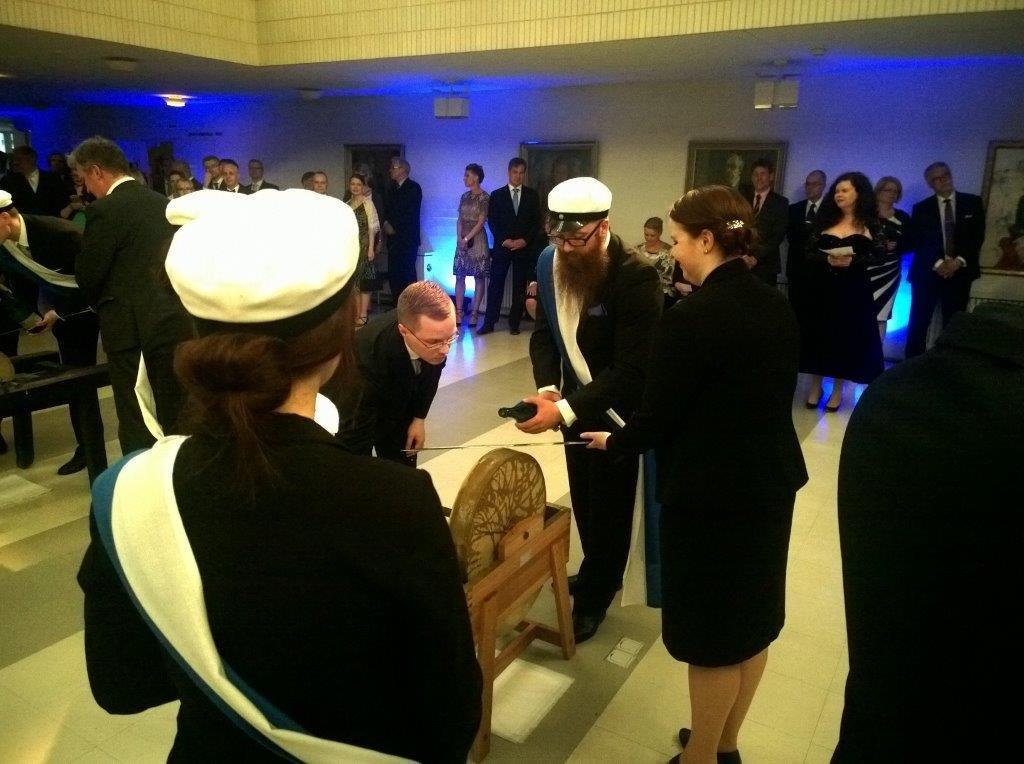
In the rehearsal on Thursday afternoon, we practised solemnly walking in pairs, receiving the sword, and bowing to the conferrer without dropping our hats. Excitement filled the air. In the sword-sharpening ceremony on Thursday evening, we symbolically honed our blades for the big day. Our avecs turned the grindstones while the heralds poured some bubbly on the swords.


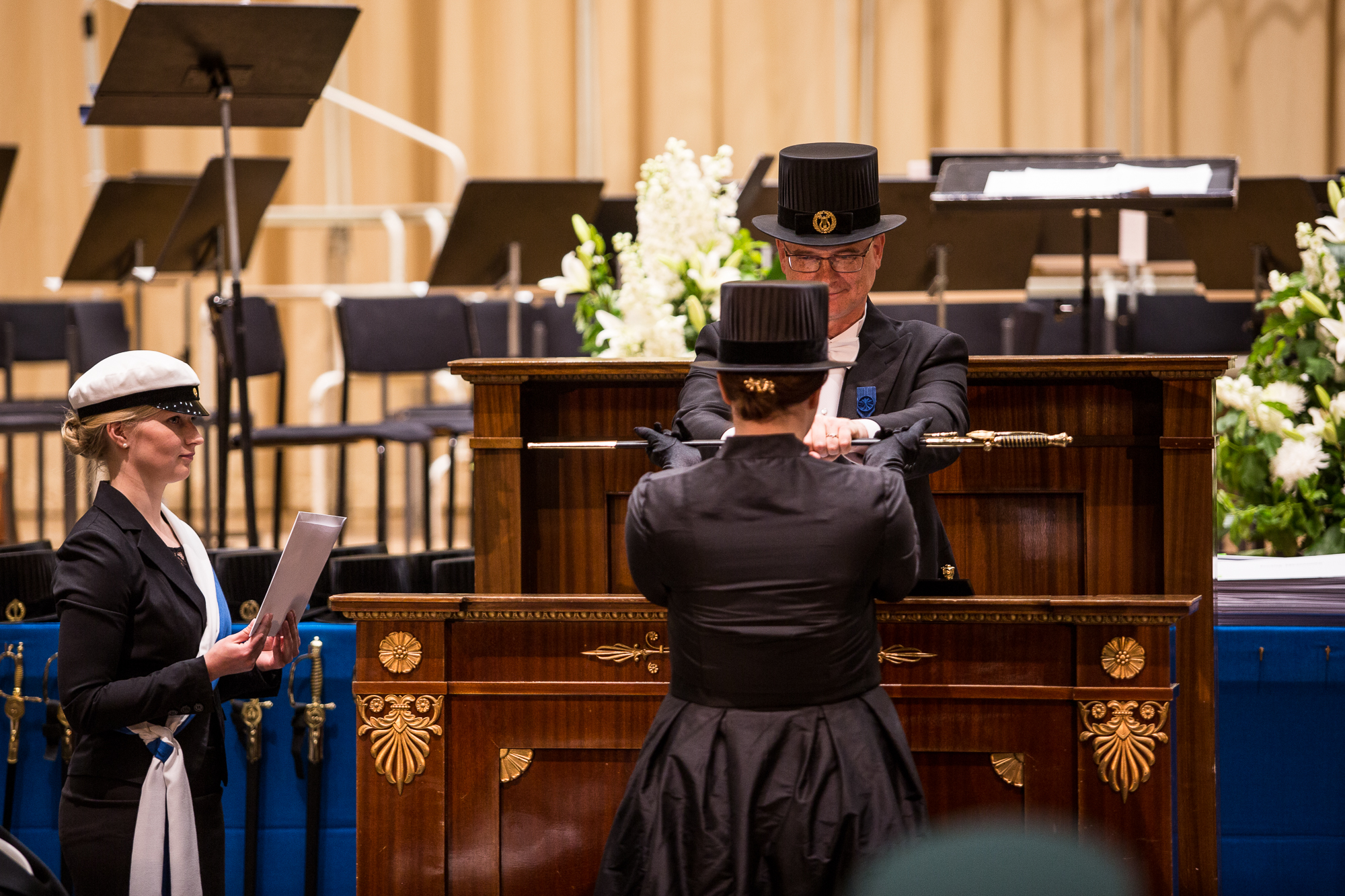
Mari-Liisa Varila receiving her sword.

On Friday noon we gathered to the Concert Hall, all in tailcoats or long black dresses. At quarter past twelve, the procession entered the hall. We sat down in the front of the room, waiting for our turn to receive the hat and sword. Each conferrer stepped up to the podium in their turn, delivering their trilingual speech – Finnish, English, and Latin. They pressed the hats on our heads and presented us with our swords and (Latin) diplomas. After the ceremony, our procession moved from the Concert Hall to the Cathedral where a bilingual service was held. Our day was made even more special by the beautiful singing of the Turku University Choir.

In the evening, we gathered to the Turku Castle. We were served a three-course dinner, interspersed with speeches and some more singing. I was honoured to have been asked to deliver the speech to the honorary doctors. We then moved to the VPK house for a polonaise and a waltz, with music provided by Sohon Torwet. Our evening ended, very appropriately, in a speech to the sun.

Text by Mari-Liisa Varila
Photos by Miikka Varila and Markku Hakala

Your thesis in three minutes

Thursday 9 March was an exciting day on campus, as it was the day for the final of the Three Minute Thesis (3MT) competition, which was organized for the first time at the University of Turku.The competition was developed by the University of Queensland and the first 3MT competition was held at UQ in 2008. The idea is that doctoral candidates introduce their research to the public as interestingly as possible in three minutes. I decided to participate because the event offers an excellent opportunity to practice presentation skills. It also helps to understand the essence of your own research when you need to explain it to others in three minutes.

The competition started with two semi-finals in early February. The first semi-final was organized for the doctoral candidates within Humanities, Education, Social Sciences, Law, and Economics, and the other for doctoral candidates within Science and Medicine. From both first rounds five top presentations were selected to the final and I was honored to learn that mine was one of them.

The 3MT final drew a large audience in the Tauno Nurmela hall. The atmosphere was full of excitement and it was very interesting to get to hear of other people’s PhD projects from different fields. There were also good prizes for the best ones. Moreover, the winner gets to participate in the Coimbra Group Competition with the video that was filmed during the final. Three best video recordings of the presentation will continue to compete in a live competition in Edinburgh in the beginning of June.

In addition to the diploma all finalists received at the event, we all gained useful experience in giving a presentation and summing up our research. All in all, the whole experience was very positive and I hope that the University of Turku organizes this event in the future too. I encourage all doctoral candidates to grab the opportunity!

Text: Johanna Rastas
Photos: Johanna Rastas & The University of Turku

ÅboutU seminar: Publishing

In September 2015, Matti Peikola from the University of Turku and Adam Borch from Åbo Akademi University held a seminar for doctoral candidates. In a workshop held after the presentations, the participants called for more contact between doctoral candidates of UTU and ÅAU, and so a committee was created for this purpose. The committee members, Sirkku Ruokkeinen (UTU), Ira Hansen (UTU), Eva Norrman (ÅAU) and Emma Kanckos (ÅAU) named the group ÅboutU – a most clever play on the words Åbo and UTU.

During the past year, ÅboutU has focused on organizing social events and providing opportunities for networking. In addition to the bi-monthly get-togethers at Koulu, ÅboutU organised a seminar for PhD candidates in late September 2016 with the theme ‘publishing’. The seminar had two keynote speakers, Dr. Jason Finch (ÅAU) and Dr. Pekka Lintunen (UTU), who spoke on the processes of writing an article from one’s conference paper, and on acting as a referee, respectively. The PhD candidates then held five-minute presentations on their work of late.

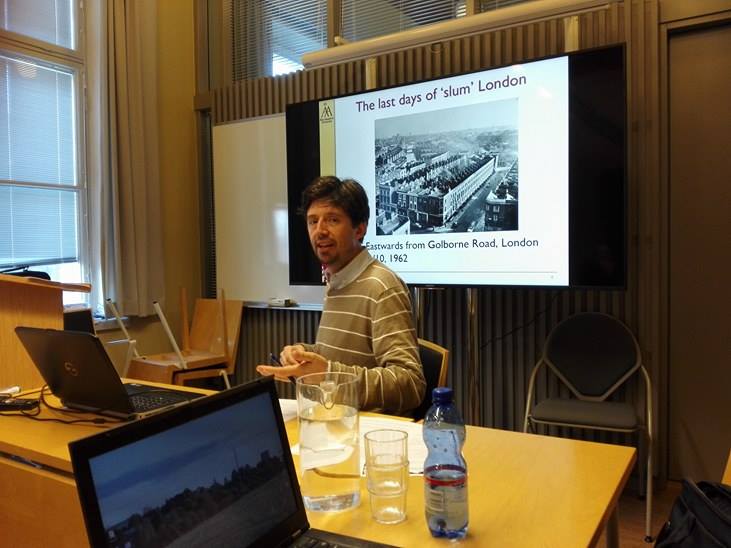
Dr. Finch’s presentation was titled “From Conference Paper to Published Article: Preparing Submissions to Journals and Edited Collections”. Dr. Finch began by pointing out that for those who are planning a career in academia, there is a need to distinguish oneself by writing journal articles. Conference papers are a good starting point.

jason
Dr. Jason Finch (ÅAU)

The most important part of a conference paper as well as an article is a new idea that somehow contributes to your field. However, working that idea into a conference paper or into an article are two different processes. When planning a conference paper that will be turned into an article, you might want to write the full length article first, and then present a shorter version of it at a conference. You can also write the conference paper first, and expand the paper based on the feedback received at the conference. In any case you should have a clear vision of the journal you wish to publish in and edit your text accordingly.

pekka
Dr. Pekka Lintunen (UTU)

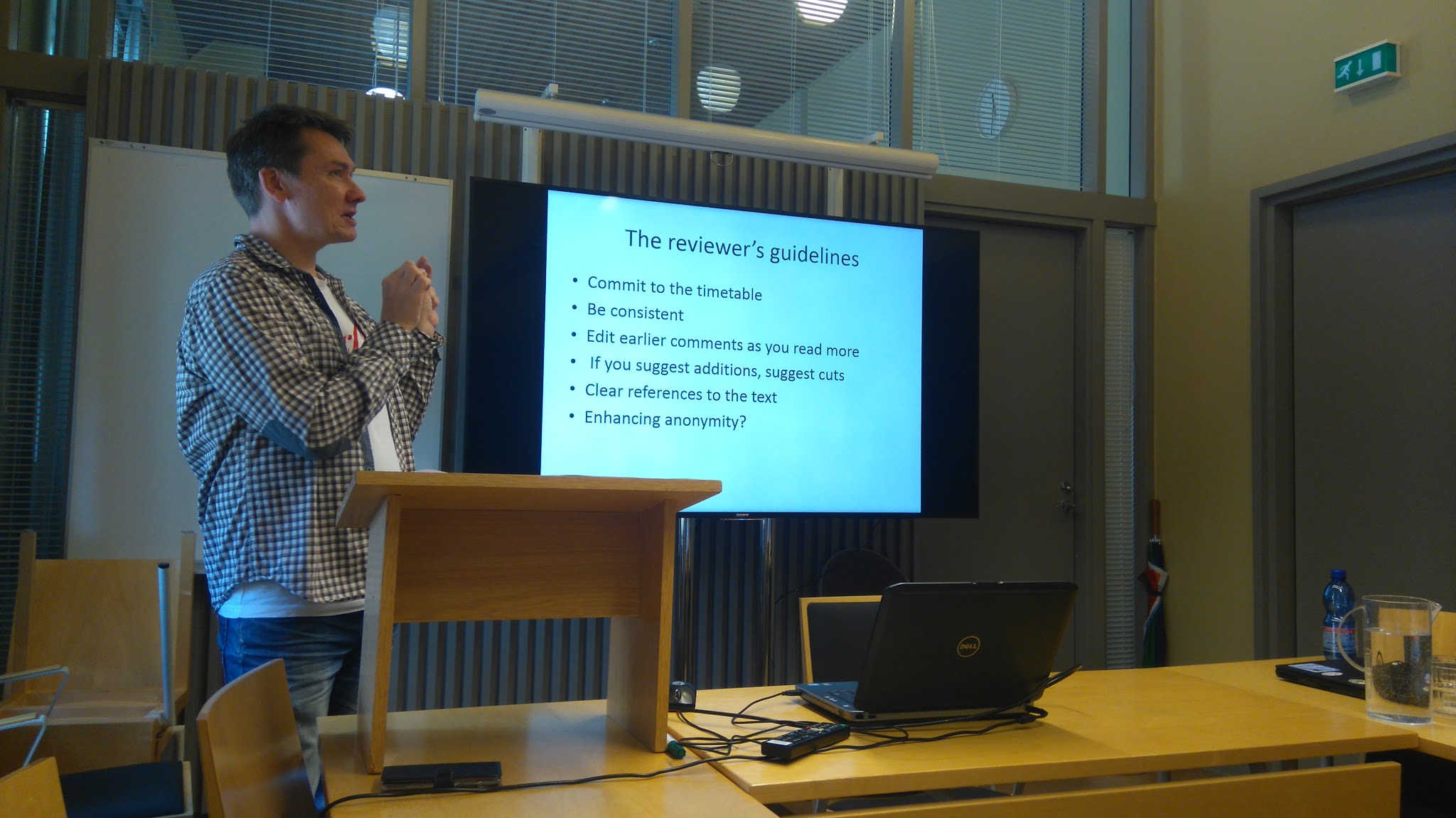
Dr. Lintunen’s presentation was titled “The Peer Review Process from the Perspective of the Reviewer”, and it described the do’s and the don’ts of acting as a reviewer. The review process begins with contact: usually the editorial board contacts you through email, sending the title and the abstract of the article. It is a good idea to accept, should your schedule allow it. There is no need to worry about qualifications – if you have been contacted, Lintunen reassured us, you are probably qualified.

The instructions for the reviewers can sometimes be found on the journal’s website. If not, you can email and ask for them. You might also want to check the journal’s instructions for authors. In a review process you should pay attention to the goals of the paper, its theoretical framework, references, and argumentation. You should consider whether the paper is suitable for the journal it has been submitted to. If so, think whether the argument is clearly presented, valid and reliable. Are the results well evaluated and defended? Are the results based on the data? Remember to stick to your own field and expertise when you are giving your feedback.

After the keynotes, thirteen PhD candidates gave five-minute presentations on their ongoing work, for example recent publications or difficulties they had run into during the process. The presentations were followed by discussion. Issues dealing with article publishing were naturally a recurrent theme; Marja-Leena Niitemaa discussed reviewer’s comments she had already received, while Eva Norrman and Aino Liira spoke of the process of co-writing and the content of their articles. Sara Norja and Susanna Mäkinen discussed their articles in preparation; both were writing an article based on a conference paper. Jay Rauhoff, Emma Kanckos and Ira Hansen focused on more specific sections of their dissertations, while Sirkku Ruokkeinen and Cathryn McWilliams used the opportunity to ask for advice concerning their work. Timo Savela, Eva Fjällstöm and Johanna Rastas, who were there for the ÅboutU seminar for the first time, presented the topics of their dissertation work.

aboutu
ÅboutU is looking for new committee members.

The September Seminar was also the venue for selecting a new committee for ÅboutU. Jay Rauhoff, a UTU PhD candidate, has already volunteered. The current committee is searching for two new members from the Åbo Akademi University, and one additional member from University of Turku English Departments. If you’d like to take part in bringing our two departments together, please contact Jay at gajara[at]utu.fi.

The 2016 ÅboutU committee would like to thank the keynote speakers and PhD students from ÅAU and UTU!

Text and photos by Ira Hansen, Emma Kanckos, Eva Norrman and Sirkku Ruokkeinen