Hamlet in Turku

The Department paid a visit to see Hamlet in the Turku City Theatre in March 2019. The production has garnered good reviews both by critics and audiences, and it was great to have an opportunity to see it, especially as the season is, alas, short.

SPOILER ALERT – what happens in Hamlet

If you like to keep up suspense, do not read further as I am about to give some spoilers. First of all, Hamlet’s father’s death turns out to have been murder by poison rather than an accidental snakebite. There are also other deaths: Ophelia, Polonius, and – in the end – practically everybody dies. (Not Horatio, though.)

This is good for the undertaker’s business – in the show presented in a very provoking, even thought-provoking way.

One of the most striking elements in the Turku Hamlet is the set. It combines traditional and contemporary elements in a very inventive way. In the programme booklet, the scenographer Markus Tsokkinen comments on the Finnish terms for building the set – ‘lavastaa’ and ‘kulissit’ – as derogatory terms for deception whereas he considers the set a way to enhance the truth elements of a play. Considering this, the amalgamation of old and new functions very well in bringing Shakespeare’s vision to us today.

Hamlet is one of the Bard’s big tragedies. In Finland it has been produced almost once in a decade after the first production in 1906, and it has been translated several times: by Paavo Cajander (1879), Yrjö Jylhä (1955), Lauri Sipari (1975), Eeva-Liisa Manner (1981), Veijo Meri (1982) and Matti Rossi (2013). The Turku Hamlet is based on Manner’s translation but with noticeable changes in the dialogue.

For a tragedy, Paavo Westerberg has direected a highly humorous – but in no way banal – version of Hamlet’s story. (Although Yorick might disagree.) It is multimedial, multilingual, intertextual, intermedial, intercultural – in short, multi-inter!

One of the most surprising things, personally, was Claudius. Eero Aho’s acting here was excellent, but Carl-Kristian Rundman as Polonius (very much like Gollum), Pia Andersson as Ophelia (rebel girl) and, especially, Jussi Nikkilä as Hamlet were even better. (Esko Salminen’s ghostly presence as Hamlet’s father’s ghost is also brilliant.)

To conclude, you would love to see the way they have done “To be or not to be” …

Text by Joel Kuortti
Photo by Otto-Ville Väätäinen/Turku City Theatre
Shakespeare 400 revisited

The Shakespeare 400 course was organised jointly by the University of Turku and Åbo Akademi University in autumn 2016.

After the first lecture on the history of English and the early printing history of Shakespeare’s works, the students delved deeper into other topics in Shakespeare studies. Aino Mäkikalli discussed Shakespeare’s sonnets, situating them in their historical and ideological context. Anthony Johnson highlighted the influence of early modern school curricula on Shakespeare’s plays.

The Finnish translations of Shakespeare’s plays and sonnets were introduced by Outi Paloposki. For example, in an early translation of the Scottish play, one of the characters is called Pirjo. Intrigued? Read the play here.

Tom Linkinen and Hannu Salmi approached Shakespeare from the point of view of cultural history. Linkinen discussed the ways in which genders and sexualities are performed in Shakespeare’s plays. Salmi, in turn, started from a mnemohistorical point of view, showing the audience examples of how Shakespeare has been interpreted on the silver screen. The last lecture by Joel Kuortti focused on the postcolonial rewritings of The Tempest.

The students also engaged in small group work. One of the tasks was to translate into Finnish Benedick’s troubled rant from Much Ado About Nothing (V.ii.35-41). It works quite nicely in the Turku dialect, too!

    En sunka mää ny mittä riimei ossa. Kyl mää niimpal yriti, mut ei mul mittä muut tullu miäle ku ”flikoi” ja ”sikoi”. Kuka ny simmossi puhu! Eikä koulun kans men mikkä muu, ku joulu. Mittä järke… Ei munt kyl ol tarkotettu mittä runoi värkkämä, eikä nättei puhuma muutenka!
    (Translation: Tuula Viitanen)

Text by Mari-Liisa Varila

Shakespeare 400 in Turku

This year marks the 400th anniversary of the death of William Shakespeare. Universities and other institutions around the world have been organising special events and courses throughout the year. One of these special courses is Shakespeare 400, a joint effort of the University of Turku and Åbo Akademi University.

The course runs from late October to mid-December. It comprises seven lectures by eight lecturers from four different departments: the Department of English at ÅAU, the Department of English at UTU, the Department of Cultural History (UTU), and the Department of Comparative Literature (UTU). There are altogether fifty students taking the course.

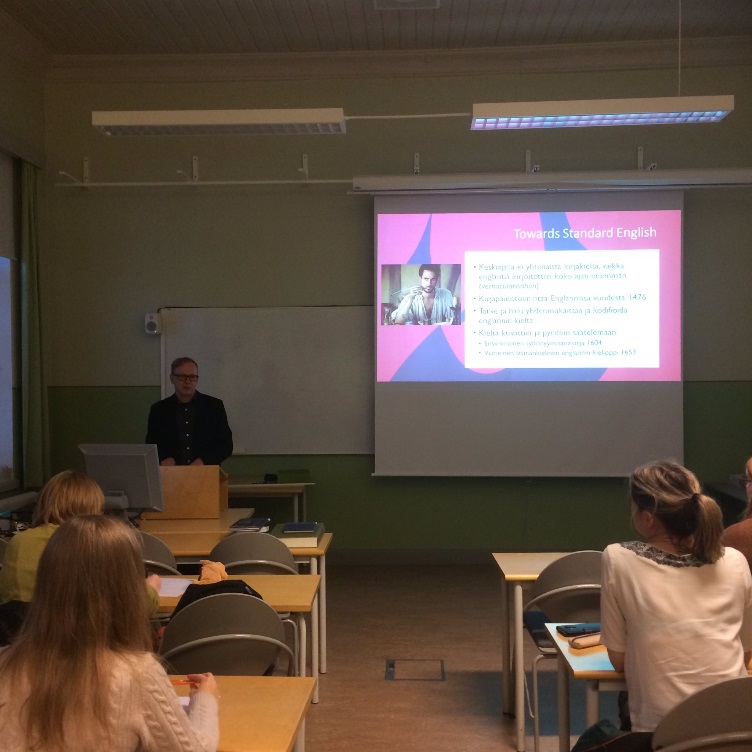
The lecture series started on 27 October with a joint lecture by Dr Janne Skaffari and Prof. Matti Peikola from our own department. Janne Skaffari offered a fascinating glimpse to Early Modern English and Shakespeare’s language. He finished the lecture by reciting a sonnet in what is known as ‘Original Pronunciation’, a reconstructed version of what ‘Shakespeare’s English’ might have sounded like. If that piqued your interest, have a look at Ben Crystal’s Hamlet here!
shakespeare400

Matti Peikola then moved on to discuss the early editions of Shakespeare plays. Although the First Folio is the most well-known edition of Shakespeare, defining the canon for years to come, it was only published after Shakespeare’s death by his colleagues. However, Shakespeare’s plays were already published individually during his lifetime, in a smaller and much cheaper quarto format. The first quarto edition of Hamlet was much shorter than the First Folio version! You can read more about the quartos here.

Both Skaffari and Peikola reminded the audience that although Shakespeare has often been treated as a canonical author figure, many of his plays actually show evidence of collaborative authorship. Read more about recent findings here.

Text and photo by Mari-Liisa Varila

Shakespeare 400 in Turku

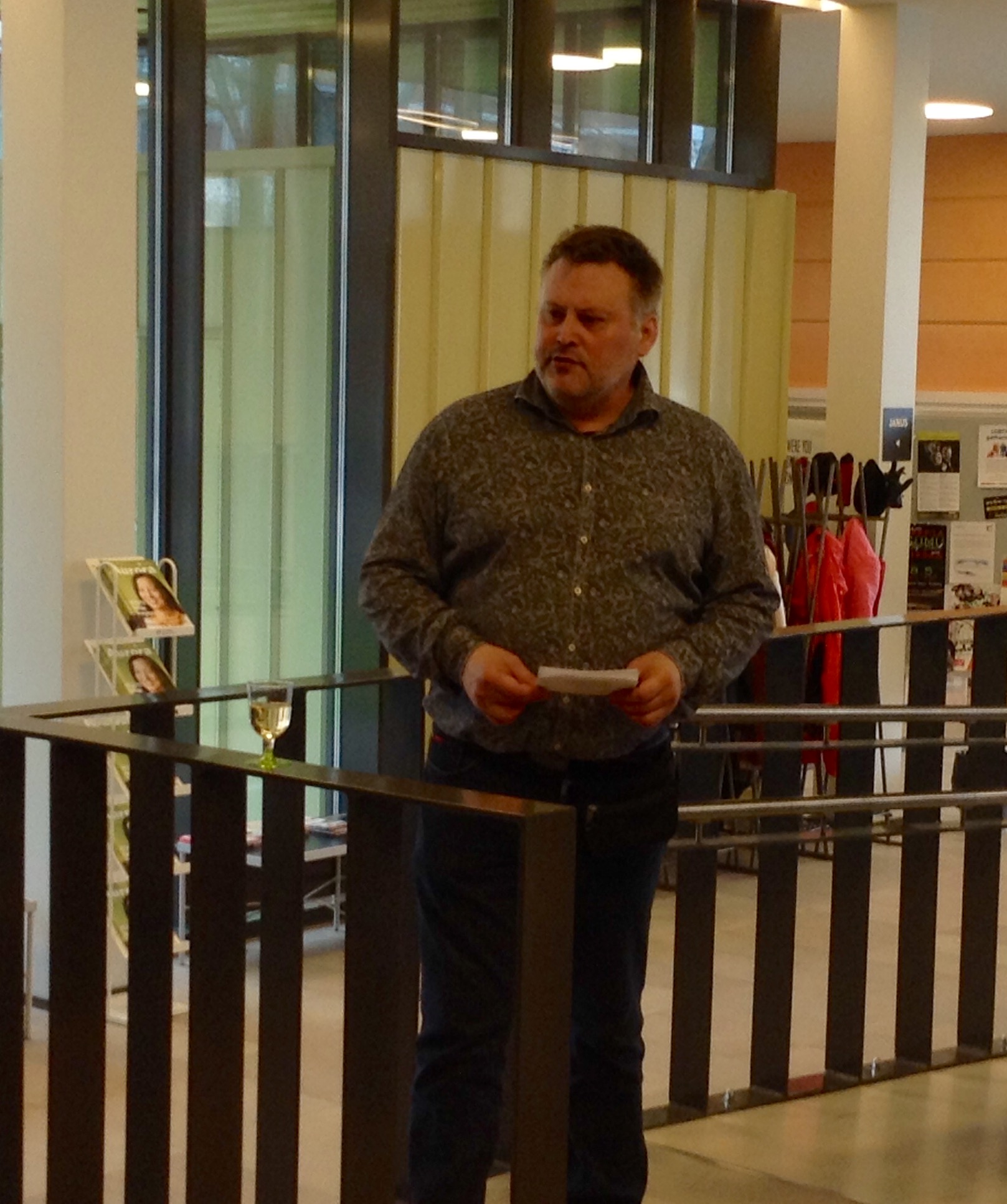
Last week, our department – along with the rest of the world – celebrated Shakespeare as Saturday April 23rd marked the 400th anniversary of the Bard of Avon’s death. Why death, you ask? Well, because we do not know his exact day of birth, and in order to celebrate, we need a date! So, a date with Shakespeare it was on Friday, when the department celebrated with toasts and a jubilee lecture. The merriment began with a toast and a speech by Professor Joel Kuortti, who chronicled some ways in which Shakespeare has figured in his life, culminating in the words of Macbeth: “I drink to the general joy o’ the whole table”.

joelshakespeare

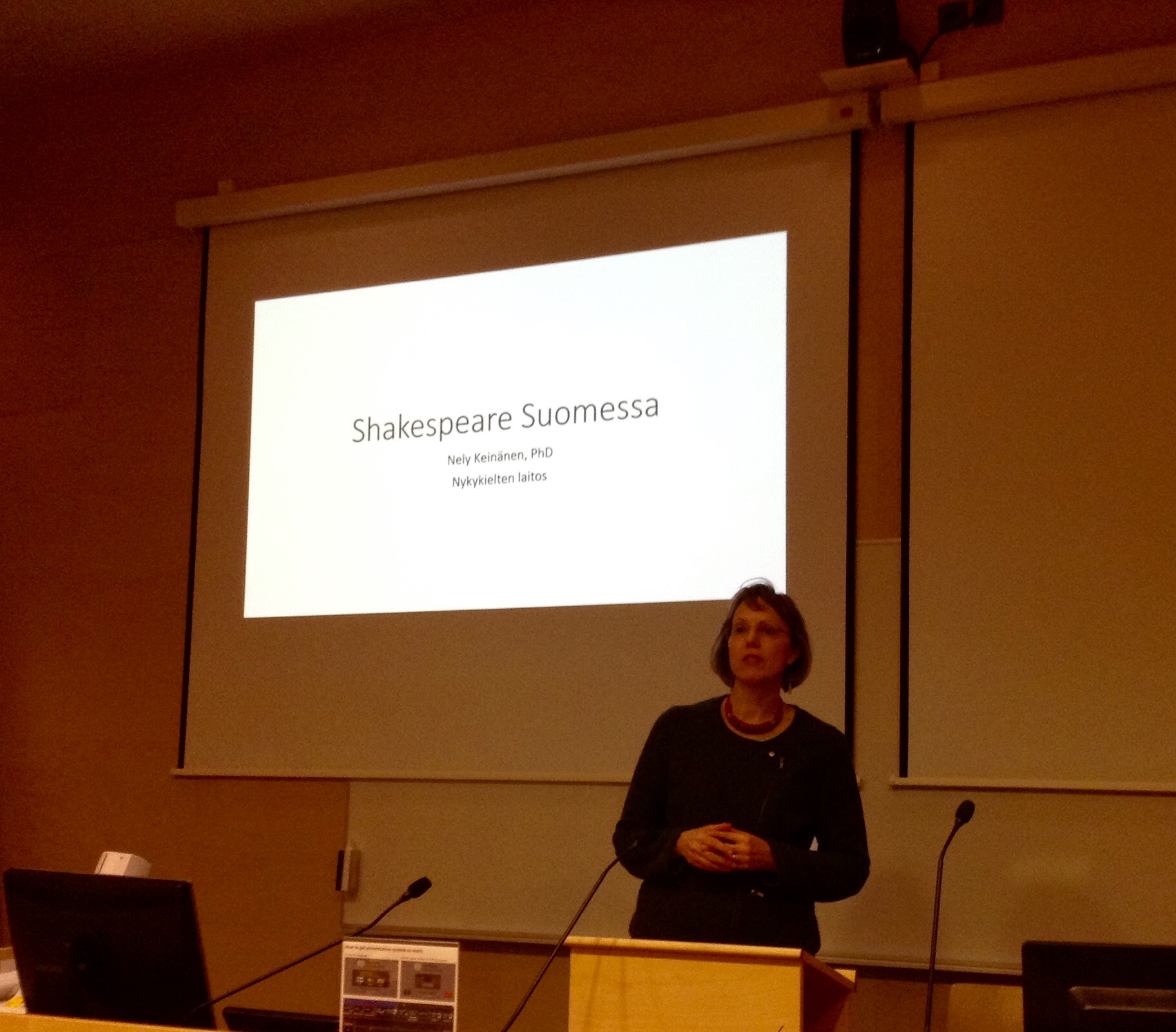
Followed by the toasts, the guest speaker, Helsinki University’s Senior Lecturer, Nely Keinänen gave a fascinating lecture on how Shakespeare’s plays were translated into Finnish and performed in Finland from the 19th century to the present day. We learned about the rich tradition of performing Shakespeare in Finland which interestingly coincided with and helped develop Finnish as a literary language. Translating Shakespeare into Finnish was seen as a great national victory for Finns, who now saw their own language take its place as a proper European language of culture. Shakespeare translations were and are yet another way for us Finns to prove ourselves that we are “most worthy friends” of English, French, and the rest.

nely
Shakespeare, then, was crucial to making Finnish a language of sophistication, culture, and the arts, and our little gathering helped celebrate that fact among others. For a celebration of death, it was a very jolly occasion indeed, marking 400 years of the Bard’s “charmed life”.

Text and photos by Elina Valovirta
Quotes from Macbeth

p.s. Stay tuned for more information on the Faculty of Humanities’ joint Shakespeare 400 lecture course in Q2 next academic year. For more info on Shakespeare festivities in England, go to www.shakespeare400.org.

Shakespeare’s Othello: Still Contemporary after 400 Years

The story is a familiar one: a father cannot approve of his daughter’s elopement with a powerful and ambitious military leader, who, despite his respectability and his service to the powers that be, remains a social outcast due to his race. One of this leader’s trusted advisors, who feels that he has been passed over for a promotion, slowly poisons his superior’s mind, finally managing to convince him that his wife has been unfaithful with another of his favored advisors. Despite the woman’s valiant efforts to defend herself and her reputation, the story ends in tragedy for all involved. Shakespeare’s Othello plays on the familiar themes of ambition, jealousy, and racial intolerance to create a tragedy that builds to its inevitable crescendo through Iago’s masterful and unfeeling manipulation and Othello’s unfortunate susceptibility to manipulation.

Othello was staged—or rather, screened—as part of the British National Theatre’s series of performances recorded live in London and presented in one-night-only screenings at cinemas throughout Europe. If you can’t make it to London, this may be the next best thing.

Director Nicholas Hytner’s adaptation of Othello does not so much “update” a classic by adding modern elements as it does reveal the lasting relevance of the play itself. Shakespeare’s original lines seem oddly appropriate to the production’s contemporary settings: the corporate boardroom, the modular buildings of a military base somewhere in the Middle East. Rory Kinnear’s Iago is chillingly self-satisfied while Adrian Lester’s Othello is frustratingly willing to be misled. Olivia Vinall is powerful as Desdemona, and Lyndsey Marshal’s Emilia lends great dramatic energy to the latter half of the play. The scene in which Lester’s Othello succeeds in strangling Vinall’s Desdemona is so stark and wrenchingly visceral that it is difficult to watch.

If anything, this production gets a bit carried away in furnishing contemporary details. (For instance, why is someone drinking something in nearly every scene—a cup of Starbucks coffee, as well as numerous plastic bottles of water, and several cans of Heineken? Such details almost become part of the play’s plot themselves.) All in all, though, this was a powerful production of Othello, and a rare opportunity to catch Shakespeare “live” in Turku.
Justin Parks

Click here for further info on National Theatre Live at Finnkino. Next shows: Macbeth Nov 18, Hamlet Dec 2.