Translating multilingual texts

Another PhD defence in just under two months! A number of doctoral candidates of the English Department are now finishing their research projects. On 24 January, it was Laura Ekberg’s big day.

Laura’s research topic combines translation studies and literature and focuses on a phenomenon also studied in linguistics. As it happens, code-switching was at the heart of the previous viva as well. The title of her dissertation is Heterolingualism and Cultural integrity in Finnish Translations of Anglophone Caribbean Novels; it is available online. The members of Laura’s team of supervisors were Outi Paloposki, Elina Valovirta and Joel Kuortti – who acted as custos – and the opponent was Professor Simona Bertacco from the University of Louisville. The viva started with the important question of which field of research the dissertation belongs to (answer: translation studies). Overall, we witnessed a remarkably friendly discussion by two experts, which really is the best kind of viva. The opponent found the material examined in the dissertation sufficient and representative and was very happy with what Laura had discovered and the poise with which she brought in multiple perspectives.

Professor Simona Bertacco giving her assessment of Laura’s dissertation.

I attended the viva as Laura’s colleague, a former teacher of hers, and a linguist with a keen interest in different approaches to code-switching and, more broadly, multilingual practices. Colleagues attending doctoral defences are always excited for the candidate, hoping their support radiates from the audience to the front of the room. Having known Laura since she was a BA student, I was happy about the confidence with which she brought together language, literature and translation – the three main topics of the Department – and about the fact that the varied training showed in the research. As a code-switching researcher myself, I was particularly interested in the recent campaign for not italicising code-switches in Caribbean literature, which goes against the common practice of separating the ‘other’ language from the main language of the text by using italics. Not italicising suggests that multilingual language use is not an aberration but something ordinary; there is no need to draw the readers’ attention to it.
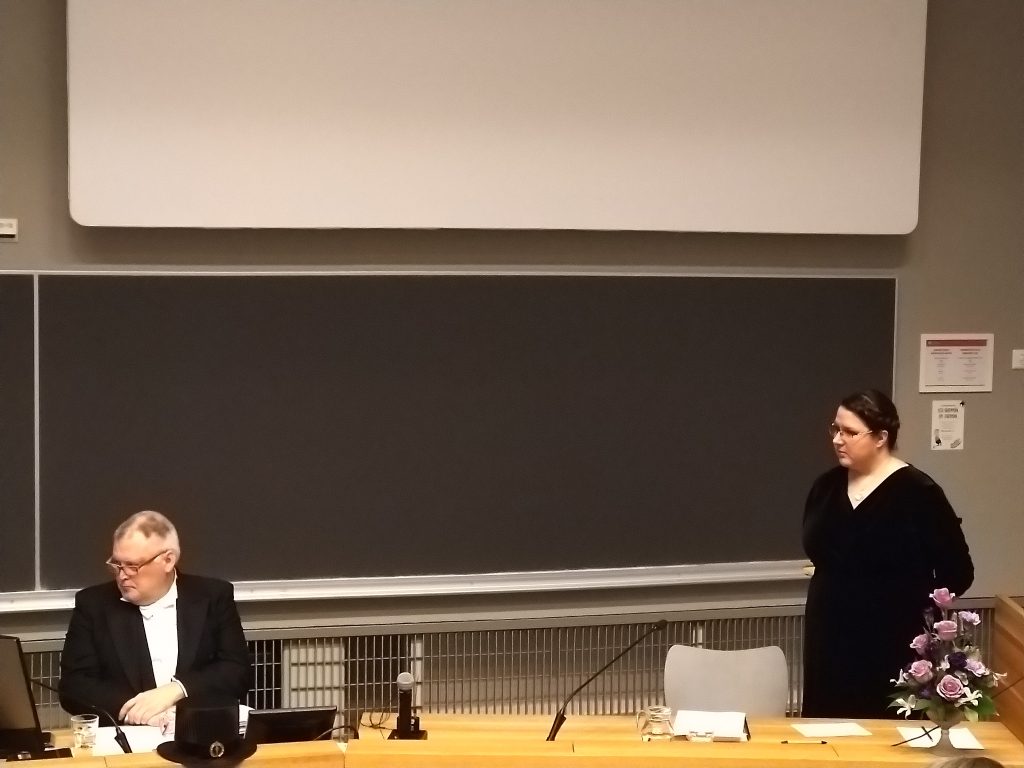
Custos and Doctor in spe listening to the Opponent’s addresss.

Laura said in the viva that she became interested in Caribbean literature in the MA thesis seminar. The things that catch your eye as a student may take you a long way.

A relieved smile at the karonkka-party.

Text by Janne Skaffari

Photos by Damon Tringham
Trextuality – at the intersection of textual scholarship and translation studies

The XII annual colloquium of Variantti, the Finnish network of researchers working on textual scholarship and scholarly editing, was held on Friday, 4 October 2019, at the University of Turku to foster interdisciplinarity between textual scholarship and translation studies.The theme trextuality encompassed textuality, transmission and translation, concepts central in both fields. In translation studies, trextuality means going beyond the source-target text pair and in textual scholarships, it refers to observing the transmission of texts across languages. Some fifty attendees heard eleven talks addressing trextual issues.

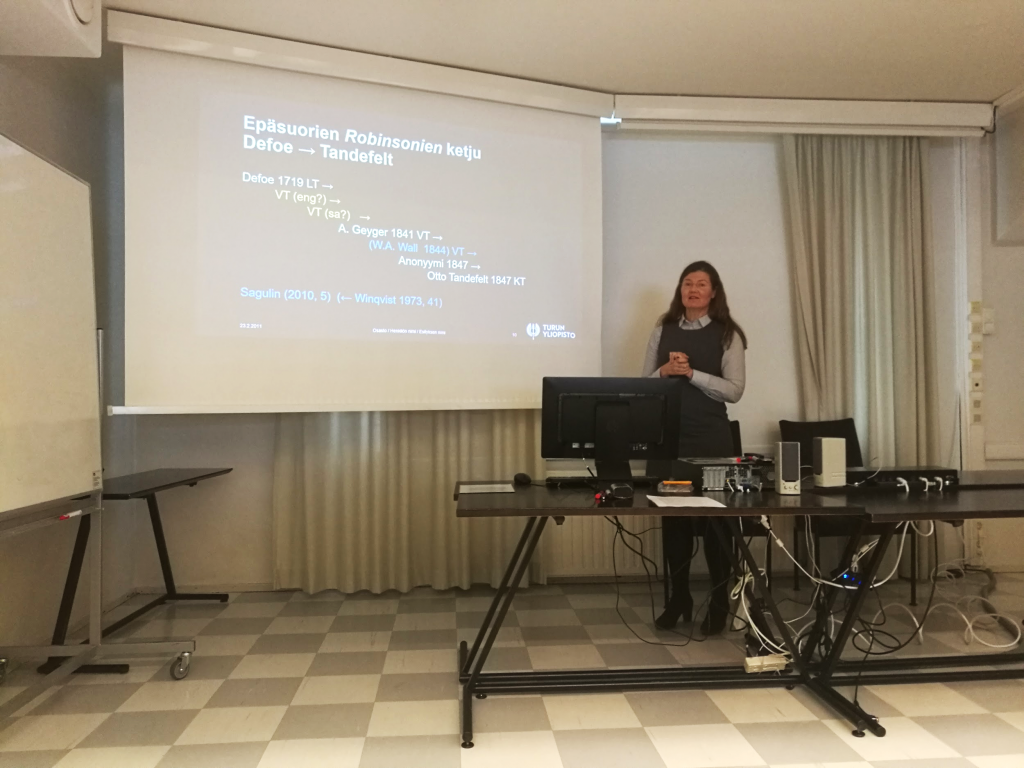
Tanja Toropainen discussed the continuum of editions and translations behind Codex Westh and its Ars Morendi part, which is a translation from German – except that the The Bible quotations are translations from Swedish. Sara Norja pointed out that like many of early English texts, also The Mirror of Alchemy is a translation – the source language of the various versions (Latin or French) can be deduced from how the alchemy-related terminology is translated. Niko Huttunen & Tuomas Juntunen explained that the forthcoming Finnish translation of The Bible for mobile platforms will have vocabulary different from what the audience is accustomed to because the language is made understandable for 20-year-olds.

Kristiina Taivalkoski-Shilov talked about the long,
multilingual transmission history of Robinson Crusoe.

Leena Eilittä discussed intertextuality in Herman Broch’s works; for example, Broch changed the title of his poem into Hille Mitternacht (A clear midnight) after having translated Walt Whitman’s A clear midnight into German. Marja Sorvari addressed the intertwinedness writing, writing in a second language, and self-translation through the example of two translingual authors, Zinaida Lindén and Polina Kopylova.

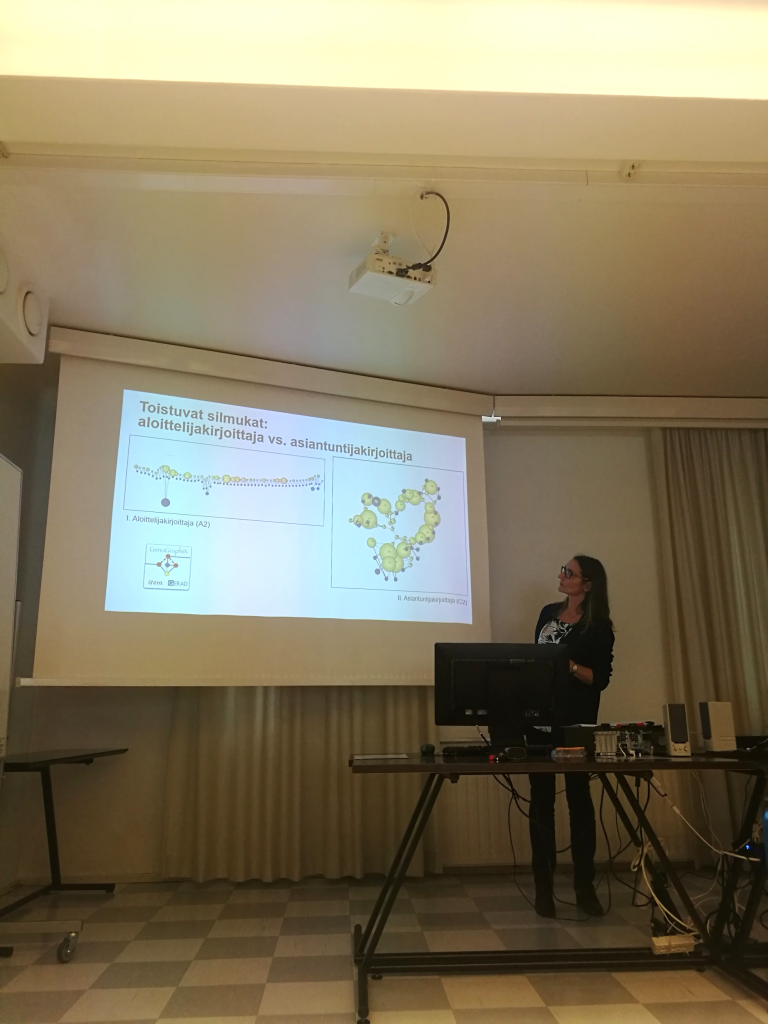
Instead of studying what changes in translation, Taivalkoski-Shilov showed how Friday’s way of talking remains unchanged in the Finnish Robinson Crusoe (re)translations even if translated indiretcly from English to German to Swedish to finally Finnish. Members of the Digilang project Christophe Leblay, Maarit Koponen, Maarit Mutta, Anna Salmela, Leena Salmi & Mikko Suhonen showed examples of text editing process visualizations using tools such as GenographiX: for example, A2-level writers proceed straightforwardly while C2-level producers make loops as they write and edit different parts of the text at different times.

Maarit Mutta showed how writing processes can be visualized.

Annamari Korhonen suggested that because something always changes when a text is translated, translating is creative even with pragmatic texts. Tuuli Ahonen demonstrated how a translator cannot translate the whole film if one of the modes – picture, dialogue, music, or sound effects – is missing because the subtitles are part of the polysemiotic whole that the modes together make.

Minna Seppänen & Outi Paloposki discussed how in the early 19th-century Ancient Greek literature was translated into Finnish more to show off one’s language skills than to produce beautiful Finnish translations. The day concluded with the perspective of a professional translator: Jaakko Kankaanpää shared his observations on the differences, such as replacing racist vocaublary with politically correct terminology, between various Finnish (re)translations of Agatha Christie’s novels, including his own ones.

Text and photos: Laura Ivaska

Introducing our latest permanent staff member: Q&A with Maarit Koponen


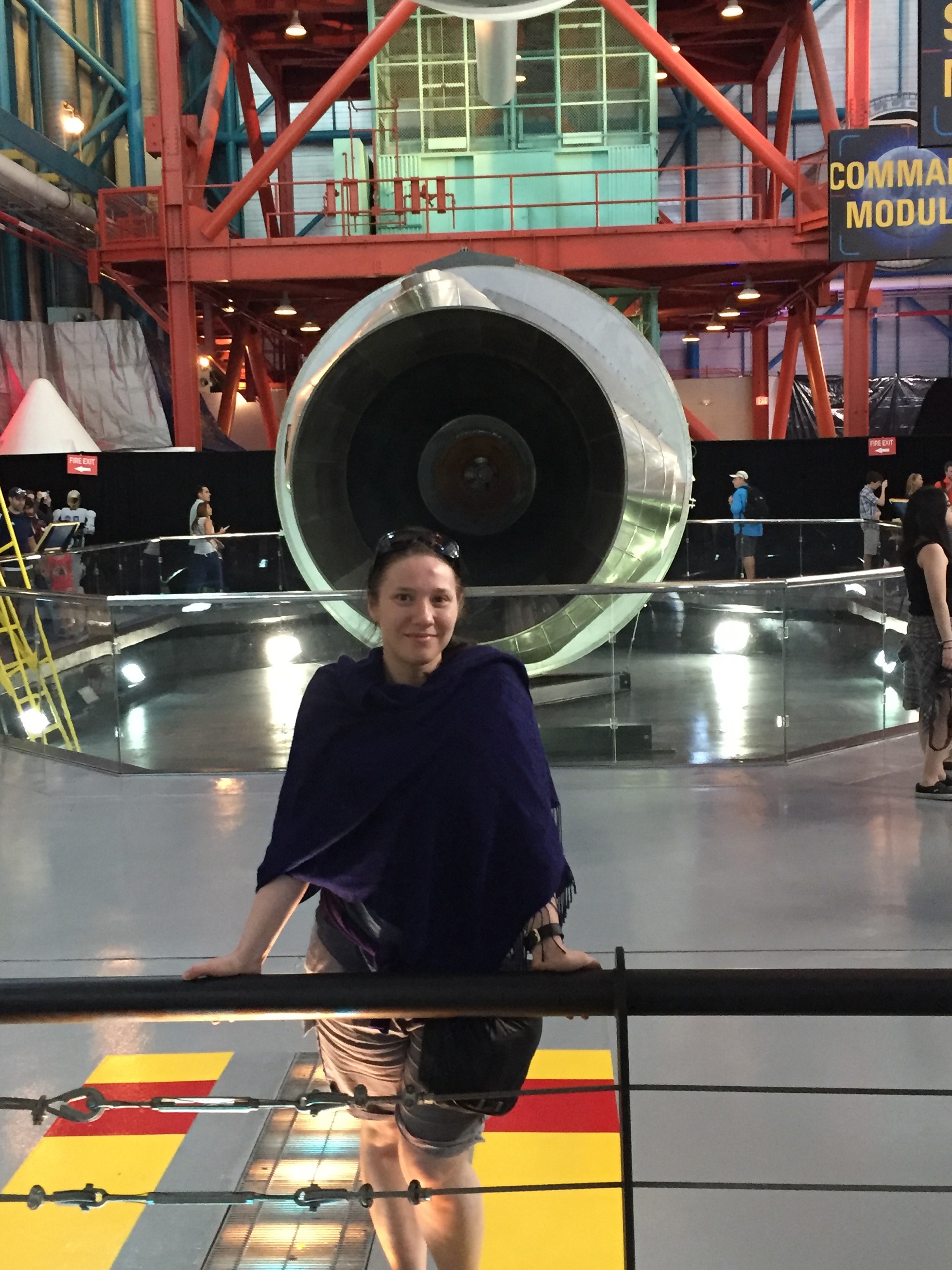
Maarit Koponen visiting the Kennedy Space Center.

1. Tell us a little bit of who you are.
I am a university lecturer of English, researcher of translation technology, a former professional translator, and a fan of both historical dramas and science fiction. I have an MA in English Philology and a PhD in Language Technology, both from the University of Helsinki. I live in Helsinki, and commute to Turku, for which reason I feel both profound appreciation and frequent annoyance toward the Finnish railway system.

2. What kinds of courses do you teach? How and when can our students meet you?
I teach English BA-level courses, such as Academic Writing & Speaking and Grammar 2, and various translation and technology courses on the Multilingual Translation Studies MA track. Currently my office hours are on Thursdays, 11-12, but that tends to change in different semesters. Making an appointment by email is a good option.

3. What do you do research on? What would you like to study in future?
My research focuses on translation technology, particularly machine translation, and the effect of technology on translation processes – how they produce translations. Questions of cognitive processing fascinate me, and in future research I hope to be able to dig deeper into the effect of (machine) translated text quality and errors on cognitive load both for translators and for readers of those texts. How do translators process errors and correct them? How do errors affect the reader response, and how are readers able to recover information even from an imperfect text?

4. Can you describe what a typical working day is like for a lecturer?
Different working days vary a lot, so it is difficult to define a “typical” one. There are days where I am teaching several lectures, or taking part in various meetings, or both, with lots of running in between. There are days preparing lectures and marking student papers. And then there are research days, which may mean staring at an xml file trying to figure out what on Earth is going on with my data, or writing, which may mean either furious typing or staring at a blank page.

5. What do you do when you are not a lecturer? Any time for other things in life?
I enjoy music and dance – I play percussion instruments and go to dance classes to get exercise beyond running between lectures and meetings. For a relaxing evening, I enjoy watching documentaries. My interests range from the history of the English monarchy to dinosaurs to all things space, aliens, conspiracy theories, and true crime, which is occasionally characterized as “baffling and slightly worrisome” by my nearest and dearest.

Shakespeare 400 in Turku

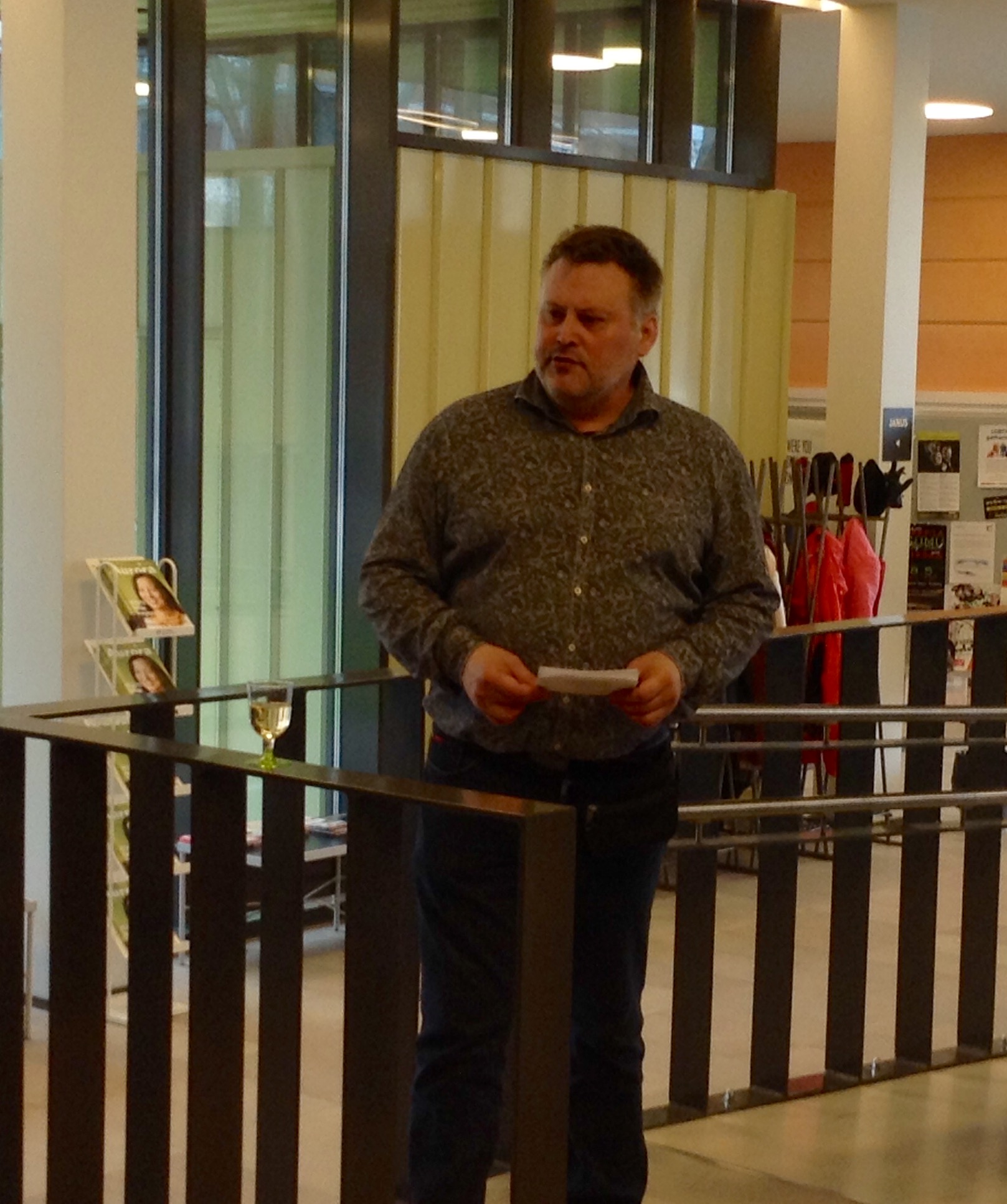
Last week, our department – along with the rest of the world – celebrated Shakespeare as Saturday April 23rd marked the 400th anniversary of the Bard of Avon’s death. Why death, you ask? Well, because we do not know his exact day of birth, and in order to celebrate, we need a date! So, a date with Shakespeare it was on Friday, when the department celebrated with toasts and a jubilee lecture. The merriment began with a toast and a speech by Professor Joel Kuortti, who chronicled some ways in which Shakespeare has figured in his life, culminating in the words of Macbeth: “I drink to the general joy o’ the whole table”.

joelshakespeare

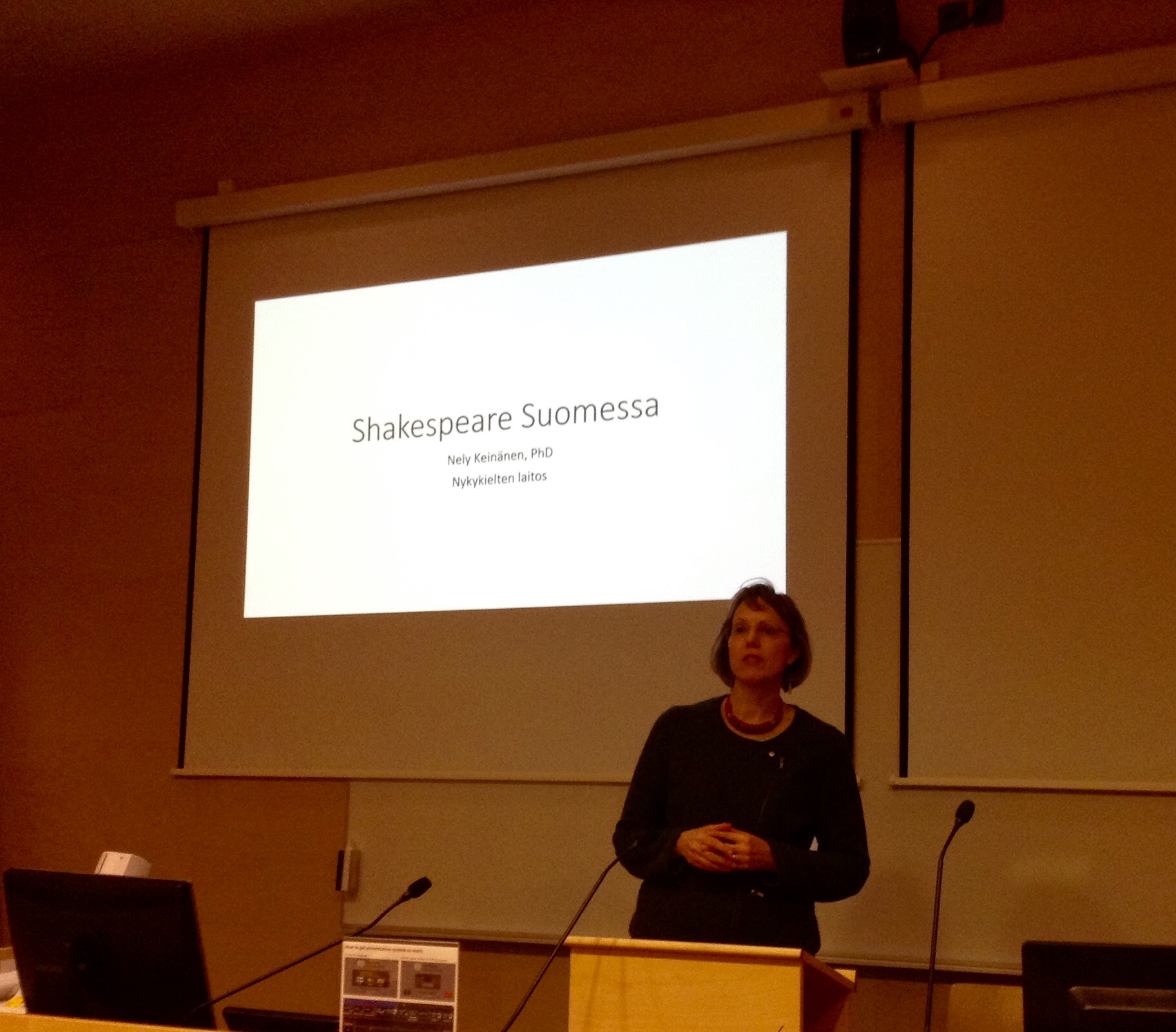
Followed by the toasts, the guest speaker, Helsinki University’s Senior Lecturer, Nely Keinänen gave a fascinating lecture on how Shakespeare’s plays were translated into Finnish and performed in Finland from the 19th century to the present day. We learned about the rich tradition of performing Shakespeare in Finland which interestingly coincided with and helped develop Finnish as a literary language. Translating Shakespeare into Finnish was seen as a great national victory for Finns, who now saw their own language take its place as a proper European language of culture. Shakespeare translations were and are yet another way for us Finns to prove ourselves that we are “most worthy friends” of English, French, and the rest.

nely
Shakespeare, then, was crucial to making Finnish a language of sophistication, culture, and the arts, and our little gathering helped celebrate that fact among others. For a celebration of death, it was a very jolly occasion indeed, marking 400 years of the Bard’s “charmed life”.

Text and photos by Elina Valovirta
Quotes from Macbeth

p.s. Stay tuned for more information on the Faculty of Humanities’ joint Shakespeare 400 lecture course in Q2 next academic year. For more info on Shakespeare festivities in England, go to www.shakespeare400.org.

Seven Wonders of the Frankfurt Book Fair

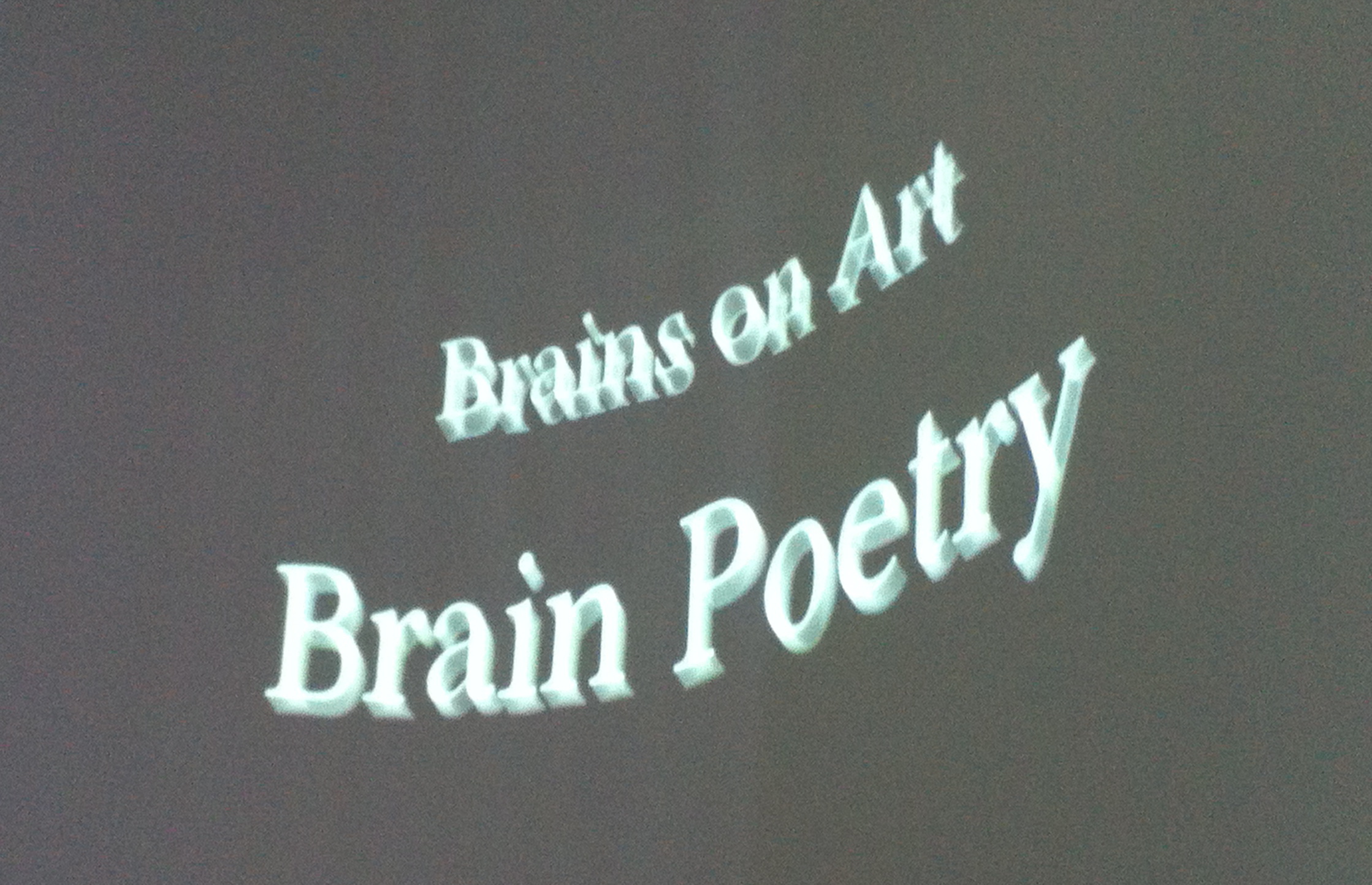
Have you ever considered how brain waves can be transferred into poetry? Don’t worry. The Helsinki-based Brains on Art collective has solved the problem for us. With the help of a tinfoil hat – i.e. a sensor helmet – and computer magic, brain waves create poems. This is first of the wonders I found in the Frankfurt Book Fair 2014 where Finland was the Guest of Honour.
brainpoetry
As I strolled the numerous halls and miles upon miles of corridors, I tried to locate the allure of this world’s greatest book event. The sheer size is the second wonder – 270 000 visitors during five days. There were mini-buses and modern cycle rickshaws to transport you from hall to hall.

Thirdly, I could mention a feature that was very welcome after dragging your feet around for hours. At least in two places there were massage points where you could get a 15-minute neck and shoulder rub for a negotiable fee. Body and soul indeed.

The fourth point is quite unbelievable. I did not buy even one book during my three days in the fair ground. Not due to abstinence but because the event is basically a trade exhibition with very little actual book selling. Business is done between publishers, agents and other book industry representatives.

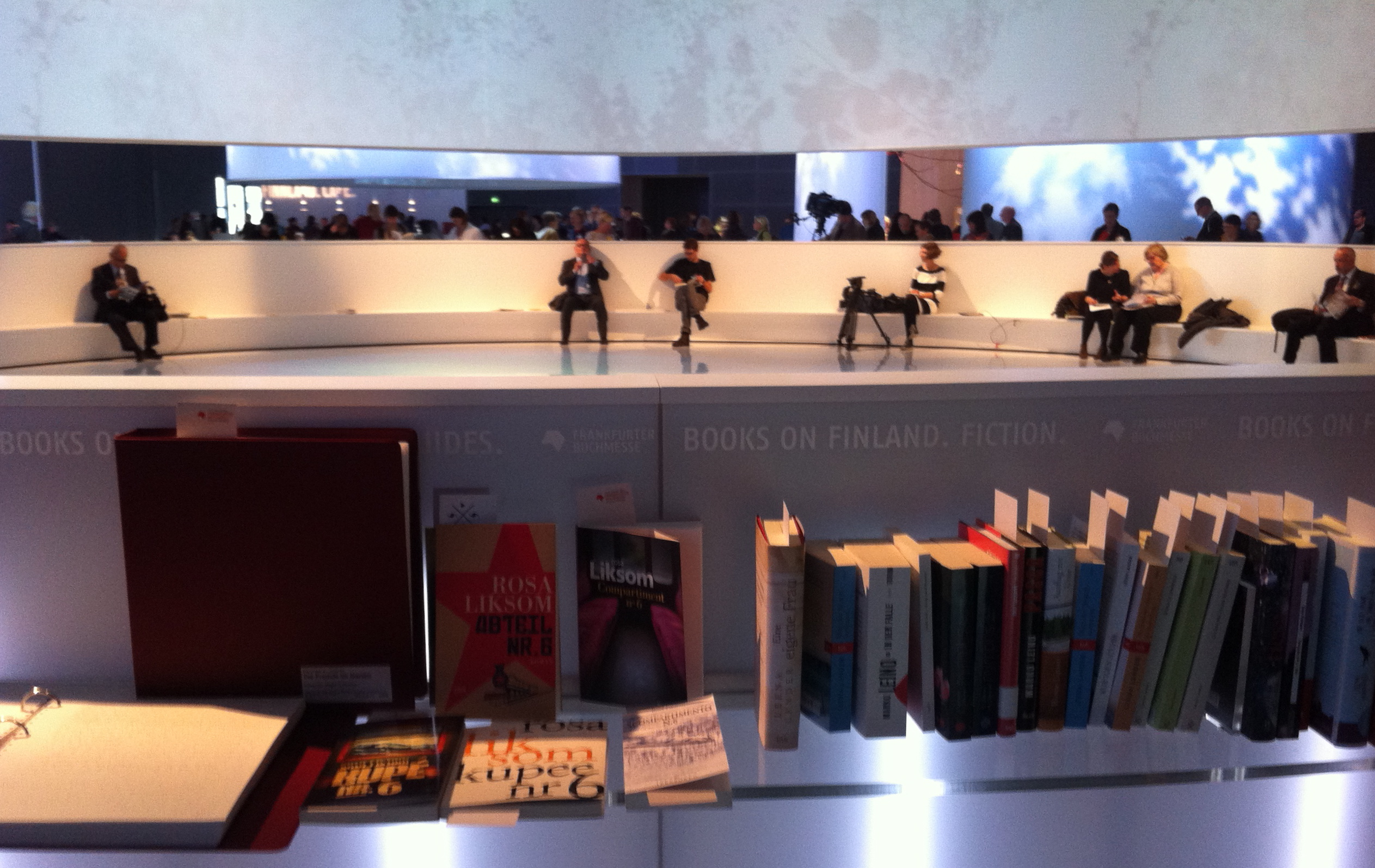
As the fifth wonder, I must mention the extent to which translators and translations were present. This could be seen everywhere but particularly in the Finnland.Cool (yes, that was the motto) Pavilion where the centre sphere displayed nearly a thousand books on Finland and translations of Finnish literature.

frankfurt
As the sixth point, I was very pleased to see that the Helsinki City Library had driven their Mobile Children’s Library bus Skidi to Frankfurt. How cool is that!

The seventh wonder is no doubt book itself. With all the talk about the demise of the traditional format, book seems to be stronger than ever. Evidence to this could be seen in the stalls from all over the world, in any number of languages, in whatever genre, with whichever type of layout.

Oh, and if you want to know how my EEG translated into poetry, here’s the result:

I am waiting weeping watching for Thee
I have not forgotten it thou’lt do me
I have no name
I could lie down like a tired child

(Obviously, the computer cheats, so can you crack this and recognize the original poets/poems?)

Text and photos: Joel Kuortti