Revisiting Galway: Translation Meets Book History

The English Department seems to be building up a special affinity with Galway. The ESSE conference last August was attended by quite a crowd (see blog post here); earlier last year I had the chance to visit the National University of Ireland in Galway as Moore Institute Research Fellow. And now I am back at the Institute for more research and networking in connection with a seminar on book history and translation studies.
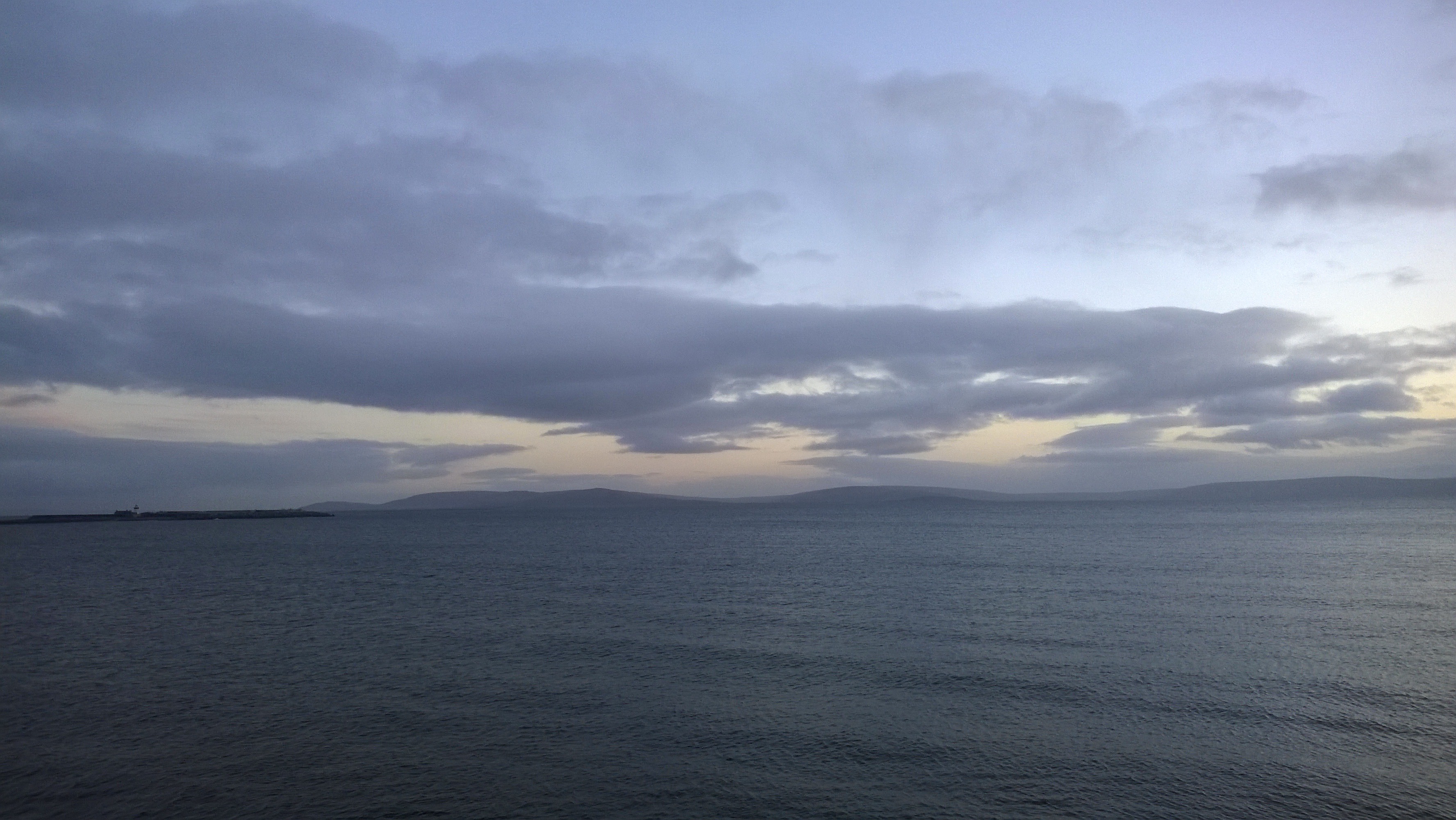
There are a thousand excellent reasons to come back to Galway: the Irish are an extremely friendly people (and seem to share a number of things with Finns – maybe living at opposite ends of Europe makes for some sort of a bond?), Galway is an attractive and cosy town with an interesting history, and the University offers a vibrant intellectual atmosphere and a very warm welcome to visiting scholars.
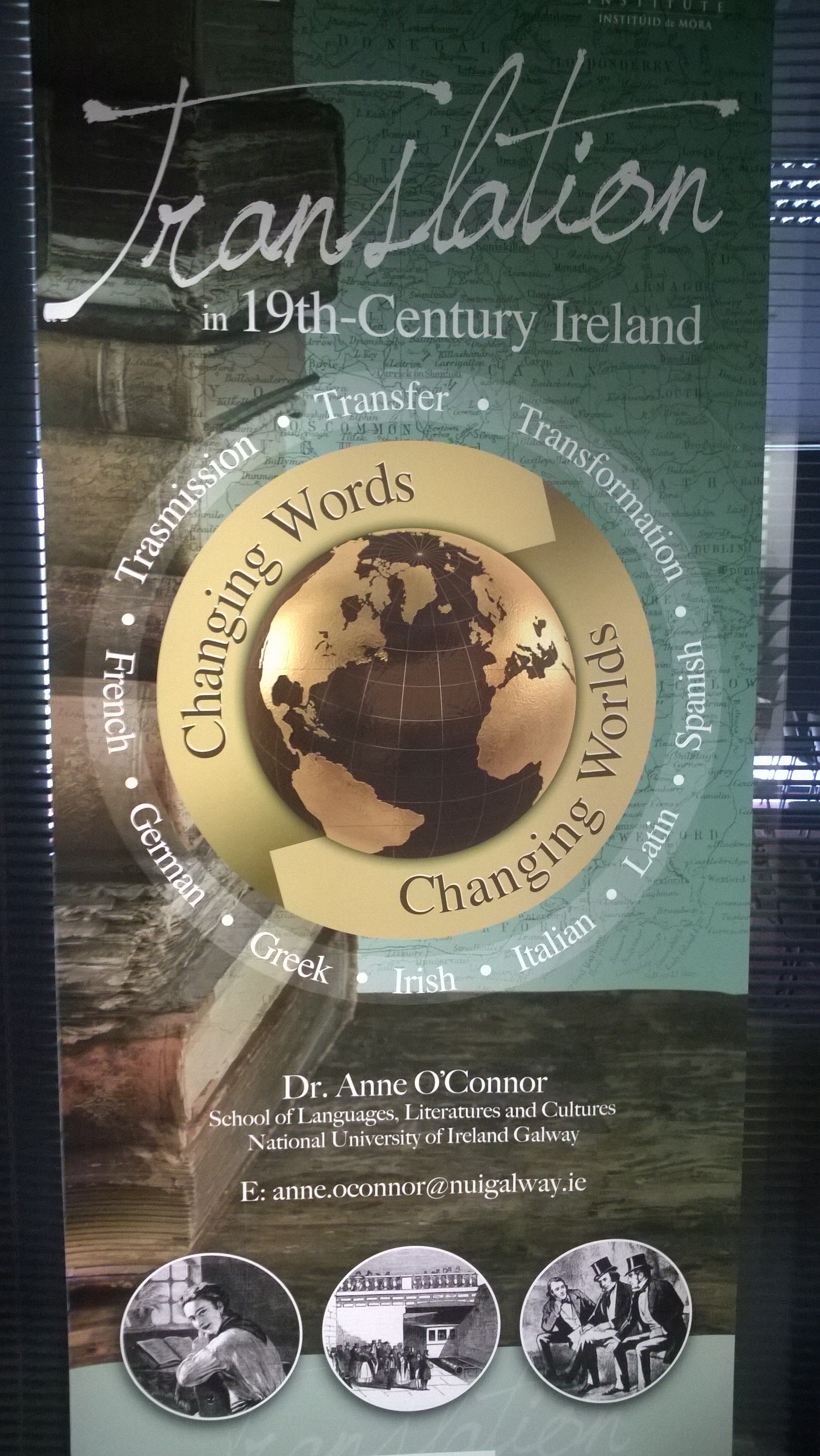
The conference “Book History Meets Translation Studies” was organised by Dr. Alice Colombo, a Marie Curie scholar in Galway, together with Dr. Anne O’Connor, who has just come out with a fantastic book on Irish translation history in the 19th century (see here) and Dr. Niall Ó Ciosáin, a renowned scholar of the Irish print culture (see here). The conference brought together researchers from different parts of the world and with widely varying topics, ranging from multilingual texts in 19th century North Africa to book illustrations, from Urdu scribes’ manuals to publishers’ archives. Katja Vuokko from our department gave a paper on Finnish translators’ footnotes; I talked about the Tauchnitz series “Collection of British Authors” and the introduction of British literature in Finland. The keynote speaker was Prof. Norbert Bachleitner from the University of Vienna with a highly interesting paper on 18th century women translators.

Apart from academic interests, Galway boasts a wealth of historical sites and places to see (and a very large number of pubs). In a street corner there is a statue of Oscar Wilde and the Estonian author Eduard Vilde, “a humorous quip on literary history”. The original statue of the W/Vildes is in Tartu (sculptor Tiiu Kirsipuu); the copy was presented to the city of Galway to celebrate Estonia’s membership in the EU. In real life, the two authors never met.

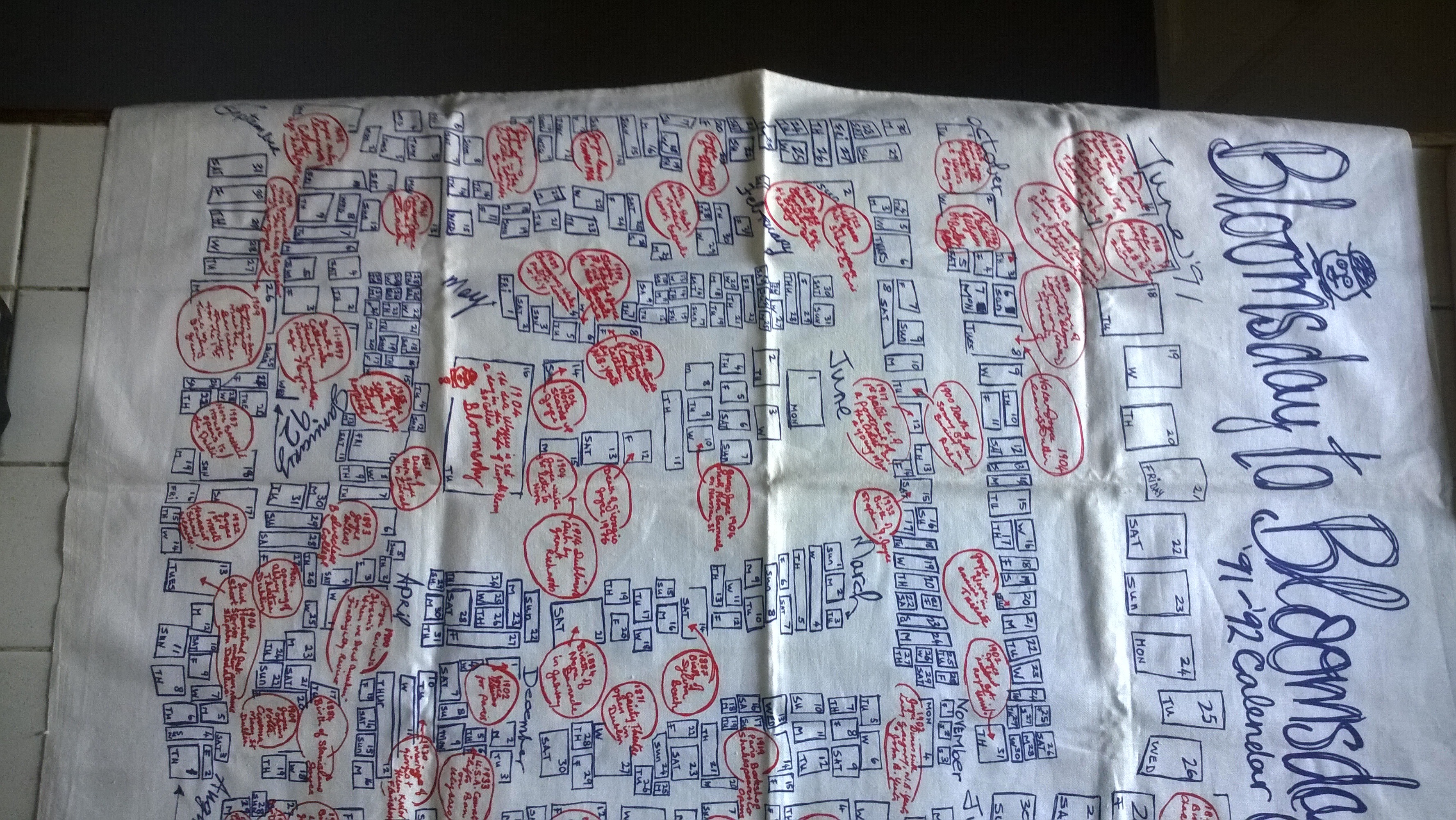
For me the most memorable place in Galway is Nora Barnacle’s house in Bowling Green, where I was taken by my wonderful landlady Sheila (the museum is presently not open for public). This was the home of Nora, James Joyce’s wife, and it is the smallest museum in Ireland with just two rooms and a backyard. Mary and Sheila Gallagher bought the house in 1987 and it is thanks to them that the house has been preserved and restored. The teatowel in the picture below celebrated the 1991 Bloomsday; one in the series of events organised by Mary and Sheila.
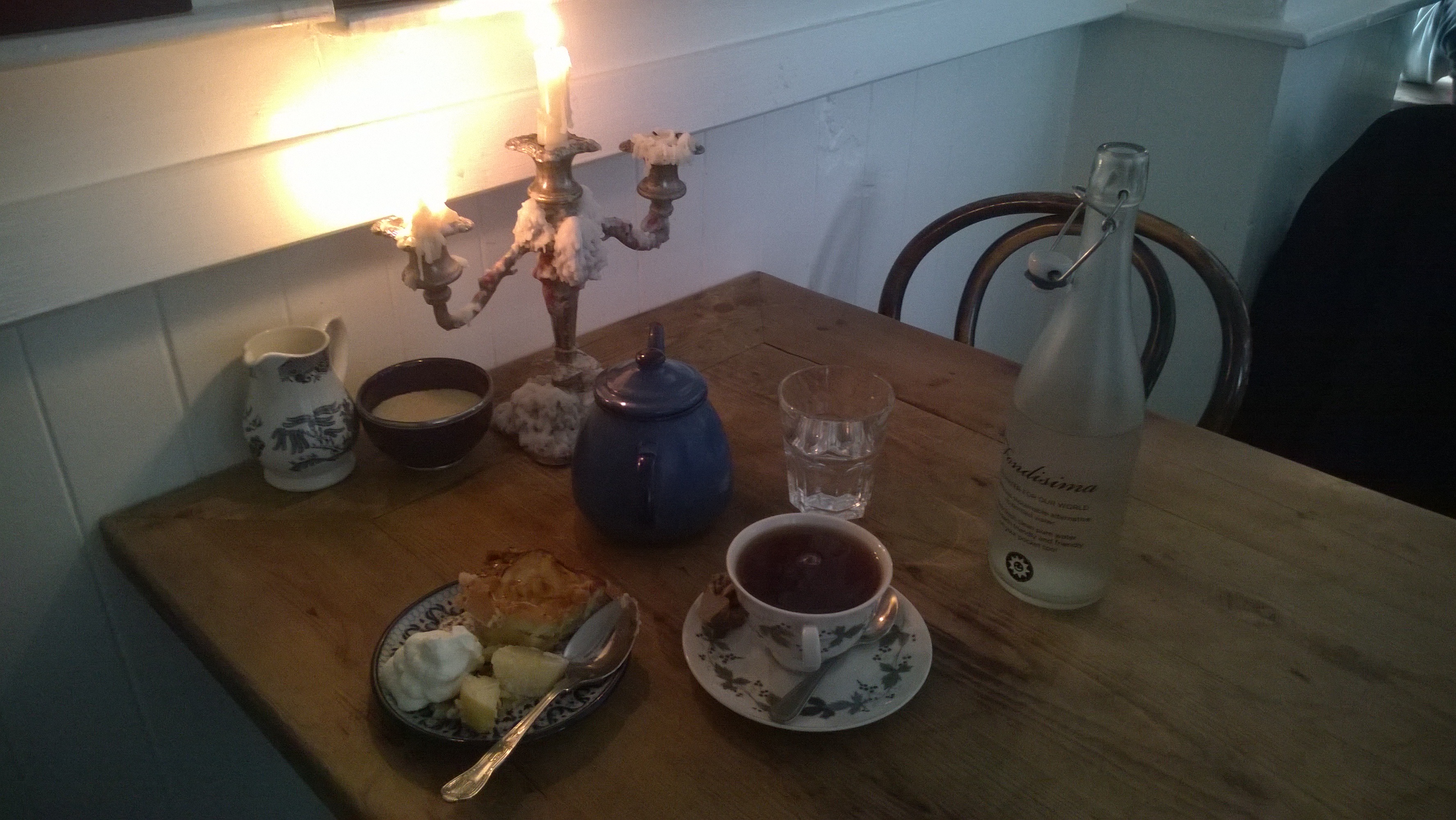
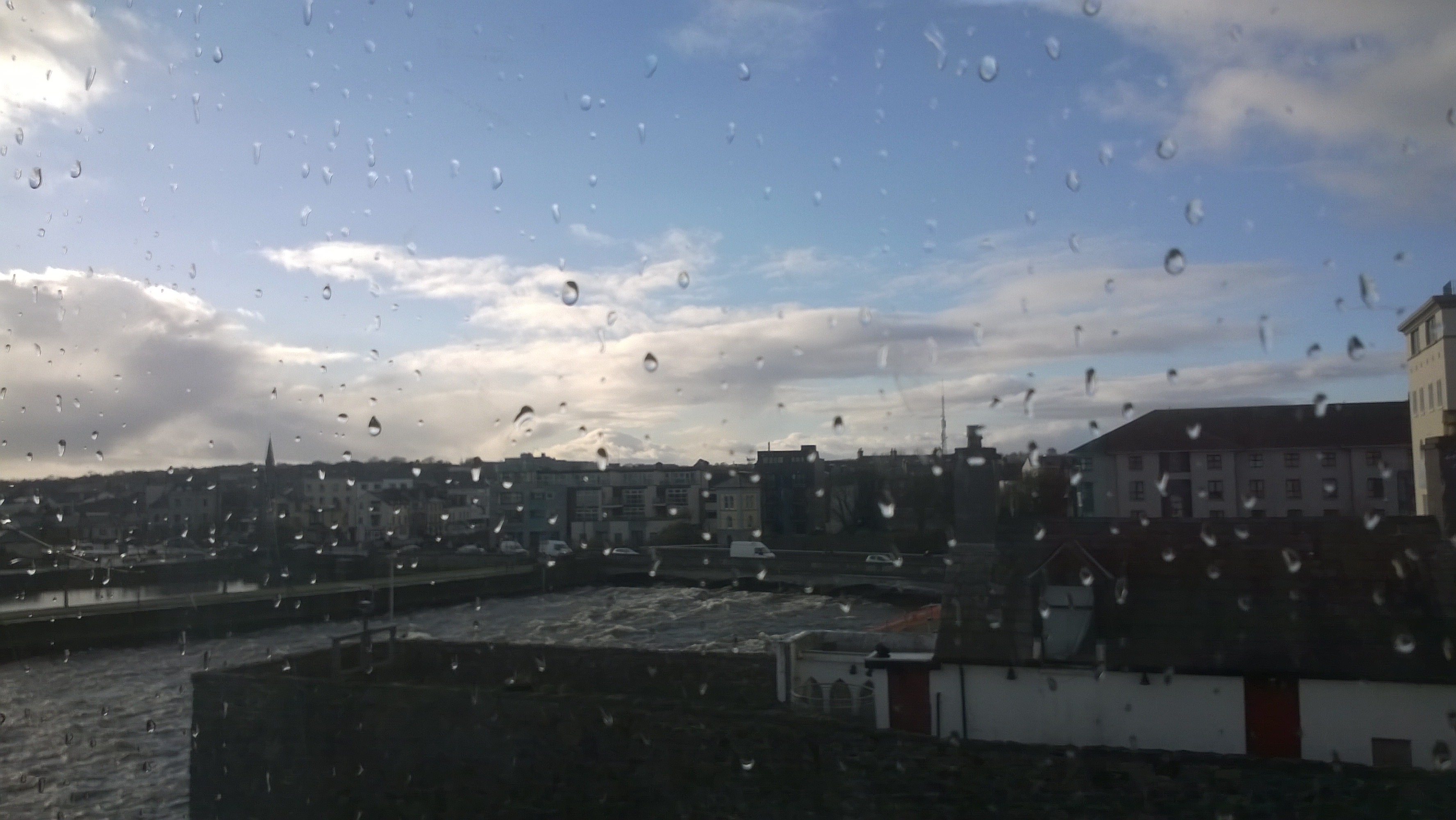
No research visit is complete without cafés and tea houses. There is plenty to choose from in Galway: Ard Bia at Spanish Arch and The Kitchen at the Galway museum are my favourites. A perfect way of combining work and leisure on a rainy day!
Text and photos by Outi Paloposki
Heat wave and historical linguistics in Essen

For university faculty, summer does not simply equal vacation. It is also a prime time for international conferences that are part of our work as researchers. In the end of August, historical linguists flocked to Essen, Germany for the 19th biennial ICEHL conference (22–26 August). ICEHL stands for “International Conference on English Historical Linguistics”.

essen2

The four conference days were packed with excellent plenaries and fascinating papers on all aspects of English historical linguistics – for example pragmatics, speech representation, syntax, variation, language contact, phonology and semantics. Together, the papers covered a millennium of the story of English, from Old English to Late Modern English. You can take a look at the programme here.

Our Philological Track was well represented in the conference. Hanna Salmi gave a paper on verse and prose debates in early modern England. Aleksi Mäkilähde discussed his pragmaphilological approach to the study of language choice in Early Modern English school drama. Janne Skaffari also dealt with multilingual practices in a paper he gave together with Arja Nurmi from the University of Tampere. Finally, Matti Peikola and I discussed early sixteenth-century title-pages as sites of textual discourse. We were delighted to be in the same session with our former Turku colleague Carla Suhr (currently University of Helsinki) who also explored early English title-pages in her talk.

While the other members of our team are frequent ICEHL delegates, this was my first (but probably not the last) ICEHL conference. I really enjoyed my time in Essen, and the heat wave that struck us during the conference was a welcome break after the chilly Finnish summer. The next ICEHL will be hosted by the University of Edinburgh in 2018. As that is the 20th ICEHL conference, organised during the famous Fringe festival in August, I am sure it will be a festive experience indeed!

Text and photos by Mari-Liisa Varila

Battle and Hastings

My three-year research project on multilingual practices in England in the ‘long twelfth century’ ended in August, when its last research trip took me to the UK for the sixth time since 2012. In addition to doing library work, I paid a visit to the place where my long century began: Hastings, on the south coast, and the small town of Battle, which is just fifteen minutes from Hastings by train and, despite its fierce name, quite a sleepy place today. Hastings is a pleasant seaside town, a lively resort on a sunny Sunday afternoon in August but quiet and a little sad on a grey Monday morning.

All students of British history associate Hastings with the battle that won Duke William of Normandy the crown of England on 14th October, 1066. The fighting actually took place outside Hastings itself, at a site where a few years after his victory William the Conqueror built a monastery. The spot where England’s King Harold lost his life on that bloody day was where the high altar of the Battle Abbey church was located.

eng_battruins

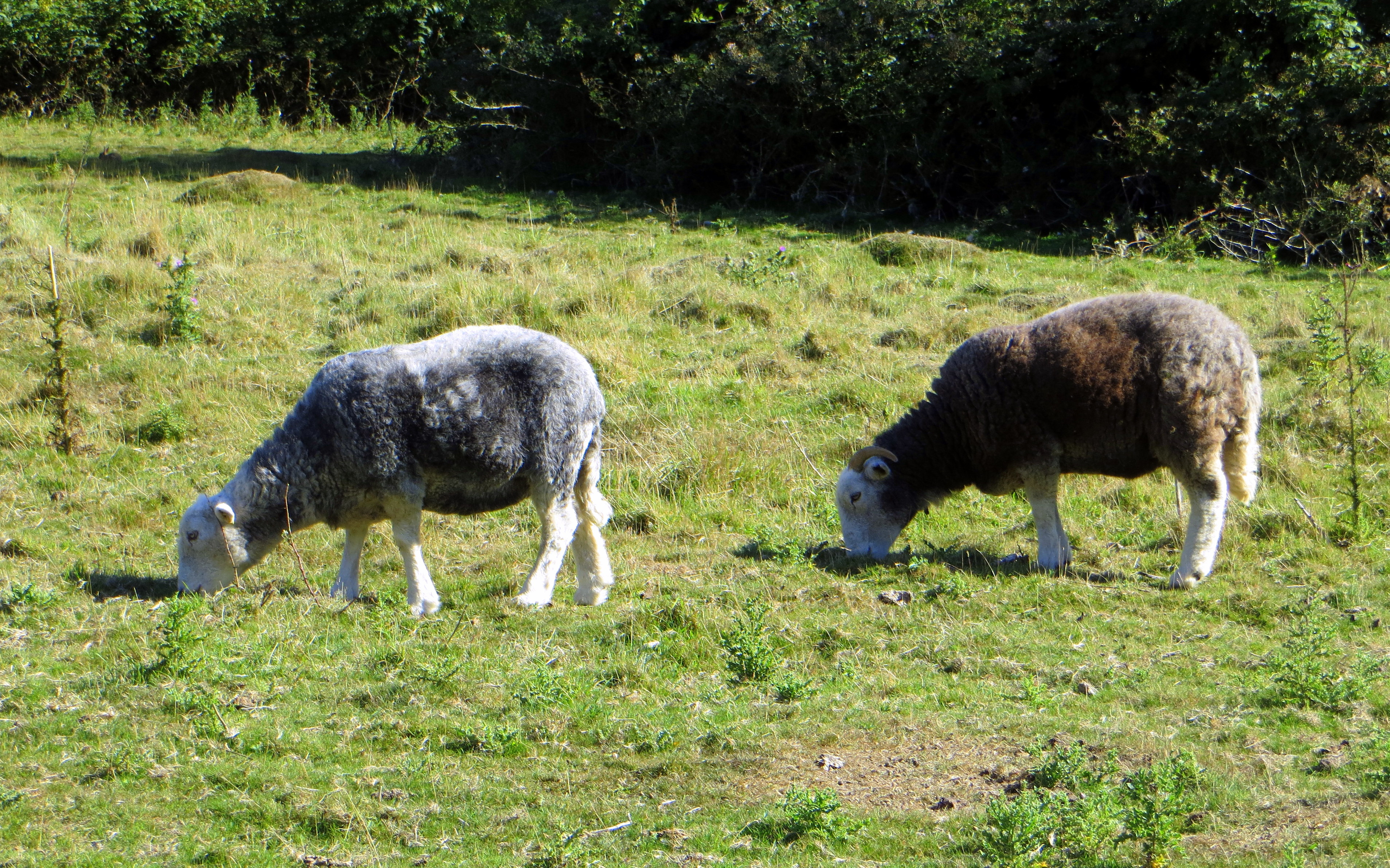
Over ten thousand men fought in the battle that changed the course of history in just one day. On a sunny summer’s day centuries later, this is quite hard to imagine, especially as the battlefield is now a meadow with grazing sheep, inside what is perhaps best described as a not particularly well looked-after park. The walk around the battlefield takes little more than half an hour, and although there are tourists pottering about, they are outnumbered by the sheep. The Abbey is now in ruins, but the site, run by English Heritage, is still interesting to visit. The village of Battle makes the most of the historic significance of the place; even one of the restaurants serves lunches that cost exactly £10.66.

eng_battsheep

The consequences of the battle of Hastings and the Norman Conquest more broadly include social, political and cultural changes – and also linguistic ones, as French gained a new, prominent position in England. It was English lexis in particularly that was influenced by language contact; the previous sentence alone contains at least half a dozen words of French origin. As a historical linguist, I hope that the linguistic legacy of the Conquest is also remembered next year – the 950th anniversary of the Battle of Hastings.

Text and photos by Janne Skaffari.

A Heat Wave of Digital Humanities

cover_leipzig

leipzig2
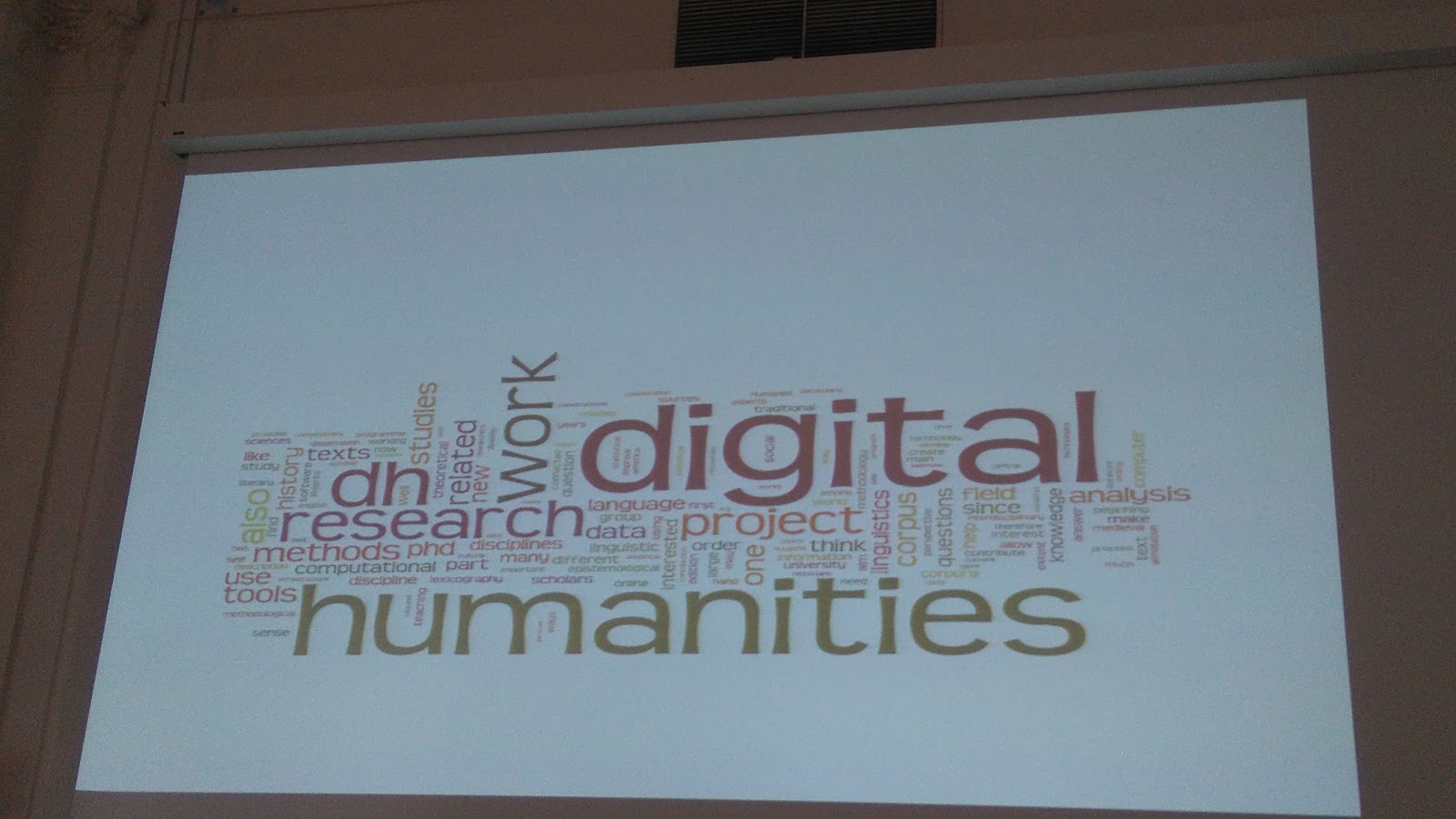
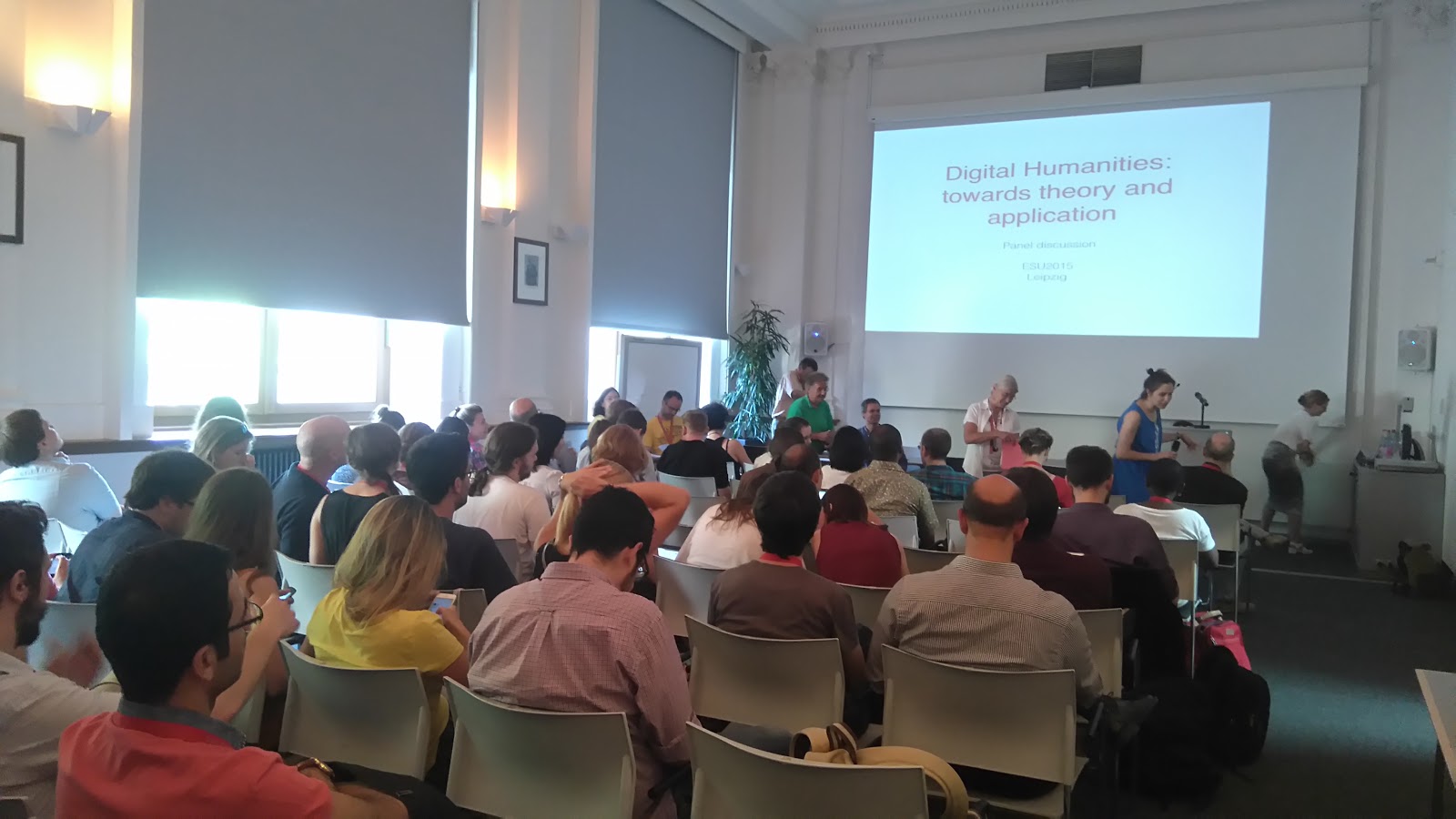
It’s not summer for a doctoral student if it doesn’t include an intensive training week or two. We two intrepid travellers from the Department attended the sixth European Summer University in Digital Humanities (ESU DH), “Culture and Technology”, held at Universität Leipzig July 28-August 7.

Founded by Prof. Elisabeth Burr, ESU DH is a multilingual, multidisciplinary forum for young digital humanists of all stripes. The summer university offers a great number of workshops on topics ranging from programming languages and editorial principles to software tools. In addition to the two workshops taken by each participant, we were treated to a number of lectures and project presentations, poster sessions, panels and even two science slams. (Our workshop won the first one!) One of the most rewarding aspects of ESU DH was discussions with people hailing from various disciplines, united by our interest in the digital applications of humanities research.
leipzig3
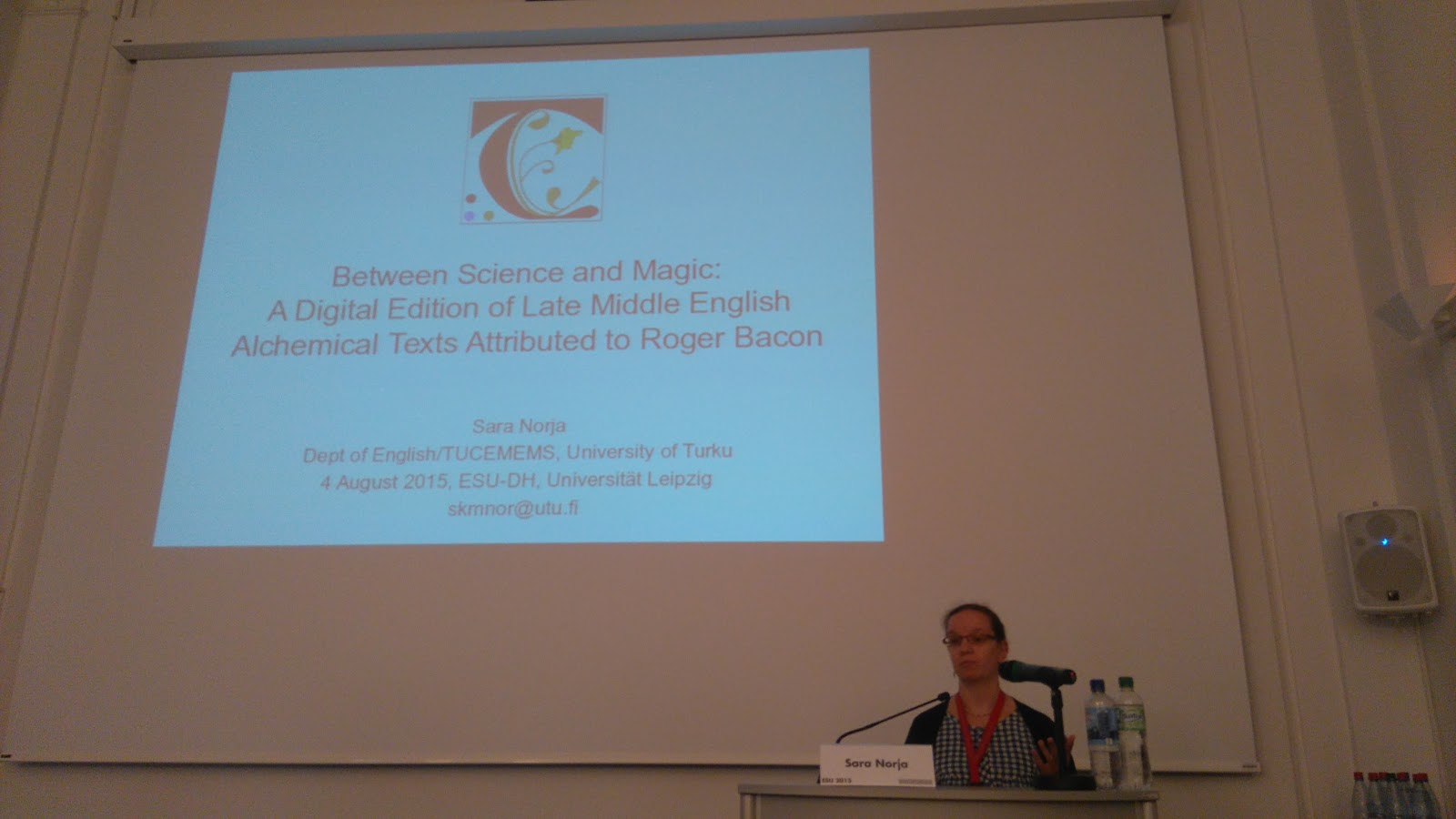
We both attended the two-week workshop “Digital Editions and Editorial Theory: Historical Texts and Documents”. The first week, taught by Dr. Johanna Green (University of Glasgow), concentrated on (digital) editorial theory, using online editions of historical texts to highlight issues discussed. Both of our doctoral dissertations deal with historical texts in digital environments, so the workshop’s content had great practical value. Sara’s doctoral dissertation incorporates a digital edition of early English texts, while Sirkku’s involves a corpus of Renaissance paratexts. Both benefit from the instruction in editorial theory. Hence one of the highlights of the workshop was the theoretical discussion on different digital editions already published online, which gave insight into the options available for future work. The editions varied in presentation and style from The Dream of the Rood to Jane Austen’s Fiction Manuscripts and The Chymistry of Isaac Newton.

The second week, taught by Kathryn Simpson (Edinburgh Napier University), was more hands-on, introducing us to the world of XML-encoded digital editing using material from the Livingstone Online Project. The project has collected a sizeable number of Livingstone’s field diaries, used spectral imaging technology to bring out the (often rather illegible) diary page, and is in the process of producing a digital edition. We got to participate in the project through transcribing pages from David Livingstone’s field diaries into XML using OXygen.
leipzig4
Livingstone, 1871 Field Diary, 297b/157-138 in color (left) and spectral ratio (right).
Image credit: Livingstone Online Project (CC).

Despite the full schedule, ESU DH managed to include a plethora of social events including coffees and communal dinners, as well as excursions to local museums and parks. The evening activities were slightly hampered by the heat, which climbed close to 40 degrees celsius (!) Thankfully the school itself was air conditioned. Since Leipzig celebrates its 1000th year as a city in 2015, there was too much to see to let the heat bother us. (Including a really rather convincing Elvis impersonator performing in a free open air concert on our final evening.) The highlight of the events for us was the visit to the Museum für Druckkunst, a printing history museum with a collection of several dozen printing presses, type foundries, and a number of historical print products, including their collection of incunabula.

leipzig6
All in all, the summer university was a fantastic experience and we both highly recommend it for anyone interested in, or doing research on, digital humanities.

Text: Sara Norja and Sirkku Ruokkeinen
Cover image credit: Maciej Eder (Uniwersytet Pedagogiczny, Kraków, Poland)

The Department by the River

As mentioned earlier in the Tale of Two Departments, there are two Departments of English here in Turku. Situated as we are on the University Hill, our department is known as the Department Up the Hill, while our Åbo Akademi sister department (right at the brink of the river Aura) is known as the Department by the River.

This year we have been determined to increase cooperation between the two units. Among other things, this means that we encourage our students to complete optional studies in the other department, allowing this way a wider selection of special fields.

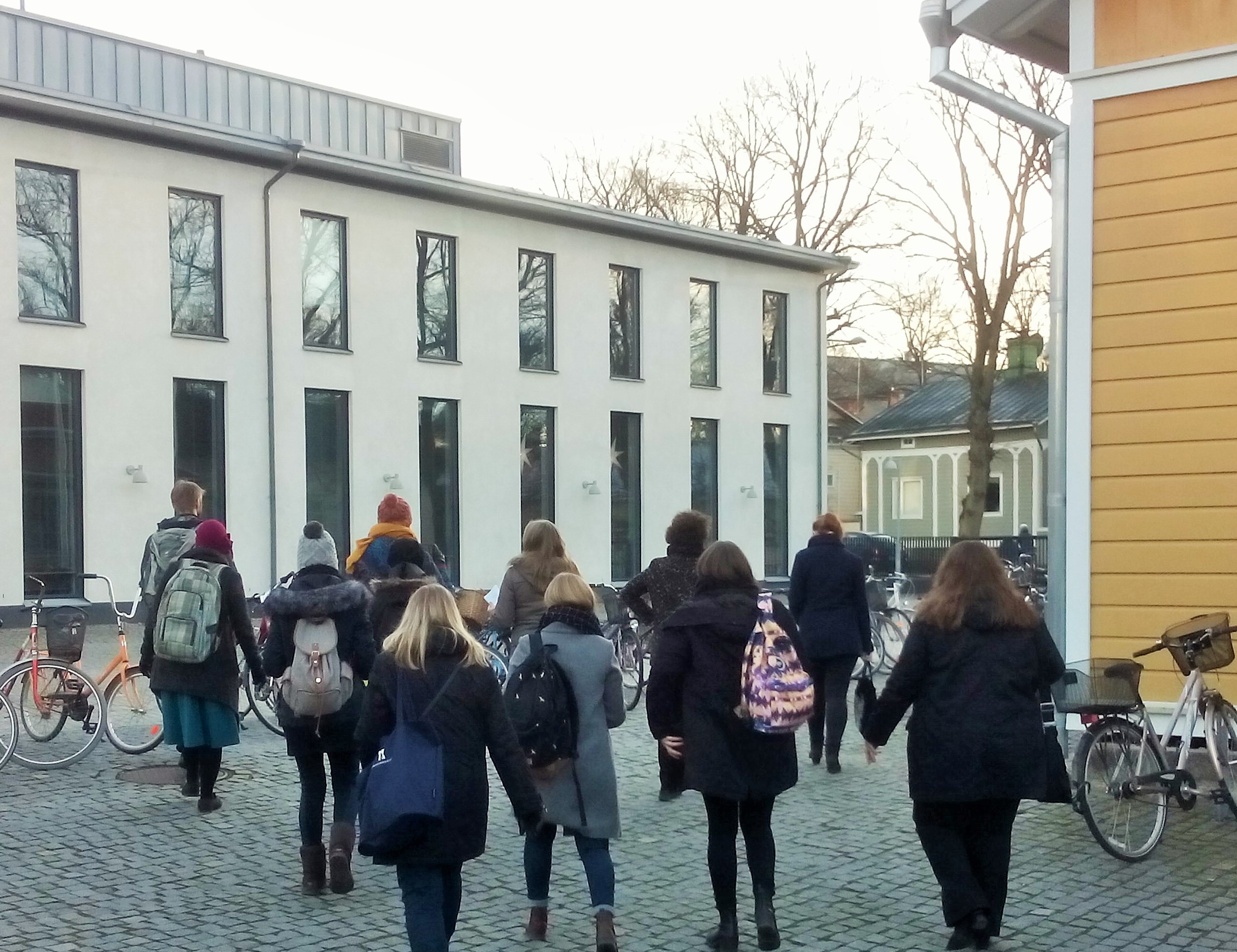
On Halloween in October, we hosted a guided tour of the TY campus to the ÅA students and staff. On an exceptionally sunny and bright December afternoon, it was finally our turn to make a counter visit to the Åbo Akademi campus.

SAMSUNG
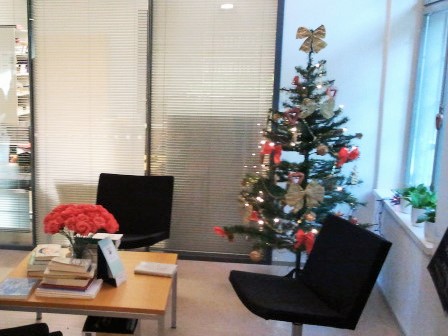
It’s Christmas time at the English Department by the River.

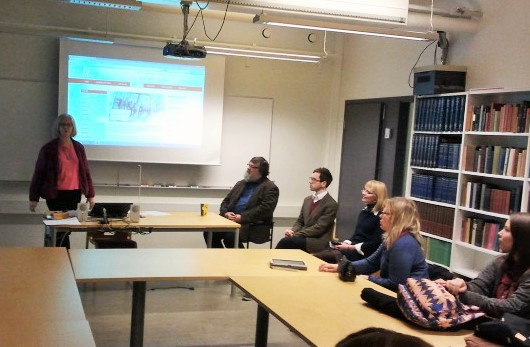
The ÅA Department’s intern Annette Byskata and doctoral student Adam Borch greeted us at the entrance hall of the Arken building, where most of the ÅA Humanities’ units are located. They directed us first to the second floor of the building and into the ÅA English Department’s corridor. We got to see where the Department office is located, but also learned that it will be moved soon because of changes in the admin staff. Also, we saw the Department’s three main lecture rooms (Helikon, Kramer and Donner), and sat down at the Kramer hall to meet the staff, hear about their teaching and to learn how to browse the ÅA website.

SAMSUNG
Our guide, Annette Byskata, at the Arken lobby.

The Head of the Department, Brita Wårvik, welcomed us to the tour and introduced us to the ÅA syllabus. Anthony Johnson, Jason Finch, and Stuart McWilliams gave us more detailed info on the Department’s literature courses. Signe-Anita Lindgrén, the SLA expert of the department, talked about the teacher track of the Department, while Martin Gill discussed the Department’s culture-oriented teaching. Finally, Brita introduced the discourse studies related courses available. During the Q&A with the staff, we discovered practical facts: e.g. that the ÅA term is divided into quarters differently from TY (something to consider when taking their courses!). Also, many of their courses last only one quarter, where as our courses typically last two quarters. These kind of differences may allow flexibility for TY students wanting to complete courses in a schedule different to ours.

SAMSUNG
The ÅA staff introducing their curriculum.

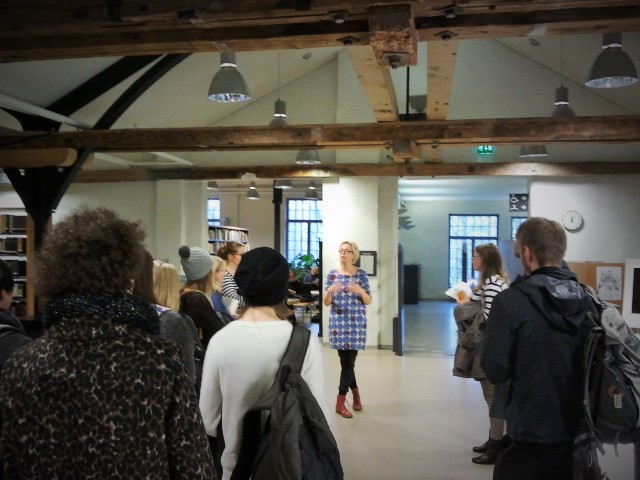
After meeting the staff, we were ready to continue with our tour. The next pit-stop was the Humanities library on the first floor of Arken. The librarian Maria Lassén-Seger greeted us at the library entrance and talked to us about the library customs and about the history of the building, which was originally a factory. In fact, the first Finnish tractor was built there! Maria took us to see the linguistics and English sections of the library’s collections before sending us off to the next stop of our tour, the Asa building.

SAMSUNG
Maria Lassén-Seger urges the TY students to use the ÅA libraries, too.

In the Asa building, Annette and Adam first guided us to the IT centre of ÅA on the first floor, humorously named “the Oracle”. Rumour has it that occasionally the helpdesk’s instructions are as ambiguous as the oracle’s advice in a well-written Greek comedy. Finally, we stopped by the course book library in the Asa building, where the students had the possibility to activate their TY library cards for ÅA use.

Warm thanks again to the staff of the Department by the River for inviting us and for organising such a fun and educational tour for us!

Text by Anna Kalpio
Photos by Anna Kalpio & Adam Borch


abo1
The TY group ventures from Arken to the Asa building.

Seven Wonders of the Frankfurt Book Fair

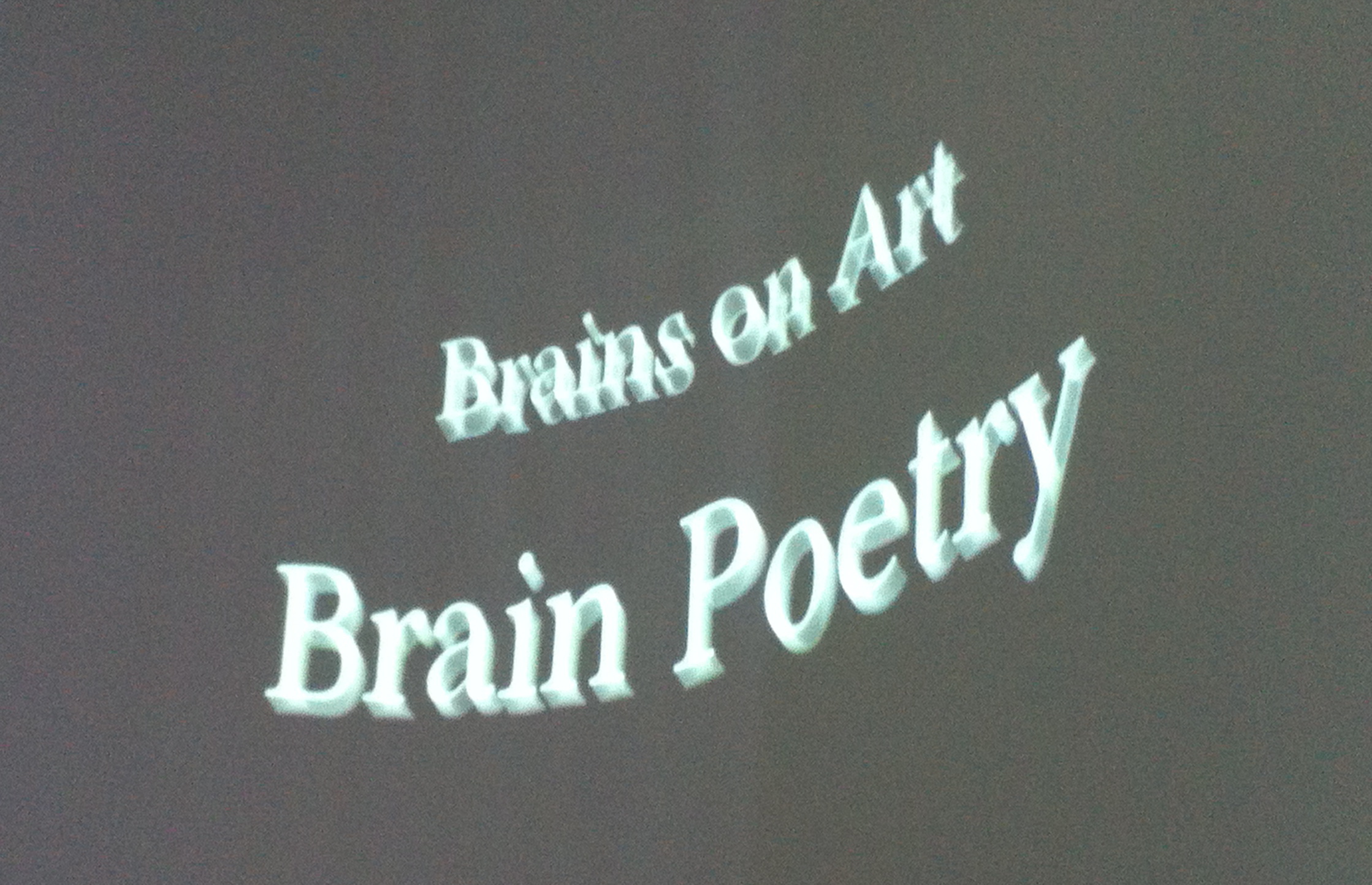
Have you ever considered how brain waves can be transferred into poetry? Don’t worry. The Helsinki-based Brains on Art collective has solved the problem for us. With the help of a tinfoil hat – i.e. a sensor helmet – and computer magic, brain waves create poems. This is first of the wonders I found in the Frankfurt Book Fair 2014 where Finland was the Guest of Honour.
brainpoetry
As I strolled the numerous halls and miles upon miles of corridors, I tried to locate the allure of this world’s greatest book event. The sheer size is the second wonder – 270 000 visitors during five days. There were mini-buses and modern cycle rickshaws to transport you from hall to hall.

Thirdly, I could mention a feature that was very welcome after dragging your feet around for hours. At least in two places there were massage points where you could get a 15-minute neck and shoulder rub for a negotiable fee. Body and soul indeed.

The fourth point is quite unbelievable. I did not buy even one book during my three days in the fair ground. Not due to abstinence but because the event is basically a trade exhibition with very little actual book selling. Business is done between publishers, agents and other book industry representatives.

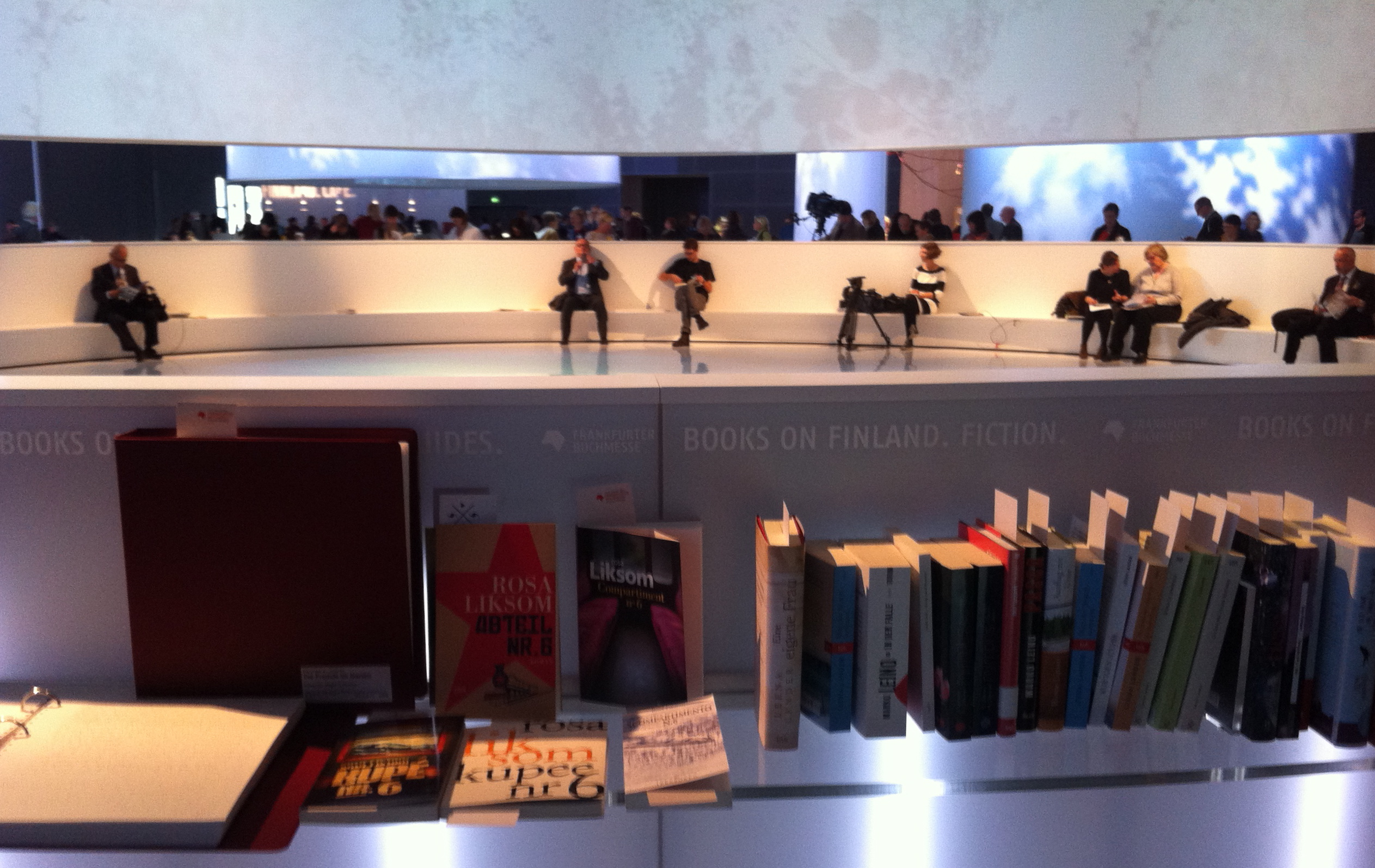
As the fifth wonder, I must mention the extent to which translators and translations were present. This could be seen everywhere but particularly in the Finnland.Cool (yes, that was the motto) Pavilion where the centre sphere displayed nearly a thousand books on Finland and translations of Finnish literature.

frankfurt
As the sixth point, I was very pleased to see that the Helsinki City Library had driven their Mobile Children’s Library bus Skidi to Frankfurt. How cool is that!

The seventh wonder is no doubt book itself. With all the talk about the demise of the traditional format, book seems to be stronger than ever. Evidence to this could be seen in the stalls from all over the world, in any number of languages, in whatever genre, with whichever type of layout.

Oh, and if you want to know how my EEG translated into poetry, here’s the result:

I am waiting weeping watching for Thee
I have not forgotten it thou’lt do me
I have no name
I could lie down like a tired child

(Obviously, the computer cheats, so can you crack this and recognize the original poets/poems?)

Text and photos: Joel Kuortti

The world’s knowledge, and some cakes

lnt_britlib

I’m doing something I probably shouldn’t be doing: writing a blog entry under the watchful eye of George Bernard Shaw (well, his bust really). This is the Manuscripts Reading Room in one of my favourite buildings in London, the British Library, next to King’s Cross and St Pancras stations. I have been coming here every now and then for years, since soon after the building opened in the late 1990s.

So it’s a library. It’s the largest one in the world; no wonder the BL’s motto is ‘Explore the world’s knowledge’. For someone who needs to read texts written centuries ago, there is no single place that would have more to offer. To me, the BL also feels like a little piece of Nordic calm in the middle of a hectic city, and indeed, Colin St John Wilson, the architect who designed it, was inspired by Alvar Aalto. However, the BL is not like an Aalto building: it is more ornate and somehow warmer. Not everyone likes the look of the building; scathing remarks have been made by, for instance, the Prince of Wales.

The spaces that I spend time in include the Manuscripts and the two Humanities Reading Rooms, the last two often crowded yet quiet enough, the Manuscripts room a haven of peace – a great place for working. Academic study aside, you can practically live on the premises. When you feel peckish or have a sudden craving for coffee or cake – and cakes are very important if you are in English studies – you can choose where to have your Chelsea buns and soya lattes: there is a restaurant and three cafés, two of them outdoors. If you have a reader’s ticket and prefer a cheaper snack, you can pop in the Readers’ room (with a roof terrace but not much of a view) and make use of the vending machines.

The cafés are open to all visitors, not just registered readers, as are the exhibitions rooms and the shop. There is plenty to see in the gallery for an English student, from the Beowulf manuscript to drafts of some of the greatest pop songs of the 20th century. To have a look at some of the BL’s collections, you don’t even have to leave your home: simply click at www.bl.uk.

Back to research then. Resting on the cushion in front of me is a book from the early 13th century, hand-written of course, and the only existing copy of the text in the world. This is indeed a house of treasures.

Text and images by Janne Skaffari

lnt_britlib_hall
An inside view of the British Library hall, by an insider.