Organizing an in-service teacher training module – societal interaction at its best

During the academic year of 2022-2023, the English Department and the Centre for Language Learning Research (Leala) have had the pleasure of hosting a national in-service teacher training module for second or foreign language (L2) teachers in Finland. We named this module SuSuKi, which stands for Sujuvuutta suulliseen kielitaitoon (roughly translated as “making oral language skills more fluent”), and we focused on the learning, teaching and assessment of oral language skills. The module has been funded by the Finnish National Agency for Education, and the training has been led by Professor Pekka Lintunen. Throughout the module, Project Researcher Venla Eirola has taken care of the practical matters related to the organization of the training.

Lectures, workshops and new perspectives

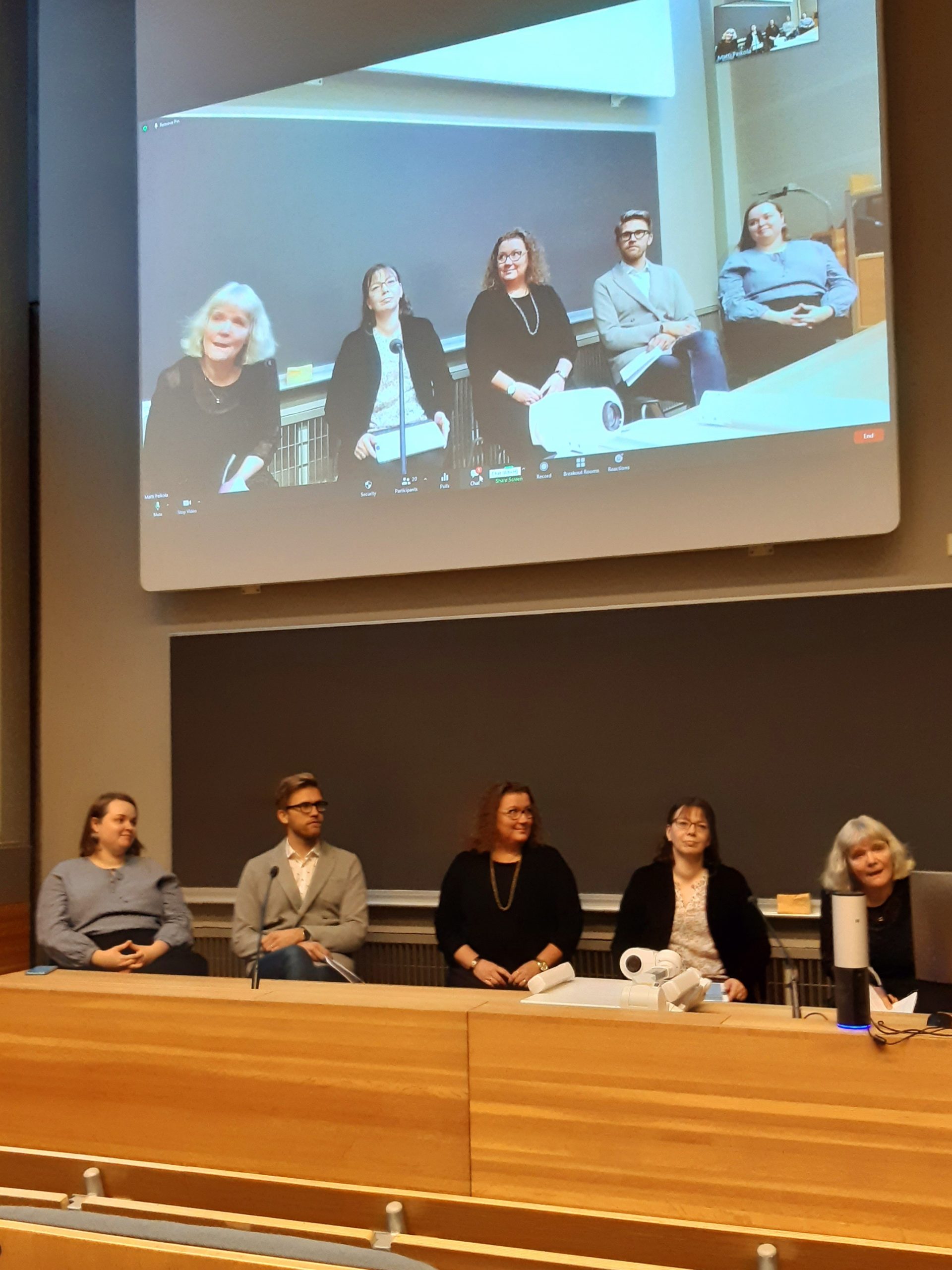
The module was inspired by our strong tradition in spoken language research and also by earlier in-service teacher training modules organized within Leala. We approached second language oral proficiency from different perspectives during the module. The module consisted of five meetings from September to April, which were introduced during hybrid-mode lectures on Friday, and a smaller group of teachers also participated in an on-site workshop on the topic on Saturday. In the first meeting, Pekka Lintunen, Pauliina Peltonen and Elina Lehtilä opened the whole module with lectures on speech fluency. The workshops focused on topics such as fluency-building exercises and fluency assessment. In the second meeting, Elina Tergujeff and Henna Heinonen from the University of Jyväskylä lectured on the teaching and assessment of pronunciation, and language-specific workshops were led by Heinonen for Swedish, Janne Korkka for English, Maarit Mutta for French, and Sanna Pelttari for Spanish.
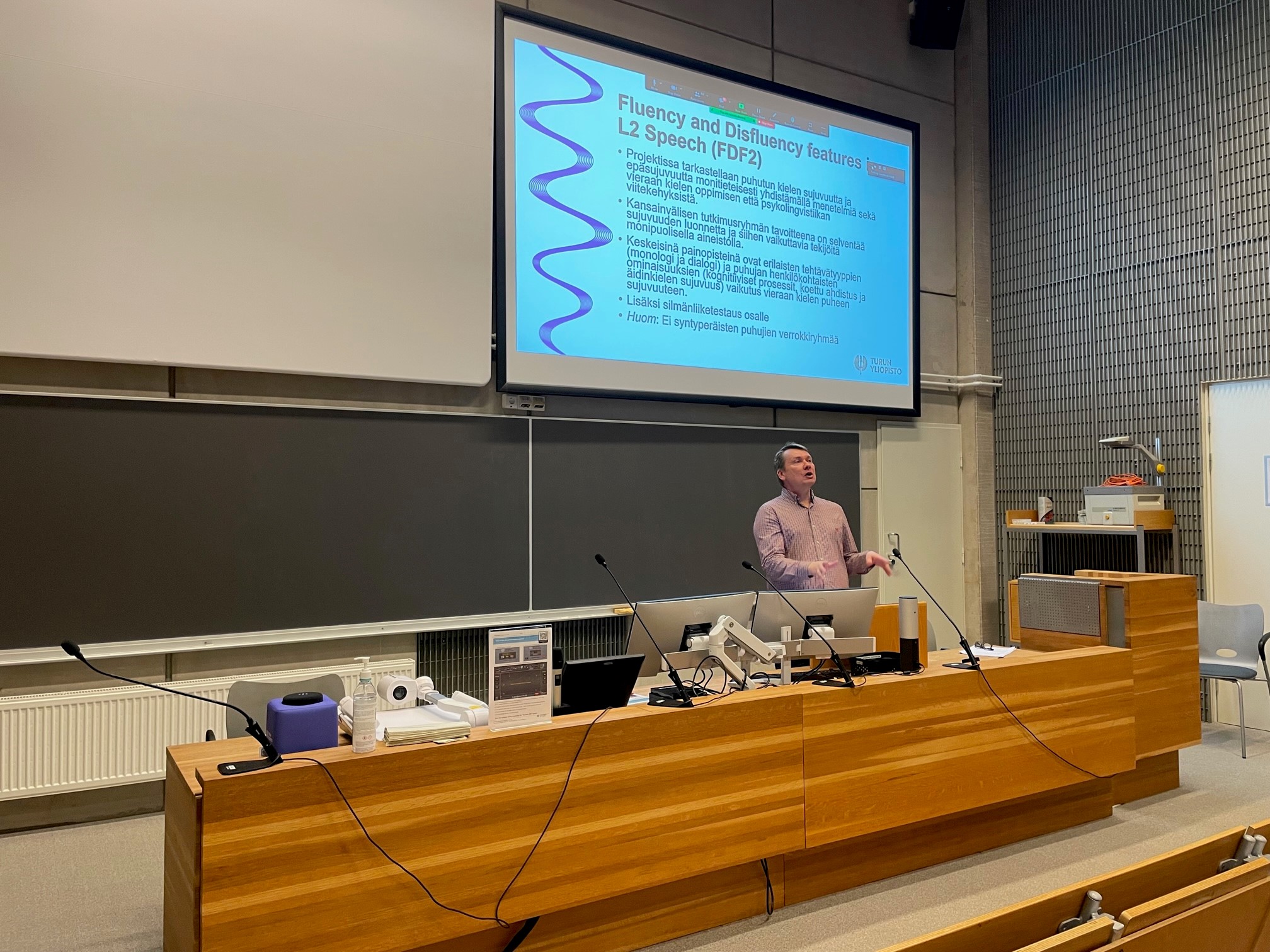
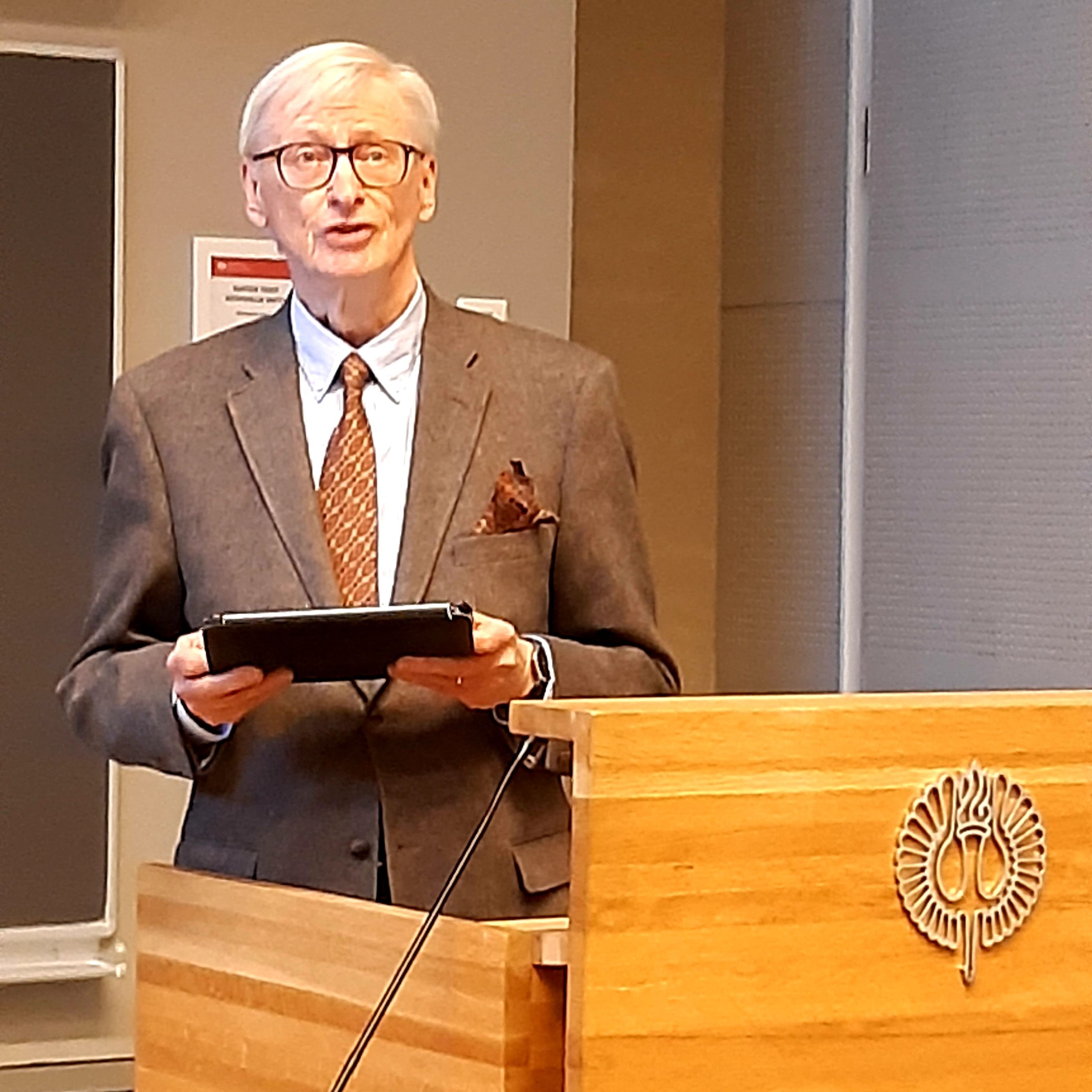
Pekka Lintunen during the opening lecture on speech fluency in September

In the spring semester, the training continued with a meeting on digitalization and interaction in spoken language teaching by Sanna Pelttari, Outi Veivo and Teppo Jakonen. A workshop led by Liisa Peura and Hilla-Marja Honkalammi explored the use of social robots in spoken language teaching. The last two meetings focused on individual differences: for example, Outi Veivo and Sanna Olkkonen lectured on the importance of the learner’s cognitive processes, and Magdalena Szyszka discussed oral language learning from the perspective of emotions and learning strategies.

On the whole, the module has been very successful. More than 100 teachers around Finland attended the Friday lectures, and about 20-25 teachers also participated in the workshops. This was far more than we had anticipated! We also received much positive feedback from the teachers for what we had organized.

Inspiring interaction with the teachers

Universities are considered to have three main tasks: conduct research, provide teaching based on research, and interact with the society that surrounds it. A module such as this has been very much fun to plan and organize, and it is also very rewarding from the organizer’s perspective. We get to provide teaching based on our latest research findings, some not even published yet, and have a direct impact on teachers and how L2 teaching is conducted at Finnish schools. This kind of societal interaction is highly important with L2 learning research and a prime example of what researchers dream about: a fast transfer of knowledge. Dialogue with schools and teachers is at the core of what we do. We provide examples of what could work according to the latest research findings, and teachers provide us feedback on what our ideas sound like from their perspectives. In addition, we also get plenty of new research ideas when we hear concrete questions and problems that language teachers tackle with in their everyday work.
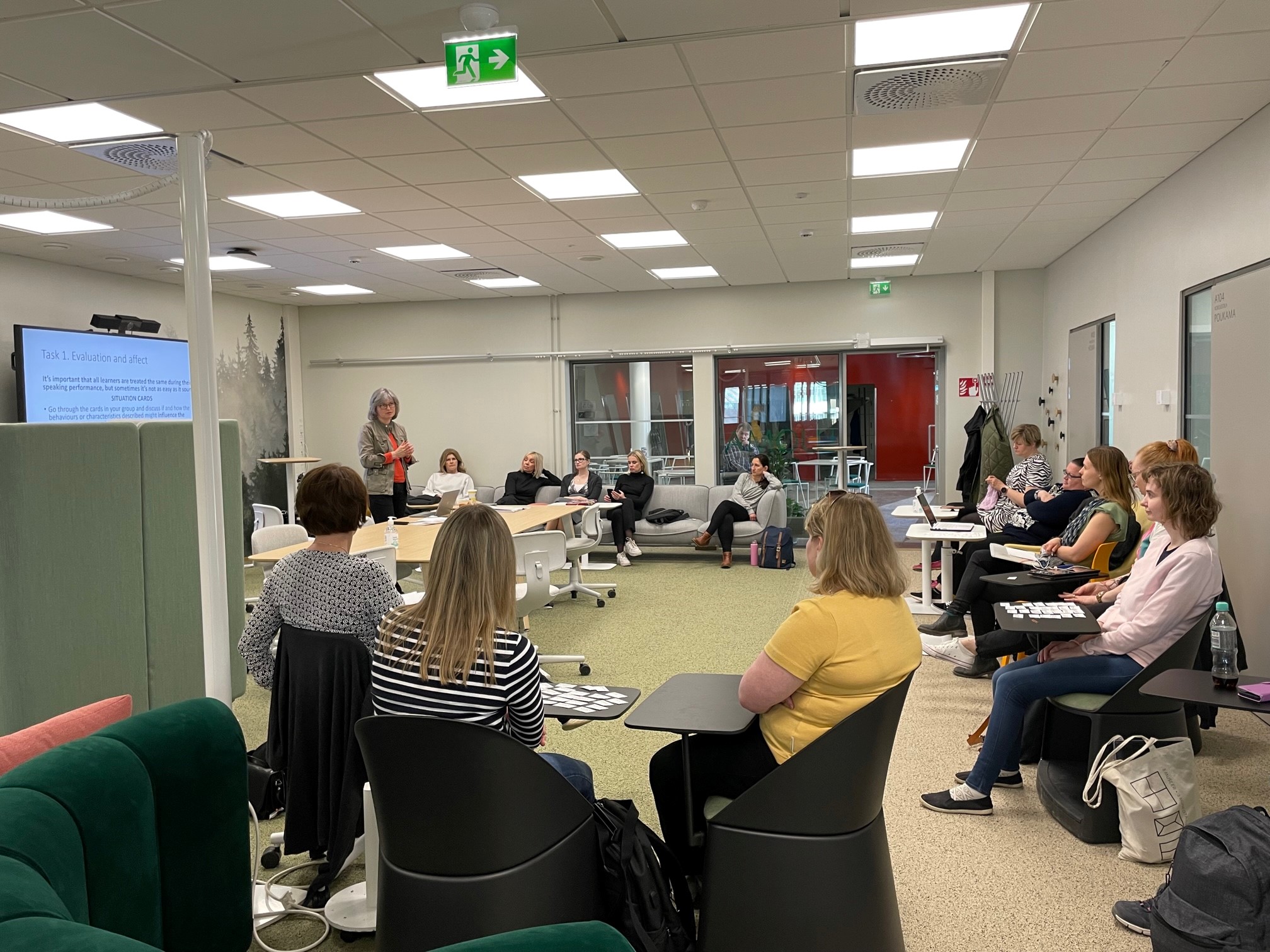
Magdalena Szyszka giving a workshop on emotions in language learning in April

Online workshops in the autumn 2023

At the end of this module, there is even some sadness in the air as we need to say goodbye to the project when the academic year ends. However, last week we received the great news that the Finnish National Agency for Education allows us to organize three extra training sessions in the autumn term as well. This is excellent news and extends this training module to new audiences. In the autumn, we will organize everything as purely online meetings so that teachers from all over Finland can participate. We will discuss speech fluency in September, pronunciation in October, and individual learner differences in November. Stay tuned for these extra sessions!

Text: Pekka Lintunen & Venla Eirola

Photos: Venla Eirola
So-Swiss-ticated in Zurich

Switzerland. The home of cheese, chocolate, the Alps… and a bustling English Department at the University of Zurich with an overwhelmingly well-stocked library that I could have lived in for the entirety of my four-week stay and I still wouldn’t have even scratched the surface, and a staff that welcomed me with open arms?

As it turned out, yes.

After two years of part-time PhD work, the stars finally aligned and as funding was secured, the distant dream of a research visit to the home Department of one of my supervisors came to fruition. I arrived in Zurich in late April and was immediately met with extreme kindness and willingness to help with anything and everything from everyone I met at my host Department.

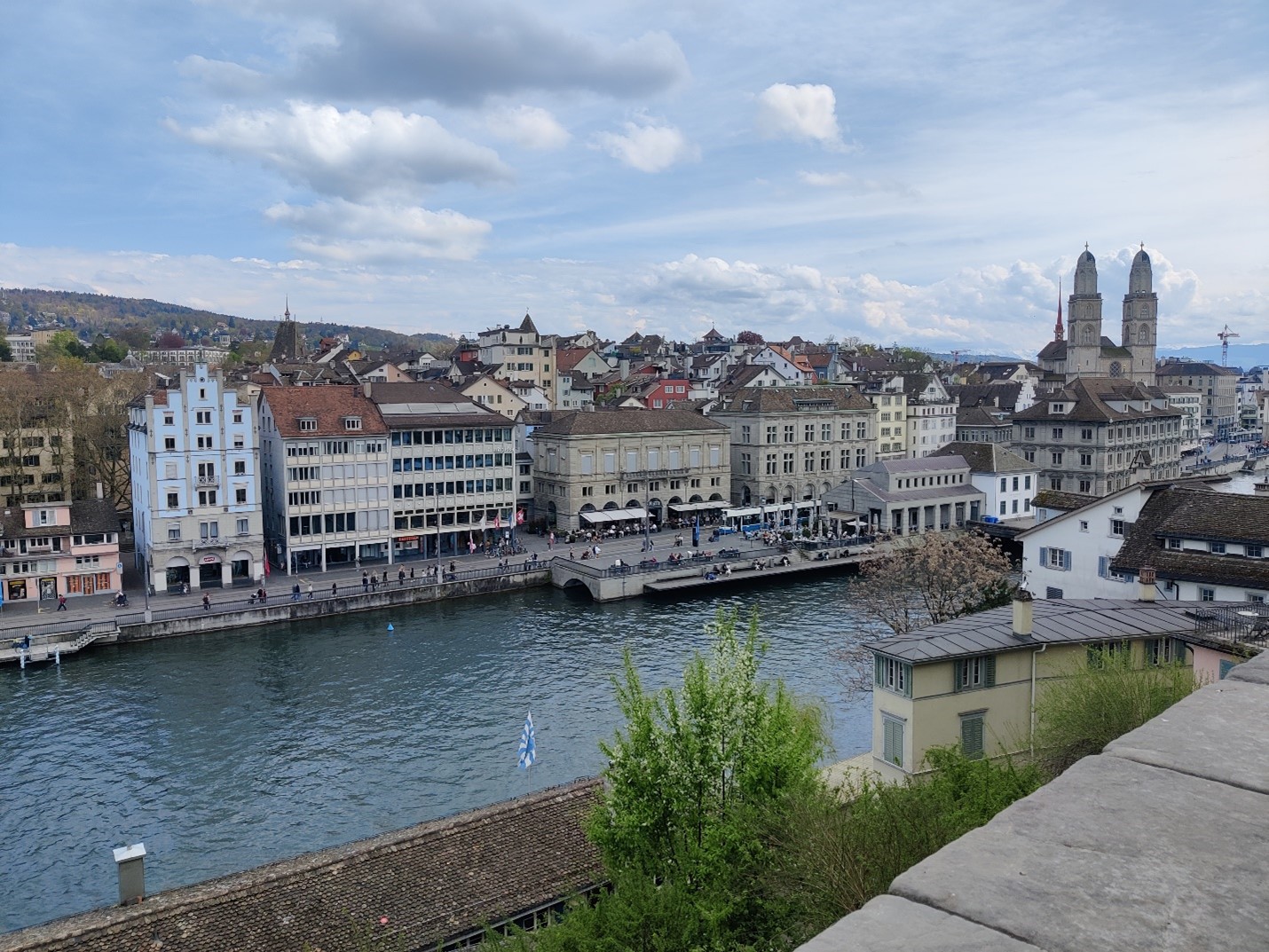
A view of the Limmat river from Lindenhof, the former site of a Roman fort and, later, Charlemagne’s grandson’s palace.

My weeks were spent with my nose firmly planted in both primary and secondary sources of my dissertation as well as discussing my research with my supervisor and getting to know some of the rest of the staff more closely. I also had a chance to present my research at one of the Department’s Lunch Talks, where the audience enjoys their lunch while listening to presentations.

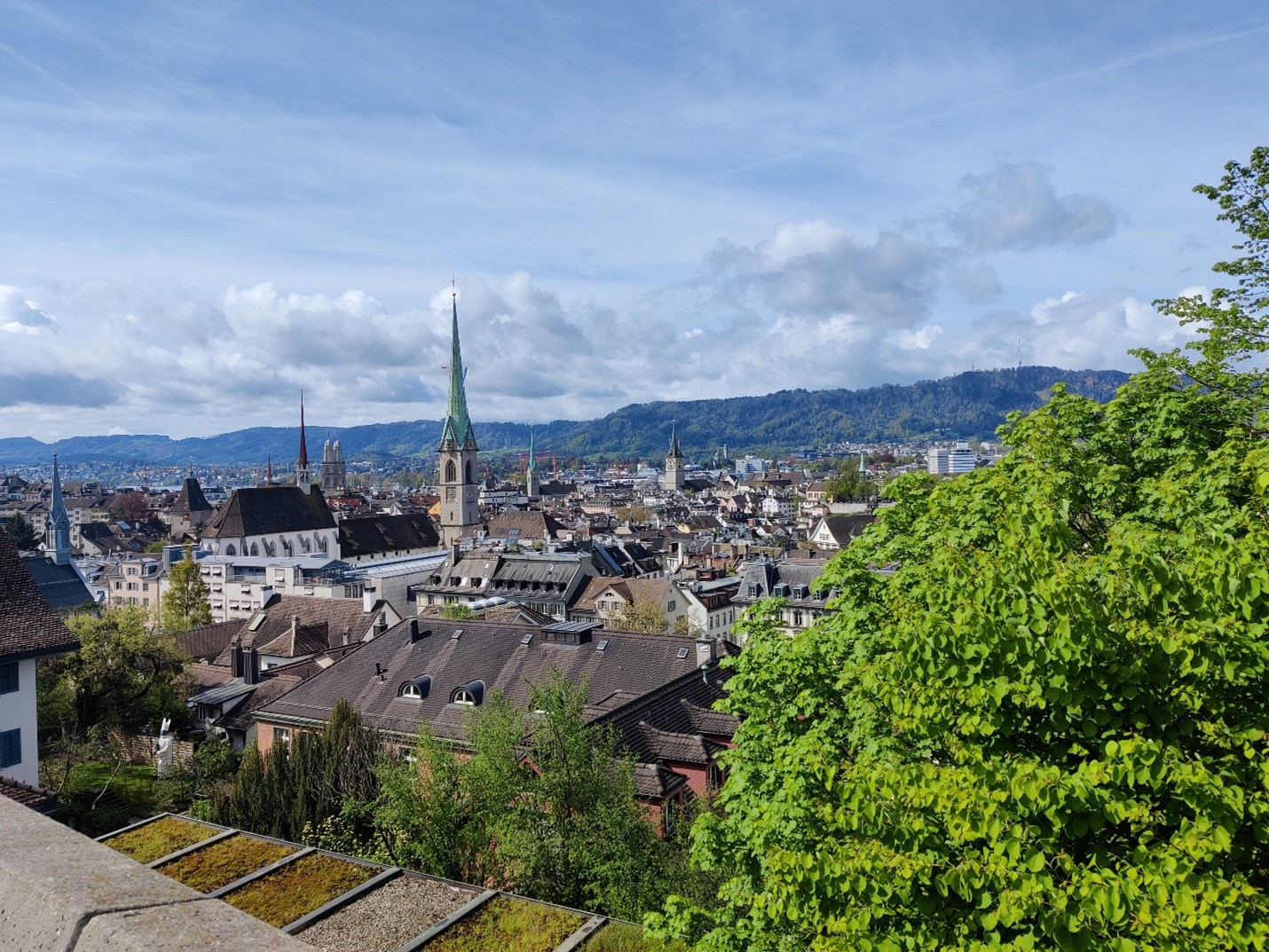
The rooftops and church towers of Zurich.

The weekends were for exploring. I wandered the streets of the medieval Altstadt (Old Town) and visited its various churches, including the Fraumünster, the founding charter of which is from 853 and on display in the church’s crypt (not going to lie, this was maybe the most exciting single thing I encountered). I explored the National Museum, the Kunsthaus (art museum), and paleontological and archeological museums, as well as the local zoo. Venturing south, I visited the town of Rapperswil to get a better view of the Alps. Fun fact: Rapperswil is home to the longest wooden bridge in Switzerland!

Lake Zürich, the Rapperswil-Hurden wooden bridge, and the Alps in the distance.

Another fun fact: If you decide to cross Lake Zürich via said bridge and take the train back to Zurich from the other side, once the wooden bridge ends after 841 meters, you are actually nowhere near the closest train station and you might find yourself walking for 5 kilometers in 23 degree heat, growing increasingly desperate and losing hope of ever reaching your destination with each step.

Against all odds, I survived to tell the tale.

All in all, I enjoyed my visit immensely. In addition to achieving all of my academic goals, I became a huge fan of Swiss bakery culture and the efficiency of public transport, expanded my knowledge of Swiss chocolate brands, and discovered that melted cheese, mashed potatoes and pickled onions make a delicious combination.

I would like to thank the English Department of the University of Zurich and the Kone Foundation for making this visit possible.

Text and photos by Ida Meerto

A long way to Arcanum: the English Department on the move

When the staff of the English Department have just moved into their brand-new premises in the newly renovated Arcanum building on the University’s lower campus at the beginning of 2023, this may be a convenient moment to take a brief look at the previous oases on the itinerary of the departmental caravan from its beginnings to the present day. There have been altogether five stops on the way to Arcanum.

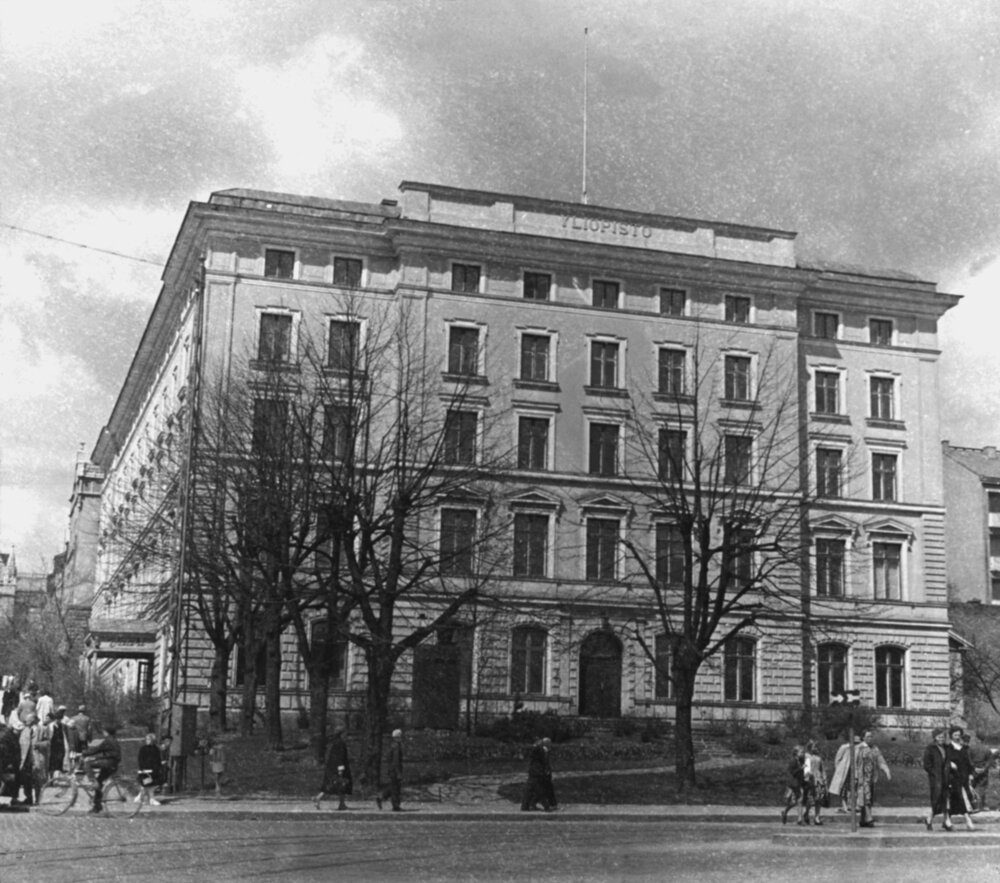
Taking the founding of the chair for English Philology in 1945 as the date of the founding of the Department, it was first located, together with the entire academic community of the new Finnish-speaking university of Turku, in the premises of the old Hotel Phoenix, a colossal late nineteenth-century building on the market square. Phoenix itself no longer exists, for it was demolished 1959.  

The building Phoenix in springtime in mid-1950s (photo from the Central Archives of the University of Turku)

Any available space for the departments in the building, originally designed for an entirely different purpose, must have been very limited, for the many functions of the new establishment, including teaching, administration and library, were housed under the same roof. As a result, there was a pressing need for expansion.

In the next phase, the University makes a move closer to the location of the old Academia Aboensis (1640) around the Cathedral. The oldest of the modern buildings on the current University hill date back to the 1950s. The Library was completed 1954 and the Main building 1958. From the mid-fifties until the mid-seventies, the English Department had its own library in three of the seminar rooms on the top floor of the Library building, within the space of present Feeniks library. In addition, there may have been some temporary space available for office hours, and the like, on the second floor of the Main building until the early 1960s.

Along with the increasing numbers of students and staff in the English Department during the 1960s, there was an acute need for more office space. At this point in the mid-1960s, the premises in Hämeenkatu 1, previously occupied by the Department of Dentistry, became available when a new building for dentistry was completed in Lemminkäisenkatu 2 in 1965.

The premises in Hämeenkatu 1 consisted of one long corridor with a number of rather small rooms on either side, originally designed for the needs of dental practices. The rooms were shared between several humanities departments, including history and philosophy. English had four rooms. One of them was the department office, and another was reserved for a visiting Fulbright professor. The other two were mostly used for office hours and consultation. Working at (and from) home was very much the norm for the staff at the time, and any joint meetings of staff and students were held elsewhere on campus.

Many of the long-standing problems of inadequate facilities and insufficient working and teaching space were resolved when a whole new building was constructed for the Humanities in Henrikinkatu 2 in 1975. The H-shaped building was originally called Humaniora II, Humaniora I having been Fennicum in Henrikinkatu 3, completed 1969. Humaniora II was renamed Juslenia, and it became a home for the Department until 2012. For the first time, most of the Indo-European language departments came to be in the same building, together with several other humanities subjects from archaeology and history to literature and cultural studies.

Having individual offices for the members of staff was one of the highly appreciated innovations of Juslenia. Also, having several teaching rooms close by in the same corridor was another welcome novelty we had not experienced earlier. Similarly, there was an easy access to the seminar library on the same floor as the Department. Yet another big change was the much-needed social space for the staff in the form of a coffee-room. With its iconic round table, this new facility had a lasting and enormously important positive impact on our social and academic interaction.

Over the years, with our initial enthusiasm gradually waning, we became more and more aware of the shortcomings of the building. Many of these had their origin in the stark contrast between the original design of the building and its practical realisation. As a result of an economic setback coinciding with the building project, the University was unable to carry out the construction, as originally envisaged. Among other things, one entire floor, containing a cafeteria/restaurant, had to be deleted from the plan altogether. Also, the surface area of each of the remaining floors had to be drastically reduced. Consequences of such dysfunctional adjustments could not pass unnoticed. They would be apparent, for example, in an awkward organization of the space, just as well as the crudish design of the interior and the limitations of available facilities. In the end, the pros for tearing down the entire building outweighed the cons for repairing it.

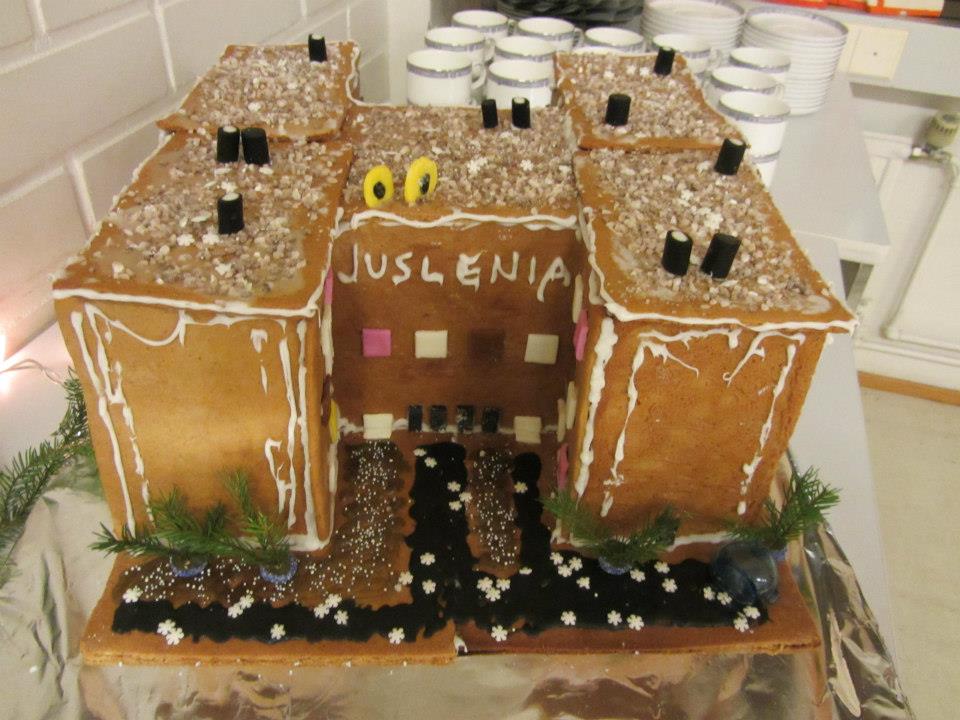
Still, in spite of its unevenness and roughness, Juslenia always brings to mind happy and pleasant memories, probably because we stayed there for such a long time, close to forty years. The final fall of Juslenia was complete in 2019, but in the Department, we had already lived through the upcoming loss by ceremonially cutting a gingerbread replica of the building into pieces of cookies at a Christmas party before leaving the building.   

Gingerbread Juslenia (photo by Mari-Liisa Varila)

Our penultimate stop before Arcanum takes us to Rosetta and its sister-building Signum, both charming old buildings from the turn of the twentieth century. After the property had become part of the University, it was renovated on several occasions for different purposes, most recently for housing the departments of English, French and German translation. Both buildings had offices and teaching rooms, and a joint library of the translation departments in Signum. After the merger of the translation departments with the respective philologies in 2010, the latter, with English among them, moved into Rosetta/Signum a couple of years after. All departments moved out of these premises by the end of 2022.  

There are many positive things to be said about Rosetta/Signum as a workplace. First and foremost, there was an atmosphere of a handsome old building about them, which was very nice. The staff rooms varied in size, but were on the whole quite comfortable, and much the same can be said about the teaching rooms. There was also a joint common room for those working in the building. My impression is that colleagues were generally quite pleased with the place and what it had to offer.

One aspect of the Rosetta building that was sometimes criticised had to do with the interior of its architecture, especially the number of doors everywhere. With the offices aligned along both sides of the numerous corridors with separating doors at both ends made the building a bit like a labyrinth, where students and visitors might have had difficulties finding their way around.

Aerial view of Rosetta and Signum (behind). Photo by Hanna Oksanen, copyright University of Turku Communications

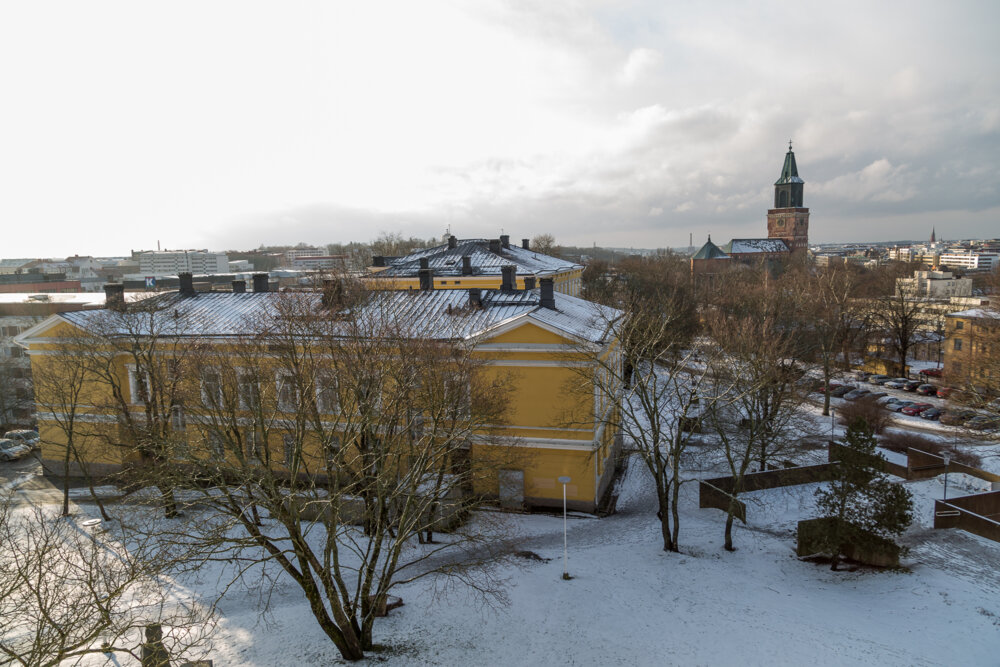
Finally, we’ll get to Arcanum. From what I have seen so far, the building is superior to all the earlier ones in a number of ways. It is not only a modern building to begin with, but one that has been very recently renovated and refurbished completely for the needs of its users. Everything is conveniently accessible and close at hand. The teaching rooms are pleasant and spacious with excellent, up-to-date facilities. Another truly great improvement is the fact that all departments of the current Faculty of Humanities are for the first time in the very same building. This is a tremendous asset for the spirit of cross-disciplinary interaction and cooperation and will, no doubt, amply prove its worth in the years to come. 

Arcanum in winter. Photo by Suvi Harvisalo, copyright University of Turku Communications

It has sometimes been said that the walls are less important in Academia; it’s more important what goes on within the walls. This is true, of course, but only up to a point. The splendid premises of Arcanum rather indicate a very close interaction between the outside and inside. When the walls are constructed in harmony with the wishes, efforts and needs of the people inside, they connect rather than separate. It is a great joy to see that our long journey from Phoenix has been brought to such a happy close in Arcanum.

P.S. I am grateful to Teppo Jakonen and Janne Skaffari for their help in the preparation of this contribution. Teppo very kindly assisted in finding the photographic illustrations.

Text by Risto Hiltunen

Finding the Right Answers in Fiction

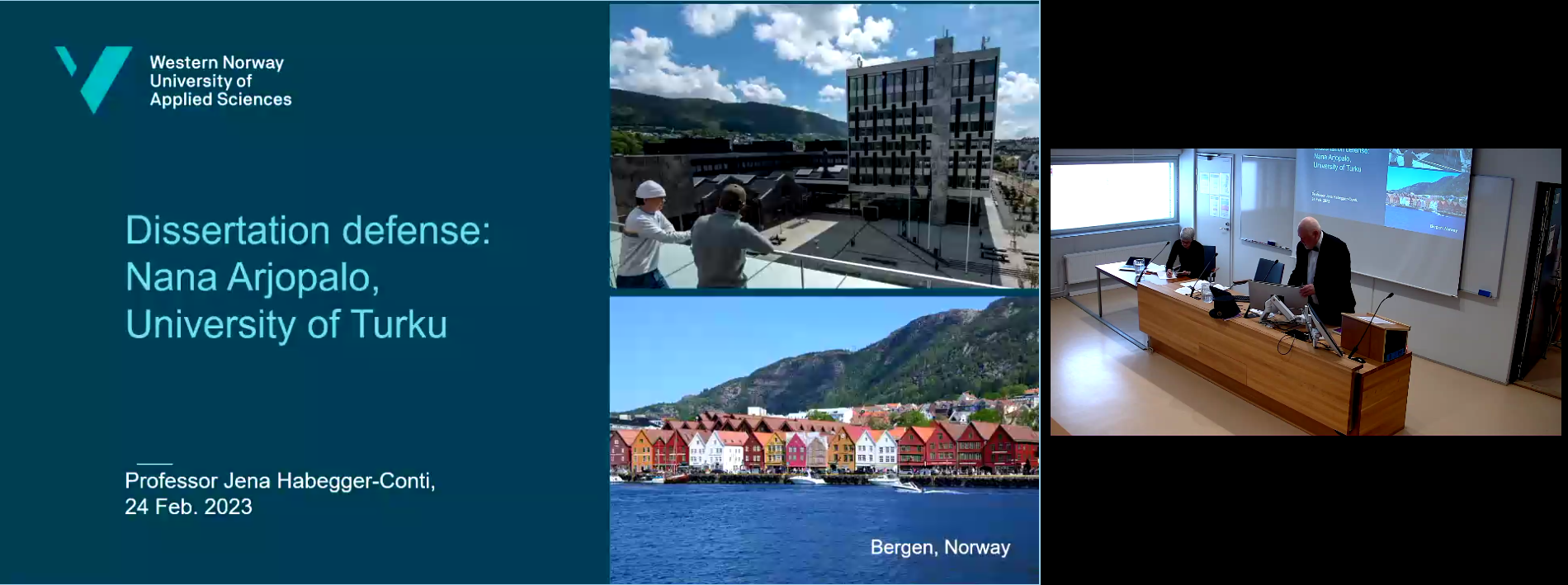
Nana Arjopalo gave an outstanding performance defending her doctoral dissertation Narrating Deliverance: The Literary Double in the Writing of Chitra Banerjee Divakaruni, Jhumpa Lahiri, and Bharati Mukherjee on Friday, February 24, 2023. The viva was a true celebration of literature and the impact it has on humanity.

Professor Joel Kuortti testing the connection, picture and sound. Screenshot by Olga Harrison

The event was kindly streamed online via Echo360, the connection allowing remote viewers such as I to watch and listen to it closely. The broadcast began around 30 minutes before the actual event, and the early viewers had a chance to follow final preparations of the ceremony. The defense itself began at 12:15 with Nana Arjopalo proceeding to her microphone, followed by Professor Joel Kuortti acting as custos and Professor Jena Lee Habegger-Conti as the opponent.

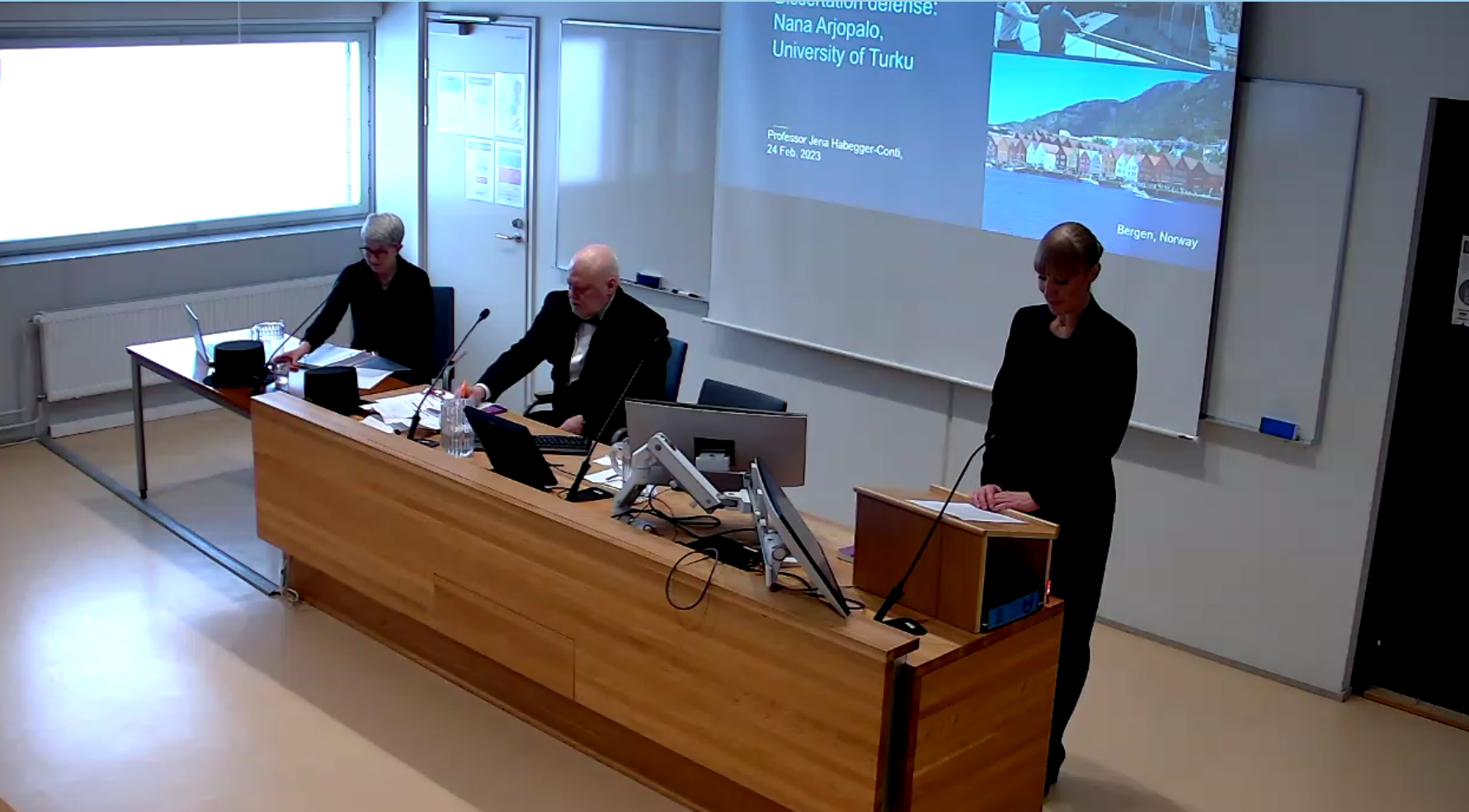
Doctoral Candidate Nana Arjopalo giving her lectio praecursoria. Screenshot by Olga Harrison

Arjopalo gave the lectio praecursoria in Finnish, covering both personal and theoretical aspects of her dissertation. Arjopalo has been an avid reader ever since discovering the fascinating world of fairy tales in her childhood. In her speech she emphasized the significance of literature to humanity. The viewers learned how fiction may offer a space to process life even better than biographical literature, as it helps one to work on personal and collective trauma, and offers a connection to others, even if one is physically away from a community. Arjopalo concluded that the right answers emerge when one asks the right questions.

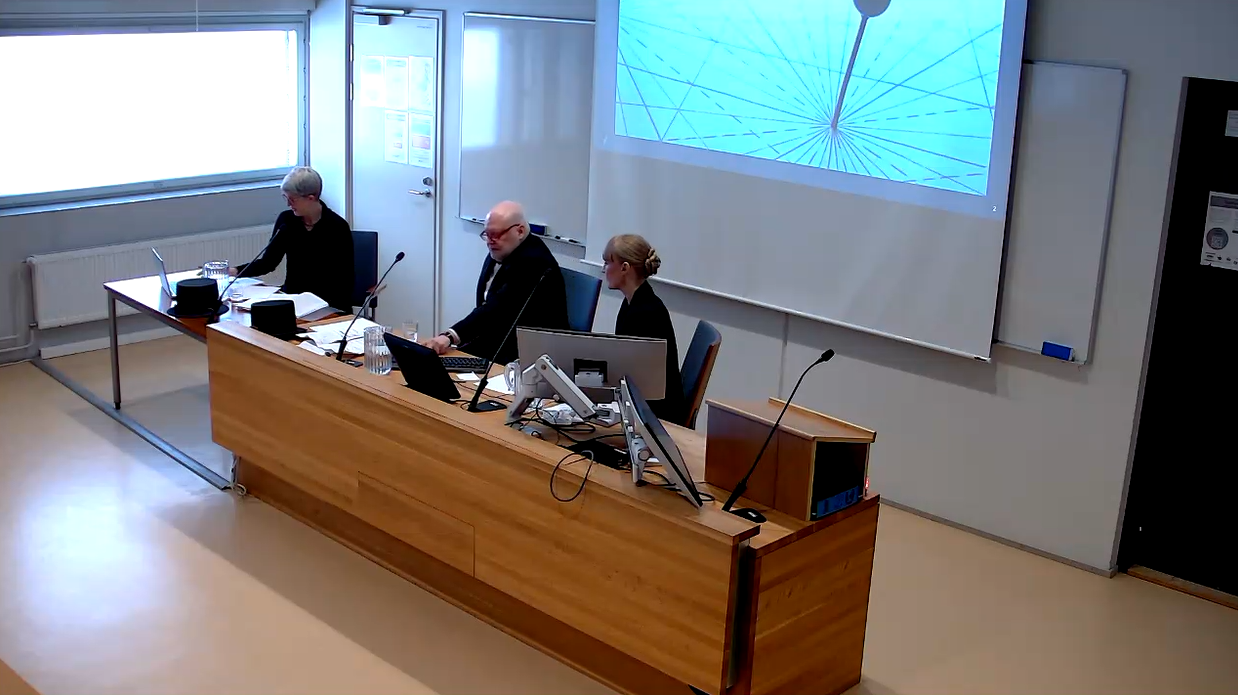
The questions followed, in English, as the opponent presented her assessment and critique of the dissertation. Professor Habegger-Conti was interested in an array of subjects from the positioning to critical regionalism. Despite the range of the issues covered, the conversation flowed smoothly. There was a great deal of agreement between the opponent and the doctoral candidate, and even some terminology discrepancies were resolved without a major dispute. In her concluding words, Arjopalo stated that the discussion was reflective of the work that she had done, and that she had succeeded in making the reader draw specific conclusions from her dissertation.

Professor Jena Lee Habegger-Conti discussing Positioning. Screenshot by Teppo Jakonen

Professor Habegger-Conti was evidently pleased to read and discuss the thesis, and ultimately recommended the faculty to accept the doctoral dissertation. As there were no questions from the audience to add to an hour-and-a-half long discussion, Professor Kuortti declared the event concluded. The newly-proclaimed Doctor of Philosophy Nana Arjopalo received congratulations from the numerous audience members on-site, and invited everyone present to further celebrate outside the lecture hall, where Echo360, unfortunately, did not follow.

That set aside, it was, indeed, a pleasure to follow the doctoral defense in literature and to be reminded about the importance of asking the right questions. Congratulations to Nana Arjopalo, Ph.D., and best wishes for her future endeavors!

Text by Olga Harrison

Becoming an English teacher in Namibia and Finland

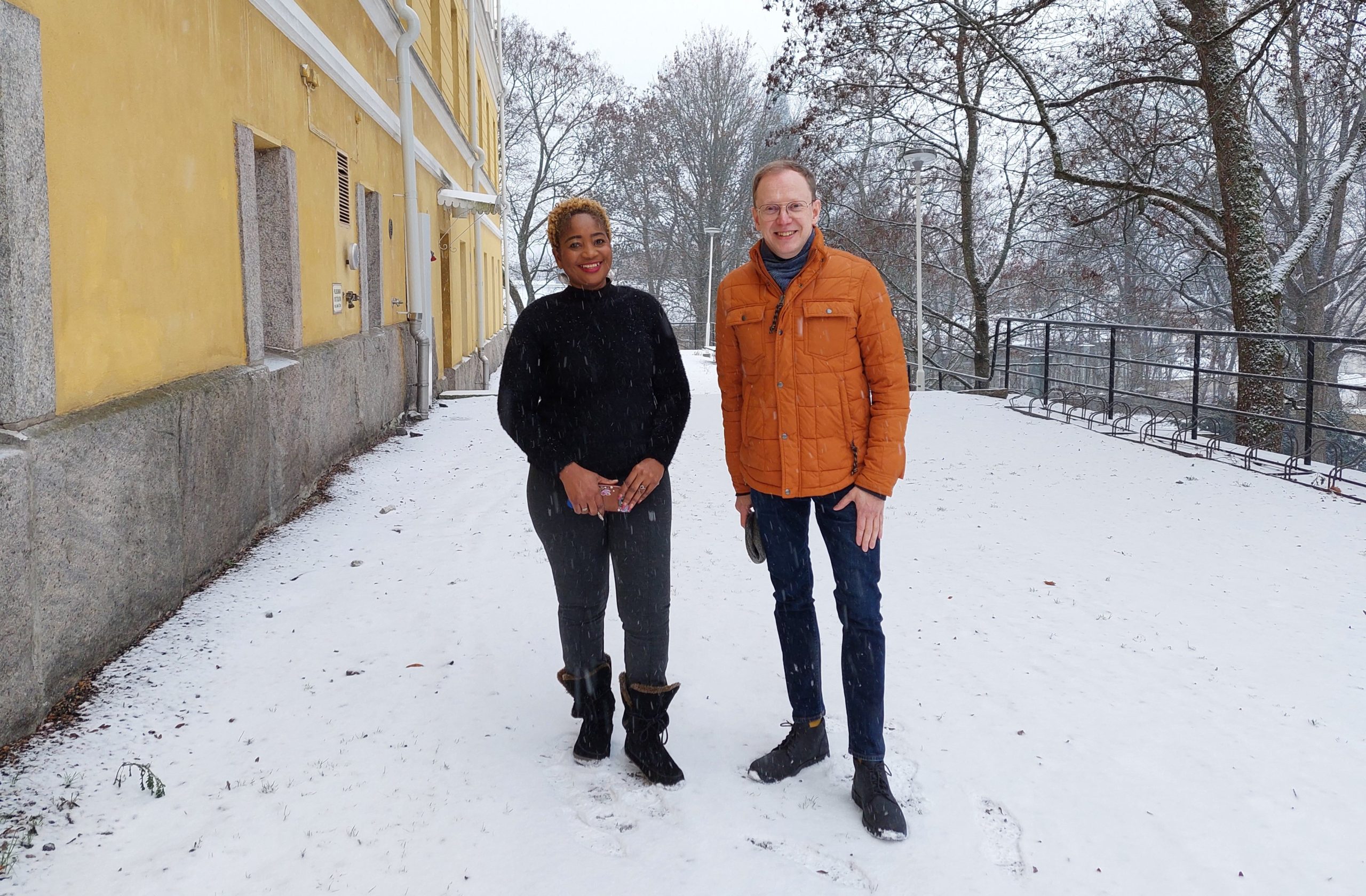
This autumn, the School of Languages and Translation Studies has had a visitor from the University of Namibia (UNAM), Dr Meameno Shiweda, who is a specialist in teacher education. In this blog post, Meameno and Janne Skaffari talk about similarities and differences in what and whom they teach and, more broadly, in the educational systems of our two countries.

Janne: How does one become an English teacher in Namibia?

Meameno: Anyone with an interest in teaching English can enrol in a teacher training program for junior/senior primary or junior/senior secondary levels, provided that they have good grades in five subjects, and a minimum of a C grade in English at Namibia Senior Secondary Certificate. A minimum C grade in another language is also a requirement. C is roughly the same as cum laude or magna in your matriculation exam.

J: It is quite different from Finland, where you apply to study English as your major or minor at university, and teacher training is basically a minor subject that corresponds to one year’s work. It is often completed as part of the MA degree. This route is for secondary-school English teachers, but for primary schools, you do not necessarily need more than a primary-school teacher’s university degree in Education. When does English begin in your program? Our majors do English Department courses from the first semester on.

M: Throughout their four years of teacher training, our students receive a mix of English modules and teaching-methods training. English majors also commence from the first semester onwards, and they are taught by English subject specialists from various departments in the School of Education. The first year begins with phonetics, phonology and children’s literature, and in the second year they focus on speaking and youth literature. The third year is reading and writing, while the fourth and final year is adult literature and grammar.

J: Oh, grammar comes that late! What kinds of observations have you made about teaching and studying during your visit?

M: The length of time a student studies English before having to determine whether or not they want to become English instructors is an important observation I have made here. Additionally, I have learned that prospective teacher-training students are interviewed to gauge their level of preparedness for the teaching profession, as opposed to our practice at UNAM.

J: We think it is important that students have time to become familiar with their major and minor subjects at the BA stage and then focus more on a particular career during MA studies.

M: I’ve learned from my experiences here and from talking to colleagues that getting extensive English training before concentrating on a teaching job is more realistic.

J: Yes, we really hope it helps! Students also get to see that there are other career opportunities.

M & J: We wish all our students – in Namibia and Finland – good luck with their studies and future careers!

Text by Meameno Shiweda & Janne Skaffari

Photo by Teppo Jakonen

A DOCTORATE will be given for the completion and defense of a dissertation

Susanna Mäkinen defended her doctoral dissertation, Stability and variation in the genre of runaway slave notices in American newspapers 1704-1865, on Friday 20 May 2022. While the never-tiring doctoral researchers of the English department have produced quite a few dissertation and vivas to accompany them in the recent years, Susanna was the first one to enjoy the full traditional experience of a doctoral defense, complete with the opponent actually present in the same room and a karonkka (held at the iconic Turku Castle, an excellent choice of location by the way), since the beginning of the pandemic.

The opponent, custos, and candidate

The viva took place in the Tauno Nurmela hall and drew in quite a crowd. The viva was also streamed on Echo for those unable to attend in person. The viva started right on time at 12.15, with Professor Matti Peikola as custos, even though the arrival of the opponent Professor Terry Walker (Mittuniversitetet, Sweden) had been slightly delayed (if nothing goes wrong, did the event even happen?).

With everyone present and accounted for, Professor Peikola welcomed everyone to the viva. Susanna delivered the lectio praecursoria, a short oral presentation of the research and its significance. Susanna and Professor Walker then proceeded to have a lively discussion on the dissertation. The discussion ranged from the terms used in the dissertation to the choice of a chapter title and the reasoning behind choices made regarding the material (which includes 2603 runaway slave notices), methods and analysis. While Professor Walker presented Susanna with several tough questions, Susanna handled them beautifully. The discussion was relaxed throughout the defense and both the opponent and the doctoral candidate seemed to truly enjoy themselves, which was a joy to watch. The discussion took about an hour and a half, but the time seemed to fly by (at least for yours truly, whether the candidate agrees is unclear at this time).

Defending your dissertation is fun!

The viva marks the end of an often long and significant period in a researcher’s life. Years of work has been poured into the dissertation, which is then publicly defended. When asked what she would do differently now that she has gone through those years of labor, Susanna lamented on her apparently less than ideal note-taking, but noted that when it comes to the dissertation itself, “I’m pretty happy with what I’ve done.”

What more could a researcher at their doctoral defense ask for than a dissertation they are happy with? Not much comes to mind.

Congratulations to Susanna on this amazing achievement and the best of luck in your future endeavors! 

Text by Ida Meerto

Photos by Timo Savela

Defenses during Covid: Traditions and pandemics

Sirkku Ruokkeinen defended her doctoral dissertation, Historical appraisal analysis: evaluation of the book in sixteenth-century England, on Saturday 4 December 2021. The defense is a culmination of years of work, and as such, often a stressful event. While the dissertation itself is naturally the focus of the years prior, the event itself has its own traditions and challenges, especially during covid. Below, Sirkku Ruokkeinen writes about defenses, traditions, and her experiences thereof.

My defense in December 2021 was the sixth the University of Turku English department has had during covid times. The pandemic influences any events at the university, and the defenses are no exception, so there were some minor changes to the defense to follow the University Covid guidelines.

Preceding the defense, there is a long list of practical matters to tend to. The candidate must have the dissertation printed and distributed. The press releases are written by the candidate and delivered to the university communication services. The electronics and connections in the space reserved for the defense have to be checked. There is also some limited communication between the candidate and the opponent – in this case Prof. Claudia Claridge of Universität Augsburg – about the practicalities such as setting up the defense practice Zoom event and the defense Zoom event itself. The opponent also needs to be informed of any changes to the dissertation made based on the pre-examiner comments, so that they know how the issues pointed out have been resolved, and may address them further in the defense with the full knowledge of what the candidate has said on the topic.

The defense itself took place through Zoom, but also had open admittance for a live audience. This two-media aspect brought its own challenges. For example, the traditional formulae of the lectio praecursoria and defense invitations had to be well thought out, with special consideration given to who is being addressed: the audience in the room, the audience at home, or the opponent in zoom. Issues of digital and technical nature had to be considered in advance, so as to be prepared to fix any issues as quickly as possible. I was fortunate to have knowledge and experience on my side, as the custos and marshal (Prof. Matti Peikola and Dr Janne Skaffari) had participated in several pre- and post-covid defenses and could advise me on best practices.

The defense is a rather formal affair, which I always felt was a quite sharp contrast to the generally laid-back atmosphere in the Finnish universities. This, of course, reflects the importance of the event as the threshold to the highest available academic degree. The customs are largely dictated by the university. For example, the presence of a custos, who acts as the master of ceremonies, is degreed by the University guidelines. Other customs are more specific to the department or school, such as agreements about the dress code and the setup of the auditorium.

There are some traditions for the evening party as well. The karonkka – a party thrown by the candidate in celebration of the opponent – is traditional in all Finnish universities. Unfortunately, my opponent could not be present, and hence no karonkka in her honor could be arranged. Instead, I enjoyed some bubbly after the defense with my closest colleagues and friends. Although the karonkka could not be arranged due to the present situation, I was able to enjoy the English department traditions. Firstly, I received a most magnificent new cover design for my dissertation from the department. The new design is made with one goal in mind: to joke around with the doctor in spe under the guise of popularizing the research. The alternative covers have been prepared for all new doctors within the department since 1983 – a tradition that began with Professor Emeritus Risto Hiltunen’s cover. I also got to enjoy Historical Appraisal Analysis: THE MOVIE, prepared by the Philological Colloquium. This tradition, particular to the philologists of the department, involves the preparation of a play or other new rendition of materials found within the dissertation.

All in all, although the pandemic offered some complications to the arrangements, the event itself went well, the celebration afterwards was lovely. Most importantly, the evaluation committee recommended that the dissertation be awarded the grade “pass”, and I could begin my Christmas holidays.

Text by Sirkku Ruokkeinen

Photos by Janne Skaffari

75 Years of the Joys of English

The Department of English became a subject department at the University of Turku 75 years ago in 1946. In 1980, translation studies were transferred from Language Institutes into the university, and were merged with the philology departments in 2010. We celebrated this anniversary on Tuesday 14 December 2021. The Corona epidemic had postponed the occasion but this did not defeat the festive spirit.

Professor Emeritus Risto Hiltunen chronicling the department’s 75-year history — and beyond.

The programme of the seminar included an overview of the history of the department by Professor Emeritus Risto Hiltunen. He took us through the years from the first chair in English held by Yrjö M. Biese (and even earlier times) to the gradual expansion of the department, the merger of philology and translation departments and the introduction of the 2010 Universities Act that changed the juridical position of Finnish universities, until the present.

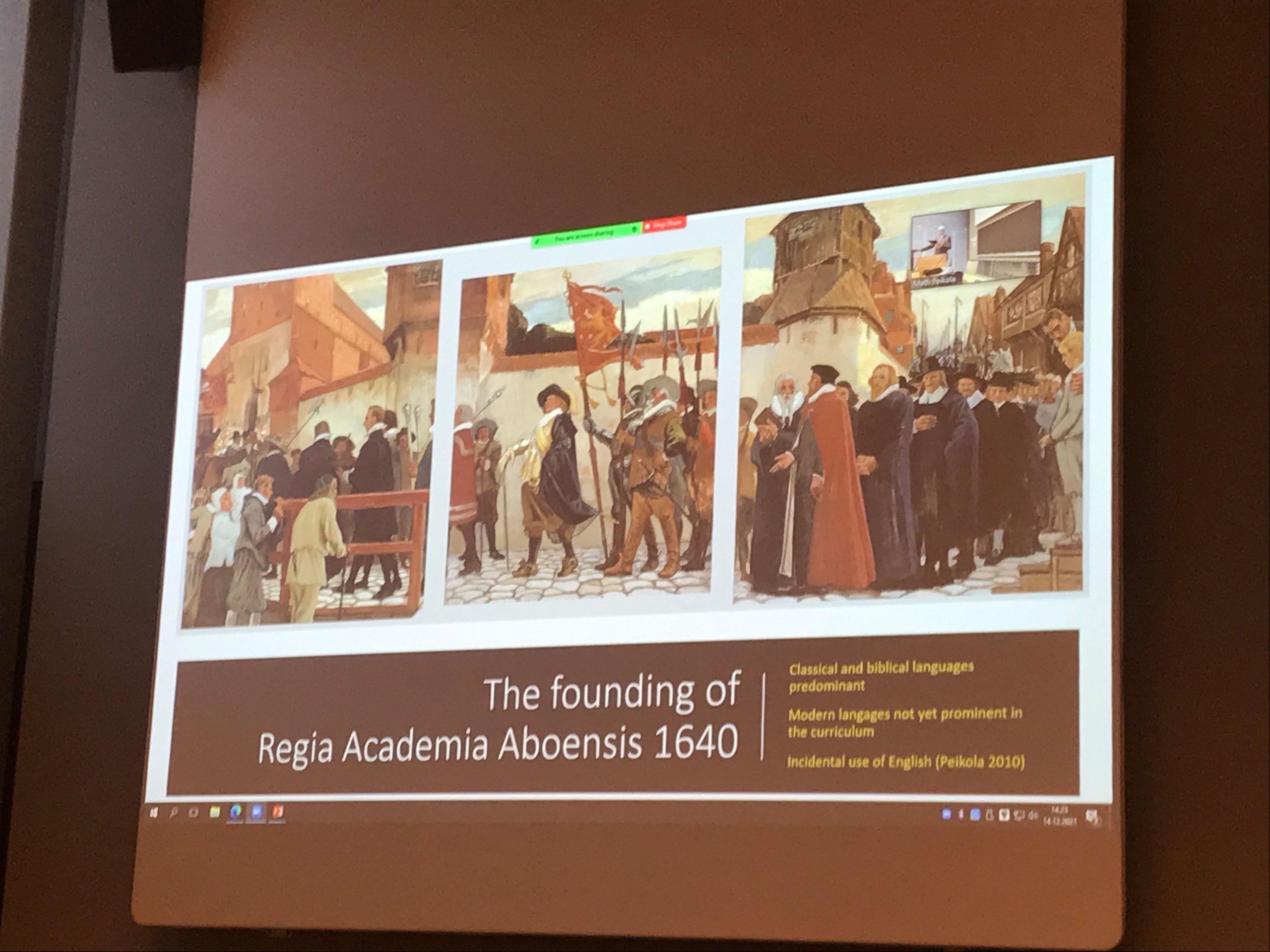
Risto’s speech reached all the way to the history of Academia Aboensis, the origin of university-level study of languages in Turku.

Risto’s presentation was followed by a panel discussion chaired by Professor Matti Peikola, representing our alumni and present students: Taru Savolainen, Miika Katajamäki, Maija S. Peltola, Sanna-Kaisa Tanskanen and Marianna Sunnari. All the panelists had started their studies in different decades, and have had different careers, and were thus a very good cross-section of the Department. The discussion was very lively and higlighted various sides of the Department’s history and the people who had worked and studied there.

The alumni panel offered various views on studying English at Turku. All positive!

One of the highlights of the event was the presence of Professor Emerita Liisa Dahl. Liisa followed Inna Koskenniemi in the first English Assistant Professorship after Inna toook over Yrjö’s Professorship. Another delightful highlight was the tea and coffee service that we had at the end – provided by the ever so wonderful students of Anglica.

At the event, we also witnessed the publication of MM Examina: Two Thousand Theses from the Department of English, University of Turku 1950–2020 edited by Joel Kuortti. This volume, fresh from the printers, follows the former M Examina (edited by Janne Skaffari in 1995) by listing a thousand more theses and dissertations from the Department that have been completed after the 50th anniversary in 1995.

Current head of department, Professor Joel Kuortti, showcasing the new MM Examina bibliography. Professor Outi Paloposki (right) taking a photo in turn!

All in all, the event brought light and joy to a dark winter day in a time otherwise burdened with long-standing and widespread troubles and uncertainties. It gives great pleasure to celebrate with such a great bunch of people – past, present, and future!

Text by Joel Kuortti, Professor, Head of Department

Photos by Janne Skaffari and Elina Valovirta

Defending alchemy

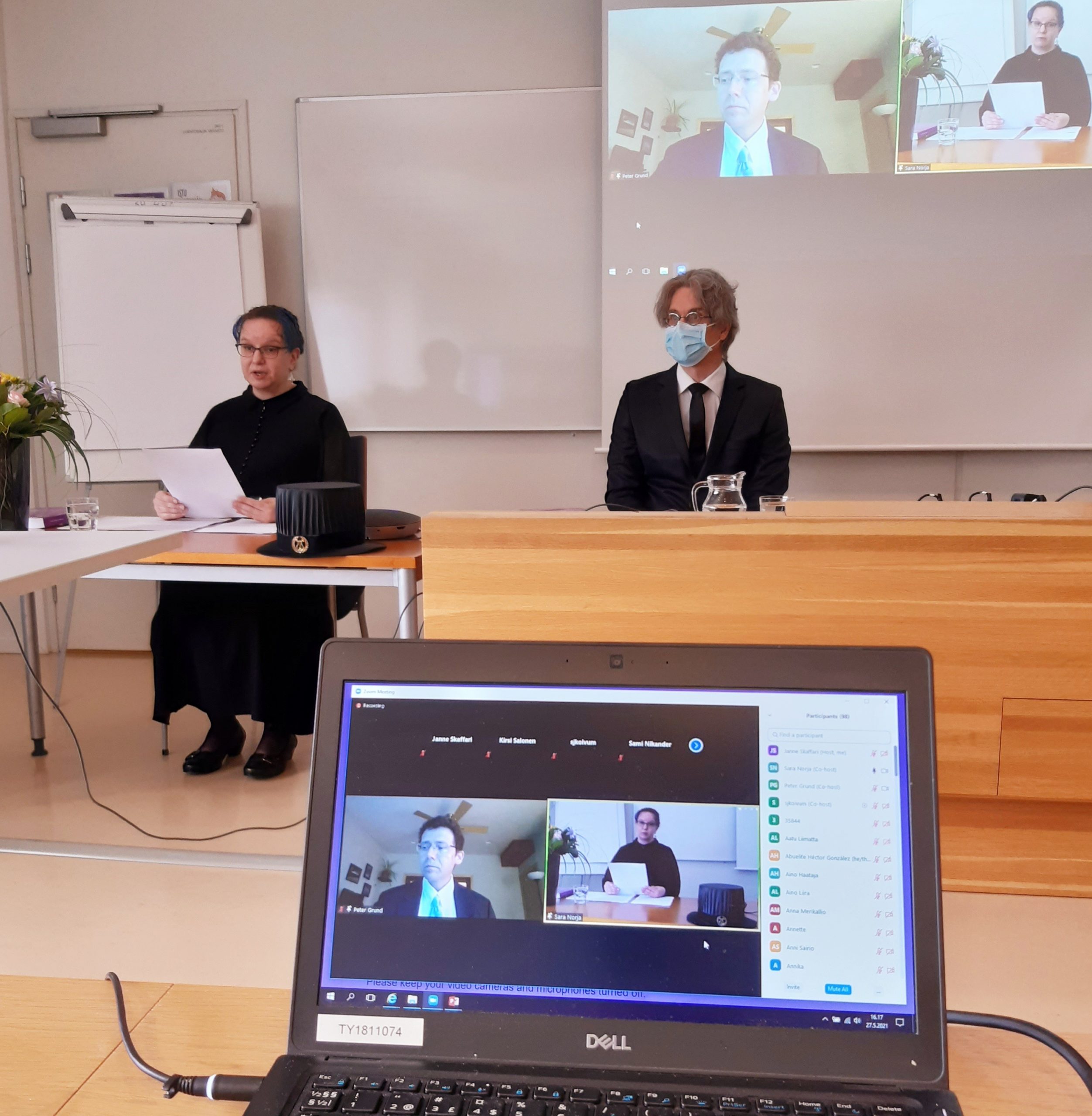
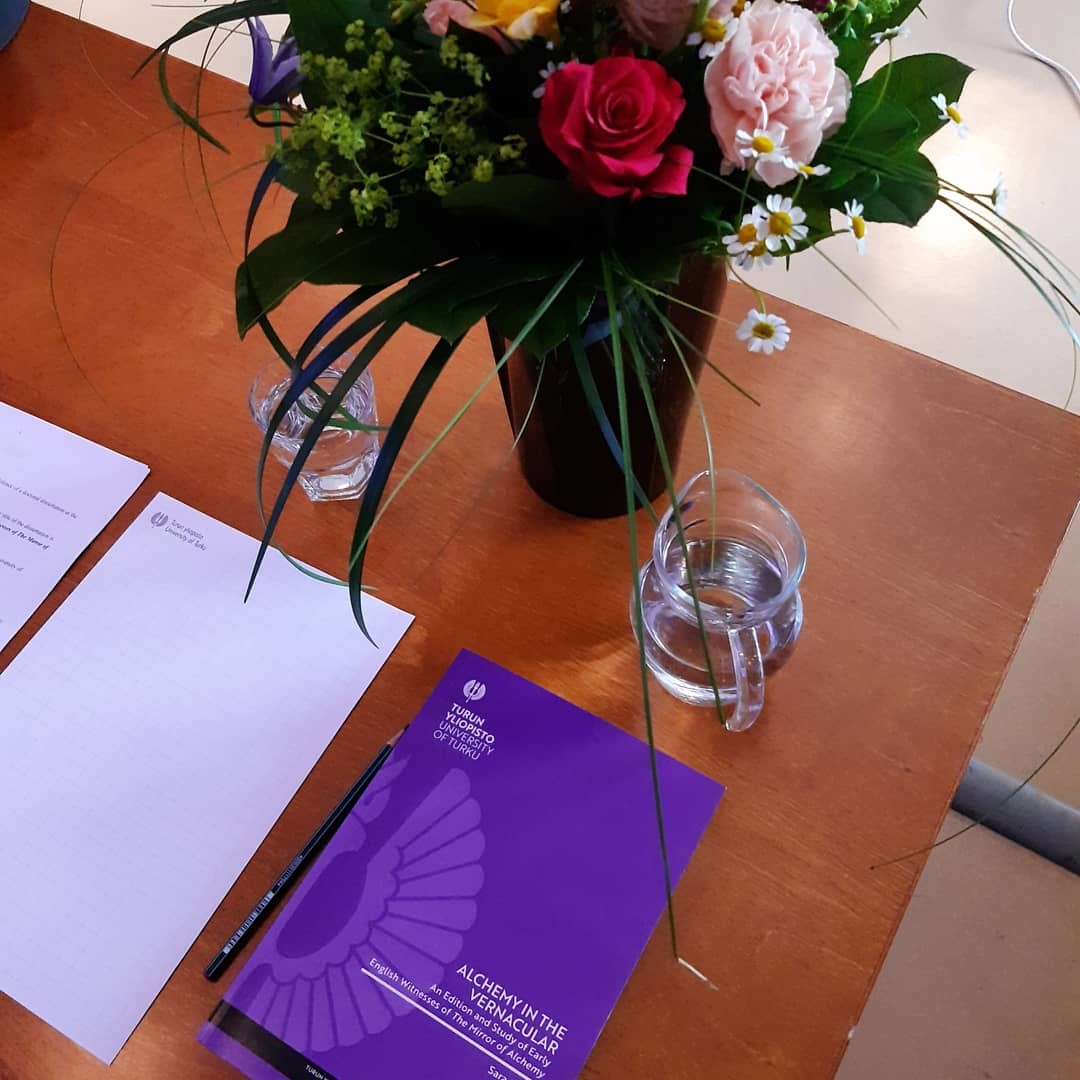
Doctor in spe Sara Norja defended her doctoral dissertation, Alchemy in the Vernacular: An Edition and Study of Early English Witnesses of The Mirror of Alchemy, on Thursday 27 May 2021. Here, she writes about the viva and the days leading up to it.

Due to the pandemic the viva was on Zoom, so the arrangements were a little different from usual. I wasn’t able to have a karonkka – the traditional academic afterparty following a viva. I can’t deny I would have loved to have one, but having fewer things to organise before the viva was also a relief, as the week of my defence was a busy one.

On Monday we had a Zoom rehearsal in the Educarium lecture hall where the viva would be broadcast from. Professor Matti Peikola and Dr Janne Skaffari (my PhD supervisors) were there with me in person, as Matti was the custos and Janne was the marshal (airut) in charge of Zoom proceedings during the viva. We had a short Zoom call with my opponent Professor Peter J. Grund (University of Kansas), and sorted out all the technical matters. It was a relief to see the room I would defend my dissertation in, and to make sure that the connections all worked!

On Thursday 27th, the day of the viva, the nerves hit me. It was good that the viva was as late as 16.00 (due to the time difference with Kansas), because despite the gnawing feeling in my belly, I even managed to eat lunch before it. However, once I was actually in Educarium and the viva was about to commence, I calmed down. The final minutes before turning on the video and sound on Zoom were the longest I’ve ever known, though!

The custos Professor Matti Peikola and I sat down in front of the camera, facing the lecture hall with six other people in it (our technical support Satu Koivumäki, Janne, and four of my family members). Quite different from the experience of sitting in front of a bigger live audience! However, I knew there were lots of people watching through Zoom, so the audience online was huge. I tried not to concentrate on that, though, but to focus on my opponent, who I could see on the screen set up opposite me.

I felt unreal – was this major event actually happening after seven years of working on my dissertation? But once the viva officially started with the customary opening words, and I began giving my lectio praecursoria (the traditional speech given by the PhD candidate at the start), everything started to flow. I gave my lectio, and asked Professor Grund to present his criticisms of my dissertation. He gave his opening statement, and then we proceeded into the questions.

I had been told previously that once the defence actually starts, it can be a delightful experience as well as a scary one. This was certainly true for me. Professor Grund asked some pretty tough questions, but I discovered that it was incredibly rewarding and fun to answer them and to discuss my dissertation with him. He was the best opponent I could have hoped for. By the time Professor Grund had given his concluding statement and the viva was over, I was fizzing with excitement and pent-up nerves. The defence was concluded by the custos, and we could proceed to congratulations.

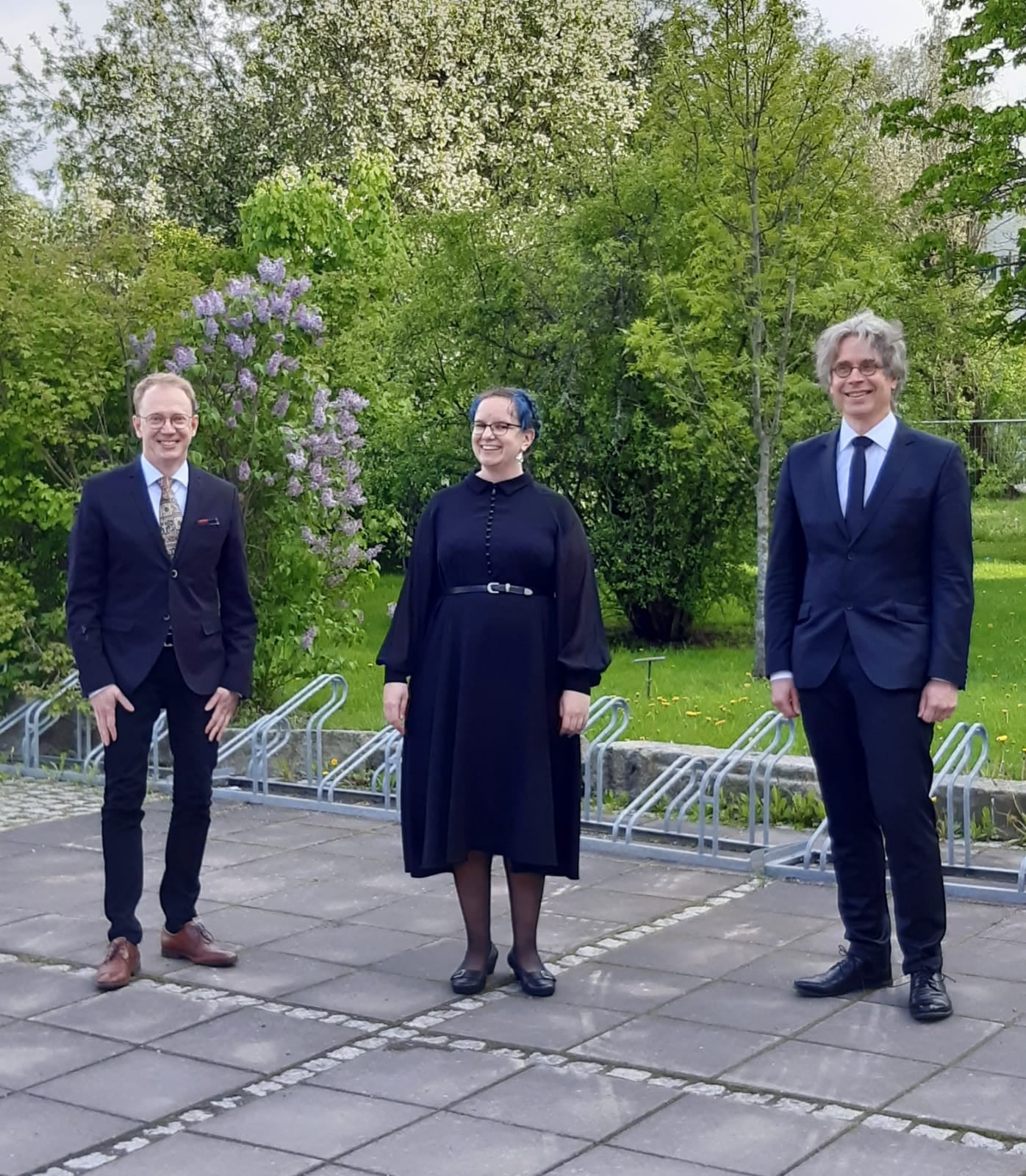
Relieved smiles after the ordeal!

Even though the pandemic meant I couldn’t have a proper karonkka, we rounded off the evening with a lovely outdoors event with a small number of my colleagues from the Department. Some excellent traditions were upheld despite the pandemic, and overall the day will stand out as a landmark event in my life.

Text by Sara Norja

Photos by Janne Skaffari and Mari-Liisa Varila

A year of remote learning – and cats

What a year it has been! This could easily be a long blog post about the effects of the pandemic on teaching and learning and what pedagogical solutions have been implemented and experimented with at the department, but today we have more important things to discuss. We need to talk about cats.

This year has been extremely active for all our cat students and cat faculty members. They seem to thrive particularly in Zoom environments and have throughout the year been a mainstay for remote learners and teachers. Let’s hear from notable cat members of the English department community – and one dog. Email interviews have been facilitated by each cat’s staff.

Kiki via Vilma Lindroos:

Due to remote learning this year, I have seized the opportunity to constantly remind Vilma that the most important thing in her life are not her studies, but me. She reports that my ears perk up at the slightest sound of conversation, ready to disrupt yet another lecture that dares to take her attention from me even for a minute. Petting me in her lap does serve her as a great stress relief when she is tackling a particularly intimidating task, so I always win.

Behold as I conquer, says Kiki.

Alma, Hilja, Lohtu and Kulju via Elina Valovirta:

Elina works from an old renovated outbuilding at our country home. We use it as our Signum’s Kaffila or Rosetta’s coffee room. Whenever Elina heads to the outbuilding to work, we follow, eager to not help. A collective napping session might ensue; Alma the opera singer might decide to belt out an aria, or Hilja and Kulju decide a wrestling match is in order right in the middle of Elina’s lecture. Lohtu begs for treats on the work desk. We have done our very best in not helping at all, and what’s not to love about that?

I can haz treat?
I can haz treat? Says Lohtu.

Elo and Fox via Minna Hjort

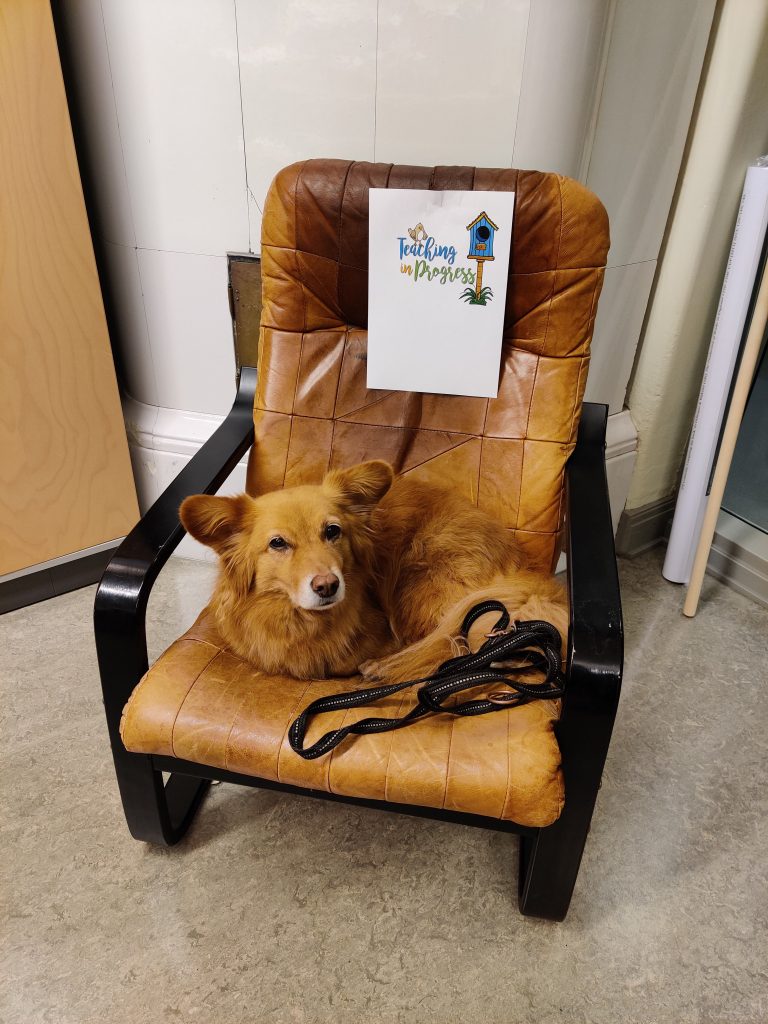
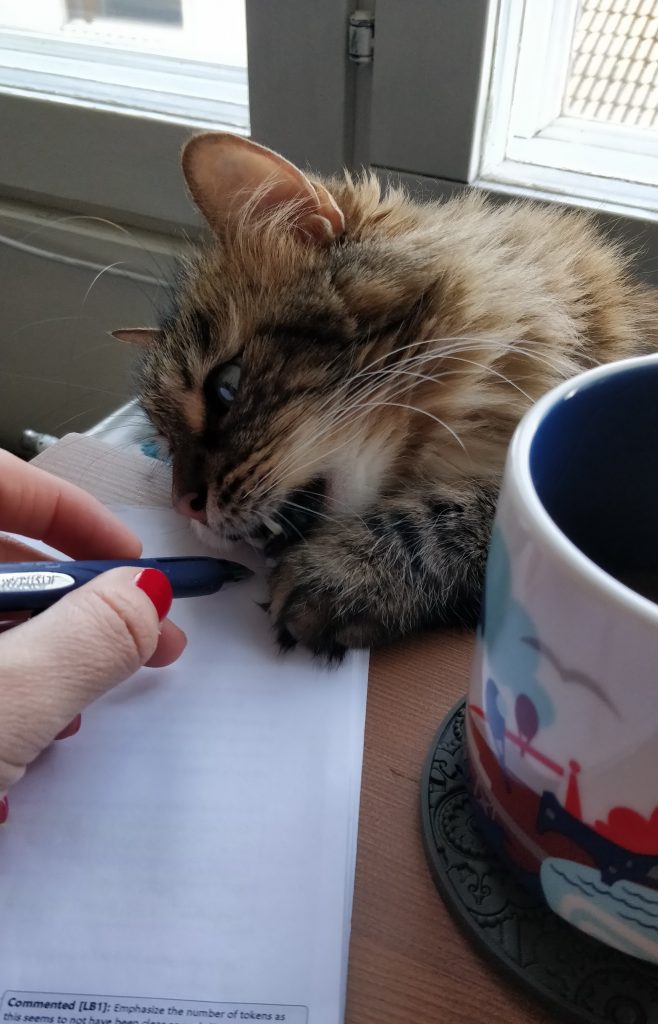
Fox has been an active co-teacher throughout the pandemic. He has not been afraid to speak his mind about a variety of topics, including the shocking fact that the department offers no classes on dog-human translation. Elo, the cat that she is, has been less interested. Although once she did find it necessary to position her butt right in front of the camera in the middle of a lesson. Occasionally she also assumes the role of reviewer 3 (see picture) and engages in document disposal management (shredding papers).

Teaching in progress. Don’t disturb me, says Fox.
I am destroyer of all papers.

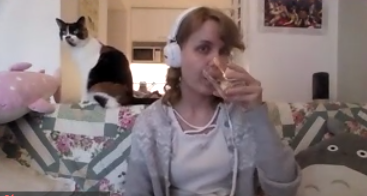
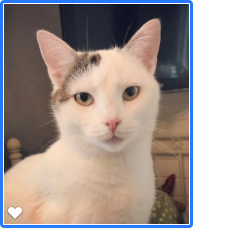
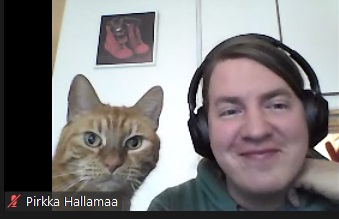
Finally, Pirkka Hallamaa, has found a way to look his best on camera: his photogenic cat provides the ultimate Zoom accessory: the cat filter.

Don’t hate me because I am beautiful.

Text by Elina Valovirta

Photos by staff and screen grab.