Two days to go: Upcoming defense on second language speech fluency

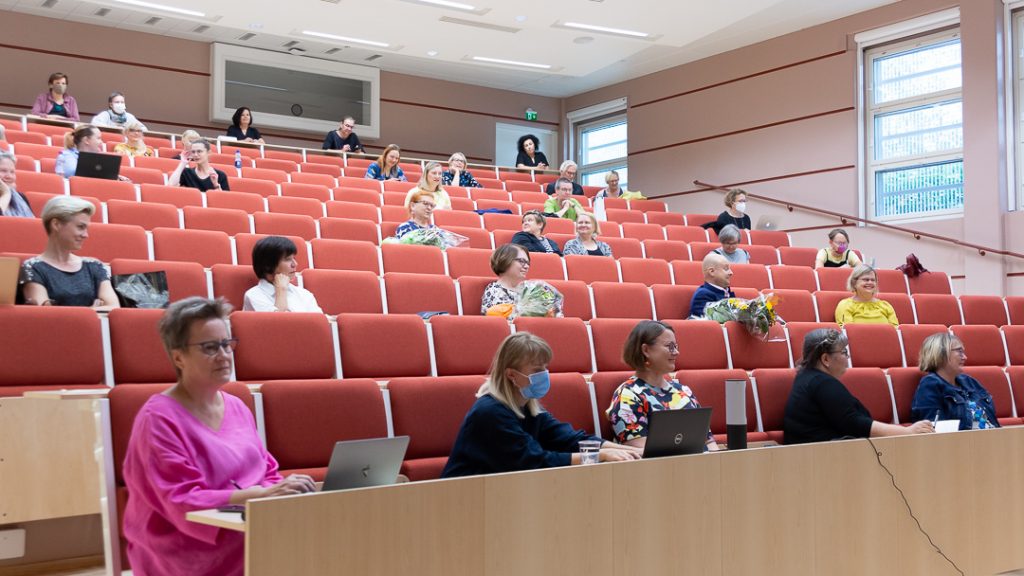
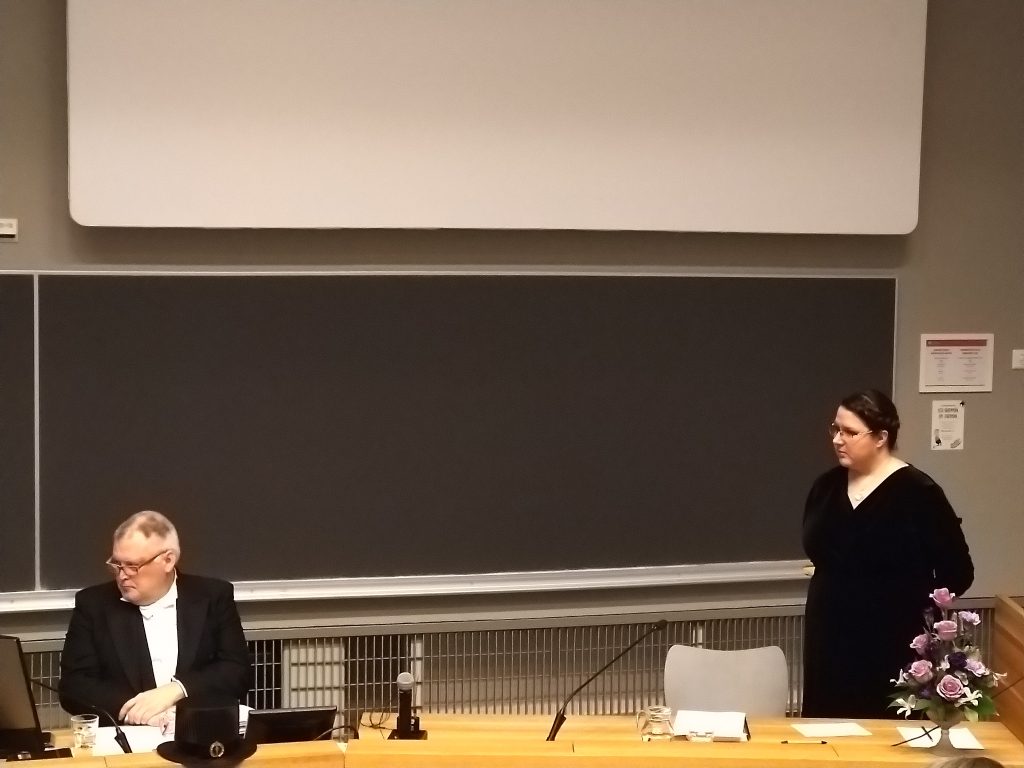
Doctoral candidate Pauliina Peltonen will defend her PhD dissertation entitled Individual and Interactional Speech Fluency in L2 English from a Problem-solving Perspective: A Mixed-methods Approach this week on September 11th, 2020. The audience will be able to follow the defense online via Zoom. Professor Judit Kormos from Lancaster University will be the opponent and Dr Pekka Lintunen will act as custos.

A doctoral defense is the final part of postgraduate studies: it is the end of one process, but also the beginning of another phase, postdoctoral studies. Defending your PhD is both exciting and nerve-wracking. You finally have the chance to talk about your research and what you have been working on for years. However, the opponent asks the questions, and the task is to react to those questions in the best way possible. Custos is the chair of the public examination of a dissertation and often the supervisor of the doctoral candidate. Normally the custos has to do three things: say one sentence to start the examination, another one to end it, and most importantly, sit quietly but stay awake during the examination—not always an easy task!
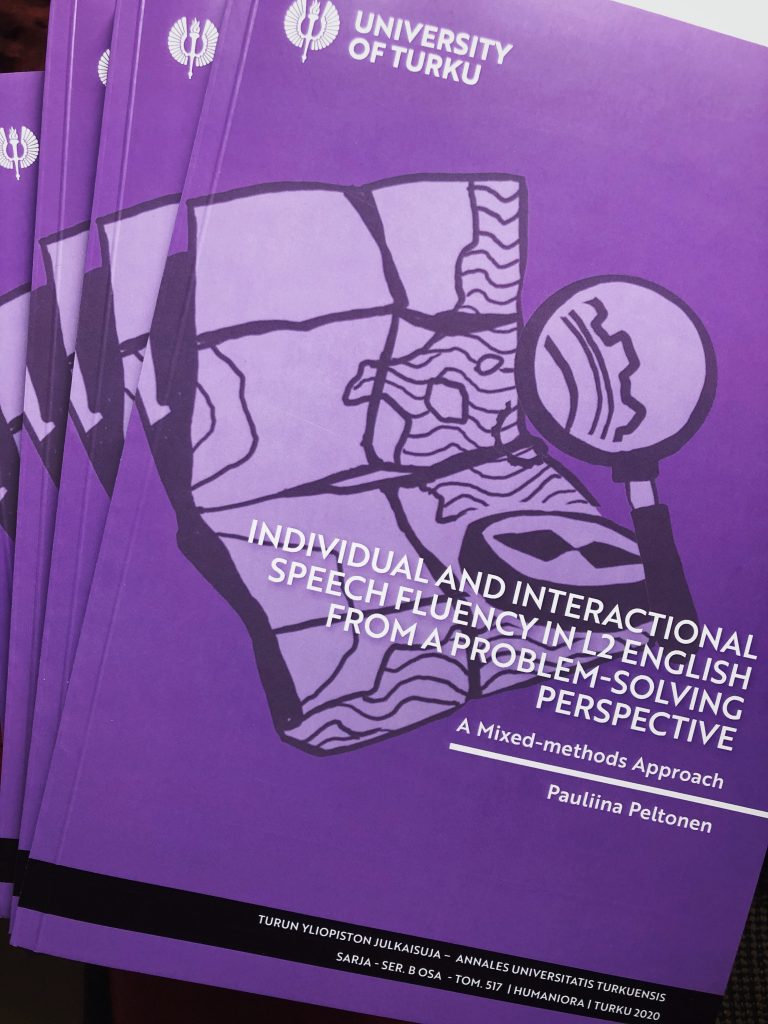
Pauliina’s dissertation addresses a central aspect of second language (L2) proficiency and speaking skills: fluency. In the dissertation, she examines L2 speech fluency and learners’ resources for maintaining it based on monologue and dialogue speech samples. Fluency is analyzed with a variety of traditional temporal measures (e.g., speech rate and silent pauses), but also from the perspective of so-called fluency resources that can help to maintain speech fluency (e.g., filled pauses, such as uh/um, and repetitions).

The findings show that L2 speech fluency is a multifaceted phenomenon. Fluency should be studied with a combination of quantitative and qualitative methods: the mixed-methods approach provides a more comprehensive picture of fluency than either approach alone. The study also shows that fluency can be viewed as a collaborative phenomenon, while traditionally, fluency has mostly been examined from an individual’s perspective based on monologue data. The study demonstrated that in interaction, learners maintain the flow of speech collaboratively across turns, for instance, by minimizing pause time.

The study provides new insights into L2 speech fluency—a topic that has become a key area of study in the Department of English in recent years. We also collaborate with other fluency researchers in the School of Languages and Translation Studies. Two fluency research projects have been launched just this autumn in the department: Fluency across Multilingual Speakers (MultiFluency; funded by the Swedish Cultural Foundation in Finland 2020–2021) and Fluency and Disfluency Features in L2 Speech (FDF2, funded by the Academy of Finland 2020–2024), both led by Dr Pekka Lintunen. So when one phase is soon over for Pauliina, the next phase will begin in these research projects. We are looking forward to continuing our collaboration and gaining more insights into L2 speech fluency in the near future!

Zoom link for the defense on Friday: https://utu.zoom.us/j/61267813839

Text by Pauliina Peltonen and Pekka Lintunen

Photo by Pauliina Peltonen
So long, Marianne: Professor Liljeström’s farewell lecture

There are (at least) three important lecture occasions in a professor’s career. First, there is the sample lecture testing the professorial candidates’ teaching abilities when the post is filled. After being appointed to their post, the new professor gives an inaugural lecture to demonstrate their newly verified professorial wisdom. Finally, at the end of their career, the farewell lecture delivers the professor’s goodbye to academia as they join the ranks of emeriti.

Many of our students at the English department are interested in topics of gender and sexuality in their papers and theses and choose Gender Studies as a minor subject. In the past, I was one of those students and now, I am an English scholar with questions of gender and sexuality at the centre of my research into Anglophone literature and culture. The farewell lecture of my former teacher, boss, viva custos, and mentor, Professor of Gender Studies, Marianne Liljeström, took place on August 25th, 2020 in the socially distanced lecture hall as well as online to celebrate her long career in building the now well-institutionalized discipline of gender studies in the Finnish, Nordic and international contexts.

Professor Liljeström lecturing from the podium one last time.

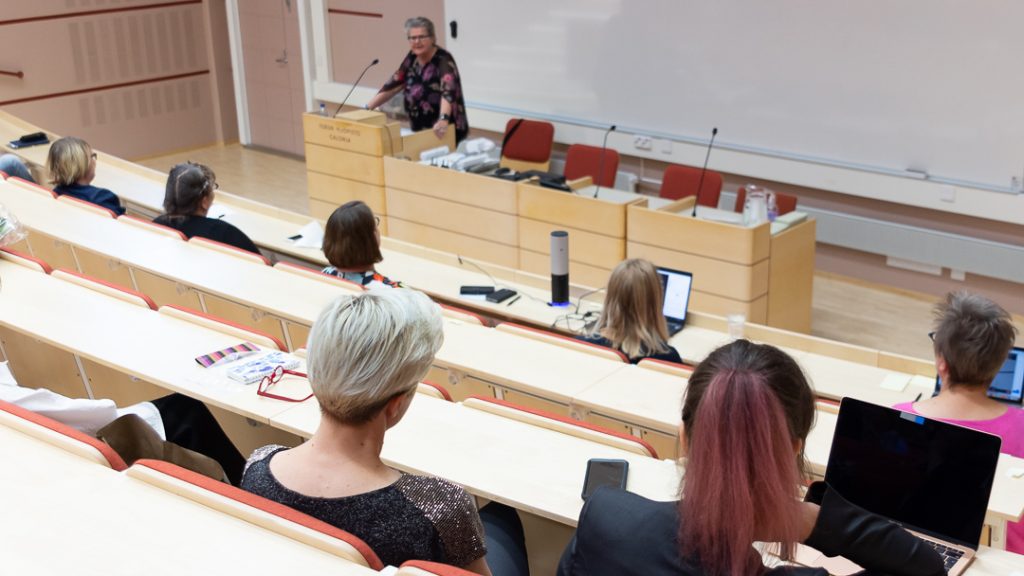
Social distancing in the lecture hall. Fifty people were invited but at least another fifty participated via Zoom.

In addition to the farewell keynote, in her true collective fashion, Professor Liljeström welcomed a panel of speakers to join her after her lecture. This is how I will remember Marianne as a scholar and educator, always encouraging others to join her endeavors and working in a collective fashion. By inviting three panelists to discuss the past and future of her discipline, Marianne once again showed her solidarity, as she put the focus from herself to the thoughts, ideas and theories surrounding the field and how best to continue building it.

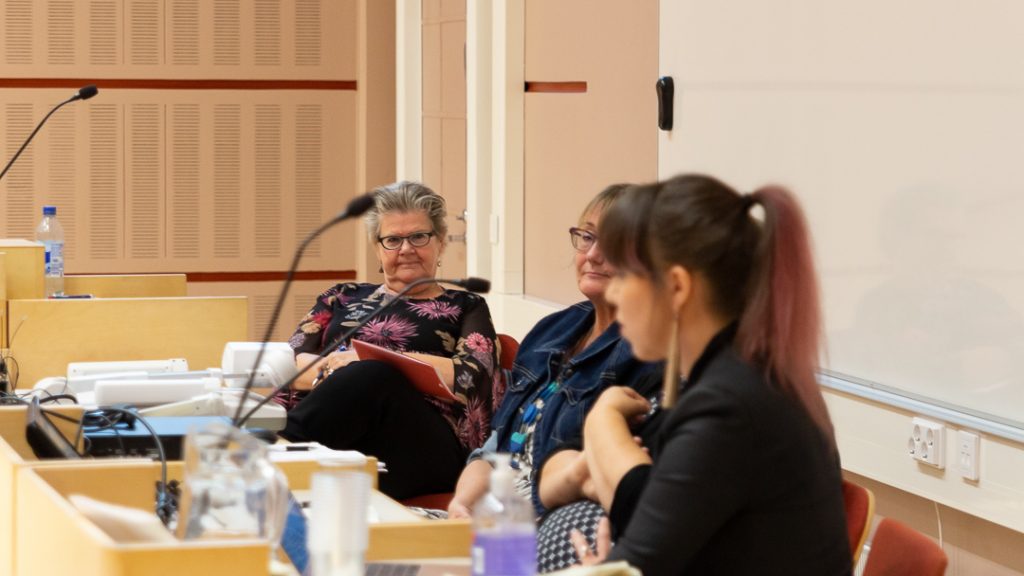
Professor Liljeström listens in her typical inquisitive fashion as Salla Aldrin Salskov details her views on pressing questions regarding the field.

A historian by training, Liljeström began her lecture by placing the major points of her professional career on a timeline to chronicle how timing has been on her side throughout: thanks to the Finnish education system, she was able to study at no cost despite coming from a humble background. She was also able to study abroad (in Moscow, Berkeley, Birmingham and elsewhere), and her own academic training coincided with the development of Gender Studies as a discipline, which she then as a full-fledged scholar awas ble to help institutionalize.

One of the important key remarks that Marianne shared with us in the farewell lecture, was how history is never merely discursive and hence immaterial, but that the work of remembering begins with fleeting affective images and sensations, when we experience something as nostalgic, get teary eyed, giggly or even when we stay silent. Materiality is always embedded in remembering, which is affective (related to feelings) by its very nature. Marianne invites us to constantly question those assumptions we are taking for granted, as the conditions of determining “facts” such as what gender might mean varies by time and ideology. Universality pushes through, but it is at the same time constantly renegotiated for a more democratic future.

Professor Liljeström is shocked by the influx of flowers and bubbly filling the lectern as well-wishers pay their respects at the send-off.

As she passed on the torch for younger generations to change the world by thought and action alike, it is time to thank Professor Liljeström for the wonderful work she has done over the years. The event was cheerful in mood, but saying goodbye incites feelings of nostalgia and other emotions, so I assume I was not the only one finding it difficult to sum up one’s feelings at the end. Perhaps best leave it to the words of Leonard Cohen: “So long, Marianne/It’s time that we began to laugh/And cry and cry and laugh about it all again”. And that’s what we did. Here’s to happy retirement days full of fun and laughter!

A round of applause and heartfelt thanks from all of us in the community to the magnificient Marianne!

Text: Elina Valovirta

Photos: Tilda Junko

Translating multilingual texts

Another PhD defence in just under two months! A number of doctoral candidates of the English Department are now finishing their research projects. On 24 January, it was Laura Ekberg’s big day.

Laura’s research topic combines translation studies and literature and focuses on a phenomenon also studied in linguistics. As it happens, code-switching was at the heart of the previous viva as well. The title of her dissertation is Heterolingualism and Cultural integrity in Finnish Translations of Anglophone Caribbean Novels; it is available online. The members of Laura’s team of supervisors were Outi Paloposki, Elina Valovirta and Joel Kuortti – who acted as custos – and the opponent was Professor Simona Bertacco from the University of Louisville. The viva started with the important question of which field of research the dissertation belongs to (answer: translation studies). Overall, we witnessed a remarkably friendly discussion by two experts, which really is the best kind of viva. The opponent found the material examined in the dissertation sufficient and representative and was very happy with what Laura had discovered and the poise with which she brought in multiple perspectives.

Professor Simona Bertacco giving her assessment of Laura’s dissertation.

I attended the viva as Laura’s colleague, a former teacher of hers, and a linguist with a keen interest in different approaches to code-switching and, more broadly, multilingual practices. Colleagues attending doctoral defences are always excited for the candidate, hoping their support radiates from the audience to the front of the room. Having known Laura since she was a BA student, I was happy about the confidence with which she brought together language, literature and translation – the three main topics of the Department – and about the fact that the varied training showed in the research. As a code-switching researcher myself, I was particularly interested in the recent campaign for not italicising code-switches in Caribbean literature, which goes against the common practice of separating the ‘other’ language from the main language of the text by using italics. Not italicising suggests that multilingual language use is not an aberration but something ordinary; there is no need to draw the readers’ attention to it.

Custos and Doctor in spe listening to the Opponent’s addresss.

Laura said in the viva that she became interested in Caribbean literature in the MA thesis seminar. The things that catch your eye as a student may take you a long way.

A relieved smile at the karonkka-party.

Text by Janne Skaffari

Photos by Damon Tringham

Philology, pragmatics and code-switching: My first viva

I had never been to a doctoral defence also known as a viva before, so I was immediately interested when I heard there was one taking place with our very own Aleksi Mäkilähde on the hot seat. Aleksi’s doctoral dissertation is called The Philological-Pragmatic Approach: A Study of Language Choice and Code-Switching in Early Modern English School Performances and as the title suggests, it examines code-switching in plays and poems by school boys at the King’s School, Canterbury, in 1665–1684. Eager to learn more about the subject, I decided to attend the viva, which took place 5 December 2019.

This being my first viva, I wasn’t quite sure how I should dress. The event soon starting at the Quantum Auditorium, I hastily did a few Google searches and found out that as an audience member, one is not expected to wear anything too fancy. I didn’t want to go under-dressed, so I took off my hoodie, put on a smart shirt and off I went. As I arrived at Quantum, I saw the candidate himself pacing around in the hall. I grabbed a copy of the thesis and sat at the back of the room. I looked at the people around me and judged my choice of clothes to be fitting.

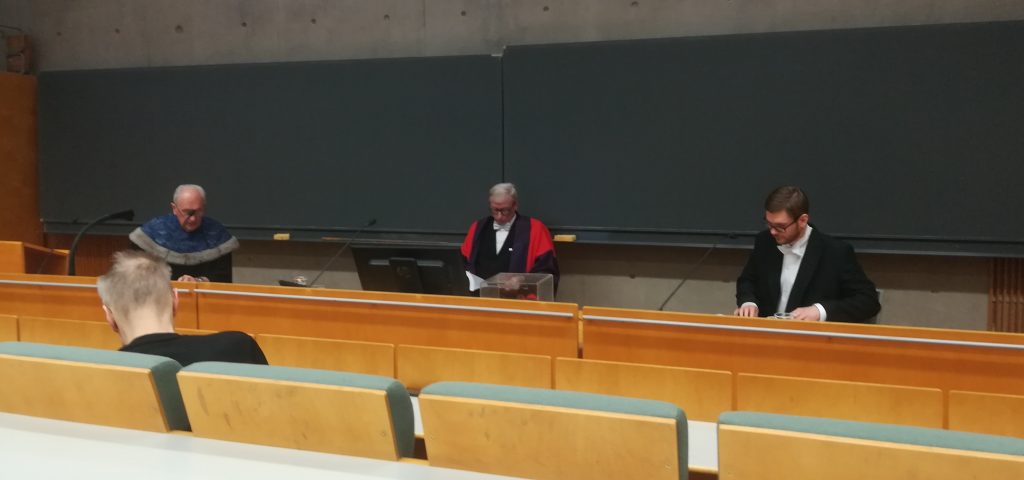
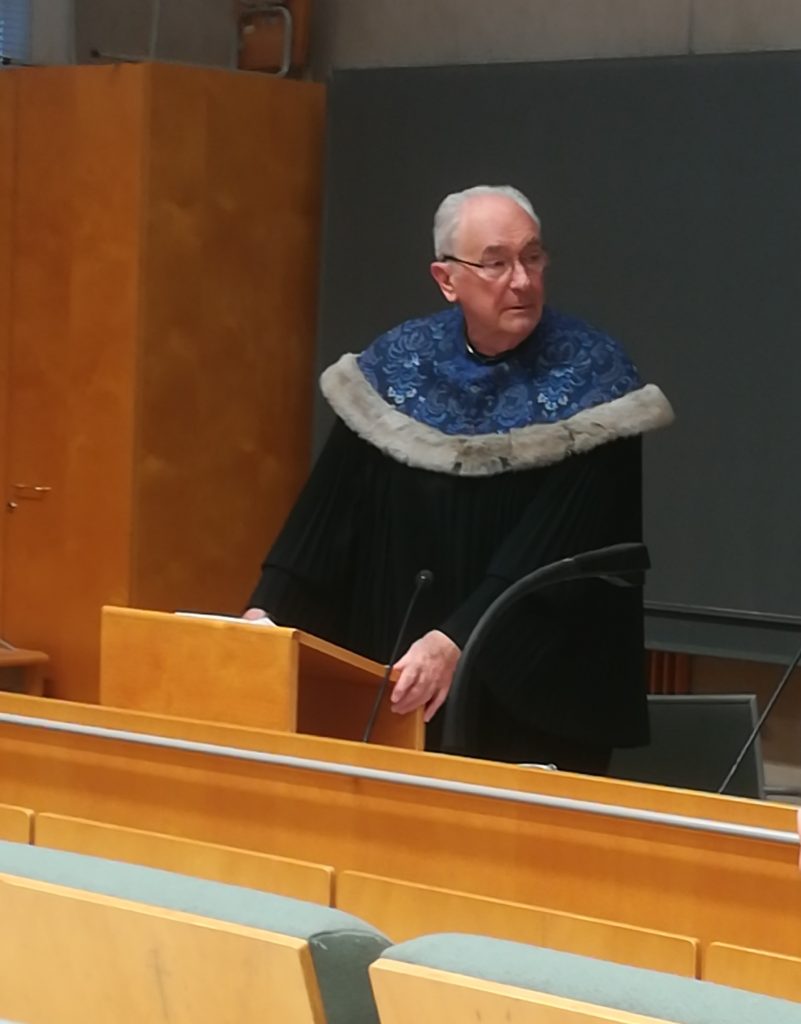
A few minutes passed. Suddenly everyone jumped up as the candidate walked in, followed by the custos, Professor Emeritus Risto Hiltunen, and the opponent, Professor Emeritus Herbert Schendl from the University of Vienna. The custos and the opponent were wearing colourful old-timey robes, which I assumed were customary, but later learned differ depending on the university.

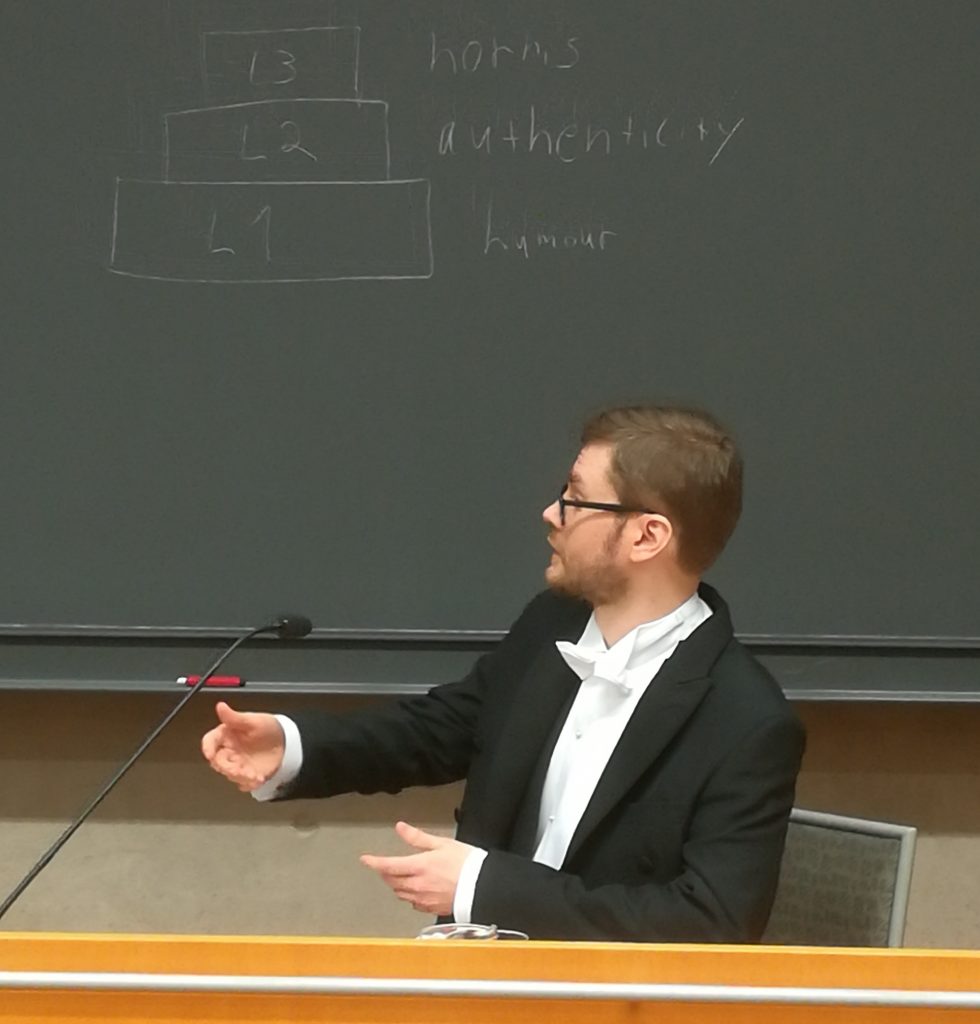
The custos spoke a few words, the candidate briefly presented his thesis in Finnish and then it was time for the opponent to ask his questions. The discussion was more informal and relaxed than I had anticipated. Some questions were more hard-hitting, but mostly it was a friendly discussion about the difference between a code-switch and a loanword, and what kind of consequences code-switching could have. I have to be honest; the discussion went quite deep into the nitty-gritty and at times, I had a hard time following. The highlight of the discussion was when Aleksi got up to the blackboard and drew something resembling a wedding cake to illustrate the complex nature of a play-within-a-play.

Some two hours after it began, the discussion ended, and the opponent gave his finishing statement. He commended the candidate’s hard work of developing a new philological-pragmatic approach and his detailed analysis of code-switching in the school plays. The custos, who had remained silent the whole time (which is customary) declared the viva to be over. Outside the auditorium, hands were shaken, gifts were given, and cake was had. To my disappointment, there was not a top hat nor sword in sight. I guess those were saved for later.

Gratulationes to Aleksi on his achievement and all the best in his future career!

Text by Otto Tarkka

Photos by Janne Skaffari

A month in northern England

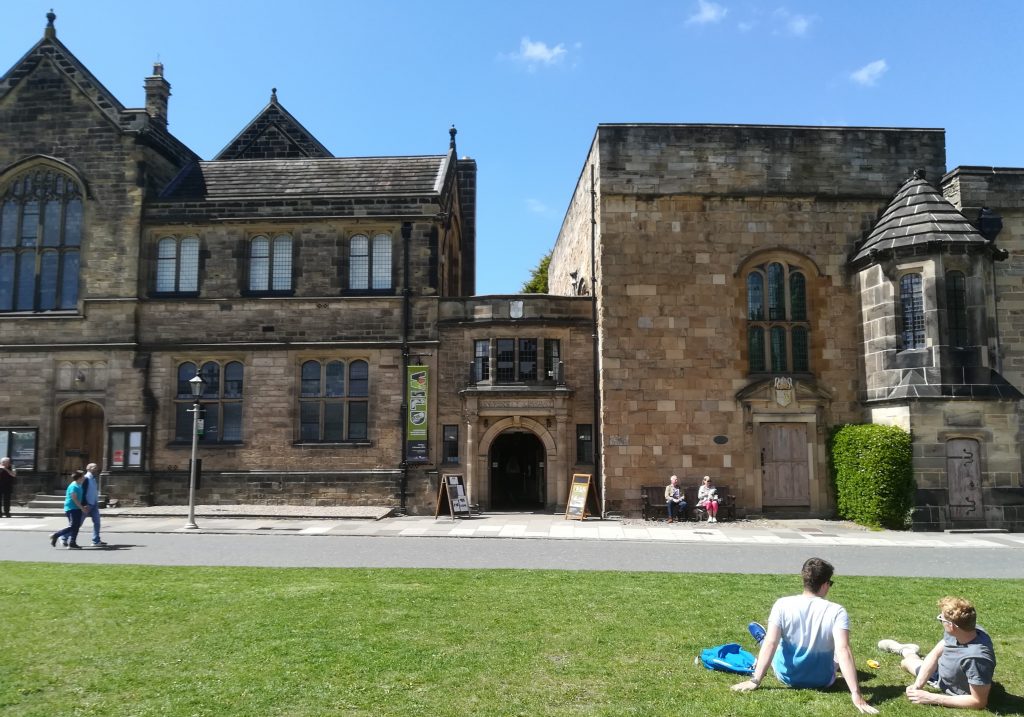
The bleak midwinter is approaching, so isn’t a throwback to last spring a wonderful idea? At the end of April, I left Turku to spend a month in the north-east of England. I had visited Durham for two days in 2015, transcribing little bits of English surviving in some Latin manuscripts, and written in my notes: “I’d like to come back”. This became possible when I got a library fellowship from the Durham University Institute of Medieval and Early Modern Studies.

This was definitely an intense work trip, but I did have time to explore the city as well. Although Durham is small, with a population of about 50,000, it bears many similarities to a city the readers of this blog know well: there is a large medieval cathedral, a river and a castle, and a disproportionately large number of students. Durham is full of instagrammable spots, and getting to know the pathways and shortcuts particularly around Palace Green Library, located between the cathedral and the castle, was an absolute pleasure.

Durham University is one of the oldest in the UK and ranks among the top 100 universities in the world. It has about 18,000 students. Since it was Easter term – reserved for examinations – they seemed to spend most of their time reading in libraries. As I resided in college, I was able to make other observations about undergraduate life, too. It is quite different from Finland, particularly as college accommodation means you spend a lot more time together with the other students, starting with breakfast each morning. There was a pleasant sense of community, which I hope the students appreciated.

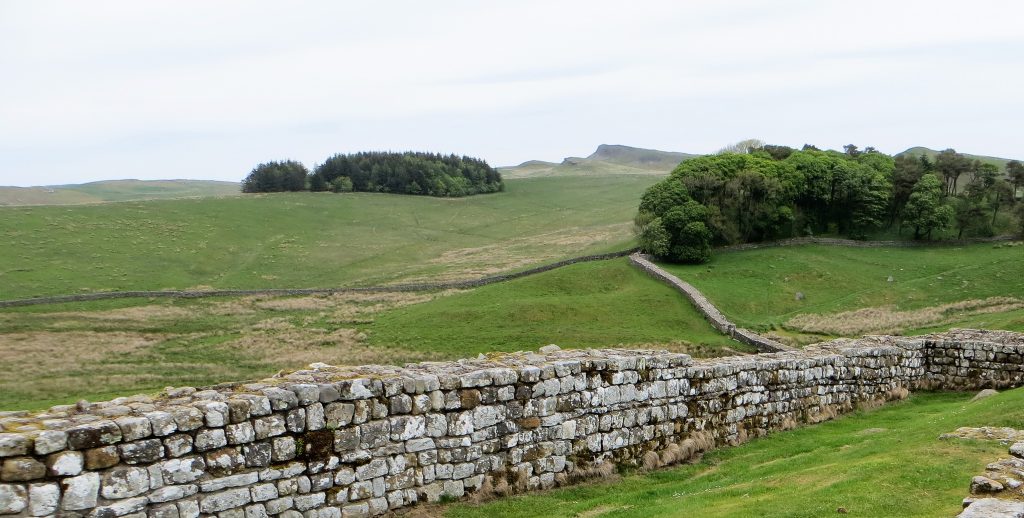
In addition to doing research and enjoying life in a beautiful old town, I was also able to make weekend trips to cities like Newcastle and Manchester and to smaller places such as Bishop Auckland and Tynemouth. A particular highlight was Hadrian’s Wall, which runs across the north of England. Having spent hours and hours examining 800-year-old manuscripts indoors, a bit of more ancient history out in the country towards the end of my trip was, quite literally, a breath of fresh air.

I would like to thank Durham University, IMEMS and the Library Fellowship for making this trip possible.

Text and photos by Janne Skaffari

More pictures on Instagram; look for captions mentioning a certain ‘Dr X’.

Trextuality – at the intersection of textual scholarship and translation studies

The XII annual colloquium of Variantti, the Finnish network of researchers working on textual scholarship and scholarly editing, was held on Friday, 4 October 2019, at the University of Turku to foster interdisciplinarity between textual scholarship and translation studies.The theme trextuality encompassed textuality, transmission and translation, concepts central in both fields. In translation studies, trextuality means going beyond the source-target text pair and in textual scholarships, it refers to observing the transmission of texts across languages. Some fifty attendees heard eleven talks addressing trextual issues.

Tanja Toropainen discussed the continuum of editions and translations behind Codex Westh and its Ars Morendi part, which is a translation from German – except that the The Bible quotations are translations from Swedish. Sara Norja pointed out that like many of early English texts, also The Mirror of Alchemy is a translation – the source language of the various versions (Latin or French) can be deduced from how the alchemy-related terminology is translated. Niko Huttunen & Tuomas Juntunen explained that the forthcoming Finnish translation of The Bible for mobile platforms will have vocabulary different from what the audience is accustomed to because the language is made understandable for 20-year-olds.

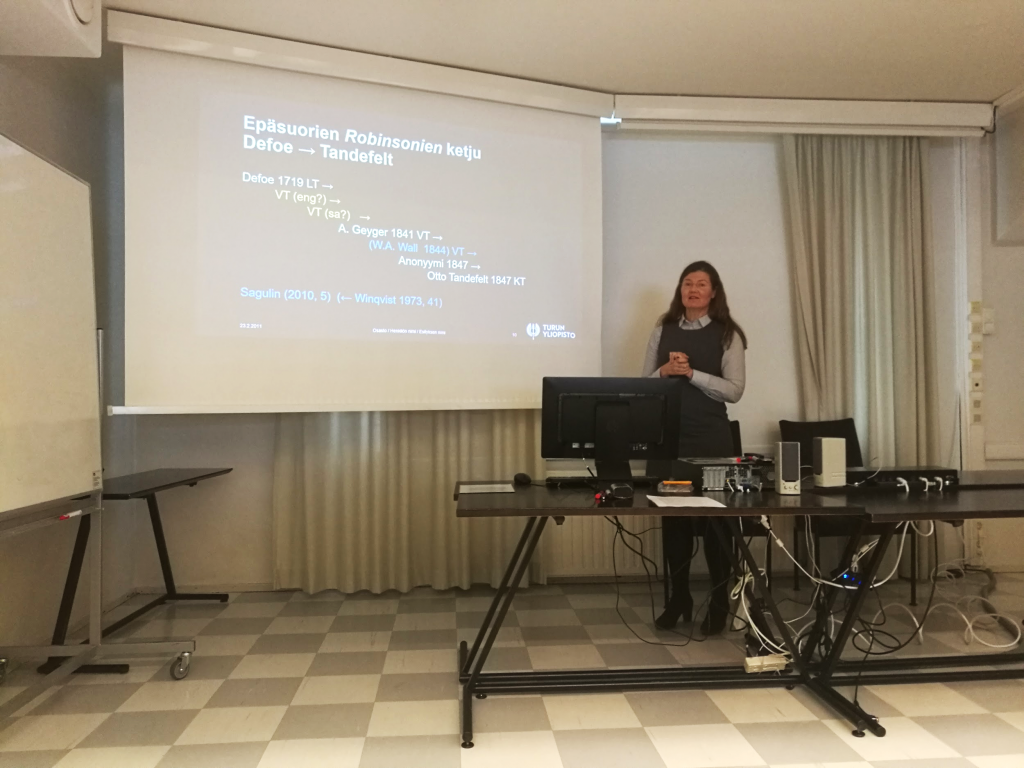
Kristiina Taivalkoski-Shilov talked about the long,
multilingual transmission history of Robinson Crusoe.

Leena Eilittä discussed intertextuality in Herman Broch’s works; for example, Broch changed the title of his poem into Hille Mitternacht (A clear midnight) after having translated Walt Whitman’s A clear midnight into German. Marja Sorvari addressed the intertwinedness writing, writing in a second language, and self-translation through the example of two translingual authors, Zinaida Lindén and Polina Kopylova.

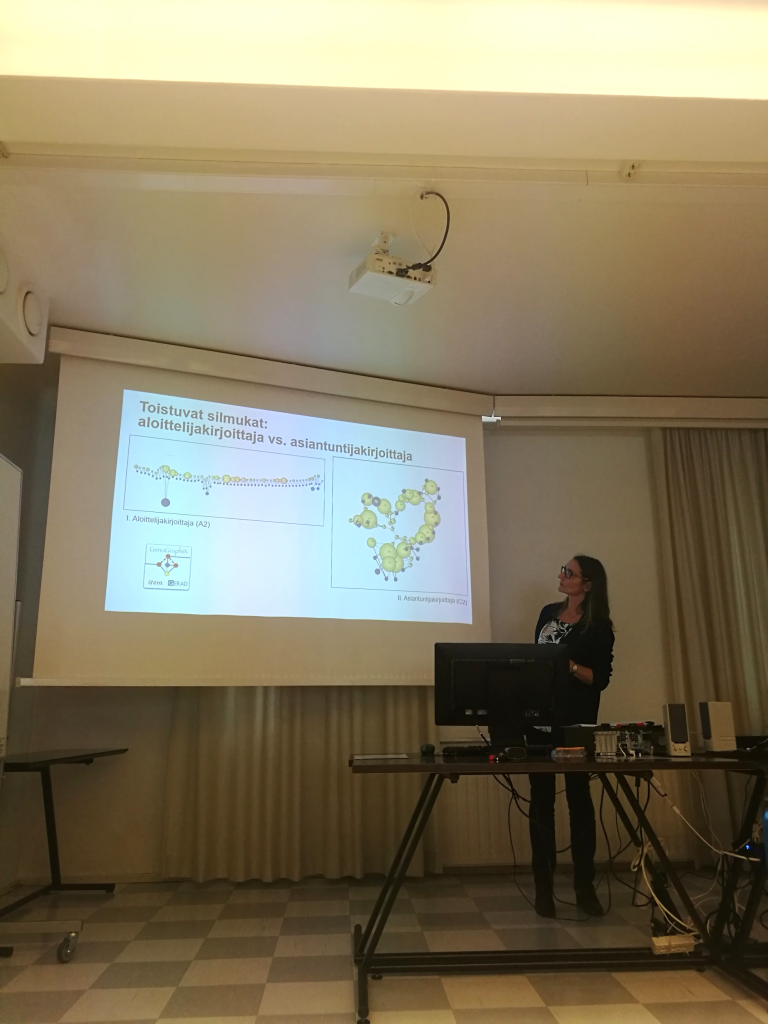
Instead of studying what changes in translation, Taivalkoski-Shilov showed how Friday’s way of talking remains unchanged in the Finnish Robinson Crusoe (re)translations even if translated indiretcly from English to German to Swedish to finally Finnish. Members of the Digilang project Christophe Leblay, Maarit Koponen, Maarit Mutta, Anna Salmela, Leena Salmi & Mikko Suhonen showed examples of text editing process visualizations using tools such as GenographiX: for example, A2-level writers proceed straightforwardly while C2-level producers make loops as they write and edit different parts of the text at different times.

Maarit Mutta showed how writing processes can be visualized.

Annamari Korhonen suggested that because something always changes when a text is translated, translating is creative even with pragmatic texts. Tuuli Ahonen demonstrated how a translator cannot translate the whole film if one of the modes – picture, dialogue, music, or sound effects – is missing because the subtitles are part of the polysemiotic whole that the modes together make.

Minna Seppänen & Outi Paloposki discussed how in the early 19th-century Ancient Greek literature was translated into Finnish more to show off one’s language skills than to produce beautiful Finnish translations. The day concluded with the perspective of a professional translator: Jaakko Kankaanpää shared his observations on the differences, such as replacing racist vocaublary with politically correct terminology, between various Finnish (re)translations of Agatha Christie’s novels, including his own ones.

Text and photos: Laura Ivaska

Visiting Poland and gaining international experience


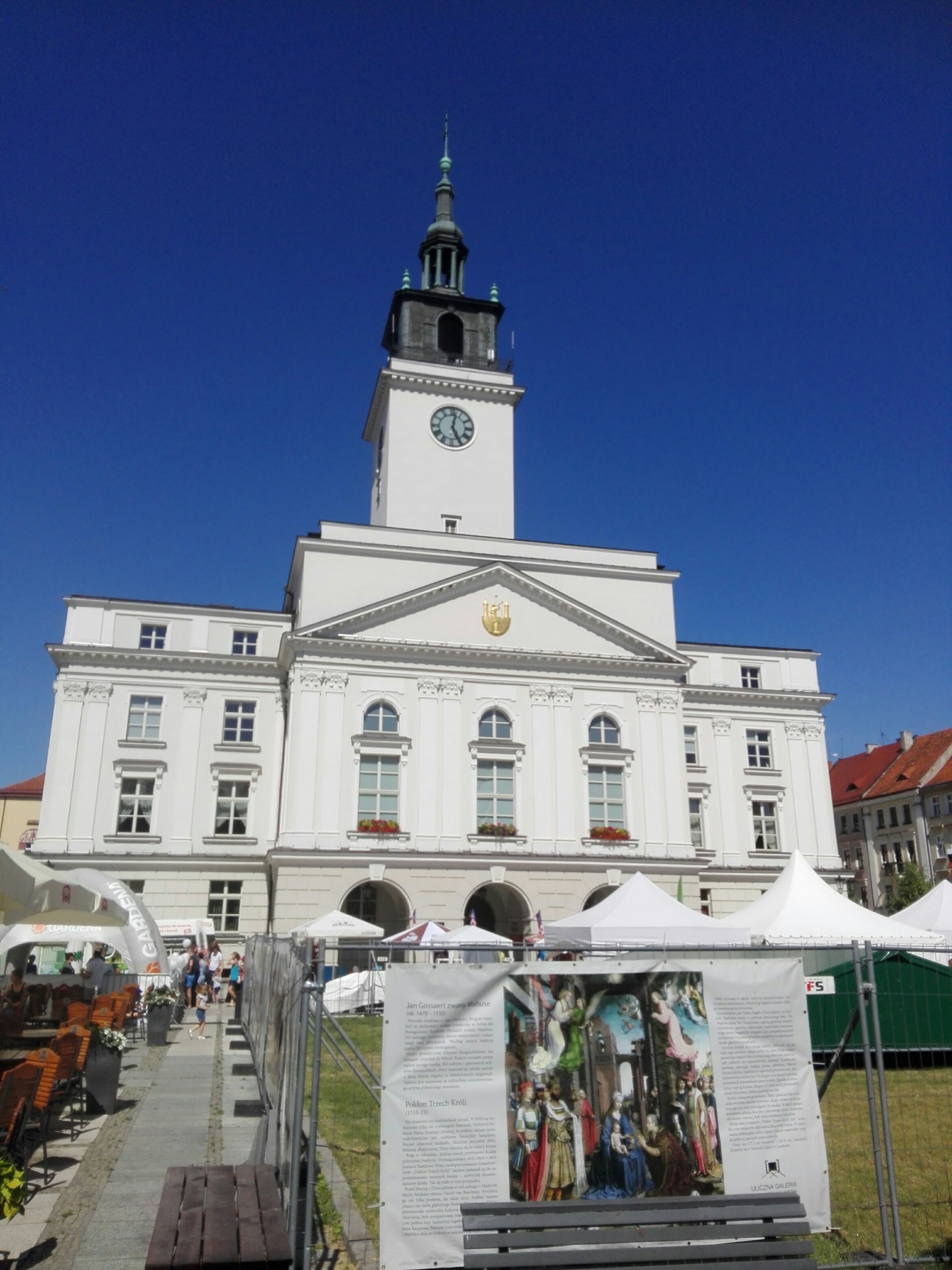
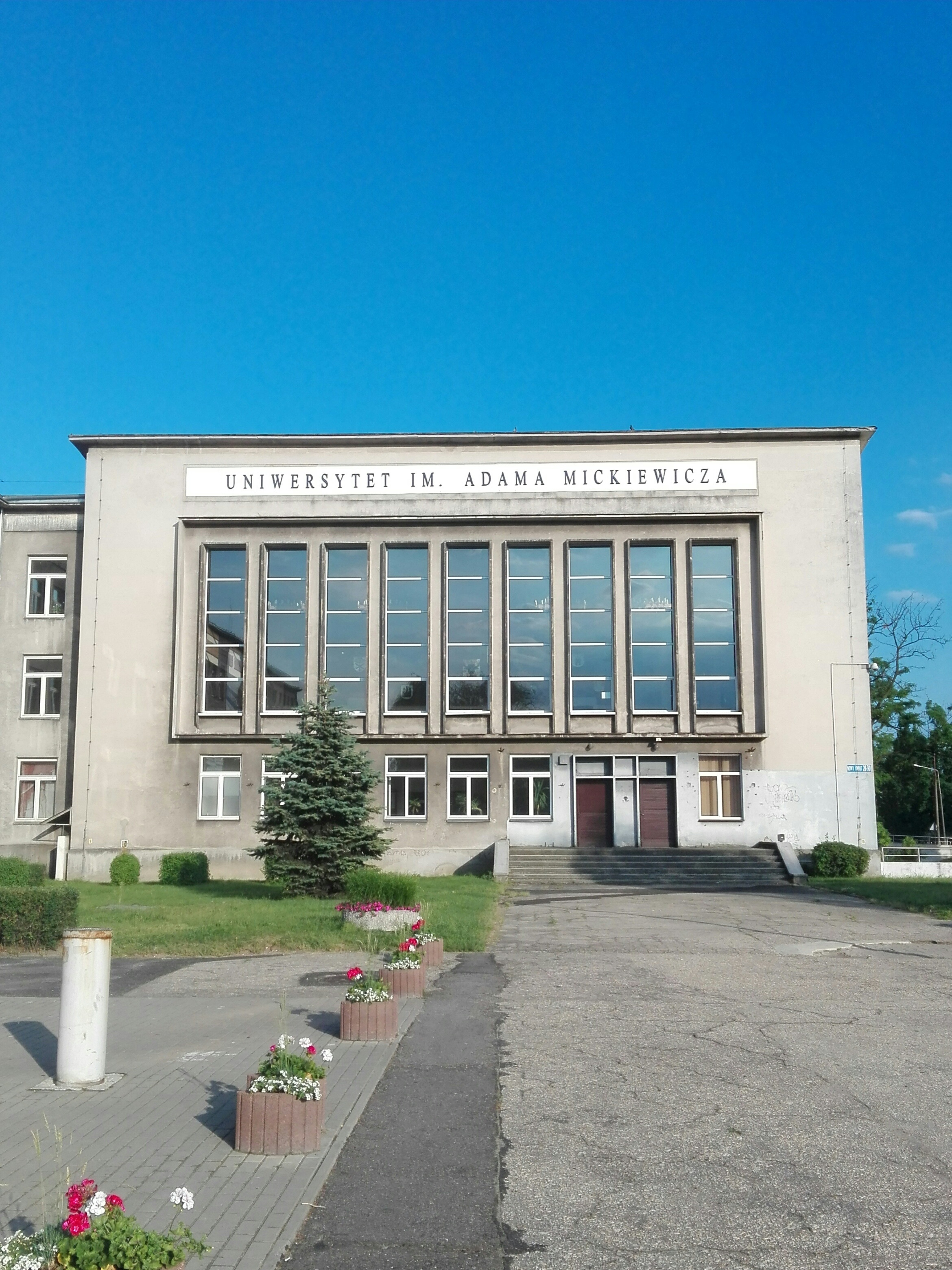
This spring has been very memorable, as I have had the pleasure of being a Visiting Professor in Kalisz, Poland. A visiting professor can refer to various kinds of things in the academic world. In this case, I was invited to the Faculty of Pedagogy and Fine Arts of the Adam Mickiewicz University in Poznań. This Faculty is located in Kalisz and educates, among others, students of English and pedagogy whose career goal is to become a teacher of English.

The fascinating thing about Kalisz is that it is considered the oldest city in Poland. Coming from the oldest city in Finland, this gave me a nice opening to all my meetings with the students. Due to my work responsibilities in Turku, I was not able to stay in Kalisz for longer periods at once. Instead, my teaching was intense: 6-8 hours of teaching while I was there. I led a workshop on Teaching and Learning Spoken English for third year students and a Workshop on Effective Learning for three first year groups of students. In addition, I met many members of staff for informal discussions on the Finnish education system and our shared research interests. I was lucky to visit Kalisz, as second language acquisition is a prominent research field at their Faculty.

My visit was part of their University of the Future programme that is funded by the EU. As part of this project, they invite international scholars to educate their students. Compared to Finnish students, the Polish students I met were mostly one step more shy and one step more insecure about their English skills, but fortunately I am familiar with both of these emotions. Much of my time was spent on convincing that making mistakes in a foreign language is ok and I thought that their English was very good. One first year student said that I was the first foreign person he had ever used English with (as they do not have native speakers as teachers). The students were very concerned with their grammar and pronunciation skills. Poznań is famous for their intense pronunciation teaching, as they spend two years on pronunciation skills. It was interesting that the materials they use are mostly the same as we have used at our university.

Towards the end, the students started to feel more relaxed with me. During our final meeting, when students presented their own projects, they even tested my pronunciation skills. I had to pronounce, for instance, trzy, wszystkiego, źdźbło and Szczebrzeszyn – and I did! I also got to discuss Kimi Räikkönen’s career, Finnish heavy metal music scene, and the lyrics to “Ievan polkka” (one student had learnt to sing it in Finnish earlier but did not understand what it meant). The most difficult question in my final exam was “Describe why you are a good learner of English”. Local teachers told me that traditionally Polish people like to focus more on what they do not know – another thing that I understand well coming from the Finnish setting. I look back on my time in Poland with fond memories.

Text and photos by Pekka Lintunen

A Poetry Researcher’s Field Day

One might assume that literature research would not necessitate fieldwork, but sometimes it is useful to those of us working with such esoteric topics as contemporary US poetry as well. In early May, I visited the State University of New York at Buffalo, and particularly their library’s Poetry Collection, in search of more materials for my research project, Difficult Relations: Reading for Emotion in Recent American Experimental Poetry.

SUNY-Buffalo, or UB as the locals like to call it, hosts the Poetry Collection, “the library of record for 20th- and 21st-century poetry in English”. The collection, started by Charles Abbott in 1937, is hidden away from the public in closed stacks, so visitors desiring to peruse books have to give a list to the staff, and they will pull it out for use in the library’s reading room. Like in many archives and special collections, use of the materials requires care, and only computers or pencils can be used for note-taking. Photographs are not allowed without special permission.

The reading room is a large hall, guarded over by a portrait of James Joyce. Incidentally, the UB Poetry Collection is also home to the world’s largest collection of Joyce-related materials, like first editions, correspondence, notebooks and photographs. Oscar Silverman, who worked at UB, had visited a Joyce exhibition in Paris in 1949 and got the idea to bring the collection to UB. Joyce is a pervasive presence in the Poetry Collection reading room, watching over it all like a grandfather of modern English literature that he is.

My 10 day visit to Buffalo was a handy one-stop method for browsing through many important works published in the last 15 years or so. Many of these were published in limited editions or are otherwise difficult to find from overseas. While I order what I can from online stores, it was very useful to have it all at my disposal at once. It also allowed me to observe the sheer materiality of recent poetry works, viewing as I did items ranging from large anthologies and collections to thin and plain chapbooks and even little cards on which poems had been printed. In a tangible way, it brought the liveliness of contemporary poetry culture into view.

UB is also home to a fairly substantial population of Canada geese, one of which is pictured here.

Text and photo by Elina Siltanen

Eating elephants

Nearly 1.5 years into my doctoral studies, I have already encountered some sort of block. Things are just not progressing the way I would like, something is not working. I feel like I have read every possible piece of available research about my topic but starting the first article seems like a horrendous endeavor. What am I doing? Where do I start? What perspective should I take? Am I prepared enough? Do I have the concepts right? Maybe I should just make another cup of tea…

A couple of days before the event that was to take place on March 21,2019, I received an e-mail stating that there were places still available in the Finding joy and productivity in academic writing lecture and workshop. Guest lecturer Carol Kiriakos, co-author of Tohtoritakuu, was to speak about practical approaches to academic writing. My first thought was, “This is scary!” Can you imagine? This was exactly what I needed, and here it was in my mailbox, and none too soon as the event was in just two days! I was not really sure what the ‘practical approaches’ might entail, but the words ‘joy’ and ‘productivity’ were what really caught my eye. Could I really find joy in my situation of ‘rookie’s block’, and could I ever become productive in my revelry of procrastination?

Carol Kiriakos provided answers to both questions, “Yes and yes.” First, you have to take an inventory of your beliefs; what beliefs do you have about yourself or your writing that keep you from writing? Participants took a few minutes to write down their beliefs, and to my astonishment, we were all struggling with the same issues: getting started, time management, insecurities pertaining to abilities, being prepared, procrastination, lack of inspiration, etc., etc. At this point, the group of participants became a united whole – we were all in the same boat struggling in the same weather to keep it afloat.

Once you are aware of what is keeping you from writing, you need to create a writing habit. At what time of day do you feel the most creative or productive? A rule of thumb is the further the day progresses, the less creative and productive we become because other things begin competing for our attention. How much should you write at one go? Kiriakos warned us not to set ourselves up for failure. If you plan to write 5 pages on a certain day and do not achieve that goal, most likely you are going to feel like you have failed and starting the writing process again may take an unnecessary number of days or weeks.

The third thing, and perhaps the most important, you should do is learn how to eat an elephant. Well? How DO you eat an elephant? According to Kiriakos, the answer is: One bite at a time. For example, if you write in your calendar “PhD thesis” for every day you would have time to work on it (as I have done and now have a lot of erasing to do), you are setting yourself up for failure. Not only is it impossible to write a PhD thesis in a day, but you are also creating the feeling that you never get anything done. A more sensible approach would be to write, “1 page for Section 2.2.”, for example, or simply “one paragraph”. The same idea can be used for setting goals, i.e. break them down into smaller bites. For example: long-term goal (months to years) -> short-term goal (weeks to months) -> daily goal (hours to days).

To combat procrastination, i.e. always waiting for inspiration or the ‘right moment’ to write, Kiriakos suggested free-writing. During the lecture and workshop, we participants engaged in two free-writing sessions, both lasting about ten minutes. Free-writing was a surprisingly good way to get into the ‘habit’ of writing. We were given a topic each time: The Ideal Academic Writer and The Most Important Thing to Me. Both topics also gave us a bone to chew, which helped us to process the beliefs we have of ourselves. When doing free-writing on your own, you do not necessarily need a topic; on the other hand, having a topic may get you put your thoughts in order. You need to set a timer, so you do not have to look at the clock, and then just write about the ideas or topics you have for writing your thesis on that particular day. With free-writing, you can find that inspiration, and the moment you sit down to free-write is exactly the ‘right moment’ you keep waiting for.
I left the workshop feeling I had eaten my elephant, or at least cut it down into smaller, more manageable pieces. Feeling inspired by Kiriakos and getting the push I needed to start writing, I decided to share my experience here. I recommend reading Tohtoritakuu to BA students , MA students, even to the experts whose doctoral hat is worn around the edges and whose sword has defended truth and knowledge many times over. It contains useful strategies for anyone contending with an elephant…. One bite at a time.

Text by Judi Rose

Hamlet in Turku

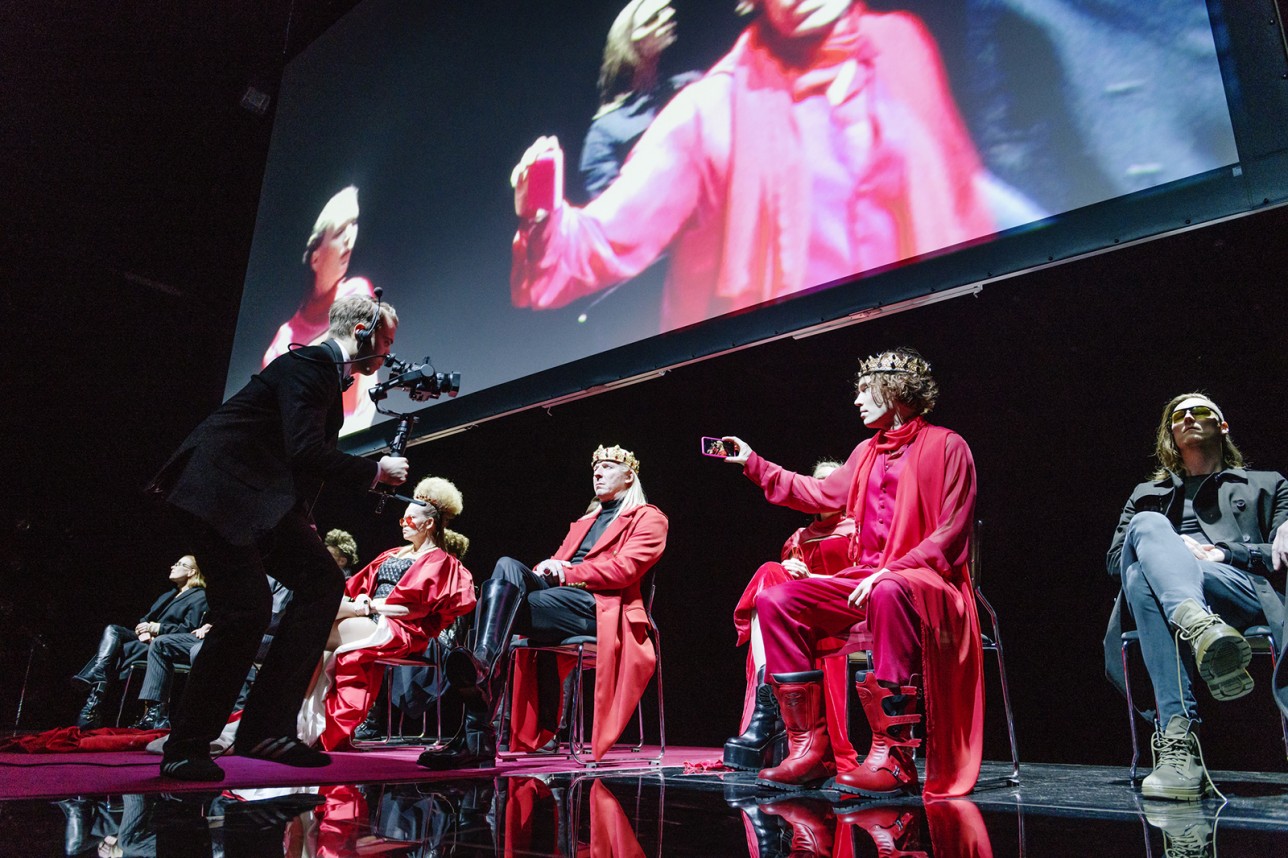
The Department paid a visit to see Hamlet in the Turku City Theatre in March 2019. The production has garnered good reviews both by critics and audiences, and it was great to have an opportunity to see it, especially as the season is, alas, short.

SPOILER ALERT – what happens in Hamlet

If you like to keep up suspense, do not read further as I am about to give some spoilers. First of all, Hamlet’s father’s death turns out to have been murder by poison rather than an accidental snakebite. There are also other deaths: Ophelia, Polonius, and – in the end – practically everybody dies. (Not Horatio, though.)

This is good for the undertaker’s business – in the show presented in a very provoking, even thought-provoking way.

One of the most striking elements in the Turku Hamlet is the set. It combines traditional and contemporary elements in a very inventive way. In the programme booklet, the scenographer Markus Tsokkinen comments on the Finnish terms for building the set – ‘lavastaa’ and ‘kulissit’ – as derogatory terms for deception whereas he considers the set a way to enhance the truth elements of a play. Considering this, the amalgamation of old and new functions very well in bringing Shakespeare’s vision to us today.

Hamlet is one of the Bard’s big tragedies. In Finland it has been produced almost once in a decade after the first production in 1906, and it has been translated several times: by Paavo Cajander (1879), Yrjö Jylhä (1955), Lauri Sipari (1975), Eeva-Liisa Manner (1981), Veijo Meri (1982) and Matti Rossi (2013). The Turku Hamlet is based on Manner’s translation but with noticeable changes in the dialogue.

For a tragedy, Paavo Westerberg has direected a highly humorous – but in no way banal – version of Hamlet’s story. (Although Yorick might disagree.) It is multimedial, multilingual, intertextual, intermedial, intercultural – in short, multi-inter!

One of the most surprising things, personally, was Claudius. Eero Aho’s acting here was excellent, but Carl-Kristian Rundman as Polonius (very much like Gollum), Pia Andersson as Ophelia (rebel girl) and, especially, Jussi Nikkilä as Hamlet were even better. (Esko Salminen’s ghostly presence as Hamlet’s father’s ghost is also brilliant.)

To conclude, you would love to see the way they have done “To be or not to be” …

Text by Joel Kuortti
Photo by Otto-Ville Väätäinen/Turku City Theatre