There’s a new professor in town: Q&A with Matti Peikola

img_1872-matti
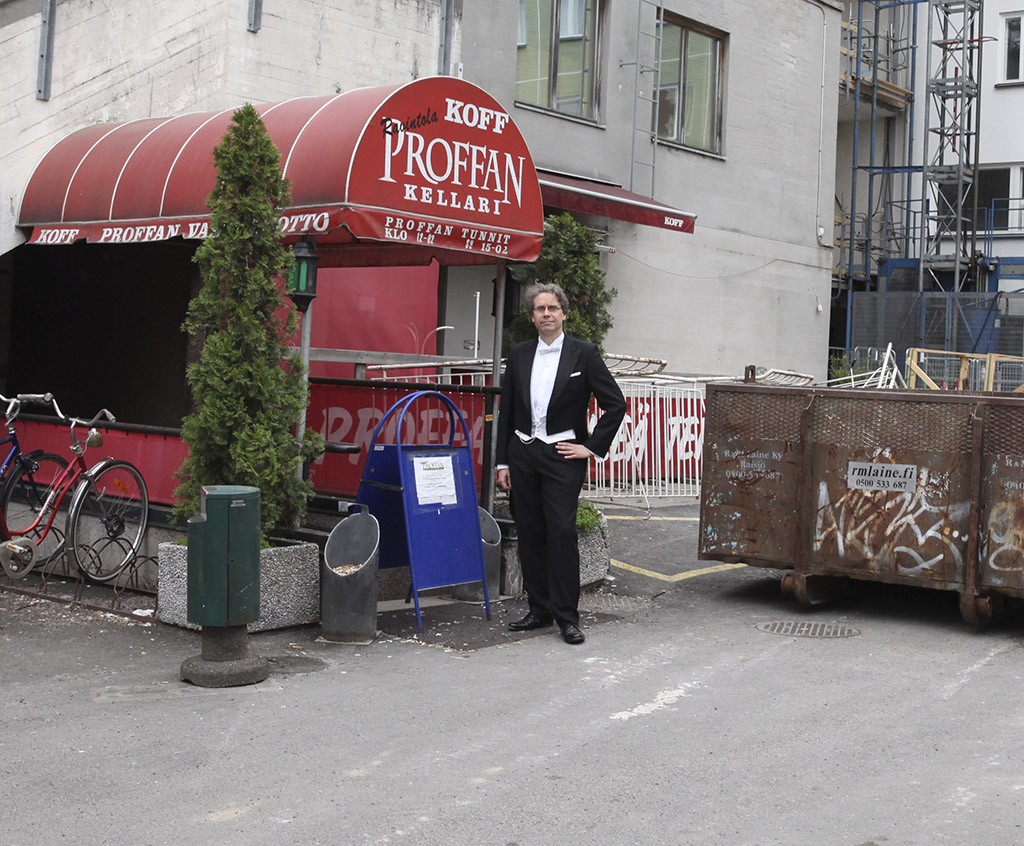
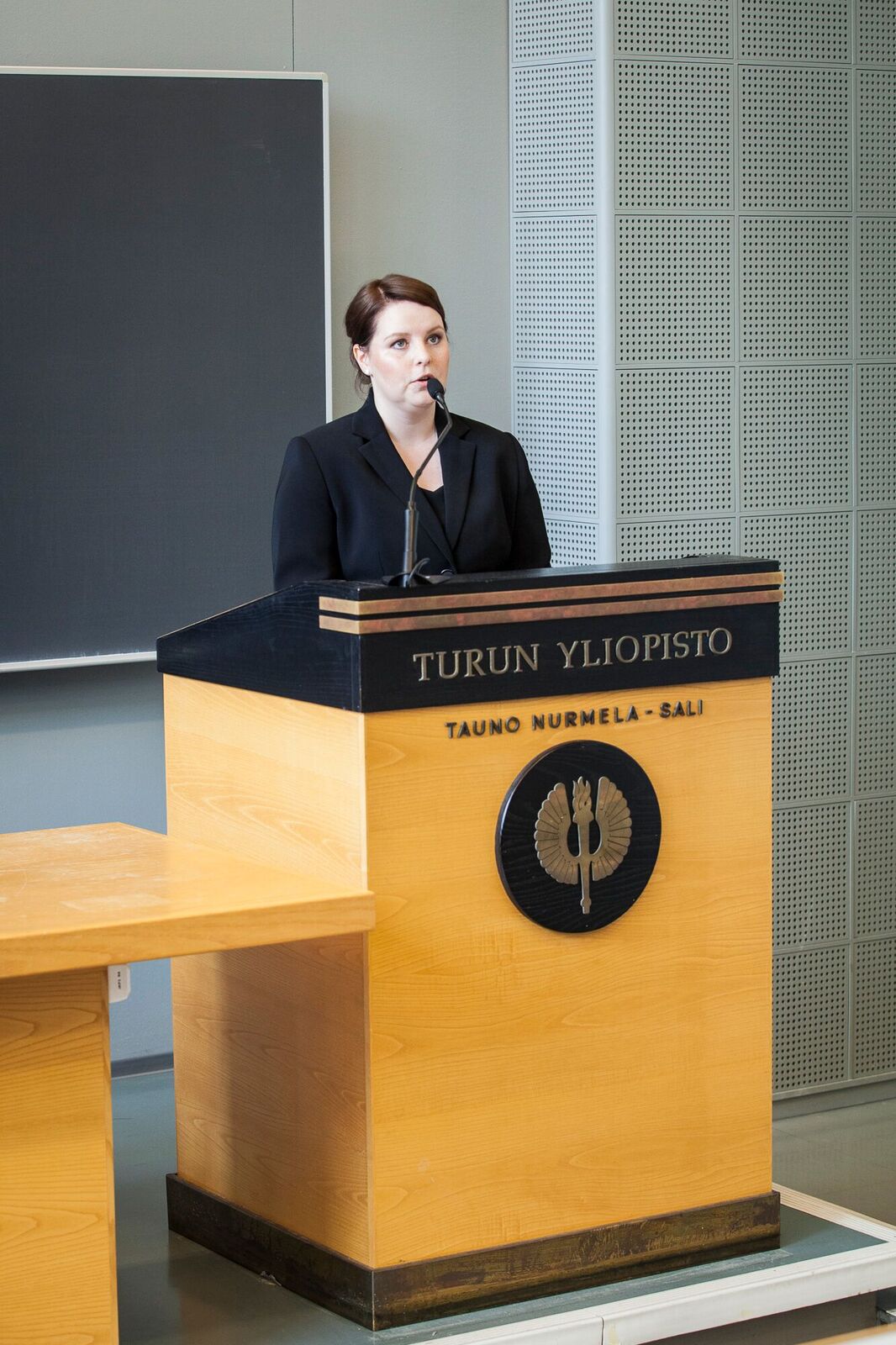
Professor Peikola in academic regalia.

1. Tell us a little bit of who you are.

I am a 48-year-old Doctor of Philosophy and a lifelong learner. I live in Turku with my wife Kirsi and our Lagotto Romagnolo dog. My academic career has primarily been at Turku, with shorter periods at Helsinki, Münster, Oxford, York and London.

2. What kinds of courses do you teach? How and when can our students meet you?

I mostly teach compulsory and elective courses on the Philological MA thesis track. I am available for consultation on Wed 14–15 or by appointment.

3. What do you do research on? What would you like to study in future?

Texts and books are my passion. I am interested in how texts are produced, circulated and consumed, from medieval to modern times. How does language use vary and how are material texts shaped in various communicative and cultural contexts? My current research interests include paratextual communication, manuscripts of English biblical translations and recorders of the Salem witchcraft papers. These and other projects will keep me busy in the foreseeable future.

4. Can you describe what a typical working day is like for professors?

No two days are alike, which is both a bonus and a challenge. Often things come up that require instantaneous attention. I value the chance to collaborate with my colleagues on co-taught courses, shared publications and joint project applications. A lot of my time goes into the reading and supervision of students’ work, which I enjoy a lot, because it allows me to learn new ideas from them. Professors are responsible for the development of their field, which requires us to follow what is going on in the academia and in the society more broadly.

5. What do you do when you are not a professor? Any time for other things in life?

The borderline between work and leisure is fuzzy. In addition to my family, nature means a lot to me: walking outdoors; watching the seasons change; spotting plants, birds and constellations in the night sky. Music is also great source of inspiration.

img_1962-matti3
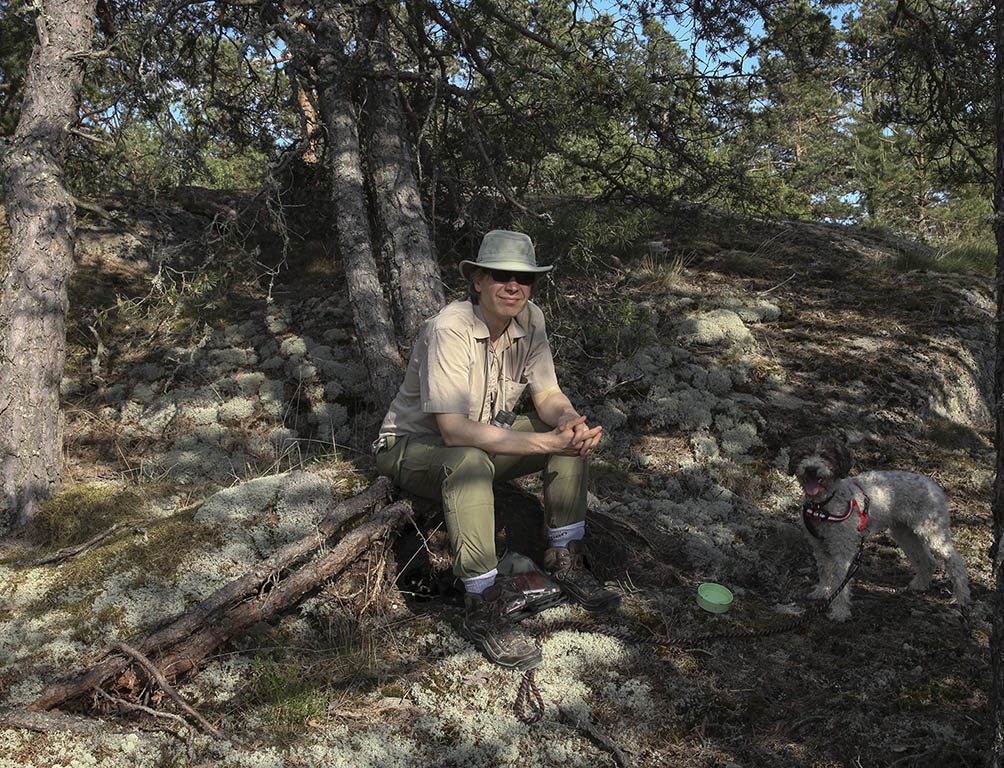
Professor Peikola and his dog enjoying the outdoors.

Shakespeare 400 in Turku

This year marks the 400th anniversary of the death of William Shakespeare. Universities and other institutions around the world have been organising special events and courses throughout the year. One of these special courses is Shakespeare 400, a joint effort of the University of Turku and Åbo Akademi University.

The course runs from late October to mid-December. It comprises seven lectures by eight lecturers from four different departments: the Department of English at ÅAU, the Department of English at UTU, the Department of Cultural History (UTU), and the Department of Comparative Literature (UTU). There are altogether fifty students taking the course.

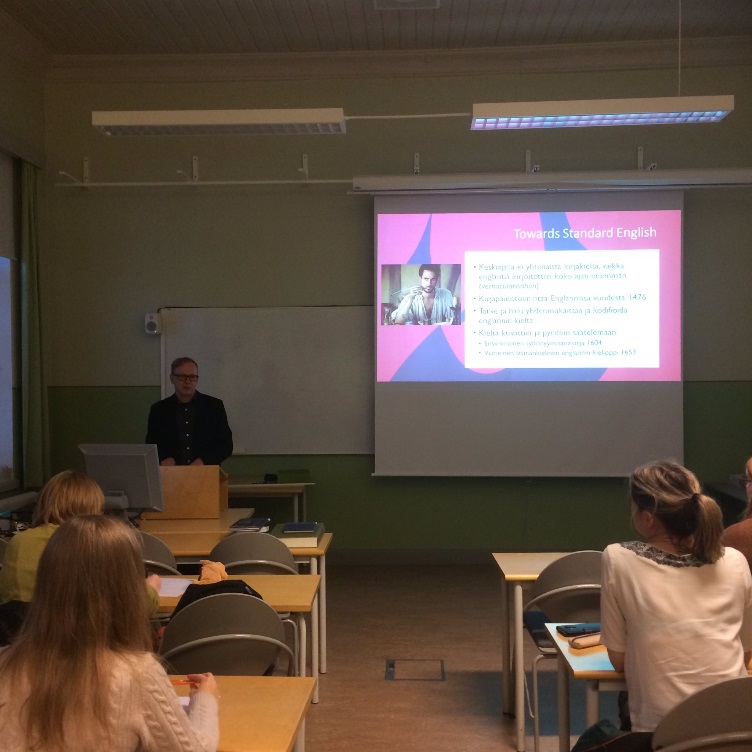
The lecture series started on 27 October with a joint lecture by Dr Janne Skaffari and Prof. Matti Peikola from our own department. Janne Skaffari offered a fascinating glimpse to Early Modern English and Shakespeare’s language. He finished the lecture by reciting a sonnet in what is known as ‘Original Pronunciation’, a reconstructed version of what ‘Shakespeare’s English’ might have sounded like. If that piqued your interest, have a look at Ben Crystal’s Hamlet here!
shakespeare400

Matti Peikola then moved on to discuss the early editions of Shakespeare plays. Although the First Folio is the most well-known edition of Shakespeare, defining the canon for years to come, it was only published after Shakespeare’s death by his colleagues. However, Shakespeare’s plays were already published individually during his lifetime, in a smaller and much cheaper quarto format. The first quarto edition of Hamlet was much shorter than the First Folio version! You can read more about the quartos here.

Both Skaffari and Peikola reminded the audience that although Shakespeare has often been treated as a canonical author figure, many of his plays actually show evidence of collaborative authorship. Read more about recent findings here.

Text and photo by Mari-Liisa Varila

ÅboutU seminar: Publishing

In September 2015, Matti Peikola from the University of Turku and Adam Borch from Åbo Akademi University held a seminar for doctoral candidates. In a workshop held after the presentations, the participants called for more contact between doctoral candidates of UTU and ÅAU, and so a committee was created for this purpose. The committee members, Sirkku Ruokkeinen (UTU), Ira Hansen (UTU), Eva Norrman (ÅAU) and Emma Kanckos (ÅAU) named the group ÅboutU – a most clever play on the words Åbo and UTU.

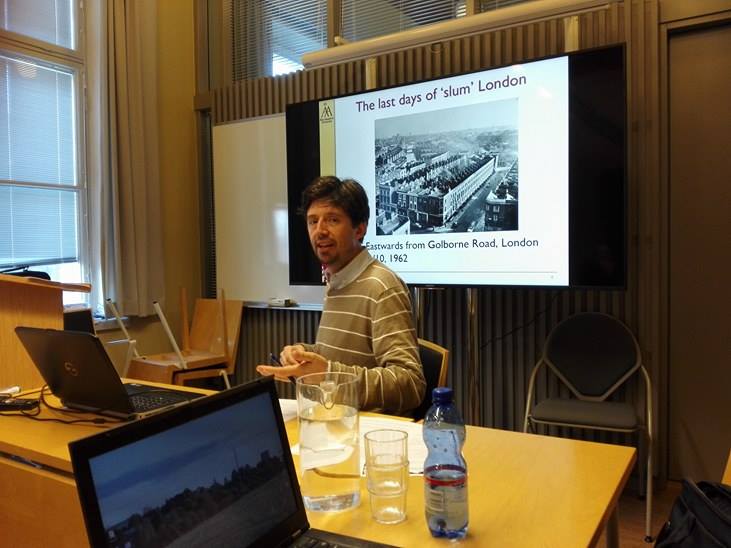
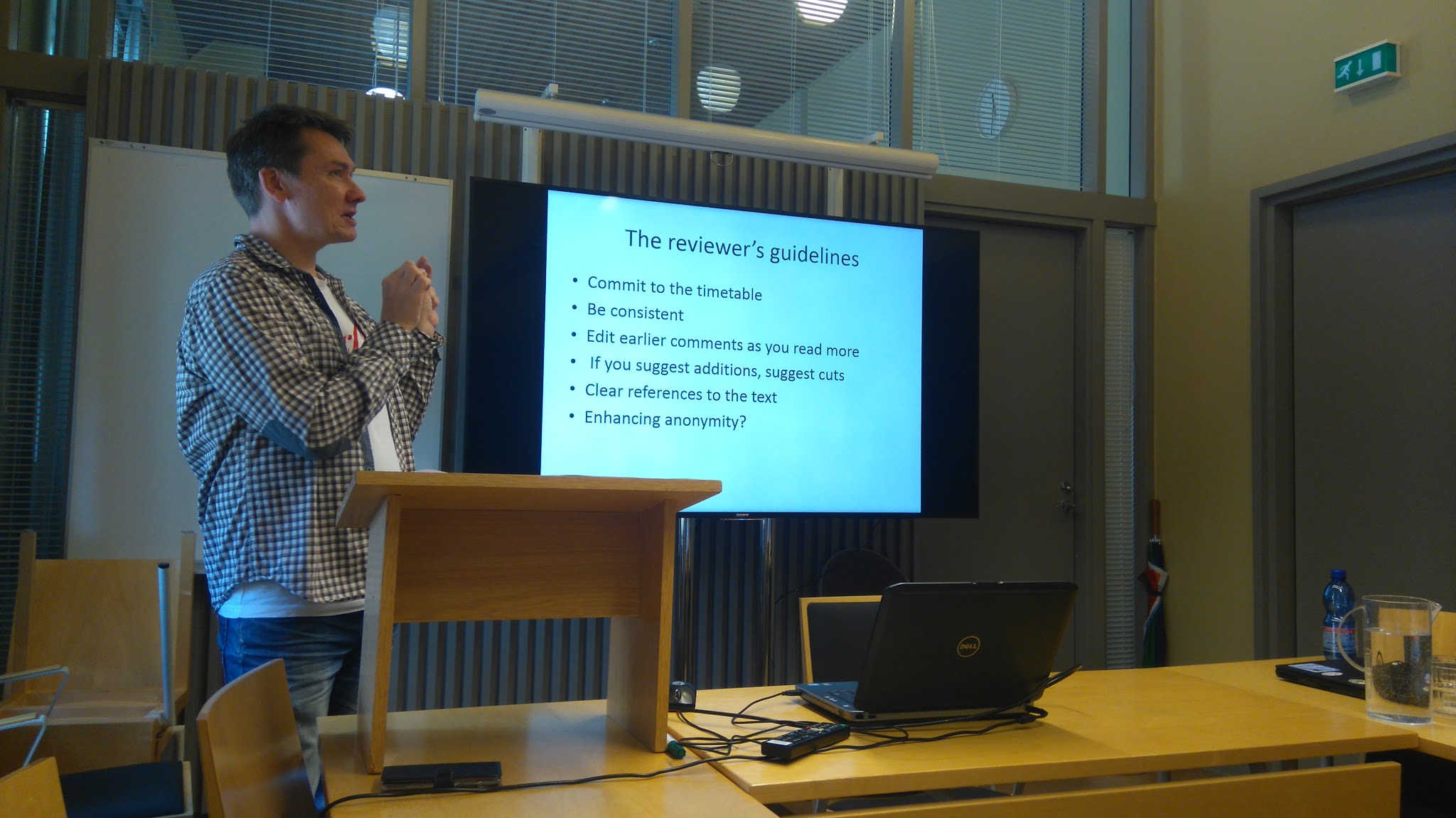
During the past year, ÅboutU has focused on organizing social events and providing opportunities for networking. In addition to the bi-monthly get-togethers at Koulu, ÅboutU organised a seminar for PhD candidates in late September 2016 with the theme ‘publishing’. The seminar had two keynote speakers, Dr. Jason Finch (ÅAU) and Dr. Pekka Lintunen (UTU), who spoke on the processes of writing an article from one’s conference paper, and on acting as a referee, respectively. The PhD candidates then held five-minute presentations on their work of late.

Dr. Finch’s presentation was titled “From Conference Paper to Published Article: Preparing Submissions to Journals and Edited Collections”. Dr. Finch began by pointing out that for those who are planning a career in academia, there is a need to distinguish oneself by writing journal articles. Conference papers are a good starting point.
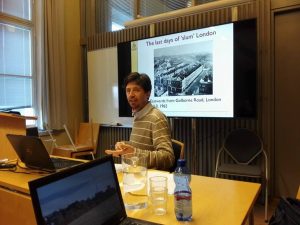
jason
Dr. Jason Finch (ÅAU)

The most important part of a conference paper as well as an article is a new idea that somehow contributes to your field. However, working that idea into a conference paper or into an article are two different processes. When planning a conference paper that will be turned into an article, you might want to write the full length article first, and then present a shorter version of it at a conference. You can also write the conference paper first, and expand the paper based on the feedback received at the conference. In any case you should have a clear vision of the journal you wish to publish in and edit your text accordingly.
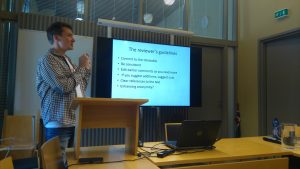
pekka
Dr. Pekka Lintunen (UTU)

Dr. Lintunen’s presentation was titled “The Peer Review Process from the Perspective of the Reviewer”, and it described the do’s and the don’ts of acting as a reviewer. The review process begins with contact: usually the editorial board contacts you through email, sending the title and the abstract of the article. It is a good idea to accept, should your schedule allow it. There is no need to worry about qualifications – if you have been contacted, Lintunen reassured us, you are probably qualified.

The instructions for the reviewers can sometimes be found on the journal’s website. If not, you can email and ask for them. You might also want to check the journal’s instructions for authors. In a review process you should pay attention to the goals of the paper, its theoretical framework, references, and argumentation. You should consider whether the paper is suitable for the journal it has been submitted to. If so, think whether the argument is clearly presented, valid and reliable. Are the results well evaluated and defended? Are the results based on the data? Remember to stick to your own field and expertise when you are giving your feedback.

After the keynotes, thirteen PhD candidates gave five-minute presentations on their ongoing work, for example recent publications or difficulties they had run into during the process. The presentations were followed by discussion. Issues dealing with article publishing were naturally a recurrent theme; Marja-Leena Niitemaa discussed reviewer’s comments she had already received, while Eva Norrman and Aino Liira spoke of the process of co-writing and the content of their articles. Sara Norja and Susanna Mäkinen discussed their articles in preparation; both were writing an article based on a conference paper. Jay Rauhoff, Emma Kanckos and Ira Hansen focused on more specific sections of their dissertations, while Sirkku Ruokkeinen and Cathryn McWilliams used the opportunity to ask for advice concerning their work. Timo Savela, Eva Fjällstöm and Johanna Rastas, who were there for the ÅboutU seminar for the first time, presented the topics of their dissertation work.
aboutu
ÅboutU is looking for new committee members.

The September Seminar was also the venue for selecting a new committee for ÅboutU. Jay Rauhoff, a UTU PhD candidate, has already volunteered. The current committee is searching for two new members from the Åbo Akademi University, and one additional member from University of Turku English Departments. If you’d like to take part in bringing our two departments together, please contact Jay at gajara[at]utu.fi.

The 2016 ÅboutU committee would like to thank the keynote speakers and PhD students from ÅAU and UTU!

Text and photos by Ira Hansen, Emma Kanckos, Eva Norrman and Sirkku Ruokkeinen
Greetings from Gorgeous Galway

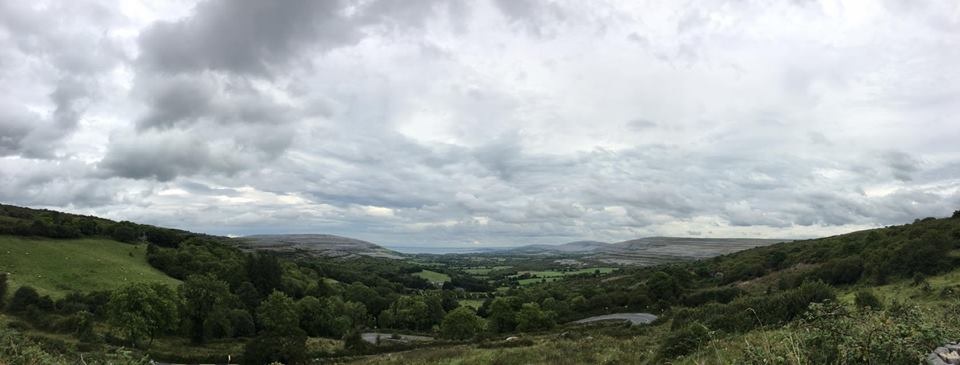
irelandview

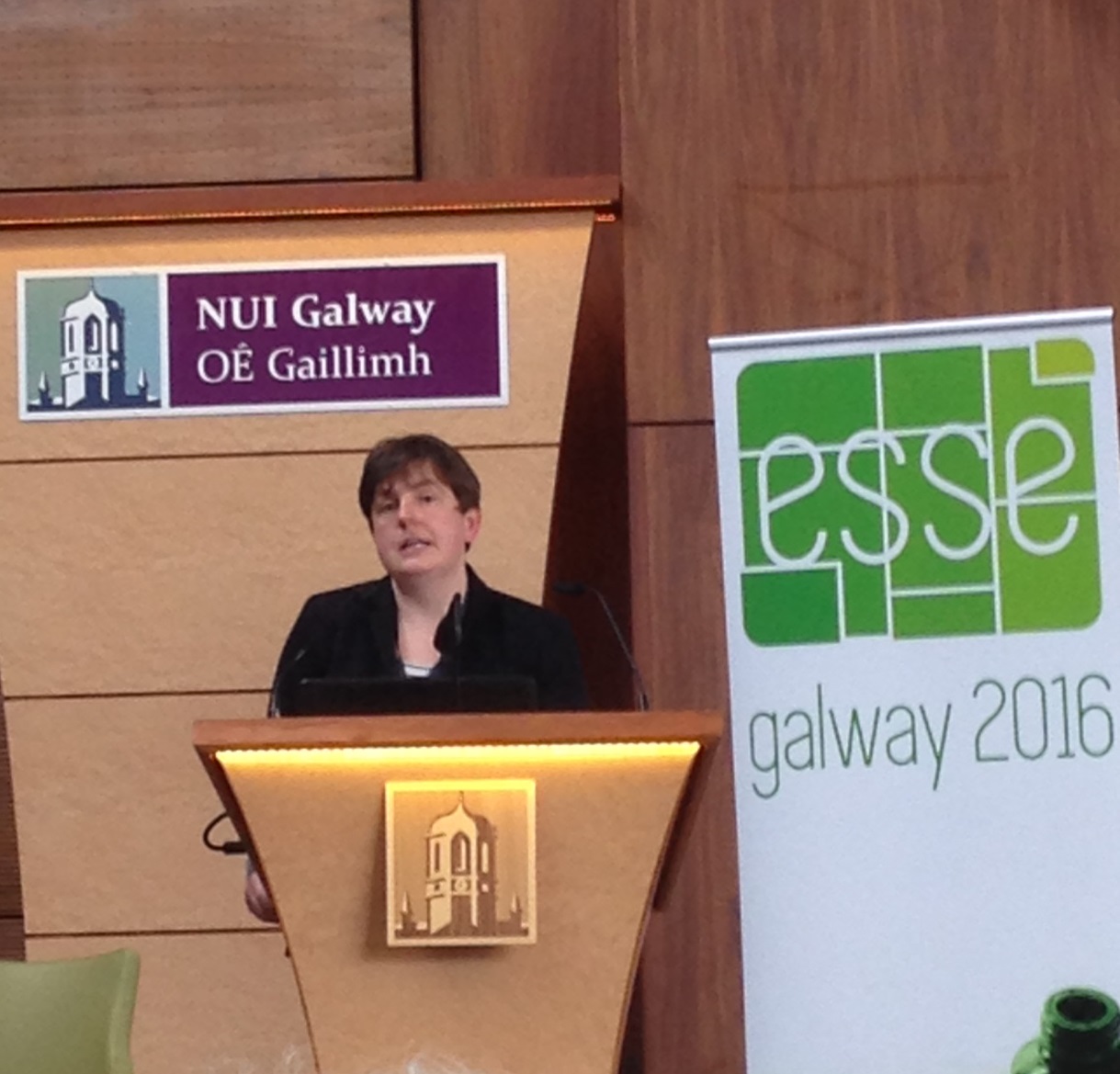
While our historical linguists were enjoying the heatwave in Essen, another delegation from the English department went on a similar mission to a place with just one letter’s difference: ESSE – the European Society for the Study of English biannual conference in gorgeous Galway, Ireland. Our research project funded by the Academy of Finland, Out of the Ordinary: Challenging Commonplace Concepts in Anglophone Literature, hosted a round table debate on the topic of competition for research funding in Europe and its consequences for English Studies. Visions were similar from all over Europe: competition for research funding is fierce, resources are diminishing, but everybody is making it work one way or another. Cautiously optimistic could perhaps be seen as the general attitude in the end of the discussion: after all, we have platforms like ESSE in and from which to push the English Studies agenda further. Besides the round table, the five-day conference with over seven hundred participants held numerous highlights, both intra- and extracurricular.

The conference began and ended with prestigious keynote lectures, the first by Emma Smith, Professor of Shakespeare Studies at Oxford. Her discussion on the changes, annotations, and scribbles made by previous owners to copies of Shakespeare’s First Folio denotes the very material quality of books as writing — they are not just stories but also stories about people who have owned or handled them. Smith is further known for her pedagogical efforts, not least of which is the Approaching Shakespeare podcast series, a very accessible way to get to know the Bard of Avon.
emmasmith

The conference ended on another high note, when Professor and author Colm Tóibín in his keynote, titled “As Things Fall Apart: The Response to Violence in the work of W.B. Yeats and James Joyce”, discussed Irish political history and literary analysis hand in hand, with a plot and detailed characterization as only a novelist/scholar could tell it. Thrilling treat, indeed!

With storytellers like Tóibín hailing from Ireland, it is no wonder that Galway will be the European Capital of Culture in 2020. The beautiful Atlantic scenery, seafood, music, culture, grazing sheep, ponies, and cattle in the green valleys make it an ideal destination for anyone looking to fall in love with places like the historical Kylemore Abbey pictured below. The Gothic castle and Victorian walled garden are now home to the Benedictine community, who welcome visitors to take in the peaceful atmosphere by the lake, which can only be described in the words of the Irish poet, Patrick Kavanagh: “Tranquillity walk with me/And no care/O, the quiet ecstasy/Like a prayer”.
kylemore

Text by Elina Valovirta
Photos by Ira Hansen and Elina Valovirta.

p.s. The next ESSE conference will be held in Brno, Czech Republic, in 2018. For more photos about ESSE, see the ESSE website and for another conference report from a participant in the very successful panel on children’s literature, see here.

Heat wave and historical linguistics in Essen

For university faculty, summer does not simply equal vacation. It is also a prime time for international conferences that are part of our work as researchers. In the end of August, historical linguists flocked to Essen, Germany for the 19th biennial ICEHL conference (22–26 August). ICEHL stands for “International Conference on English Historical Linguistics”.

essen2

The four conference days were packed with excellent plenaries and fascinating papers on all aspects of English historical linguistics – for example pragmatics, speech representation, syntax, variation, language contact, phonology and semantics. Together, the papers covered a millennium of the story of English, from Old English to Late Modern English. You can take a look at the programme here.

Our Philological Track was well represented in the conference. Hanna Salmi gave a paper on verse and prose debates in early modern England. Aleksi Mäkilähde discussed his pragmaphilological approach to the study of language choice in Early Modern English school drama. Janne Skaffari also dealt with multilingual practices in a paper he gave together with Arja Nurmi from the University of Tampere. Finally, Matti Peikola and I discussed early sixteenth-century title-pages as sites of textual discourse. We were delighted to be in the same session with our former Turku colleague Carla Suhr (currently University of Helsinki) who also explored early English title-pages in her talk.

While the other members of our team are frequent ICEHL delegates, this was my first (but probably not the last) ICEHL conference. I really enjoyed my time in Essen, and the heat wave that struck us during the conference was a welcome break after the chilly Finnish summer. The next ICEHL will be hosted by the University of Edinburgh in 2018. As that is the 20th ICEHL conference, organised during the famous Fringe festival in August, I am sure it will be a festive experience indeed!

Text and photos by Mari-Liisa Varila

Postmodern feminist challenging of dominant discourses: Mehdi Ghasemi’s doctoral defence

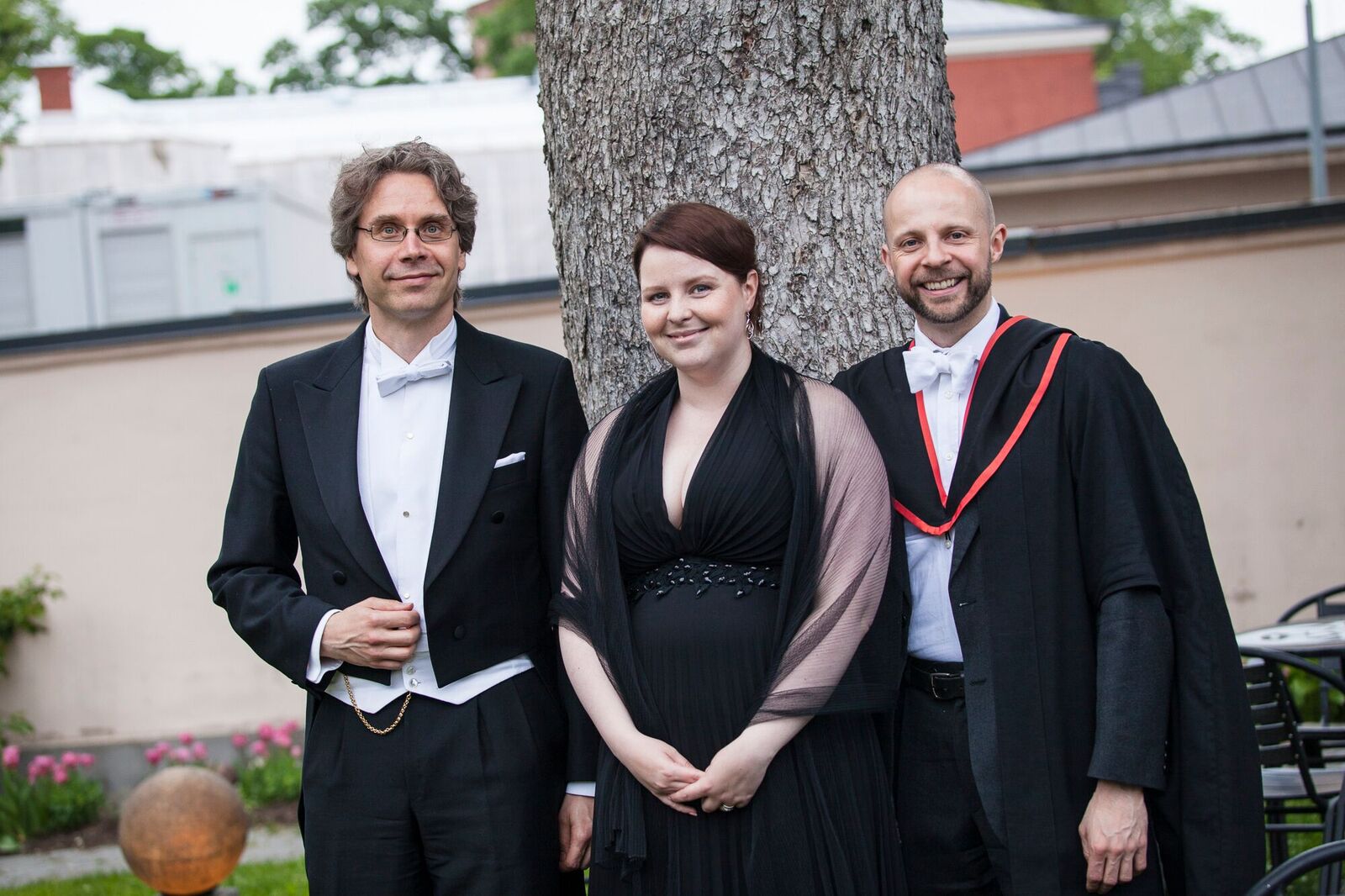
The second one of the two doctoral defences at the Department of English in the spring 2016 was Mehdi Ghasemi’s “Quest/ion of Identities in African American Feminist Postmodern Drama: A Study of Selected Plays by Suzan-Lori Parks”. The public examination of the dissertation took place at the University of Turku on 10 June, 2016. The candidate’s performance in the defence was eloquent and he was able to justify his choices and elaborate on the points that he was requested to clarify. Despite it being a Friday afternoon in June, the defence was attended by more than thirty people – and it was conducted in an orderly fashion.
mehdi
Mehdi Ghasemi’s doctoral dissertation is a study of three plays by Parks from the standpoints of postmodern drama and African American feminism with a focus on the terrains that reflect the quest and question of identities for African Americans, especially African American women. The study is a reading of three plays by Suzan Lori-Parks – The Death of the Last Black Man in the Whole Entire World (1990), Venus (1996) and Fucking A (2000). Ghasemi’s interpretetations of the three plays offer valuable insights on this understudied playwright and genre. Ghasemi argues that “Parks in these plays uses postmodern drama and African American feminism to encourage reflections on intersectionality in order to reveal the concerns of African Americans, particularly African American women“ (p. i).

The opponent was Professor Jopi Nyman from the University of Eastern Finland, and Professor Joel Kuortti acted as custos. Professor Nyman posed demanding questions on the theoretical issues involved as well as on the particular analyses of the three plays. Mr. Ghasemi replied confidently, resulting in an engaging discussion that – judging from their reactions – was also appreciated by the audience. Finally, the opponent gave his final statement. There were no questions from the floor.

Mehdi Ghasemi is from Tehran, Iran and completed his MA on “Walt Whitman’s Loud Voice of Democracy and Individuality” at the Islamic Azad University of Karaj. The dissertation is published electronically in the Annales Universitatis Turkuensis B419.

Text by Professor Joel Kuortti, custos

The transmission of early scientific writing: Mari-Liisa Varila’s doctoral defence

It is always a happy occasion for the whole department when a doctoral candidate defends their dissertation. This spring we were treated to not only one but two public examinations of doctoral dissertations. The first was that of Mari-Liisa Varila. On 28 May 2016, she defended her dissertation titled “In search of textual boundaries: A case study on the transmission of scientific writing in 16th-century England”.

Mari1

Varila’s study concentrates on the text-production practices of scribes and compilers as they copied scientific (in this case, mostly astrological) texts in manuscript form. Early scientific writing has not been researched as much as the extant material would merit; nor has book production in the early sixteenth century been studied extensively, especially the production of manuscript books. Varila’s study helps to bridge both of these gaps in research. Her primary material consists of three English manuscripts including mostly scientific texts. These manuscripts have not been studied in detail before.

Mari2

The opponent was Daniel Wakelin, Jeremy Griffiths Professor of Medieval English Palaeography at the University of Oxford. Professor Matti Peikola acted as custos. Wakelin and Varila engaged in a lively, intriguing discussion on matters scribal, textual and material. The enthusiasm with which both the opponent and the candidate participated in the discussion was palpable to the audience. Wakelin commended Varila on her innovative approach, which combines several disciplines in order to present an accurate picture of her manuscript material and conclusions.

The combination of approaches including manuscript studies, textual scholarship and historical discourse linguistics allows Varila to look at her material in novel ways and to understand the broader contexts behind the manuscripts’ production. She concludes that early scientific texts and works are often flexible in their boundaries. Scribes could copy selectively and the information content was often more important than the linguistic form. Material features are important: the constraints of the physical page can affect the texts being copied. Varila also shows that the connections between manuscripts and early printed material are a fruitful object of study. We were happy to attend such a successful examination, a fitting finale for the years of hard work!

mari4

Text by Sara Norja & Aino Liira
Photos by Miikka Varila

SLT historical linguistics seminar 13.5 – Winding through the dusty deserts of a lush philology, pt 2

World map from the Polychronicon. Wikimedia Commons, Bodleian Library.
The seminar continued with the Department of Finnish and Finno-Ugric languages revealing its onomastic side, as we heard presentations from Kirsi-Maria Nummila and Regina Bűdi. Nummila studies medieval street names in Turku and the credit that is their due to Baltic Sea region city plans or the so called German city plan. This city plan seems to have been variously implemented by some big East-European cities like Stockholm, Turku, and Tallinn, and these cities, interestingly, share street names. In her research, Nummila has questioned the traditional view that medieval street names were formed quite spontaneously drawing from the functions and situation of the street, and suggests that they might rather have been borrowed along with the city plan. Bűdi studies the proper names in the Turku bishop Ericus Erici Sorolainen’s sermon collection (Postilla 1621/1625), and more precisely in its gospel text passages. She compares these proper names to the ones found in corresponding passages in Mikael Agricola’s New Testament (1548) and the first Finnish whole Bible (1642), as well as in mainly sixteenth-century German, Latin, Greek, and Swedish translations of the Bible. Her aim is to study the similarities and differences between the proper names from these sources, the degree to which Sorolainen’s proper names were impacted by foreign languages and historical language development, and the gradual assimilation of foreign personal names into Finnish. She also wants to specify the definition of some nouns that could be seen as both common and proper nouns.

Asta Rauhala from the Department of Scandinavian Languages presented her doctoral research that concerns early, thirteenth- to seventeenth-century, Swedish loans into Finnish. Rauhala’s goal is to discover the scope and semantic categories of especially the medieval borrowed vocabulary, the speed of the borrowing process, and the length of time the loans were used in written language. Perhaps this could even lead to new etymologies or to new perspectives on language contacts and life in medieval Eastern Scandinavia! Likewise related to Scandinavian languages is Kendra Willson’s (TIAS) study that examines the possibility of Finnish and Sami names and words appearing in Scandinavian runes, especially ones that we have not been able to decipher thus far. One tricky rune that Willson presented at the seminar reads ”MINVLESIÖMEPVRVANTA” that seems to include at least the words “to me” (minvle), and “eat” or “food” (siöme), and “porridge” (pvrv) in Finnish. It was a good brainteaser to have a guess at the meaning of this passage at the seminar.

Other researchers doing detective work similar to Willson are doctoral candidates Harri Uusitalo and Reko Tikka. Uusitalo from the Department of Finnish studies the Finnish translation from Swedish of a seventeenth-century land law document, the Aitolahti land law. Uusitalo will edit the document that is still in manuscript form and investigate its sources and its possible author based on for example handwriting and vocabulary. Two sources that are previous translations are already known, but there still are passages in the document that are from neither of these. One possible writer is Hartvig Speitz, who may have written the text while sitting a punishment in jail! Uusitalo also wishes to study the development of Finnish legal language. Tikka from the Department of Classics researches games of chance in ancient Rome and the early Middle Ages. Using written and archeological sources, he aims to find out what kinds of games of chance were played and what their significance and functions were to the players. For instance, their possible use in gambling is investigated. Tikka suspects the absence from many European languages of a verb denoting especially the play of children, that exists in Finnish and Swedish (‘leikkiä’, ‘leka’), may up to recent times have discouraged the study of games as a less dignified pursuit. This kind of research is to my mind great proof of how the knowledge of and research in languages can aid cultural and historical study. The dusty deserts of philology do not seem so barren after all.
Find out more about the historical linguistic research of each department on the UTU departmental websites under “Research and doctoral studies”.

Wishing everyone a creative, sunny, and relaxing summer!
On behalf of the seminar presenters,
Aino Haataja, MA, English

SLT historical linguistics seminar 13.5 – Winding through the dusty deserts of a lush philology, pt 1

What games of chance did the ancient Romans play? What role did Latin have to play in fifteenth-century England? Can a portion of medieval street names in Turku be seen as loans from Baltic Sea region city plans, and to what degree do they draw their names from their context and functions, like a nearby market square? Could eighteenth-century runes in the Dalarna region in Sweden contain Finnish? What were the characteristics of a good book in the prologues of sixteenth-century English translated literature? Here are some examples of the questions discussed in the historical linguistics seminar of the UTU School of Languages and Translation Studies on May 13th 2016. We were many and the discussion was fruitful! Some key areas of research that were presented included multilingualism, paratextuality, historical onomastics, as well as vocabulary research and language contacts.
Sorolainen's Postilla 1625. Commons Wikimedia, University of Helsinki

Multilingualism is a concept relevant to the research of Delia Schipor, Sara Norja, and Tuomo Fonsén. Schipor was visiting from the University of Stavanger, Norway, and her study focuses on the shift from Latin to English in documentary writing in late medieval England. She studies the interplay and relative proportions of English, Latin, and French in documentary texts, and explores the possible links between genre and code choice. This same shift into English, or the process of vernacularization (becoming native-like in language), but in scientific texts, is the object of Sara Norja’s doctoral study in the Department of English. She is making a digital edition of ten manuscript versions of an English alchemical text, The Mirror of Alchemy, from the fifteenth to the seventeenth centuries. She will examine the similarities and differences between the manuscripts, their transmission, and their relationship to European alchemical tradition. Tuomo Fonsén from the Department of German, on his part, studies multilingualism in pedagogical texts, that is in seventeenth- and eighteenth-century pedagogical grammars of German in the kingdom of Sweden. These were bilingual, as Swedish was the medium of teaching German. He studies the writers, readers, and sources of these grammars, and the effects of a certain pedagogical approach on the linguistic philosophical stance of the grammars.

Paratextuality is a common denominator in the doctoral research of Sirkku Ruokkeinen and Aino Liira, both from the Department of English. Ruokkeinen studies the paratexts of sixteenth-century translated English literature aiming to find out how the work at hand is commented on, evaluated, and valued. She will use both theory on paratexts and the appraisal theory from discourse analysis as a basis for her work. Her study might even offer some answer to what constituted a good book to sixteenth-century Englishmen and –women! Aino Liira examines the communicative and text-organizing functions of paratexts in the translated version of Ranulf Higden’s Polychronicon. Her material consists of both manuscripts and early printed editions, and one of her goals is to see what impact the change in medium had on paratextual features.

To be continued
Text by Aino Haataja

Shakespeare 400 in Turku

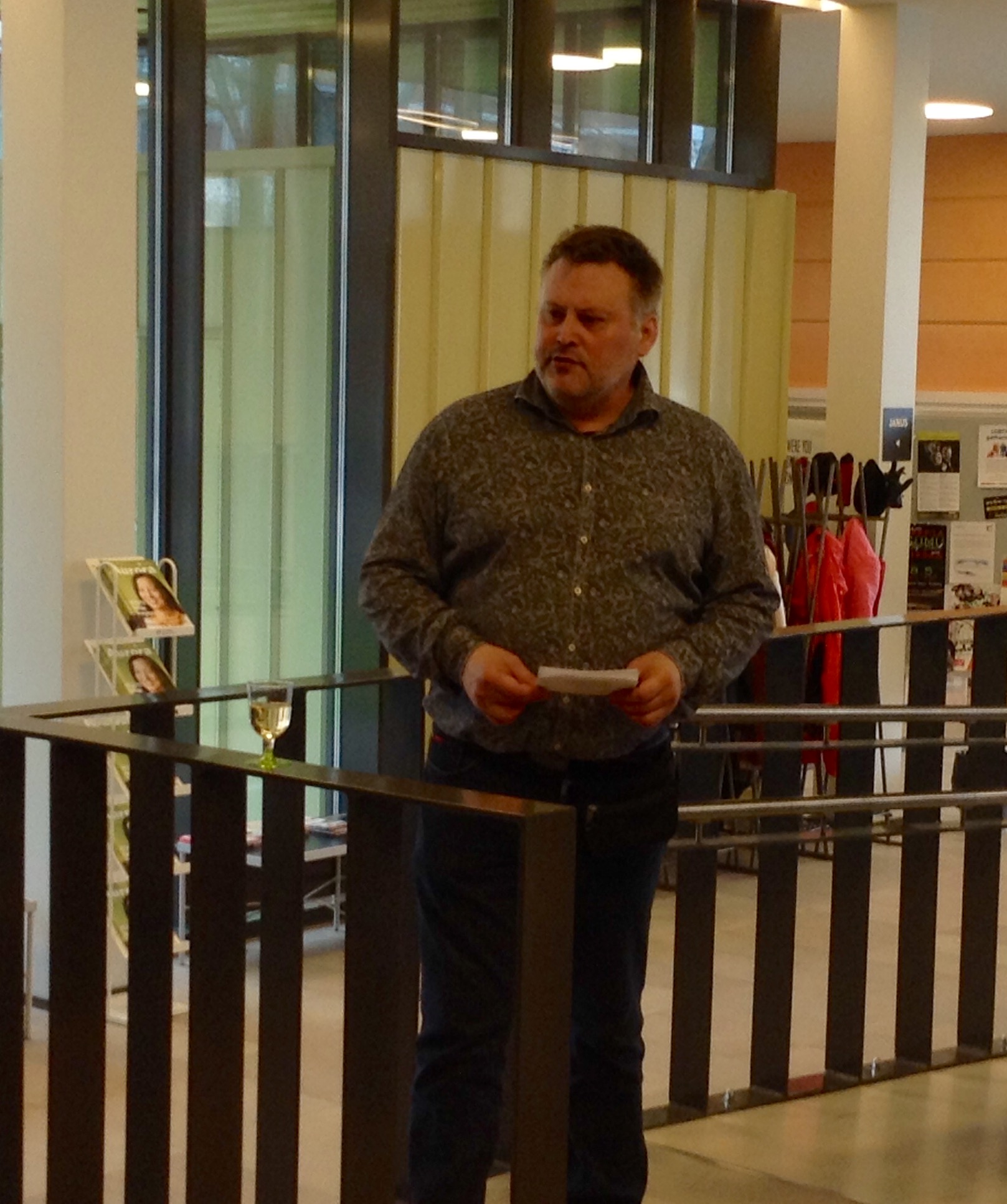
Last week, our department – along with the rest of the world – celebrated Shakespeare as Saturday April 23rd marked the 400th anniversary of the Bard of Avon’s death. Why death, you ask? Well, because we do not know his exact day of birth, and in order to celebrate, we need a date! So, a date with Shakespeare it was on Friday, when the department celebrated with toasts and a jubilee lecture. The merriment began with a toast and a speech by Professor Joel Kuortti, who chronicled some ways in which Shakespeare has figured in his life, culminating in the words of Macbeth: “I drink to the general joy o’ the whole table”.

joelshakespeare

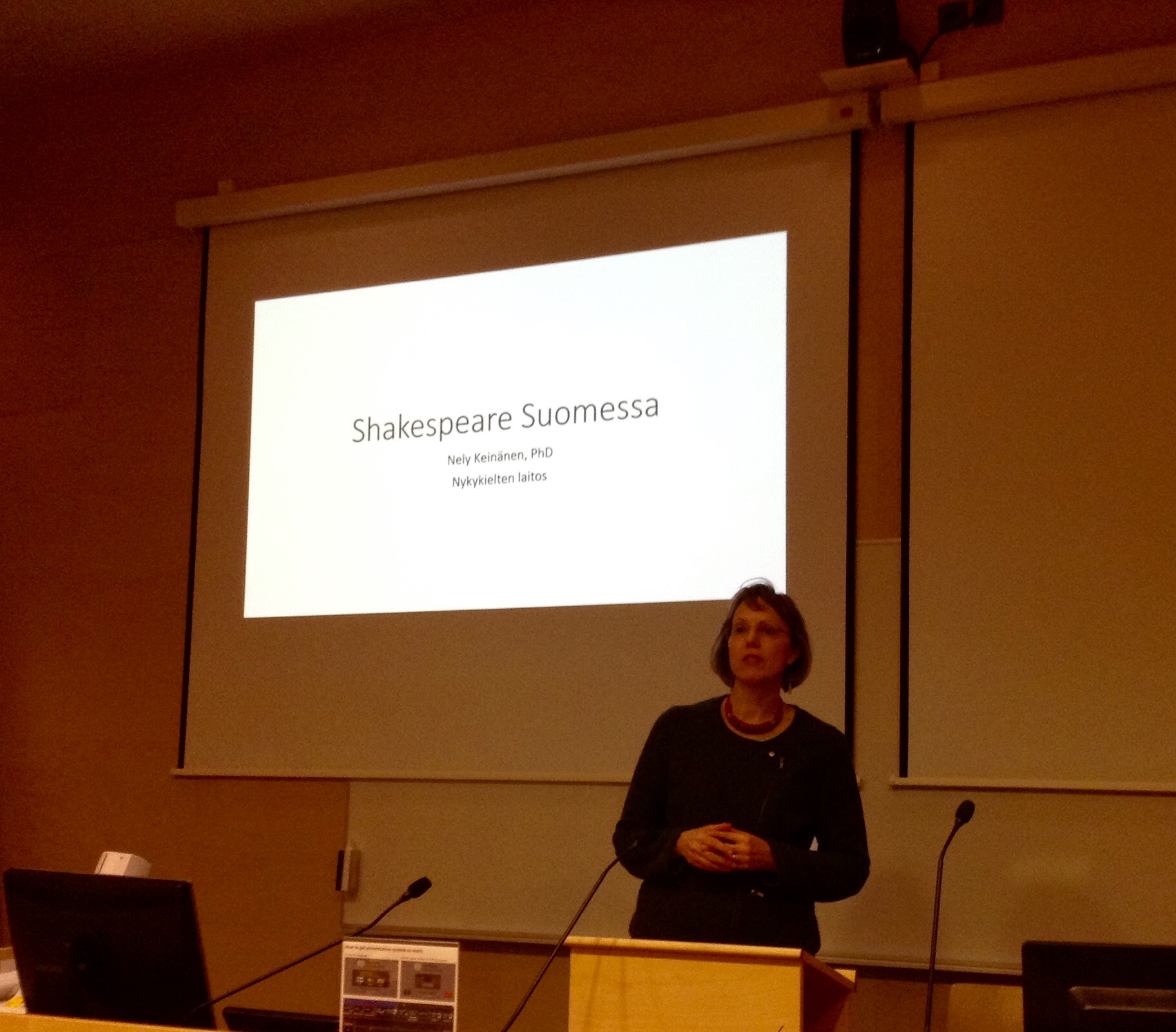
Followed by the toasts, the guest speaker, Helsinki University’s Senior Lecturer, Nely Keinänen gave a fascinating lecture on how Shakespeare’s plays were translated into Finnish and performed in Finland from the 19th century to the present day. We learned about the rich tradition of performing Shakespeare in Finland which interestingly coincided with and helped develop Finnish as a literary language. Translating Shakespeare into Finnish was seen as a great national victory for Finns, who now saw their own language take its place as a proper European language of culture. Shakespeare translations were and are yet another way for us Finns to prove ourselves that we are “most worthy friends” of English, French, and the rest.

nely
Shakespeare, then, was crucial to making Finnish a language of sophistication, culture, and the arts, and our little gathering helped celebrate that fact among others. For a celebration of death, it was a very jolly occasion indeed, marking 400 years of the Bard’s “charmed life”.

Text and photos by Elina Valovirta
Quotes from Macbeth

p.s. Stay tuned for more information on the Faculty of Humanities’ joint Shakespeare 400 lecture course in Q2 next academic year. For more info on Shakespeare festivities in England, go to www.shakespeare400.org.